How Much Protein Do You Need Per Day?
The official minimum is 0.8 g per kilogram, but most active people do better well above it. Here is how to set your own target.
If you have ever searched “how much protein do I need”, you have probably met two very different numbers: 0.8 grams per kilogram of body weight a day, or double that. Both claim science is on their side, and in a narrow sense both are right — they are just answering different questions.
The lower number is the minimum that keeps nearly all healthy adults out of deficiency. The higher numbers are about something else: keeping muscle, staying full, recovering from training, and ageing well. This guide walks through both, so you can pick a target that fits your body and life.
The official floor: what 0.8 grams per kilogram actually means
The figure you see everywhere — 0.8 grams of protein per kilogram of body weight per day — is the Recommended Dietary Allowance (RDA) set by the US National Academies, based on nitrogen-balance studies of how much protein replaces daily losses. The estimated average requirement is 0.66 g/kg; the RDA of 0.8 g/kg covers 97–98% of healthy adults. Europe’s equivalent, the EFSA reference intake, lands at 0.83 g/kg.
Here is the part that gets lost. An RDA is a floor, not a target: it answers “how little can most healthy people get away with?”, not “how much helps you thrive?” It was not designed for people who train hard, are losing weight, are over 65, or are recovering from illness.
For a 70 kg adult, the RDA is 56 grams a day — roughly two chicken breasts, or a tub of Greek yoghurt plus two eggs.
So how much do you actually need?
There is no single number for everyone, but the evidence clusters into clear ranges. Use your weight in kilograms (pounds divided by 2.2) and find your group:
- Generally healthy, not very active: 0.8–1.0 g/kg per day.
- Active, or aiming to stay strong as you age: 1.0–1.2 g/kg per day — also the PROT-AGE/ESPEN range for healthy adults over 65.
- Regularly training, or building muscle: 1.2–1.6 g/kg per day. A meta-analysis of 49 resistance-training trials found muscle-mass gains levelled off around 1.6 g/kg per day.
- Losing weight while trying to keep muscle: 1.6–2.2 g/kg per day. Higher protein protects lean tissue and keeps hunger in check when calories are restricted.
- Older adults with acute or chronic illness: 1.2–1.5 g/kg per day, per PROT-AGE and ESPEN — illness raises protein turnover, so needs go up.
Notice the spread: a 70 kg person could reasonably aim anywhere from 56 grams (sedentary, at the RDA) to around 140 grams (training hard while losing weight). That is why generic advice like “eat 100 grams a day” is unhelpful.
How to work out your own number
Pick your range above, then multiply — the maths takes thirty seconds:
Your weight in kg × your target in g/kg = your daily target in grams.
Worked examples:
- 60 kg, lightly active: 60 × 1.0 = 60 grams a day.
- 70 kg, trains three times a week: 70 × 1.4 = 98 grams a day — call it roughly 100.
- 85 kg, losing weight and lifting: 85 × 1.8 = 153 grams a day.
Two practical notes. If you carry a lot of extra body fat, these formulas can overshoot, because fat tissue needs far less protein than muscle — base the calculation on a realistic target weight instead, or discuss it with a clinician. Your target is a daily average: 90 grams one day and 110 the next beats exactly 100 every day.
It is not just the total — spread it across the day
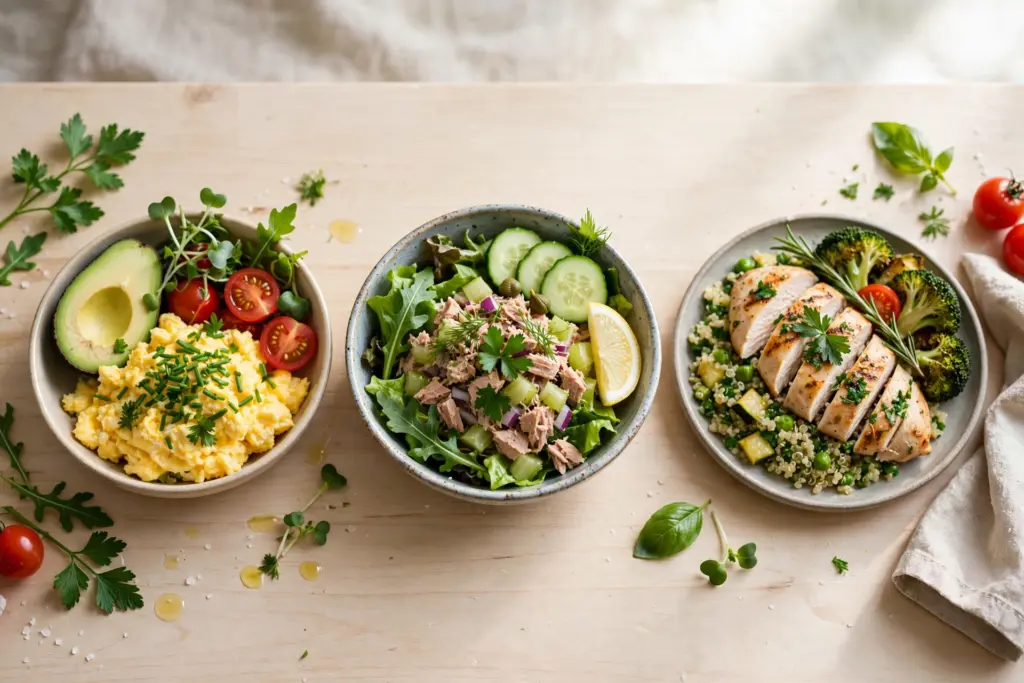
The pattern researchers keep finding: a tiny breakfast, a modest lunch, and a huge protein-heavy dinner. The total might look fine, but the muscles only got one proper signal all day.
Muscle protein synthesis — the process that repairs and builds muscle — responds to each meal separately, and it needs a decent dose to switch on. For most adults, that means roughly 25–40 grams of good-quality protein per meal, typically delivering the 2.5–3 grams of leucine that acts as the trigger. Younger adults can manage the lower end; older adults, whose muscles respond less keenly (anabolic resistance), tend to need 35–40 grams.
In practice: aim for about 0.25–0.4 grams per kilogram at each of three or four meals — for a 70 kg person, roughly 25 grams per meal, like a palm-sized piece of chicken or fish, Greek yoghurt with nuts, or three eggs with cheese. If your breakfast delivers just 8 grams, that meal alone is your easiest win.
What about the “anabolic window” after a workout? The evidence has softened that idea: total daily intake and per-meal distribution matter far more than rushing a shake within thirty minutes of your last set.
Read also: Protein Timing: Does the Anabolic Window Really Exist?
Protein as you get older
Muscle loss with age is slow and easy to miss until it affects everyday life — carrying groceries, climbing stairs, getting up from a low chair. From around age 50, adults lose roughly 0.5–1% of muscle mass per year.
This is where the RDA genuinely falls short. PROT-AGE concluded that 0.8 g/kg is too low for older people, recommending 1.0–1.2 g/kg per day for healthy adults over 65 and 1.2–1.5 g/kg for those with acute or chronic illness. In one long-term study of adults aged 70–79, those eating around 1.1 g/kg lost about 40% less lean mass over three years than those eating around 0.7 g/kg. The exception: older adults with severe kidney disease (filtration rate below 30) not on dialysis may need to limit protein — they should follow their clinician’s guidance. For everyone else, the higher range is the default, best paired with light strength work twice a week.
Protein when you are losing weight or building muscle
Two goals, one principle: when you change body composition, protein is your insurance policy. During weight loss, your body does not only burn fat — it will happily burn muscle too, unless you give it a reason not to. Higher protein (1.6–2.2 g/kg) plus resistance training is the best-documented way to keep the loss mostly fat, and protein’s filling effect makes a calorie deficit easier to live with.
For building muscle, the ceiling is lower than gym culture suggests: that 49-trial meta-analysis found no extra benefit beyond about 1.6 g/kg per day, and the training itself mattered far more than the supplement. If you already eat around 1.6 g/kg and progress has stalled, look at your training or sleep — not another scoop of powder.
Read also: Protein, Satiety and Sustainable Weight Loss
Getting it from food
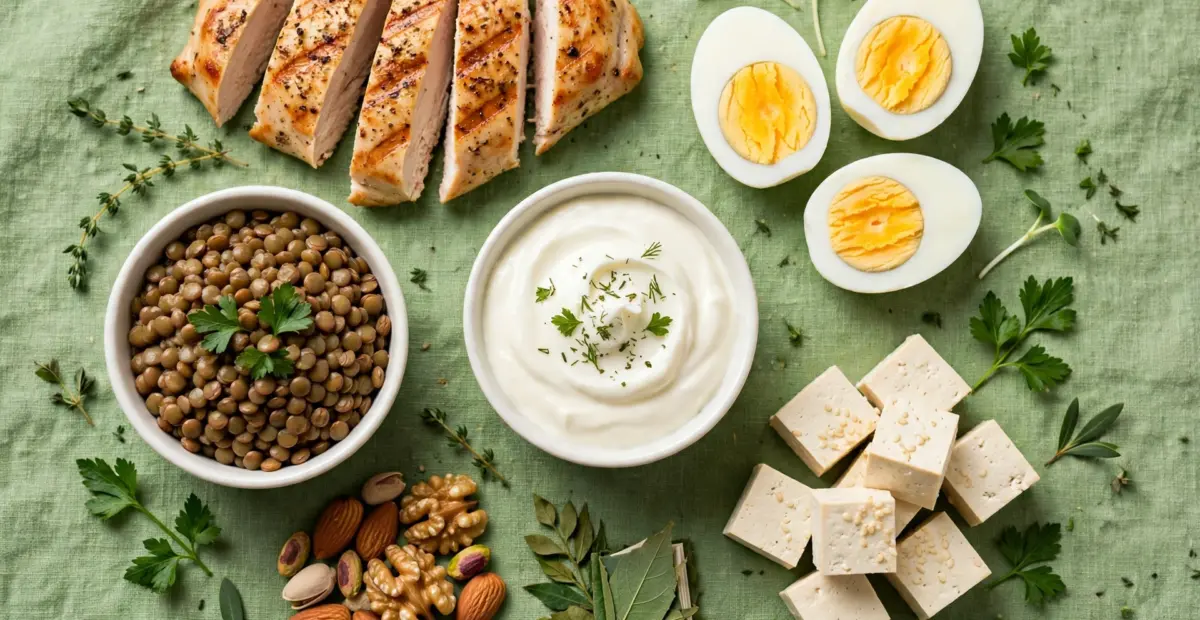
Most people can hit their target with ordinary food. Approximate protein per serving:
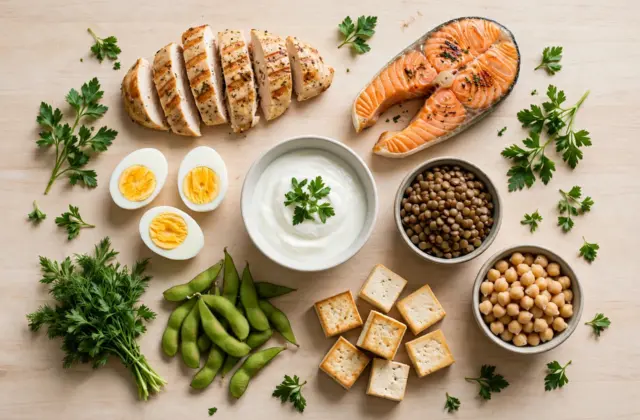
- Chicken breast, cooked (100 g): about 31 g
- Canned tuna, drained (100 g): about 25 g
- Greek yoghurt, plain non-fat (170 g tub): about 17 g
- Cottage cheese (100 g): about 11 g
- Two large eggs: about 12 g
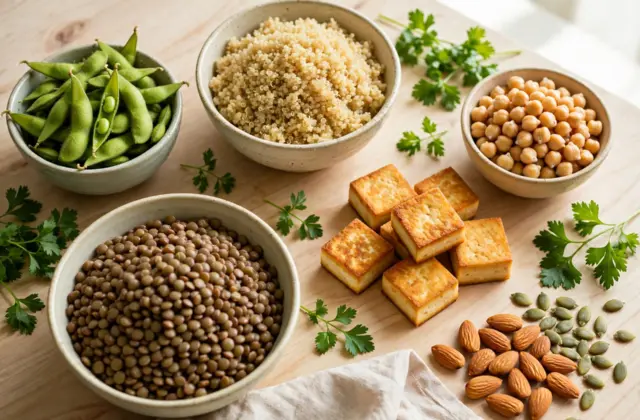
- Firm tofu (100 g): about 15–17 g
- Cooked lentils (1 cup): about 18 g
- Cooked quinoa (1 cup): about 8 g
- A glass of milk (250 ml): about 8 g
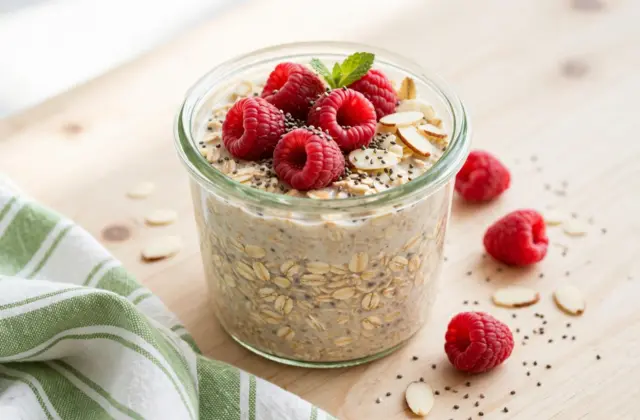
A day at around 100 grams: yoghurt with berries and nuts at breakfast (20 g), tuna and bean salad at lunch (35 g), nuts and milk as a snack (12 g), chicken with quinoa at dinner (35 g).
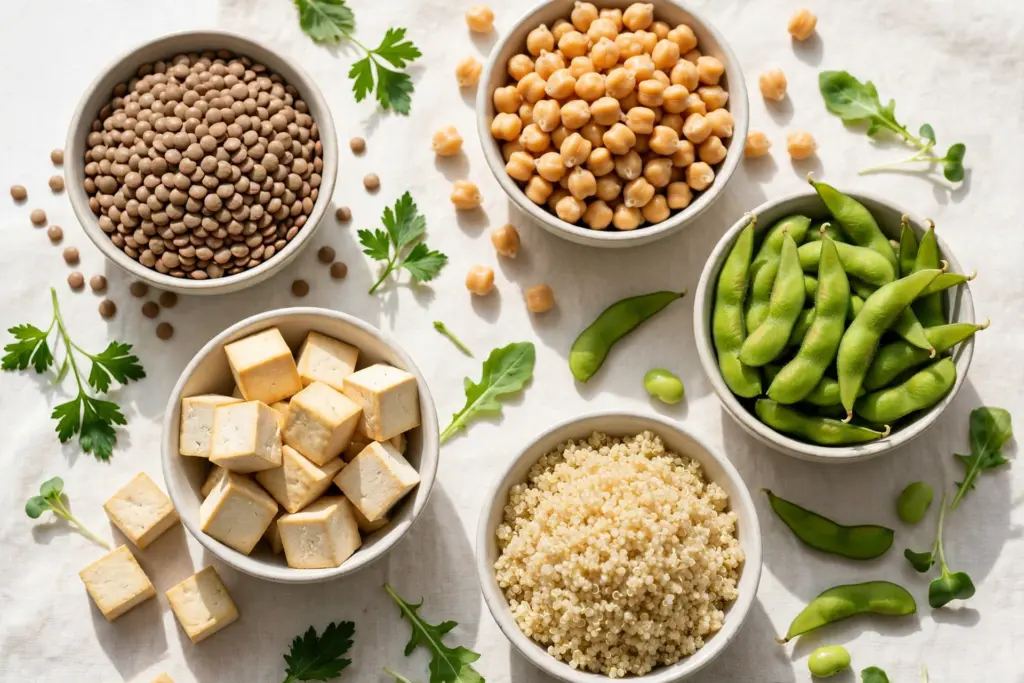
Plant-based eaters need a little more planning, not more worry. Most plant proteins are low in one or more essential amino acids — grains in lysine, legumes in methionine — so variety across the day covers the gaps. Soy foods (tofu, tempeh, edamame) are the exception, close to animal protein in profile. You do not need to combine proteins at every meal, as older advice insisted; a varied diet across the day suffices, though the higher end of your range and slightly larger portions help clear the leucine threshold.
Read also: Plant-Based Protein: Building a Complete Amino Acid Profile
Do you need a protein powder?
Only if it solves a real problem for you. Powders are convenient when appetite is low, when travelling, or when whole food is impractical. Whey is well studied and rich in leucine; soy isolate is the closest plant equivalent. A powder will not outperform food at the same dose — it is convenience, not superiority. Check the label: some products are mostly sugar with a protein halo.
What about your kidneys?
This worry refuses to die, so let us be precise. In healthy adults, higher protein intakes have not been shown to damage the kidneys: a systematic review of 26 studies found intake above the RDA had no adverse effect on kidney-function markers, and later reviews agree — filtration rates stay normal, with the small rise on higher-protein diets reflecting normal adaptation, not injury. With existing kidney disease, protein is often limited — follow your doctor’s guidance before jumping to the top of these ranges.
Frequently asked questions
Is 0.8 g/kg per day enough for me?
It prevents deficiency in a healthy, sedentary adult — that is what it was designed for. If you train, are over 65, are losing weight, or are recovering from illness, the evidence points higher, typically 1.0–1.6 g/kg.
Should I use my current weight or my ideal weight?
Use your current weight if you are within a broadly healthy range. If you carry substantial extra body fat, a realistic target weight avoids overshooting.
Does it matter if I eat all my protein at dinner?
Yes, somewhat. Muscles respond to each meal separately, so spreading protein across three or four meals — roughly 25–40 grams each — gives several building signals a day instead of one. Your daily total still matters most.
Can I get enough protein without meat?
Yes. Soy foods, lentils, beans, chickpeas, quinoa, nuts, seeds, eggs, and dairy (if you eat them) can cover any range here — aim for variety and slightly larger portions.
This article is for general information only, not medical advice. If you have kidney disease, liver disease, diabetes, or any condition affecting your diet, talk to your doctor or a registered dietitian before changing your protein intake.
Sources
- Dietary protein needs in older adults (DRI: EAR 0.66, RDA 0.80 g/kg)
- Protein scoping review, Nordic Nutrition Recommendations 2023 (EFSA intake 0.83 g/kg)
- ESPEN Expert Group: protein intake for muscle function with aging (1.0–1.2 healthy; 1.2–1.5 with illness)
- Morton et al., BJSM (2018): protein and resistance-training gains; plateau at ~1.6 g/kg/day
- Systematic review of renal health with protein intake above the US RDA