Almond Milk vs. Soy Milk: How to Compare Them
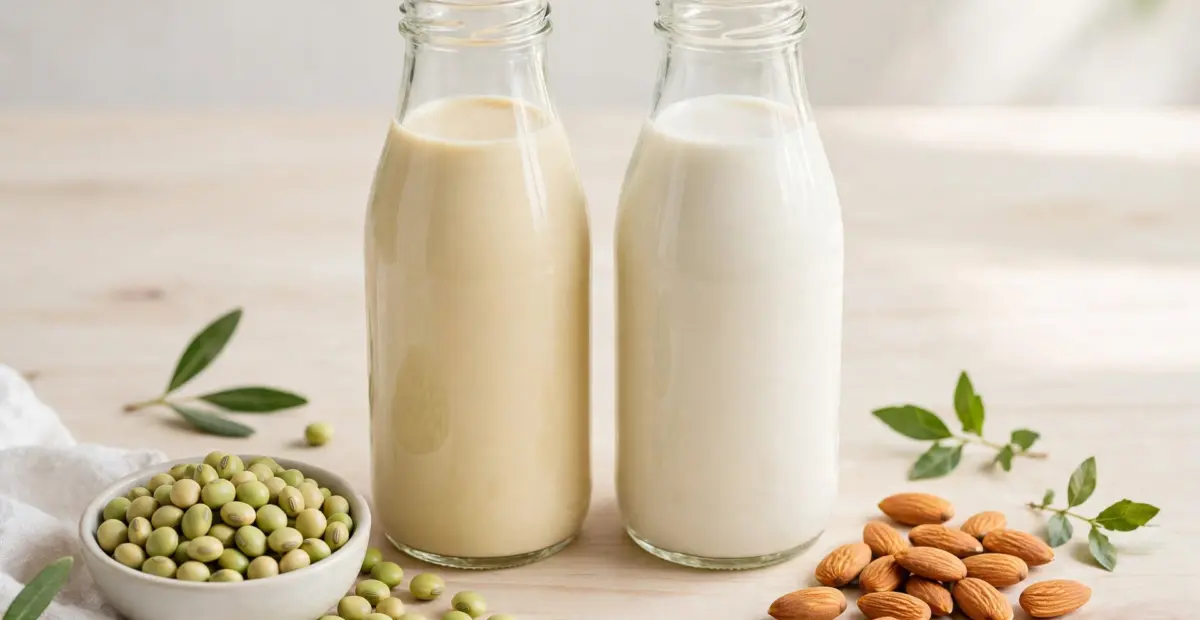
Walk down the milk aisle today and you will find two cartons that look like twins: almond milk and soy milk, both white, both poured over cereal, both promising a lighter swap for dairy. Open them up, though, and they are almost nothing alike. One is a low-calorie drink with barely any protein. The other is the only plant milk that nutritionally stands shoulder to shoulder with cow’s milk. Which one belongs in your fridge depends less on the carton and more on what you need that cup to do.
Here is the honest comparison, label by label, so you can pick with confidence instead of guessing.
What is actually in the carton?
Almond milk starts as almonds blended with water, then strained. The result is mostly water — a typical commercial carton contains only about 2% almonds. Soy milk starts as whole soybeans soaked, ground, and strained, which leaves far more of the bean’s nutrients in the drink.
That difference in starting material explains almost everything that follows. Soy milk is a food made from a protein-rich legume. Almond milk is flavoured water with a small amount of almond in it, plus whatever vitamins the manufacturer adds back.
Both are naturally lactose-free and cholesterol-free, and both are usually fortified with calcium, vitamin D, and vitamin B12. But “usually” is doing a lot of work there — fortification is voluntary and varies by brand, so the label is the only promise that counts.
The nutrition numbers, side by side
Per cup, unsweetened, the two drinks sit in different leagues. Figures below are typical values from the USDA’s FoodData Central database; brands vary, especially on fortification.
| Nutrient (1 cup, unsweetened) | Soy milk | Almond milk |
|---|---|---|
| Calories | 80–90 | 30–40 |
| Protein | 7 g | 1 g |
| Total fat | 4 g | 2.5 g |
| Saturated fat | 0.5 g | 0 g |
| Carbohydrate | 4 g | 1 g |
| Calcium (fortified) | 300–450 mg | 300–450 mg |
| Potassium | 300–380 mg | 160–180 mg |
The gap that matters most is protein: 7 grams versus 1 gram. A cup of soy milk gives you roughly the same protein as a cup of cow’s milk. A cup of almond milk gives you about as much protein as a few sips of water with an almond waved over it. If you pour almond milk on your cereal and call it breakfast, the protein in that meal is coming from somewhere else — or nowhere.
Calcium tells a different story. When both are fortified, either can match dairy’s roughly 300 mg per cup. But an unfortified almond milk can contain as little as 2 mg of calcium per cup — practically none. Soy milk has the same problem when unfortified, though unfortified soy milk is less common on shelves. Either way, “fortified with calcium” needs to appear on the label, not just in your assumption.
Protein: the deciding factor for most people
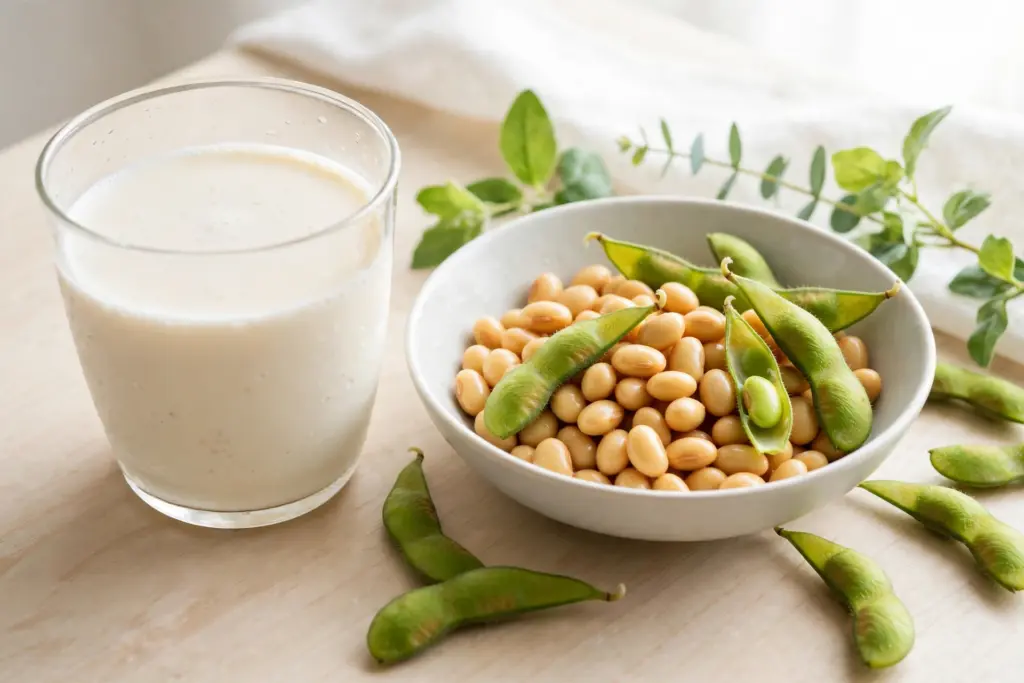
Soy protein is complete, meaning it provides all nine essential amino acids in proportions your body can use. That is rare among plant foods, and it is the main reason dietitians treat soy milk as a genuine milk substitute rather than a flavoured drink.
Almond milk’s 1 gram of protein is incomplete and negligible. It will not keep you full, it will not help you hit a protein target, and it will not stand in for milk in a smoothie that is supposed to carry you to lunch.
None of this makes almond milk “bad.” It makes it a different tool. If your breakfast already has eggs or Greek yogurt, the milk’s protein barely matters, and almond milk’s 30 calories are a genuine advantage. If your cereal bowl is the main event, soy milk earns its place.
Read also: Dairy vs. Plant-Based Milk: Key Nutrients to Compare
What the guidelines say
The U.S. Dietary Guidelines are unusually clear on this point: fortified soy beverages are the only plant-based drinks included in the dairy group, because their nutrient content is similar enough to milk. Almond, oat, rice, coconut, and hemp drinks are excluded — even when fortified with calcium — because their overall nutrition is not equivalent to dairy milk or fortified soy beverages.
That distinction is not a judgement about taste. It is a practical warning: swapping dairy for almond milk without adjusting the rest of your diet can quietly drop your protein and leave calcium to chance. The 2025–2030 Dietary Guidelines for Americans, released in January 2026, kept this position, and the guidelines’ food-pattern modelling explicitly excludes almond and other plant milks from the dairy group regardless of fortification.
Calcium: same number on the label, not always the same in your body
A fortified carton can list 300 mg of calcium, matching dairy. What the label cannot tell you is how much of that calcium your body actually absorbs — and that depends on which calcium salt the manufacturer used.
A 2005 study in the Journal of Nutrition (Zhao and colleagues) compared calcium absorption from soy milk fortified two different ways. Calcium carbonate-fortified soy milk was absorbed just as well as cow’s milk — fractional absorption of 0.211 versus 0.217, effectively identical. Soy milk fortified with tricalcium phosphate scored lower, at 0.181.
There is one more catch, and it is sitting in your fridge right now. A 2006 study by Heaney and Rafferty found that the added calcium in fortified soy drinks settles to the bottom of the carton — and shaking does not fully bring it back. If you pour from an unshaken carton, the last glass can hold far more calcium than the first. Shake well, every time, and check the ingredient list for calcium carbonate, the form with the best-studied absorption.
Sugar: where almond milk’s advantage disappears
Unsweetened almond milk wins on calories and sugar: about 30 calories and no sugar per cup. But that advantage is fragile. Sweetened versions of either milk can add 10 to 14 grams of sugar per cup — enough to erase almond milk’s calorie edge entirely and push a single serving close to the American Heart Association’s daily added-sugar limit of 25 grams for women and 36 grams for men.
The new dietary guidelines go further, recommending no amount of added sugar and capping any single meal at 10 grams. A sweetened almond milk in your morning coffee can quietly use up that whole allowance before breakfast is over.
The fix is simple and cheap: buy unsweetened, always. If you want sweetness, add it yourself so you control the amount — a drizzle of honey in your own cup beats 12 grams you never asked for.
Read also: How to Compare Sugary and Unsweetened Drinks
Heart health and soy: what the evidence actually says
Soy milk carries one claim almond milk cannot: in 1999 the U.S. Food and Drug Administration authorized a health claim that 25 grams of soy protein a day, as part of a diet low in saturated fat and cholesterol, may reduce the risk of heart disease. A cup of soy milk supplies about 7 grams toward that 25-gram target — roughly a quarter of it in one glass.
Keep the claim in perspective. The American Heart Association reviewed 22 randomized trials and found that isolated soy protein with isoflavones lowered LDL cholesterol by about 3% on average — a real but modest effect, and the isoflavones alone showed no average effect on LDL. Soy milk is a sensible part of a heart-healthy pattern because it is low in saturated fat and replaces foods that are not; it is not a treatment on its own.
Almond milk, meanwhile, is very low in saturated fat and naturally cholesterol-free, so it fits a heart-healthy pattern too — it simply brings less to the table beyond that. Almonds themselves are rich in vitamin E and monounsaturated fats, but almond milk contains so little almond that those benefits barely survive the straining.
Taste, cooking, and everyday use
On taste, almond milk is the lighter, nuttier option. It disappears into coffee and cereal without changing the flavour much, and its low calorie count makes it popular in smoothies where other ingredients supply the protein. It can curdle in very hot, acidic coffee, though — a splash of cold milk first, or a barista blend, usually solves it.
Soy milk is creamier and closer to dairy in body, which is why it behaves better in cooking, baking, and sauces. It holds up in hot coffee, thickens a soup, and makes a smoothie genuinely filling. Its flavour is mild but noticeable — beany to some palates — and it is the better choice anywhere the milk needs to do structural work, not just add liquid.
Allergies settle the question for some households outright: almond milk is out if anyone has a tree nut allergy, and soy milk is out with a soy allergy. Both are common allergens, and both must be declared clearly on the label — check before you switch a family staple.

How to read the label in 30 seconds
Stand in front of the shelf and check four things, in this order:
- Unsweetened. If the front says “original” without the word unsweetened, assume it is sweetened and check the added sugars line.
- Protein. Soy should read around 7 g per cup; almond milk around 1 g. If a soy milk reads 3 g, it is a diluted blend, not the real thing.
- Calcium, vitamin D, and B12. Look for calcium carbonate in the ingredients and at least 20–30% of the daily value for calcium and vitamin D. Vitamin B12 matters most if you eat little or no animal food.
- The ingredient list. Short is fine. Gums like gellan gum and locust bean gum are common thickeners and are generally recognized as safe; they are there for texture, not nutrition.
Read also: How to Read Food Labels
So, which one should you buy?
Choose soy milk if you want a genuine milk replacement: similar protein to dairy, a complete amino acid profile, and a place in the dairy group under the dietary guidelines. It is the better pick for kids, for anyone cutting back on dairy, for smoothies that need to keep you full, and for cooking.
Choose almond milk if you want the lightest possible pour: 30 calories a cup, no sugar, a mild nutty flavour, and you already get your protein and calcium from other foods. It is the better pick for calorie-conscious coffee and cereal, and for anyone who dislikes soy’s taste or has a soy allergy.
Choose neither sweetened version. That is the one rule both sides share. The sugar in a sweetened carton cancels the best reason to buy either drink.
There is no winner here, only a better fit. Soy milk replaces milk. Almond milk replaces water with flavour. Once you know which job you are hiring the carton for, the choice makes itself.
Frequently asked questions
Is almond milk or soy milk healthier?
It depends on what you need. Soy milk is nutritionally closer to dairy milk, with about 7 grams of complete protein per cup and a place in the dietary guidelines’ dairy group. Almond milk is much lower in calories (30–40 per cup versus 80–90) but provides only about 1 gram of protein. For most people replacing dairy, soy milk is the stronger choice.
Does almond milk have as much calcium as soy milk?
When both are fortified, yes — either can provide 300–450 mg of calcium per cup, similar to dairy milk. But fortification varies by brand, and unfortified almond milk can contain as little as 2 mg per cup. Always check the label, shake the carton well, and look for calcium carbonate, the form best absorbed according to absorption studies.
Can almond milk replace milk in cooking?
It can replace milk as a liquid, but it is thin and low in protein, so sauces and baked goods may turn out less rich. Soy milk is creamier and behaves more like dairy in cooking and baking. Almond milk also has a higher chance of curdling in hot coffee.
Is soy milk safe to drink every day?
For most adults, yes. Soy foods have been eaten for centuries, and the FDA’s health claim is based on 25 grams of soy protein a day as part of a diet low in saturated fat and cholesterol. People with a soy allergy should avoid it, and anyone with a hormone-sensitive condition who drinks large amounts daily should discuss it with their clinician — but a cup or two a day is an ordinary, well-studied habit.
Sources
- U.S. Department of Agriculture, Agricultural Research Service. FoodData Central — nutrient values for unsweetened soy milk and almond milk per cup.
- Dietary Guidelines Advisory Committee. Food Pattern Modeling Protocol: Dairy and Fortified Soy Alternatives (2024) — fortified soy beverages are the only plant-based alternatives included in the dairy group; almond, rice, coconut, oat, and hemp drinks are excluded regardless of calcium fortification.
- Zhao Y, Martin BR, Weaver CM. Calcium Bioavailability of Calcium Carbonate Fortified Soymilk Is Equivalent to Cow’s Milk in Young Women. Journal of Nutrition 2005;135:2379–2382 — calcium carbonate-fortified soy milk absorbed as well as cow’s milk (0.211 vs 0.217); tricalcium phosphate lower (0.181).
- Heaney RP, Rafferty K. Carbonate- and phosphate-fortified soy beverages and calcium settling. Journal of the American Dietetic Association 2006 — added calcium settles in the carton and shaking does not fully restore it.
- Sacks FM, et al. Soy Protein, Isoflavones, and Cardiovascular Health: An American Heart Association Science Advisory. Circulation 2006;113:1034–1044 — across 22 trials, soy protein with isoflavones lowered LDL cholesterol by about 3% on average.
- U.S. Food and Drug Administration. 21 CFR 101.82 — Health claims: Soy protein and risk of coronary heart disease — 25 g/day of soy protein as part of a diet low in saturated fat and cholesterol may reduce heart disease risk.
- American Heart Association. How Much Sugar Is Too Much? — daily added-sugar limits of 25 g for women and 36 g for men.
- U.S. Food and Drug Administration. Milk and Plant-Based Milk Alternatives: Know the Nutrient Difference — guidance on choosing plant milks higher in protein, calcium, vitamin D, and potassium and lower in saturated fat and added sugars.
Disclaimer: This article is for general information only and is not medical advice. If you have a soy or tree nut allergy, a hormone-sensitive condition, or specific dietary needs, talk to your clinician or a registered dietitian before changing your diet.