Protein Timing: Does the Anabolic Window Really Exist?
The famous 30-minute window is far wider than supplement marketing suggests. Total daily protein matters more.

You have seen the ritual. Someone finishes their last set, towel around their neck, and sprints for the locker room — not to stretch, but to chug a protein shake before some invisible deadline expires. The logic feels airtight: exercise breaks muscle down, protein builds it back, so the faster you eat, the better your results.
For two decades, gym culture treated the post-workout window like a ticking clock. Thirty minutes, tops. Miss it, and the workout was supposedly wasted. It made for great supplement advertising and a lot of anxious gulps of lukewarm whey. The science, as it tends to do, tells a calmer story.
Where the 30-minute rule came from
In 2001, researchers in Denmark ran a study that would echo through gyms for decades. Thirteen elderly men, averaging 74 years old, trained three times a week for twelve weeks and drank a small supplement — 10 grams of protein, 7 grams of carbohydrate, a little fat — either immediately after training or two hours later. The immediate group added measurable muscle to their quadriceps. The delayed group did not.
Later reviews flagged the caveats — the “delayed” group still ate their normal daily meals, and the benefit was strongest in people whose overall protein intake was modest to begin with.
Around the same time, acute lab experiments kept adding fuel. Infusing amino acids straight into the bloodstream after exercise ramped up muscle protein synthesis, and fast-digesting whey spiked blood amino acids quicker than slow-digesting casein. Supplement marketing collapsed all of this into one slogan: your muscles are starving, feed them now. The leap from “amino acids rise after exercise” to “you must eat within 30 minutes” was never tested; it was assumed.
The big picture: total protein beats timing
In 2013, Brad Schoenfeld, Alan Aragon and James Krieger did what nobody had done before: they pooled 23 randomized trials on protein timing — more than 500 participants — and ran the numbers together. At first glance, timing looked helpful: a small-to-moderate boost to muscle growth. But the moment they accounted for how much protein each group ate over the entire day, the timing effect vanished. Total daily protein was the strongest predictor of who grew and who did not. When everyone ate enough protein, when they ate it stopped mattering.
Five years later, Schoenfeld and Aragon revisited the question with a plain-language review. Their conclusion: the narrow post-exercise window is not the make-or-break factor gym lore claims. Eating protein reasonably close to training — within a few hours before or after — is sensible, but sprinting for your shaker is not.
A 2018 analysis of 49 trials and nearly 1,900 lifters found weight training drove the overwhelming majority of strength and muscle gains; protein was the helper, not the hero. The same analysis found gains level off at about 1.6 grams of protein per kilogram of body weight per day — beyond that, extra protein does not build extra muscle (the confidence interval stretched to 2.2 g/kg, which is why maximizers aim toward the top of that range).
Before or after? Take your pick
One of the more practical tests came in 2017, when Schoenfeld’s team gave trained men 25 grams of protein either immediately before or immediately after training for ten weeks. The result: no meaningful difference in muscle growth or strength between the groups. The narrow “anabolic window of opportunity” simply did not show up.
That finding is oddly freeing: if you train at lunch and dinner is your post-workout meal, fine; if you prefer eating before you train, also fine. The protein you ate three hours before your session is still being digested while you lift — your muscles are not starting from zero.
How much protein each meal needs
Muscle protein synthesis — the process of building new muscle tissue — responds to protein in a saturable way: there is a dose that maxes it out, and more does not push it higher. In young men, about 20 grams of high-quality protein after exercise maximized the response over the next four hours.
For full meals, researchers suggest scaling to your size: roughly 0.4–0.5 grams per kilogram of lean body mass. For someone carrying 70 kilos of lean mass, that is about 28–35 grams of protein in the meal around training. Eating much more in one sitting is not harmful, but the extra mostly gets used as energy rather than extra muscle.
Read also: Easy High-Fiber Breakfast Ideas
In a tightly controlled 2013 study, 24 trained men ate 80 grams of whey over twelve hours of post-exercise recovery: 10 grams every 90 minutes, 20 grams every 3 hours, or 40 grams every 6 hours. The middle pattern — 20 grams every three hours — stimulated muscle protein synthesis 31–48% more than the other two. Constant nibbling under-doses each meal; two giant boluses leave long gaps between feedings. Moderate, repeated doses win.
In practice, that means three to five protein-containing meals a day, spaced a few hours apart, beats both grazing on tiny portions and saving it all for dinner.

The one timing strategy with real evidence: before bed
Here is where timing earns its keep. Overnight, your body fasts for seven or eight hours, and muscle protein synthesis slows to a crawl. Protein eaten shortly before sleep, though, is digested and absorbed normally through the night, keeping amino acids available while you sleep.
In one evening-training trial, 40 grams of casein taken 30 minutes before bed raised overnight muscle protein synthesis by roughly 22% compared with a placebo and improved whole-body protein balance through the night. A 2016 review of the evidence concluded that at least 40 grams of protein before sleep robustly stimulates overnight muscle building — and that combining pre-sleep protein with a weeks-long training program produces measurably greater gains in muscle mass and strength.
Two details matter: the dose (20 grams did not move the needle in older adults — the effect showed up at 40 grams) and the type (casein digests slowly; a big bowl of Greek yogurt or cottage cheese does the same job from whole food).

When protein timing genuinely matters
The window is not dead — it is just wider and more conditional than advertised. Timing deserves your attention when:
- You train fasted. Lifting first thing in the morning on an empty stomach means your last meal was eight-plus hours ago. Getting protein in soon after training genuinely helps, because no recent meal is still being digested.
- You train twice a day. With short recovery between sessions, refueling protein (and carbohydrate) between workouts is smart logistics, not superstition.
- Your total intake is low. If you are eating near the basic RDA of 0.8 g/kg, every gram counts more, and placing protein around training squeezes more from less.
- You are dieting. In a calorie deficit, higher protein protects muscle, and spreading that large total across the day makes it achievable.
A practical protein-timing plan
Forget the stopwatch. Here is the routine the evidence actually supports:
- Hit your daily total first: roughly 1.6–2.0 g/kg if you train for muscle; up toward the top of that range if you are in a hard diet.
- Eat 25–40 g of protein within a few hours on either side of training — before, after, or both. Keep the pre- and post-training meals within about 3–4 hours of each other.
- Spread the rest across 3–5 meals, roughly 20–40 g each, spaced 3–5 hours apart.
- Add 30–40 g of slow-digesting protein before bed — a casein shake, Greek yogurt, or cottage cheese.
- Then stop thinking about it. Consistency with training and daily protein beats any precision timing ritual.
Frequently asked questions
Do I need a protein shake immediately after my workout?
No. A ten-week trial found pre- and post-workout protein produced the same gains, and the large 2013 meta-analysis found timing effects disappear once daily intake is matched. Eating within a few hours of training is plenty — the exact minute does not matter.
Is whey better than whole food for timing?
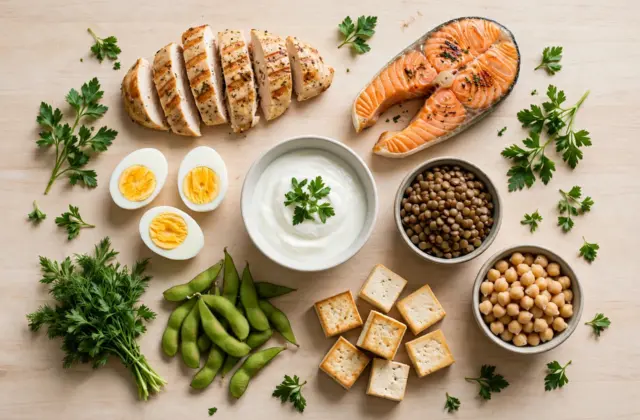
Whey digests fast, which was the original argument for it. But the window is hours wide, not minutes, so chicken, eggs, fish, or Greek yogurt work just as well. Choose whey for convenience, not magic.
Should I eat protein before bed even on rest days?
The strongest evidence for pre-sleep protein comes from training days, where it extends the recovery window overnight. On rest days it is harmless and still supplies amino acids through the night, but your daily total matters more than hitting this ritual every single night.
What if I train fasted in the morning?
Then timing matters more for you. After an overnight fast plus a workout, your muscles have gone ten or more hours without amino acids. Aim for 25–40 grams of protein within an hour or two after training in that specific case.
This article is for general information only and is not medical advice. If you have kidney disease, diabetes, or any condition that affects how your body handles protein, talk to your doctor or a registered dietitian before changing your intake.
Sources
- Schoenfeld BJ, Aragon AA, Krieger JW. The effect of protein timing on muscle strength and hypertrophy: a meta-analysis. J Int Soc Sports Nutr. 2013. doi.org/10.1186/1550-2783-10-53
- Aragon AA, Schoenfeld BJ. Nutrient timing revisited: is there a post-exercise anabolic window? J Int Soc Sports Nutr. 2013. link.springer.com/article/10.1186/1550-2783-10-5
- Schoenfeld BJ, et al. Pre- versus post-exercise protein intake has similar effects on muscular adaptations. PeerJ. 2017. doi.org/10.7717/peerj.2825
- Areta JL, et al. Timing and distribution of protein ingestion during prolonged recovery from resistance exercise alters myofibrillar protein synthesis. J Physiol. 2013. pmc.ncbi.nlm.nih.gov/articles/PMC3650697
- Trommelen J, van Loon LJC. Pre-sleep protein ingestion to improve the skeletal muscle adaptive response to exercise training. 2016. pmc.ncbi.nlm.nih.gov/articles/PMC5188418
- Morton RW, et al. A systematic review, meta-analysis and meta-regression of the effect of protein supplementation on resistance training-induced gains in muscle mass and strength in healthy adults. Br J Sports Med. 2018. doi.org/10.1136/bjsports-2017-097608
- Moore DR, et al. Ingested protein dose response of muscle and albumin protein synthesis after resistance exercise in young men. 2009. Reviewed in: pmc.ncbi.nlm.nih.gov/articles/PMC3832113
- Esmarck B, et al. Timing of postexercise protein intake is important for muscle hypertrophy with resistance training in elderly humans. J Physiol. 2001. Discussed in: jssm.org