Easy High-Fiber Breakfast Ideas
Most of us start the day behind on fiber before we’ve even left the kitchen. A plain bagel, a sugary cereal, or nothing at all — and by lunch, the day’s fiber target already looks out of reach. Breakfast is the easiest place to fix that, because it’s the one meal you can build around a single high-fiber food and be a third of the way to your daily goal before 9 a.m. You don’t need a new diet or a specialty shop. You need oats, berries, seeds, and a little planning.
Fiber is the part of plant foods your body can’t digest, and that’s exactly what makes it useful. Soluble fiber slows digestion and helps steady blood sugar; insoluble fiber adds bulk and keeps things moving. Most adults fall well short of the recommended amount — the average American eats roughly 15 to 17 grams a day — so a breakfast that delivers 8 to 12 grams is a genuine head start.
How much fiber should breakfast carry?
The Institute of Medicine sets the Adequate Intake for fiber at 14 grams per 1,000 calories, which works out to about 25 grams a day for women and 38 grams for men aged 19 to 50, dropping to 21 and 30 grams after 50. The FDA’s Daily Value on food labels is 28 grams. A useful rule of thumb: aim for roughly a third of your daily target at breakfast, so 8 to 12 grams for most adults.
That number is worth chasing. A large 2019 analysis in The Lancet, pooling 185 prospective studies and 58 clinical trials, found that people eating the most fiber had a 15 to 30 percent lower risk of dying from any cause and from cardiovascular disease than people eating the least, with the biggest risk reductions seen at intakes of 25 to 29 grams a day. Breakfast is simply the most reliable place to bank a chunk of that.
One caution: if your current breakfast has almost no fiber, don’t jump to 12 grams overnight. Add about 5 grams a day, spread across meals, and drink water with it — fiber works best with fluid, and a sudden jump is the fastest way to end up bloated.
The five building blocks of a high-fiber breakfast
Nearly every good high-fiber breakfast is a combination of a few familiar foods. Learn the numbers once and you can mix and match for months.
Oats. Half a cup of dry rolled oats gives you about 4 grams of fiber, and a cup of cooked instant oatmeal gives you about 4 grams too. Oats also contain beta-glucan, a soluble fiber the FDA recognizes in a health claim: diets low in saturated fat and cholesterol that include at least 3 grams of beta-glucan a day from whole oats or barley may reduce the risk of coronary heart disease.
Berries. Raspberries are the fiber champion of the fruit bowl at about 8 grams per cup, according to the Mayo Clinic’s chart of high-fiber foods, which draws on USDA data. Blackberries are close behind. A handful of berries on anything instantly upgrades it.
Chia and flax seeds. Chia seeds pack about 10 grams of fiber per ounce (roughly 2 tablespoons), the densest common breakfast food. Ground flaxseed adds about 2 to 3 grams per tablespoon and stirs into almost anything without changing the taste much.
Whole grains. A slice of whole-wheat bread carries about 2 grams of fiber, roughly double a slice of white bread. The difference looks small, but across two slices of toast and a sandwich later in the day, it adds up.
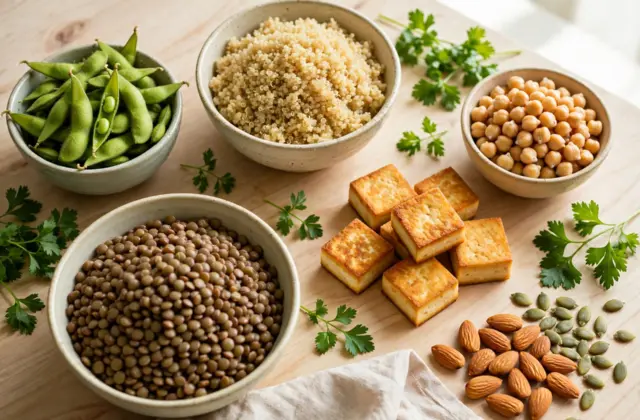
Beans and legumes. They rarely appear at breakfast, which is a missed opportunity — beans are among the highest-fiber foods there are, and a savory breakfast built on them can carry more fiber than any bowl of cereal.
Read also: How to Add Fiber to Your Diet
1. Overnight oats with berries and chia
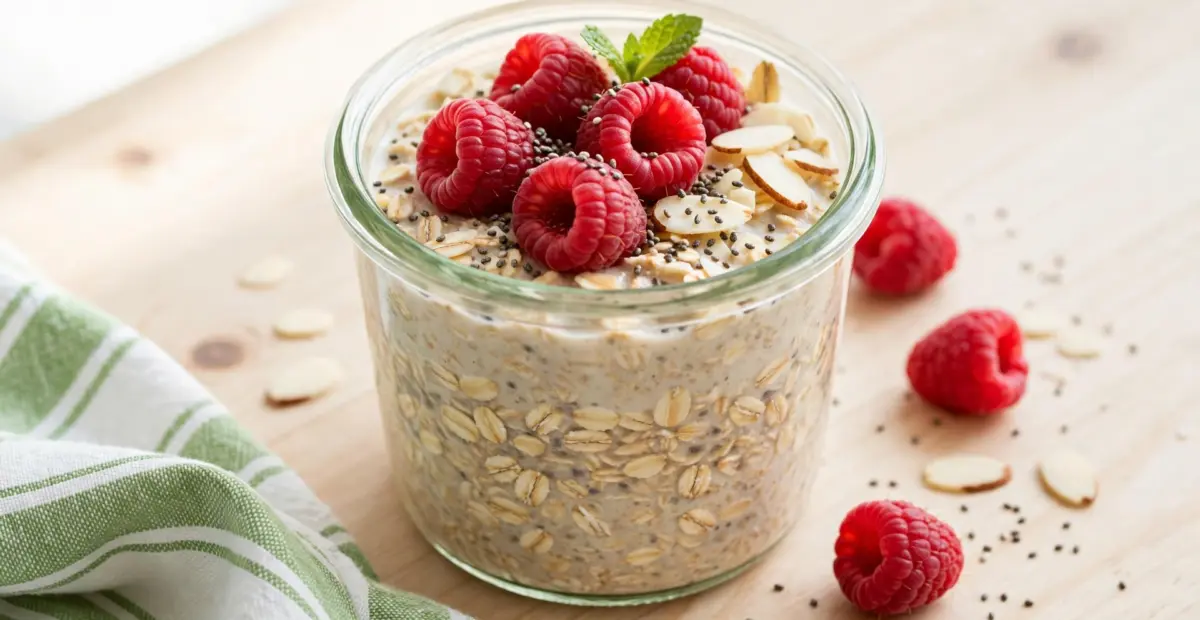
This is the workhorse. Stir half a cup of rolled oats, half a cup of milk or a dairy-free alternative, a tablespoon of chia seeds, and a spoonful of yogurt in a jar the night before. In the morning, top with half a cup of raspberries. The oats give you about 4 grams of fiber, the chia about 5, and the berries about 4 — roughly 13 grams before you’ve made a single decision. Make three jars on Sunday and breakfast is solved until Wednesday.
Swap the toppings through the week and it never gets boring: sliced banana and peanut butter, frozen blueberries and walnuts, or grated apple with cinnamon and raisins. Frozen berries work just as well as fresh here, and they soften overnight into the oats.
2. Chia pudding that tastes like dessert
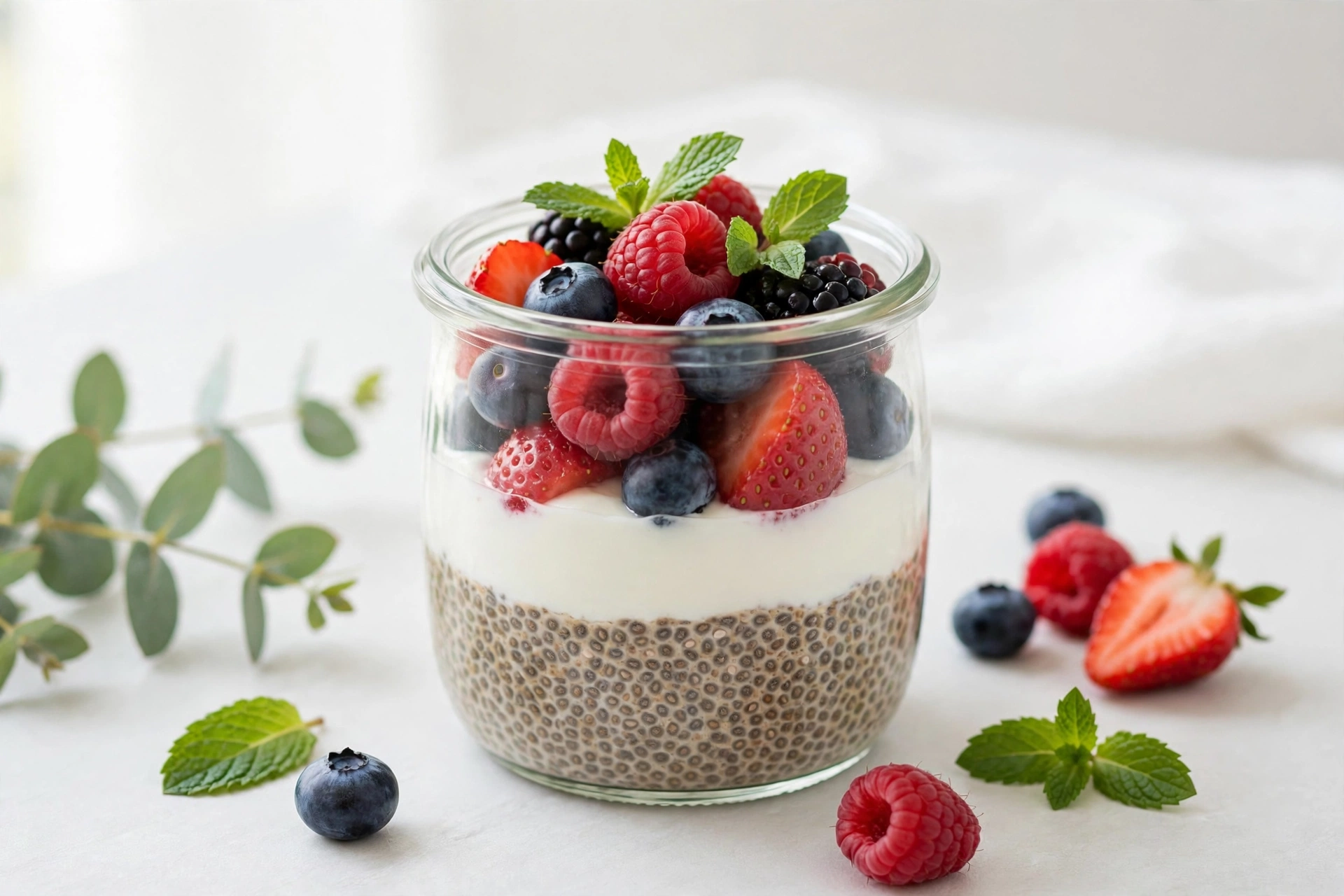
Mix 3 tablespoons of chia seeds with a cup of milk, a splash of vanilla, and a drizzle of honey or maple syrup, then refrigerate overnight. By morning it has set into a thick pudding with about 15 grams of fiber in the chia alone. Layer it with berries and a spoonful of Greek yogurt — a three-quarter cup of plain Greek yogurt adds about 17 grams of protein — and you have something that eats like dessert and keeps you full until lunch. If the texture puts you off, blend the mixture before chilling; it comes out smooth, like a mousse.
3. Greek yogurt, berries, and nuts
When you have five minutes and no patience, this is the move: a cup of plain Greek yogurt, a cup of raspberries, and a small handful of almonds or walnuts. The berries carry the fiber — about 8 grams — the nuts add a gram or two plus healthy fats, and the yogurt brings the protein that keeps the meal satisfying. Skip the pre-sweetened flavored yogurts; a spoonful of honey gives you the sweetness with far less added sugar.
Read also: How to Build a Better Breakfast
4. Whole-grain toast, two ways
Toast gets dismissed as a low-fiber breakfast, but that’s a white-bread problem. Two slices of whole-wheat toast give you about 4 grams of fiber before toppings, and the toppings do the rest.
Try mashed avocado with a squeeze of lemon and a sprinkle of chili flakes — creamy, filling, and easy to eat standing up. Or go savory: warm white beans mashed with garlic and olive oil, topped with a poached egg (about 6 grams of protein per egg) and a handful of spinach. It sounds like lunch — but a savory breakfast is often the one that keeps you fullest, because beans and eggs together cover both fiber and protein.

5. A smoothie that actually has fiber in it
Most smoothies fail the fiber test because they’re built on juice and a banana. Juice has the fiber stripped out, so a smoothie made from it is mostly sugar water with good branding. Build yours the other way: whole fruit, a handful of spinach or kale, half a cup of rolled oats, and a tablespoon of ground flaxseed, blended with milk or water. The oats and flaxseed alone add about 6 to 7 grams of fiber, and the whole fruit keeps its own.
Read also: How to Choose Whole Grains
6. A five-minute savory scramble
Not everyone wants something sweet in the morning. Scramble two eggs with a handful of spinach, a few cherry tomatoes, and a quarter cup of black beans warmed in the pan first. Serve it on a slice of whole-wheat toast. The beans and toast supply the fiber, the eggs supply the protein, and the whole thing takes about as long as waiting for a bagel to toast. Leftover roasted vegetables from last night’s dinner work just as well as the spinach.
A week of high-fiber breakfasts
If decision fatigue is the problem, copy this and stop thinking about it:
- Monday: Overnight oats with raspberries and chia seeds
- Tuesday: Greek yogurt with berries, walnuts, and a drizzle of honey
- Wednesday: Whole-grain toast with avocado and a poached egg
- Thursday: Chia pudding layered with frozen blueberries and yogurt
- Friday: Savory scramble with black beans, spinach, and whole-wheat toast
- Saturday: Oatmeal cooked with grated apple, cinnamon, and ground flaxseed
- Sunday: Smoothie with oats, banana, spinach, and flaxseed, plus a slice of whole-grain toast
Every day on that list lands somewhere between 8 and 15 grams of fiber, and none needs more than ten minutes in the morning — most need less, because the work happened the night before.
Three mistakes that quietly undo the fiber
Drinking your fruit. A glass of orange juice has essentially no fiber, while the oranges it came from had plenty. Eat the fruit; drink water.
Trusting the box. Cereals that shout about fiber on the front can still be mostly added sugar. Flip it over: look for “whole grain” or “whole wheat” as the first ingredient, at least 3 grams of fiber per serving, and less than 5 grams of added sugar.
Forgetting the water. Fiber absorbs water as it moves through your gut — that’s part of how it works, and it’s why a high-fiber breakfast without a glass of water can leave you feeling heavy. Keep a glass on the table and drink it with the meal, not as an afterthought.
Frequently asked questions
How much fiber should I aim for at breakfast?
About a third of your daily target is a good goal — roughly 8 to 12 grams for most adults. The Institute of Medicine’s Adequate Intake is 25 grams a day for women and 38 grams for men aged 19 to 50, so a breakfast in that range leaves the rest of the day very manageable.
Can I get enough fiber from cereal alone?
Some high-fiber cereals can deliver 5 to 7 grams per serving, which is a solid start, but most ordinary breakfast cereals give you 1 to 3 grams. Pairing cereal with berries or a spoonful of chia seeds is usually easier than hunting for the perfect box.
Will a high-fiber breakfast upset my stomach?
It can if you jump from almost no fiber to a lot in one day. Increase gradually — about 5 extra grams a day — and drink water with your meals. Most people adjust within a week or two.
Is frozen fruit as good as fresh for fiber?
Yes. Freezing doesn’t remove fiber, and frozen berries are often picked ripe and frozen quickly, so their nutrient content holds up well. They’re also cheaper out of season — ideal for overnight oats and smoothies.
Sources
- Institute of Medicine — Dietary Reference Intakes for Energy, Carbohydrate, Fiber, Fat, Fatty Acids, Cholesterol, Protein, and Amino Acids (2005)
- Reynolds A, Mann J, Cummings J, et al. — Carbohydrate quality and human health: a series of systematic reviews and meta-analyses, The Lancet (2019)
- Mayo Clinic — Chart of high-fiber foods (USDA data)
- U.S. FDA — 21 CFR 101.81, Health claims: soluble fiber from certain foods and risk of coronary heart disease
- USDA FoodData Central
- World Health Organization — Healthy diet fact sheet
This article is for general information only and is not medical advice. If you have a digestive condition or are changing your diet for a medical reason, talk with your clinician or a registered dietitian first.