Vitamin D Food Sources: What to Know
Vitamin D is the odd one out in the vitamin world. Most vitamins come mainly from food, but vitamin D mostly comes from sunlight — and food only fills in part of the gap. That is why the question “which foods have vitamin D?” has a shorter answer than you’d expect, and why the foods that do contain it matter more than they might seem.
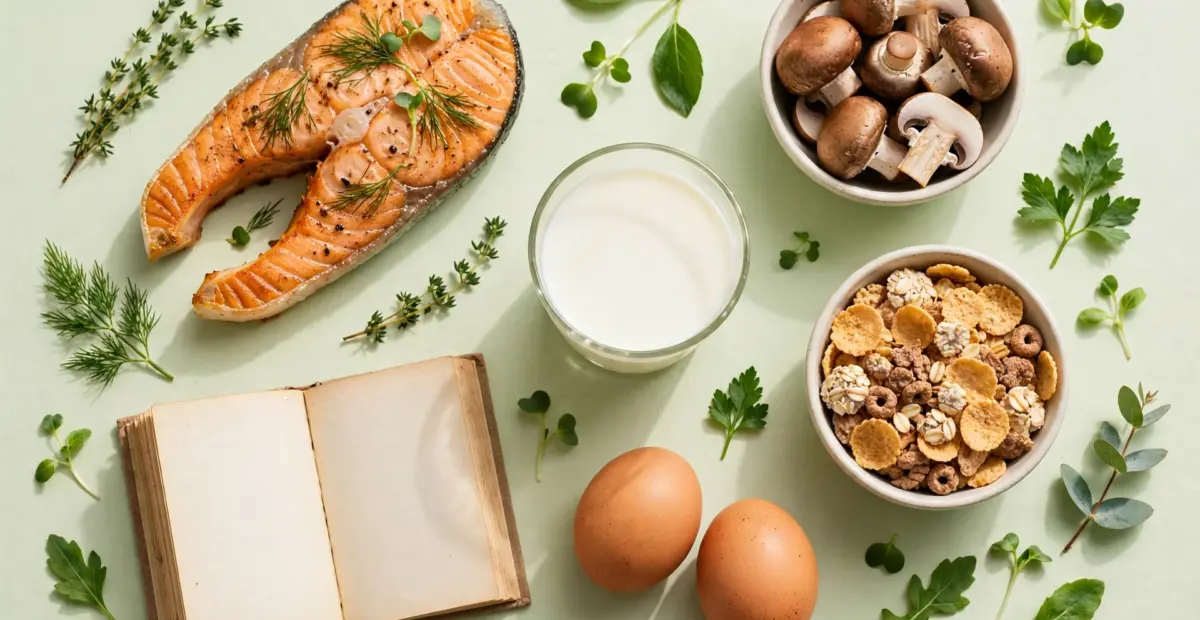
Here is the honest picture: very few foods naturally contain vitamin D in meaningful amounts. Fatty fish carry the most by far, fortified foods do the everyday heavy lifting for most people, and one surprising plant food — mushrooms exposed to ultraviolet light — can rival a serving of fish.
Why vitamin D is different from other vitamins
Vitamin D is a fat-soluble vitamin your body also makes on its own: ultraviolet rays from sunlight trigger its synthesis, and it is then activated in the liver and kidney. Its best-known job is helping your gut absorb calcium and keeping bones mineralized; without enough of it, bones can become thin or misshapen, and in children a severe shortage causes rickets. It also plays roles in immune function, muscle function, and inflammation, according to the National Institutes of Health (NIH) Office of Dietary Supplements.
That sunlight connection is also what makes food sources so important to understand. Sun exposure varies enormously — by season, latitude, time of day, skin tone, clothing, and how much time you actually spend outside. The NIH notes that the official intake recommendations were set on the assumption that people get minimal sun exposure, so they are effectively food-and-supplement targets. If you spend most of your day indoors, or live through a long, dark winter, food has to carry more of the load.
And the load is real. An analysis of National Health and Nutrition Examination Survey (NHANES) data from 2005–2006 found that 41.6% of U.S. adults had blood levels of vitamin D at or below 20 ng/mL — the threshold the National Academies use as the line for sufficiency. Definitions vary and newer data show lower rates under stricter cutoffs, but the pattern is consistent: a large share of adults run lower than ideal, and diet is one of the few levers you control directly.
How much vitamin D do you actually need?
Before ranking foods, it helps to know the target. The NIH Office of Dietary Supplements sets the Recommended Dietary Allowance (RDA) at 600 IU (15 micrograms) a day for adults aged 1 to 70, and 800 IU (20 micrograms) a day for adults over 70. The same 600 IU applies during pregnancy and breastfeeding. The Daily Value printed on U.S. Nutrition Facts labels is 20 micrograms (800 IU).
There is also a ceiling. The tolerable upper intake level for adults is 4,000 IU (100 micrograms) a day from all sources combined — food plus supplements. That is not a goal; it is the highest intake considered unlikely to cause harm. Food alone almost never gets you there: you would need to eat several salmon fillets a day.
Read also: Vitamin D: How Much Do You Actually Need?
The heavy hitters: fatty fish
If there is one food group that genuinely moves the needle on vitamin D, it is fatty fish. The flesh of trout, salmon, tuna, and mackerel is among the best natural sources, and the numbers from the NIH’s food table make the gap clear:
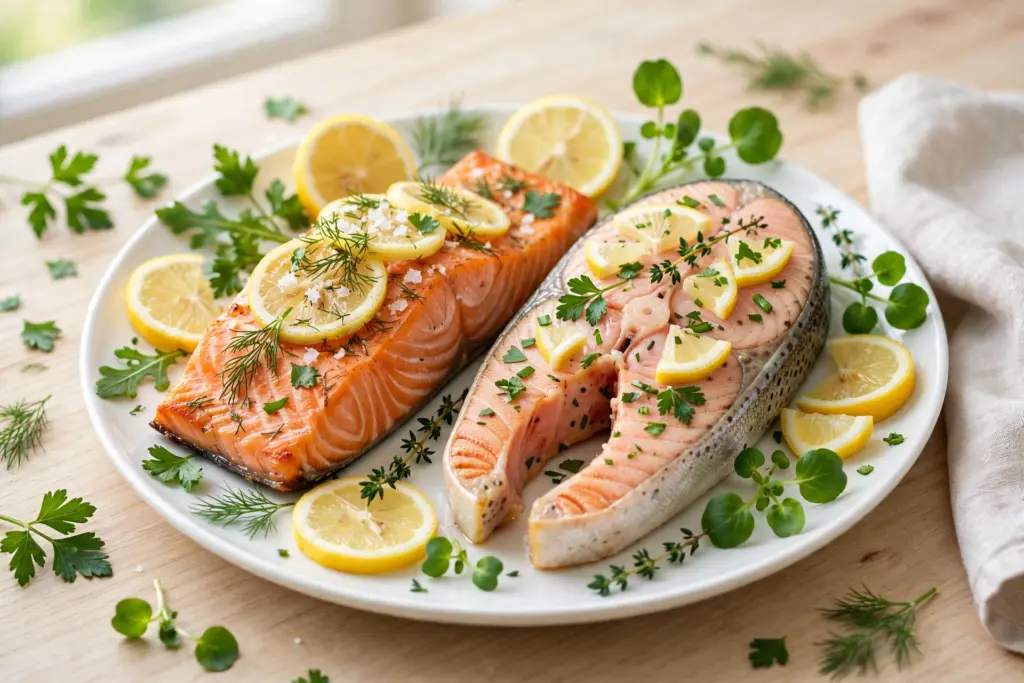
- Rainbow trout, farmed, cooked (3 ounces): 645 IU — 81% of the Daily Value
- Sockeye salmon, cooked (3 ounces): 570 IU — 71% of the Daily Value
- Canned light tuna in water, drained (3 ounces): 40 IU — 5% of the Daily Value
- Sardines, canned in oil, drained (2 sardines): 46 IU — 6% of the Daily Value
One serving of trout or salmon nearly covers a whole day’s target on its own. That is why fish is the centerpiece of any food-first vitamin D strategy — and why it pairs so neatly with heart-health advice. The American Heart Association recommends eating fish, particularly fatty fish, at least twice a week, with each serving about 3.5 ounces cooked. Two salmon dinners a week alone would supply roughly 1,140 IU, or about a quarter of a week’s RDA, before anything else on your plate is counted.
Read also: How to Include Healthy Fats in Meals
Not all fish are equal here. White fish like cod or tilapia contain very little vitamin D, and canned light tuna — the kind most people keep in the pantry — is surprisingly modest at 40 IU per serving. If vitamin D is the goal, reach for the oily fish: salmon, trout, mackerel, sardines, and herring. Canned salmon counts too, and it is often the most affordable way to get a high-vitamin-D fish into a weekday lunch.
The one plant source that counts: UV-exposed mushrooms
Mushrooms are the only notable plant-based source of vitamin D — but with a catch that matters. Ordinary mushrooms grown in the dark contain almost none: half a cup of raw portabella has about 4 IU. Mushrooms exposed to ultraviolet light, either from sunlight or UV lamps during growing or after harvest, are a different food entirely. Half a cup of sliced white mushrooms exposed to UV light provides 366 IU — 46% of the Daily Value — and some UV-exposed varieties provide even more per serving.
How do you know which ones you’re buying? Check the package — UV-exposed mushrooms are usually labeled with a vitamin D claim. If the label says nothing, assume the content is negligible.
Fortified foods do most of the everyday work
Here is the part that surprises most people: in the United States, fortified foods — not fish — provide most of the vitamin D in the average diet. That is simply because they are eaten every day. The NIH puts it plainly: almost all of the U.S. milk supply is voluntarily fortified with about 120 IU of vitamin D per cup, usually as D3. Plant-based milks are often fortified to similar levels, though the exact amount varies by brand, so the label is the authority.
- Fortified cow’s milk (1 cup): 120 IU — 15% of the Daily Value
- Fortified soy, almond, or oat milk (1 cup): 100–144 IU — 13–18% of the Daily Value
- Fortified ready-to-eat cereal (1 serving): about 80 IU — 10% of the Daily Value
- Fortified orange juice (1 cup): about 100 IU — 13% of the Daily Value
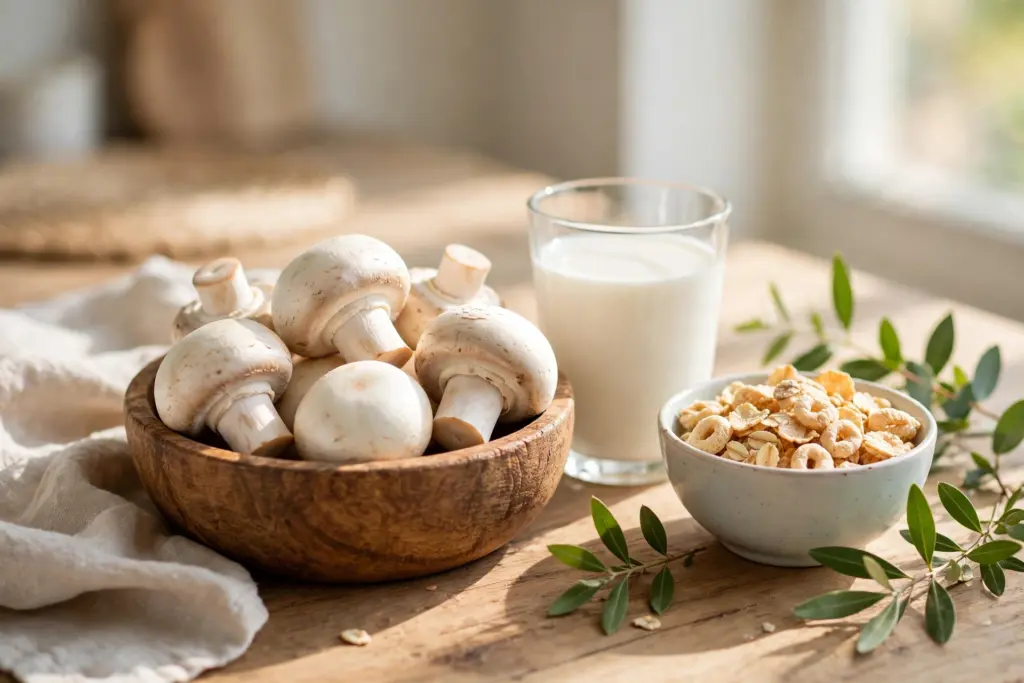
Individually, these are modest numbers, but together they add up: a breakfast of fortified cereal with fortified milk and a glass of fortified orange juice can supply roughly 300 IU — half the adult RDA — before you have eaten anything else.
A few things worth knowing about fortified foods. First, cheese and ice cream are usually not fortified, even though they are made from milk — a slice of cheddar provides only about 17 IU. Second, fortification levels vary by country; in Canada, for example, milk fortification is mandatory at a slightly lower level. If you live outside the United States, check your local labels rather than assuming the numbers above apply.
The small contributors: eggs, liver, and cheese
A handful of other foods contain small amounts: one large scrambled egg provides about 44 IU (6% of the Daily Value), almost all of it in the yolk, and three ounces of braised beef liver about 42 IU. Cheddar cheese, at 17 IU per 1.5 ounces, barely registers. Cod liver oil is the exception — 1,360 IU per tablespoon — but it is very high in vitamin A, so it is not something to take casually every day without checking with a clinician.
These foods are not vitamin D strategies on their own — you would need about fourteen eggs to reach the RDA — but they nudge the total upward in a varied diet. Vitamin D is fat-soluble, and the NIH notes that having some fat in a meal helps absorption, so the egg yolk’s own fat is working in your favor here.
What about sunlight?
For many people, sunlight is still the largest source of vitamin D — but the NIH deliberately gives no one-size-fits-all recommendation for how much sun you need, because it depends on season, time of day, latitude, cloud cover, skin tone, age, and how much skin is exposed. In winter at higher latitudes, the sun’s angle is too low for meaningful production at all. That variability is exactly why food matters: sunlight is a bonus when conditions are right, not a dependable baseline — and dermatologists rightly caution against unprotected sun exposure because of skin-cancer risk.
Putting it together: a day of vitamin D from food
The numbers become much friendlier when you stack them. Here is an ordinary day, using the NIH’s food values:
- Breakfast: fortified cereal with a cup of fortified milk — about 200 IU
- Lunch: a sandwich with an egg and a slice of cheese, plus a glass of fortified plant milk — about 160 IU
- Dinner: a 3-ounce salmon fillet with a side of sautéed UV-exposed mushrooms — about 750 IU
That day totals roughly 1,110 IU — comfortably above the 600 IU RDA, with no supplements and nothing exotic. On a day without fish, the same framework still works: fortified milk, cereal, eggs, and mushrooms can combine to roughly 400–500 IU, a solid base to build on.
Read also: Vitamin C Foods: Everyday Sources
When food alone may not be enough
Some people will struggle to reach the RDA from food alone: people who rarely eat fish, avoid dairy and fortified plant milks, spend little time outdoors, live in northern latitudes, have darker skin (which makes less vitamin D from the same sun exposure), or are older adults, whose skin synthesizes vitamin D less efficiently. For them, a supplement is often the practical answer — but the dose and the need for testing are decisions to make with a clinician, not from a blog post.
What food can do, reliably, is move you a long way toward the target. Two servings of fatty fish a week, a daily fortified milk or plant milk, fortified cereal when you eat it, and UV-exposed mushrooms when you can find them: that combination covers most adults most of the time.
Frequently asked questions
Which food has the most vitamin D?
Cod liver oil, at 1,360 IU per tablespoon, is the most concentrated source — but it is very high in vitamin A, so it is not an everyday food. Among ordinary foods, fatty fish lead: rainbow trout provides 645 IU and sockeye salmon 570 IU per 3-ounce serving.
Do mushrooms really contain vitamin D?
Only mushrooms exposed to ultraviolet light. Ordinary mushrooms contain almost none (about 4 IU per half cup), while UV-exposed white mushrooms provide about 366 IU per half cup. Check the packaging — it will usually say “vitamin D” or “UV-exposed” if they qualify.
Can I get enough vitamin D from food alone?
It is possible, but it takes intention. A day with fatty fish, fortified milk, and fortified cereal can exceed the 600 IU RDA. Without fish or fortified foods, it is very hard — most other foods contribute only small amounts, so people who avoid those categories often need sunlight or a supplement to close the gap.
Sources
- NIH Office of Dietary Supplements — Vitamin D, Health Professional Fact Sheet (RDA values, food content table, fortification, and serum-level thresholds)
- NIH Office of Dietary Supplements — Vitamin D, Consumer Fact Sheet
- American Heart Association — Fish and Omega-3 Fatty Acids (two servings of fatty fish per week, 3.5-ounce servings)
- Forrest, K. Y. Z., & Stuhldreher, W. L. (2011). Prevalence and correlates of vitamin D deficiency in US adults. Nutrition Research (41.6% of U.S. adults at or below 20 ng/mL, NHANES 2005–2006)
- Cui, A., et al. (2022). Prevalence, trend, and predictor analyses of vitamin D deficiency in the US population, 2001–2018. Frontiers in Nutrition
- USDA FoodData Central (food composition values)
Disclaimer: This article is for general information only and is not medical advice. Vitamin D needs vary by age, health status, and sun exposure, and supplements can interact with medications. Talk to your clinician before starting a vitamin D supplement or having your levels tested.