Vitamin B12 Foods for Different Eating Patterns
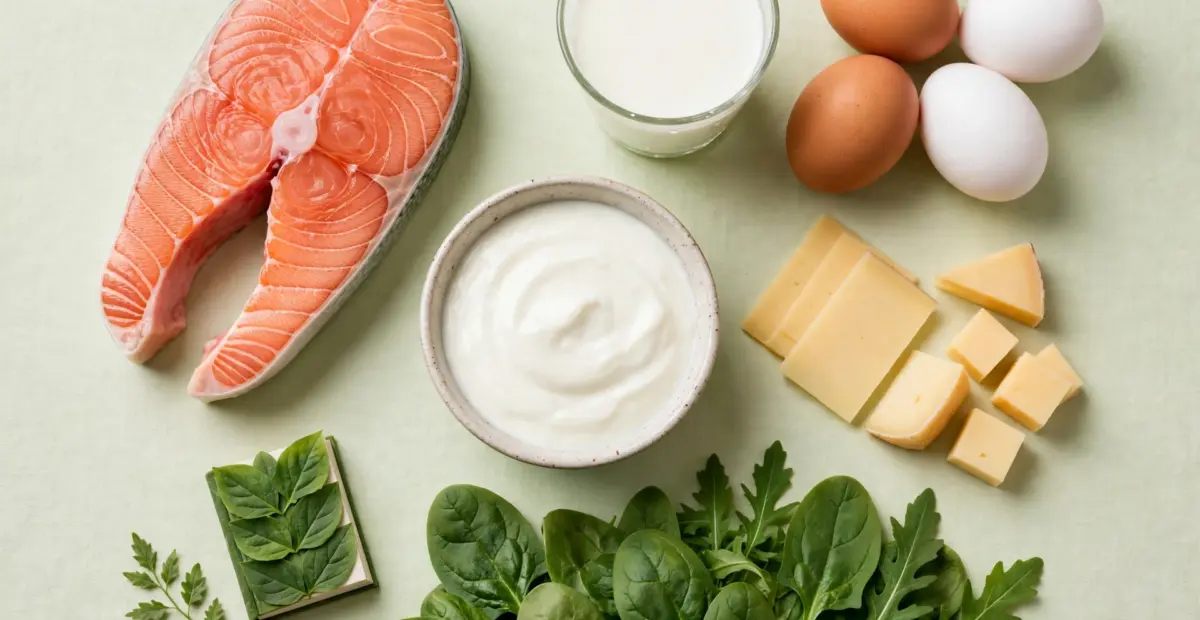
Vitamin B12 is one of the easiest nutrients to get — and one of the easiest to miss. It hides in plain sight in everyday foods, yet whole eating patterns can run low on it for years without anyone noticing. The reason is simple: B12 comes almost entirely from animal foods and fortified products. If you eat meat, fish, eggs, and dairy, you probably cover your needs without thinking about it. If you don’t, you need a plan.
The good news is that every eating pattern has a reliable route to enough B12. You just need to know which foods actually deliver it, how much you need, and where the gaps tend to appear. This guide walks through all of it — omnivore, vegetarian, vegan, and the over-50s — with real numbers from the NIH and USDA.
What vitamin B12 does, and why it matters
Vitamin B12, also called cobalamin, is a water-soluble vitamin your body needs to form healthy red blood cells, keep your nervous system working, and make DNA. Without enough of it, your body produces red blood cells that are unusually large and don’t work properly — a condition called megaloblastic anemia — which can leave you feeling tired and weak. B12 deficiency can also damage nerves, even in people who haven’t developed anemia.
Here’s what makes B12 unusual: no plant or animal makes it on its own. It’s made only by certain bacteria. Animals accumulate it by eating bacteria-rich feed or through bacteria in their gut, which is why B12 ends up concentrated in meat, fish, eggs, and dairy. Plants don’t contain B12 in any meaningful amount unless a manufacturer adds it. That single fact shapes everything about how different eating patterns handle this vitamin.
How much B12 do you actually need?
The amount is tiny — measured in micrograms, not milligrams. According to the National Institutes of Health (NIH) Office of Dietary Supplements, the Recommended Dietary Allowance (RDA) for vitamin B12 is 2.4 micrograms (mcg) per day for adults, rising to 2.6 mcg during pregnancy and 2.8 mcg while breastfeeding.
Two details matter more than the number itself. First, your body absorbs only a fraction of what you swallow — roughly half of a 1 to 2 mcg dose, and less from larger doses, because absorption depends on a stomach protein called intrinsic factor, which has a limited capacity. Second, no Tolerable Upper Intake Level has been set for B12, because no adverse effects have been linked to excess intake from food or supplements in healthy people. In practice, that means the risk runs in one direction: too little, not too much.
Your body also stores B12 — mainly in the liver — and those stores can last for years. That’s why a deficiency can build quietly. Someone who stops eating animal foods may feel fine for a long time before low B12 starts to show up as fatigue, tingling hands and feet, or trouble concentrating.
The richest B12 foods, ranked
Some foods deliver a week’s worth of B12 in a single serving. Others contribute a little at a time and need to be combined. The values below come from USDA FoodData Central, as listed in the NIH fact sheet, with the adult Daily Value set at 2.4 mcg.
| Food | Serving | B12 | % of daily value |
|---|---|---|---|
| Clams, cooked | 3 oz (85 g) | 84.1 mcg | 3,504% |
| Beef liver, pan-fried | 3 oz (85 g) | 70.7 mcg | 2,946% |
| Salmon, wild, cooked | 3 oz (85 g) | 4.8 mcg | 200% |
| Tuna, canned in water | 3 oz (85 g) | 2.5 mcg | 104% |
| Ground beef, 85% lean | 3 oz (85 g) | 2.4 mcg | 100% |
| Fortified nutritional yeast | about ¼ cup | 8.3–24 mcg | 346–1,000% |
| Fortified breakfast cereal | 1 serving (25% DV) | 0.6 mcg | 25% |
| Milk, low-fat | 1 cup | 1.2 mcg | 50% |
| Yogurt, plain | 1 cup | 1.1 mcg | 46% |
| Egg, whole, large | 1 egg | 0.6 mcg | 25% |
One look at that table explains why eating patterns matter so much. A single salmon fillet covers the whole day. A cup of milk covers half. An egg covers a quarter. And a bowl of unfortified plant foods covers nothing at all.
If you eat everything: the easy route
For omnivores, B12 is rarely a problem. One serving of fish, meat, or poultry a day usually meets the RDA on its own — a 3-ounce piece of salmon delivers about twice the daily target, and even lean ground beef covers 100% of it. Add a morning egg and a glass of milk, and you’re comfortably above the line before lunch.
That doesn’t mean omnivores can ignore B12 entirely. The people most likely to run low while eating animal foods are older adults, people taking long-term acid-reducing medicines, and anyone who has had stomach or bowel surgery — because the issue is absorption, not intake. An estimated 10–30% of adults over age 50 have difficulty absorbing B12 from food, mainly because stomach acid production declines with age and acid is needed to free B12 from food proteins. For that reason, the NIH advises adults over 50 to get most of their B12 from fortified foods or supplements, where the vitamin is already in its free form and easier to absorb.
Read also: How to Add Protein to Everyday Meals
If you’re vegetarian: dairy and eggs can carry you, with a little planning
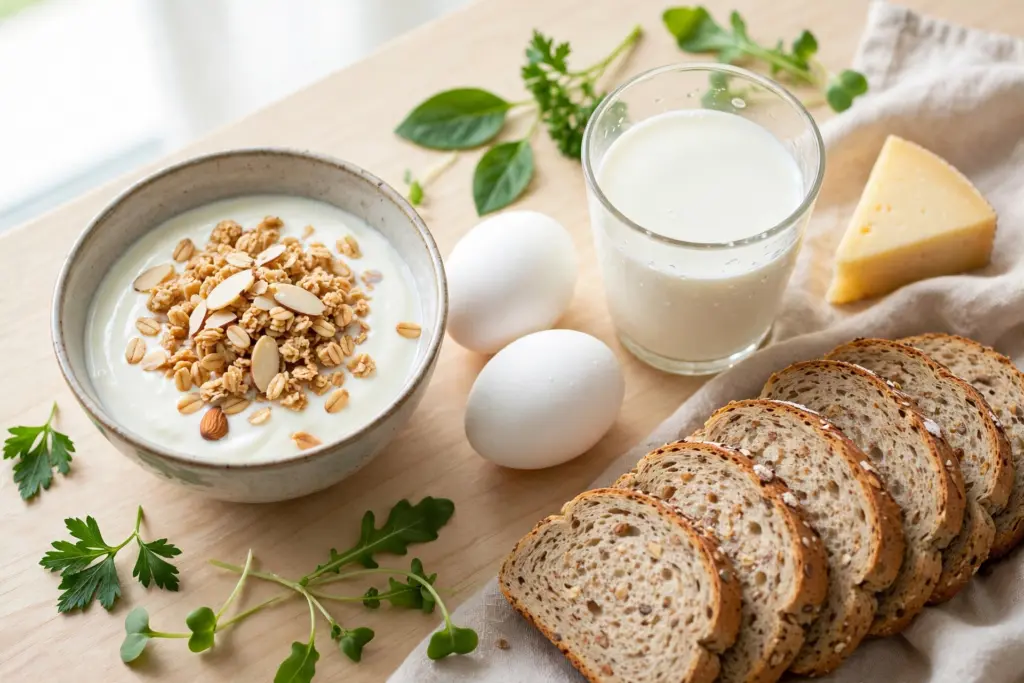
Lacto-ovo vegetarians have workable B12 sources — milk, yogurt, cheese, and eggs — but the amounts are modest, so the pattern needs a bit of arithmetic. A cup of milk gives you about 1.2 mcg (half the day), a cup of yogurt about 1.1 mcg, and one egg about 0.6 mcg. A breakfast of yogurt with a boiled egg gets you to roughly 70% of the RDA; a glass of milk with dinner closes the gap.
The catch is consistency. A vegetarian who eats dairy most days is usually fine. One who eats eggs and cheese only occasionally — or who leans heavily on plant-based meals with dairy as an afterthought — can drift low over months. Fortified foods are the easy insurance policy here: a bowl of fortified breakfast cereal or a glass of fortified plant milk adds B12 without changing how you eat. Check the Nutrition Facts label to confirm the product is actually fortified — amounts vary widely by brand, and “plant-based” on the packet does not mean B12 was added.
If you’re vegan: fortified foods and supplements are not optional
This is the pattern where B12 planning is genuinely essential. No fruit, vegetable, grain, or legume provides usable B12. Claims about seaweed, mushrooms, or fermented foods delivering B12 don’t hold up — the compounds they contain are mostly inactive analogues that don’t meet your body’s needs.
Vegans have two reliable routes, and most people use both:
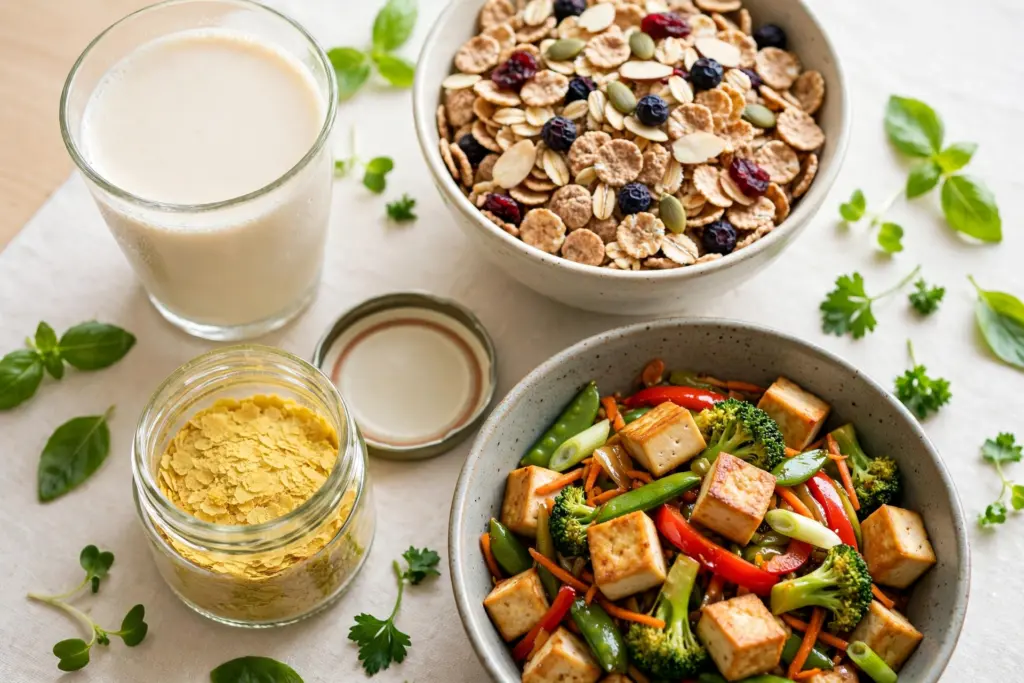
- Fortified foods. Nutritional yeast fortified with B12 is the most concentrated option — about 8.3 to 24 mcg per quarter cup, depending on the brand — and a tablespoon sprinkled over pasta or popcorn can cover the day. Fortified plant milks typically provide 1–3 mcg per cup, and fortified breakfast cereals around 0.6 mcg per serving. Spread two or three fortified foods across the day and the total adds up.
- Supplements. A daily B12 supplement is the simplest way to be sure. The NIH notes that studies have not shown an important difference in absorption between the common forms — cyanocobalamin and methylcobalamin — so the cheapest reliable option is fine. Because absorption per dose is limited, smaller daily doses are generally more efficient than one very large weekly dose, though both approaches are used.
One habit makes the difference: treat B12 as a daily checklist item, like brushing your teeth, rather than something you hope the food took care of. A fortified plant milk in your morning coffee plus a supplement covers it in under a minute.
Read also: How to Create a Balanced Vegetarian Plate
Three sample days that hit the target
Here’s what a B12-adequate day looks like in each pattern. These are illustrations, not prescriptions — mix and match to fit your own meals.
Omnivore day: Greek yogurt and a boiled egg for breakfast (~1.7 mcg), a tuna sandwich for lunch (~2.5 mcg), salmon with vegetables for dinner (~4.8 mcg). Total: well above the 2.4 mcg target.
Vegetarian day: Fortified cereal with milk for breakfast (~1.8 mcg), a cheese and egg sandwich for lunch (~1.2 mcg), lentil pasta with a glass of milk for dinner (~1.2 mcg). Total: about 4.2 mcg.
Vegan day: Fortified oat milk in coffee and fortified cereal for breakfast (~1.8 mcg), a tofu stir-fry with a tablespoon of fortified nutritional yeast for lunch (~8 mcg or more), plus a daily B12 supplement. Total: comfortably covered, with the supplement as the safety net.
Read also: Vitamin D Food Sources: What to Know
Signs you might be running low
B12 deficiency tends to creep up slowly, and its early signs are easy to blame on a busy week. According to the NIH and MedlinePlus, symptoms can include fatigue, weakness, constipation, loss of appetite, and weight loss. Neurological symptoms can also appear — numbness or tingling in the hands and feet, difficulty keeping your balance, and, in some cases, mood changes or memory difficulty.
The tricky part is that these symptoms overlap with many other conditions, from iron deficiency to thyroid problems. That is why deficiency should be confirmed with a blood test rather than guessed from symptoms. A standard serum B12 test is the usual first step; if the result lands in the borderline range (roughly 150–399 pg/mL), clinicians often check methylmalonic acid (MMA), the most sensitive marker of B12 status, to confirm or rule out a deficiency.
If you eat a vegan or mostly plant-based diet, are over 50, take metformin or long-term acid-reducing medication, or have a digestive condition that affects absorption, it’s worth raising B12 at your next check-up — even if you feel fine. A quick blood test is far simpler than undoing nerve damage that went unnoticed.
FAQ
Can I get enough B12 from food alone as a vegan?
Only if you eat fortified foods reliably every day — fortified nutritional yeast, fortified plant milks, and fortified cereals are the practical options. Because fortification levels vary by brand and it’s easy to miss a day, most nutrition authorities recommend vegans also take a B12 supplement as a safety net.
Is there a difference between cyanocobalamin and methylcobalamin?
Not one that matters for most people. The NIH notes that studies have not shown an important difference in absorption between the forms of B12 found in supplements. Cyanocobalamin is the most studied and usually the cheapest — a fine default choice.
Can you take too much B12?
No upper intake level has been established, because no adverse effects have been linked to high B12 intake from food or supplements in healthy people. That said, more is not automatically better — a standard daily supplement that meets the RDA is all you need, and very high doses don’t translate into proportionally higher absorption.
Does cooking destroy B12 in food?
Some B12 is lost during cooking, but not enough to change the picture — cooked salmon, beef, and eggs still deliver the amounts listed above. The bigger factor is simply which foods you eat and how often, not how you cook them.
The bottom line
Vitamin B12 is a small vitamin with an outsized job, and the only real question is whether your eating pattern delivers it. Omnivores usually get it without trying. Vegetarians get it from dairy and eggs, plus fortified foods as backup. Vegans need fortified foods and a supplement, full stop. And everyone over 50 should pay attention, because absorption — not appetite — is what changes with age.
Pick your route, make it a daily habit, and B12 takes care of itself.
This article is for general education only and is not medical advice. If you have symptoms of deficiency, take medication that affects absorption, or follow a vegan diet, talk with your clinician about testing and supplementation.
Sources