How to Turn a Meal Plan into a Grocery List
You planned the meals. You even felt good about it — a week of dinners mapped out, no more 5 p.m. staring into the fridge. Then you went shopping, and somehow you came home with three bags of things you didn’t need and forgot the one ingredient dinner actually depended on. The meal plan was fine. The translation was the problem.
A meal plan is a wish list until it becomes a grocery list. The good news: turning one into the other is a skill, and like most kitchen skills, it gets faster the third or fourth time you do it. Here’s a method that takes about fifteen minutes and saves you the midweek emergency shop, the wasted produce, and the money leaking out of your cart.
Start with the plan, not the store
Before you write a single item down, look at your plan as a whole week, not seven separate dinners. Most plans repeat the same building blocks: the same grains, the same cooking oil, the same handful of vegetables. When you read across the week instead of down each day, those repeats become obvious — and that’s where the savings live.
Take your seven dinners and pull out every ingredient, meal by meal, onto one rough list. Don’t worry about order yet. A chicken stir-fry on Tuesday and a chicken soup on Thursday both need chicken; write it once and add the quantities together. Two cups of rice on Monday and three on Friday is five cups of rice, not two separate shopping trips. This is the step most people skip, and it’s the step that stops you buying the same thing twice — or buying a second bag of something you already have half of at home.
Once everything is on one list, sort it by how your store is laid out: produce first, then meat and fish, then dairy and eggs, then pantry aisles, then frozen. Shopping in store order sounds trivial, but it cuts the zigzagging that turns a 30-minute shop into an hour, and it keeps the cold things cold because you pick them up last.
Read also: Weekly Meal Planning for Balanced Meals
Check the pantry before you write the list
This is the single highest-value habit in the whole process, and it takes about three minutes. Open the pantry, the fridge, and the freezer, and cross off anything you already have in enough quantity.
Be honest about “enough.” Half a bottle of soy sauce is enough for the week if your plan only needs two tablespoons. A quarter bag of rice is not enough if you need five cups. The point isn’t to be exact — it’s to stop buying duplicates of things that are already sitting there. The UN Environment Programme’s Food Waste Index Report 2024 found that households were responsible for 631 million tonnes of food waste in 2022 — about 60% of all food wasted at retail, food-service, and household level — averaging 79 kg per person per year. A surprising share of that waste starts as a duplicate purchase: the second bag of spinach bought because nobody checked the first one.
While you’re checking, note anything that’s about to go off. A wilting bunch of herbs, a yoghurt with two days left, the last of the carrots — build them into the week’s plan or use them first. A list that starts from what you already own is shorter, cheaper, and wastes less.
Turn quantities into real amounts
“Onions” on a list is a guess. “3 onions” is a purchase. Recipes usually give you the quantities; your job is to add them up across the week and round sensibly.
A few rules of thumb make this painless. Fresh produce is usually sold by weight or by piece, so convert where you can: a medium onion is roughly 150 g, a clove of garlic about 3 g, a bunch of herbs is usually enough for two or three recipes. For pantry staples, buy the size that covers the week plus a little buffer — running out of olive oil midweek is worse than having a bit left over, because oil keeps. For fresh food, the opposite applies: buy close to what you’ll use, because the gap between “enough” and “wilted in the crisper drawer” is about four days.
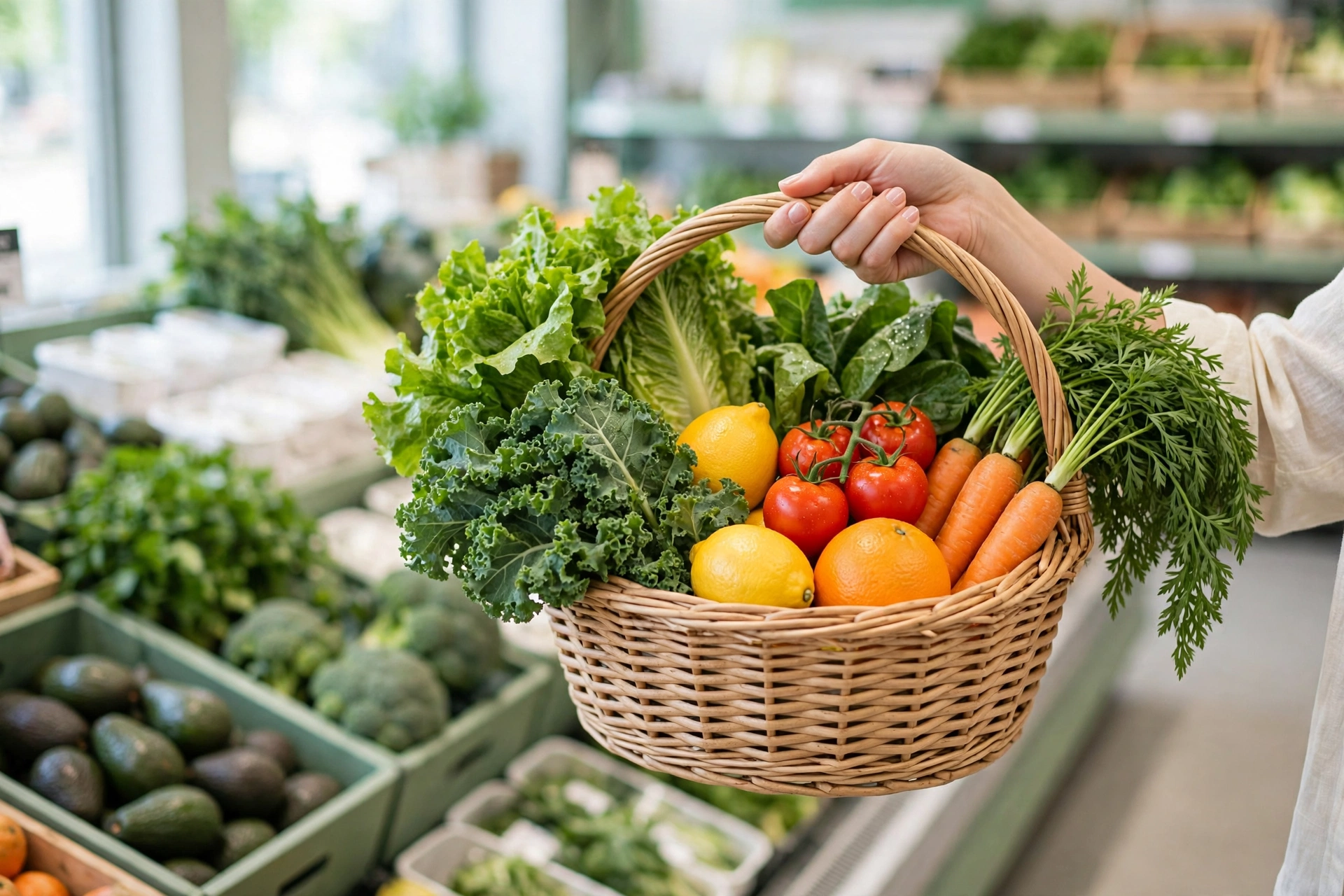
The World Health Organization recommends at least 400 g of fruit and vegetables a day — roughly five portions. If your plan is built around that target, your produce section should be the longest part of the list, and that’s a good sign. Aim for variety across the week rather than the same two vegetables every night: different colours, different textures, and a mix of fresh and frozen so the later days of the week still have something crisp to work with.
Build in the meals you didn’t plan
No plan survives the week intact. Someone works late, a dinner gets skipped, a friend drops by. If your list only covers the seven planned dinners, the first disruption sends you back to the store — or to takeaway.
So add a small “flex” section to your list: the ingredients for two or three fast fallback meals you can make from pantry staples. Eggs and toast with a side of fruit. Pasta with canned tomatoes, garlic, and beans. A grain bowl from frozen vegetables and whatever protein is in the freezer. These aren’t extra shopping — they’re the same staples, bought once, that rescue the nights the plan doesn’t cover.
Breakfasts and lunches deserve the same treatment. Many people plan dinners carefully and then improvise breakfast and lunch all week, which is how the “I’ll just grab something” spending adds up. Even a rough sketch — oats and fruit for breakfast, leftovers or sandwiches for lunch — turns those meals into list items instead of impulse buys. The USDA’s Thrifty Food Plan, its lowest-cost benchmark for a nutritious diet cooked at home, priced a week of food for a reference family of four at $236.30 in September 2026 — and that figure assumes every meal and snack is prepared at home. Every unplanned meal you buy out is money on top of that baseline.
Read also: How to Create a Healthy Grocery List
Use the label to choose between look-alikes
Your list will often give you a choice at the shelf: two cans of beans, three jars of pasta sauce, four loaves of bread. This is where the list meets the label, and a quick check saves you from bringing home the sugary or salty version by accident.
On a Nutrition Facts label, 5% Daily Value or less is low and 20% or more is high — that simple rule works for sodium, added sugars, saturated fat, and fibre alike. A sauce with 2% Daily Value for sodium is a very different purchase from one at 25%, even if the jars look identical. For added sugars, the WHO recommends keeping free sugars below 10% of total energy intake, and ideally below 5% — about 25 g a day on a 2,000-calorie diet. Checking the label once, when you first pick a product, means you don’t have to check it every week: once it’s on your regular list, it’s a known quantity.
None of this needs to happen in the aisle if you do it once at home. If a recipe calls for canned tomatoes, decide in advance whether you want the no-salt-added version, and write that on the list. The list is the place for decisions; the store is the place for collecting.
A 15-minute routine that sticks
Here’s the whole process, in order, for a typical week:
- Read the plan across the week. Pull every ingredient out of every meal onto one rough list, combining duplicates and adding up quantities.
- Check what you already have. Pantry, fridge, freezer. Cross off anything in sufficient quantity, and note what’s about to expire.
- Sort by store section. Produce, meat and fish, dairy and eggs, pantry, frozen. Cold items last.
- Add the flex meals. Two or three fast fallback meals from staples, plus rough breakfast and lunch coverage.
- Note the label choices. Write “no salt added” or “whole grain” next to items where the version matters, so you’re not deciding at the shelf.
- Shop once, from the list. Leftovers keep 3–4 days in the fridge at or below 40°F (4°C), so plan the meals that use the most perishable ingredients for the first half of the week.
Do this three weeks in a row and it stops feeling like a system and starts feeling like a habit. Your lists get shorter, your fridge gets less crowded, and the 5 p.m. question — “what’s for dinner?” — already has an answer, because the ingredients are actually in the house.
Read also: How to Stock a Healthy Pantry
Frequently asked questions
How long should turning a meal plan into a grocery list take?
About fifteen minutes for a week’s plan once you’ve done it a couple of times. The first attempt is slower because you’re still figuring out quantities; by the third week, most of your staples repeat and you’re mostly updating the fresh produce section.
Should I use a paper list or an app?
Whichever one you’ll actually check in the store. Paper lists are fast and never run out of battery; apps make it easy to reuse last week’s list and share it with someone else in the household. The format matters far less than the habit of checking the pantry first and shopping from the list rather than from memory.
What if I forget something on the list?
It happens to everyone. That’s exactly what the flex meals are for — a small set of pantry-based dinners that cover the gap without a second trip. If the forgotten item is essential to a planned dinner, swap that dinner with a later one in the week and pick the item up with the next shop, rather than making a special trip for one ingredient.
How do I keep fresh produce from going bad before I use it?
Plan the most perishable meals — salads, fresh fish, berries — for the first two or three days of the week, and lean on frozen vegetables, canned beans, and grains later in the week. Refrigerate leftovers within two hours and use them within 3–4 days. And when in doubt, buy slightly less fresh produce than you think you need: a second small shop is cheaper than a drawer full of wilted vegetables.
Sources
- World Health Organization — Healthy diet (fact sheet): at least 400 g of fruit and vegetables per day; free sugars below 10% of energy intake, ideally below 5%; salt below 5 g per day.
- USDA Food and Nutrition Service — Official USDA Food Plans: Cost of Food at Home (monthly reports): Thrifty Food Plan, September 2026 — $236.30 per week ($1,024.00 per month) for the reference family of four, all meals prepared at home.
- UN Environment Programme — Food Waste Index Report 2024: 1.05 billion tonnes of food wasted in 2022 (19% of food available to consumers); households responsible for 631 million tonnes (60%), averaging 79 kg per person per year.
- USDA Food Safety and Inspection Service — Leftovers and Food Safety: refrigerate leftovers within 2 hours; use refrigerated leftovers within 3–4 days; keep the fridge at or below 40°F (4°C).
This article is for general information only and is not medical advice. If you have a medical condition or specific dietary needs, talk to your doctor or a registered dietitian before changing how you eat.