How to Make a Nutrient-Dense Grocery List
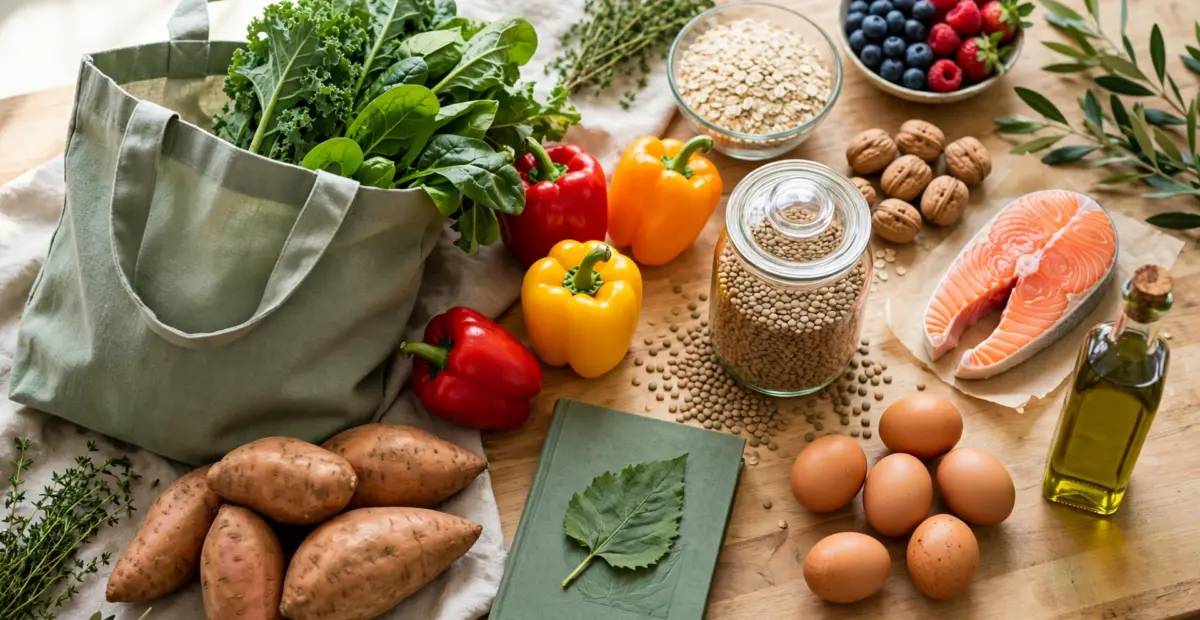
Most grocery lists are built the same way: a quick scan of the fridge, a few staples from memory, and whatever looks good in the aisle. The result is a cart that covers the week but doesn’t necessarily feed you well. A nutrient-dense grocery list flips that habit. Instead of starting with what’s missing, you start with what gives you the most nutrition for every bite — and you let that shape the whole list.
Nutrient density sounds like jargon, but the idea is simple: some foods pack a lot of vitamins, minerals, fiber, and protein into relatively few calories, while others deliver mostly calories and very little else. A bag of spinach and a bag of potato chips can sit side by side in your cart, but only one of them is doing much for your body. Building your list around the first kind of food is one of the easiest upgrades you can make to how you eat — no diet overhaul required, just better defaults.
What “nutrient-dense” actually means
Researchers have a formal way of scoring this. The Nutrient Rich Foods index, known as NRF9.3, rates foods by adding up nine nutrients to encourage — protein, fiber, vitamins A, C, and E, calcium, iron, potassium, and magnesium — and subtracting three to limit: saturated fat, added sugar, and sodium. Foods that score high deliver a lot of the good stuff per calorie; foods that score low deliver mostly calories. The index was developed by Adam Drewnowski and validated against healthy eating patterns, and it lines up with common sense: leafy greens, beans, berries, and fish sit near the top, while sugary drinks and fried snacks sit near the bottom.
You don’t need to memorize scores or calculate anything at the shelf. The NRF9.3 is useful because it confirms a simple shopping rule: favor foods that are close to their natural state, rich in color, and high in fiber or protein — and be skeptical of anything where sugar, salt, or saturated fat does most of the talking. The rest of this guide turns that rule into a list you can actually shop from.
Step 1: Fill half the cart with produce
Produce is the backbone of a nutrient-dense list, and it deserves the biggest share of your cart. The World Health Organization recommends at least 400 grams of fruits and vegetables a day for adults — roughly five portions — and notes that frozen and canned options count too, as long as they don’t come loaded with added sugar or excess sodium.
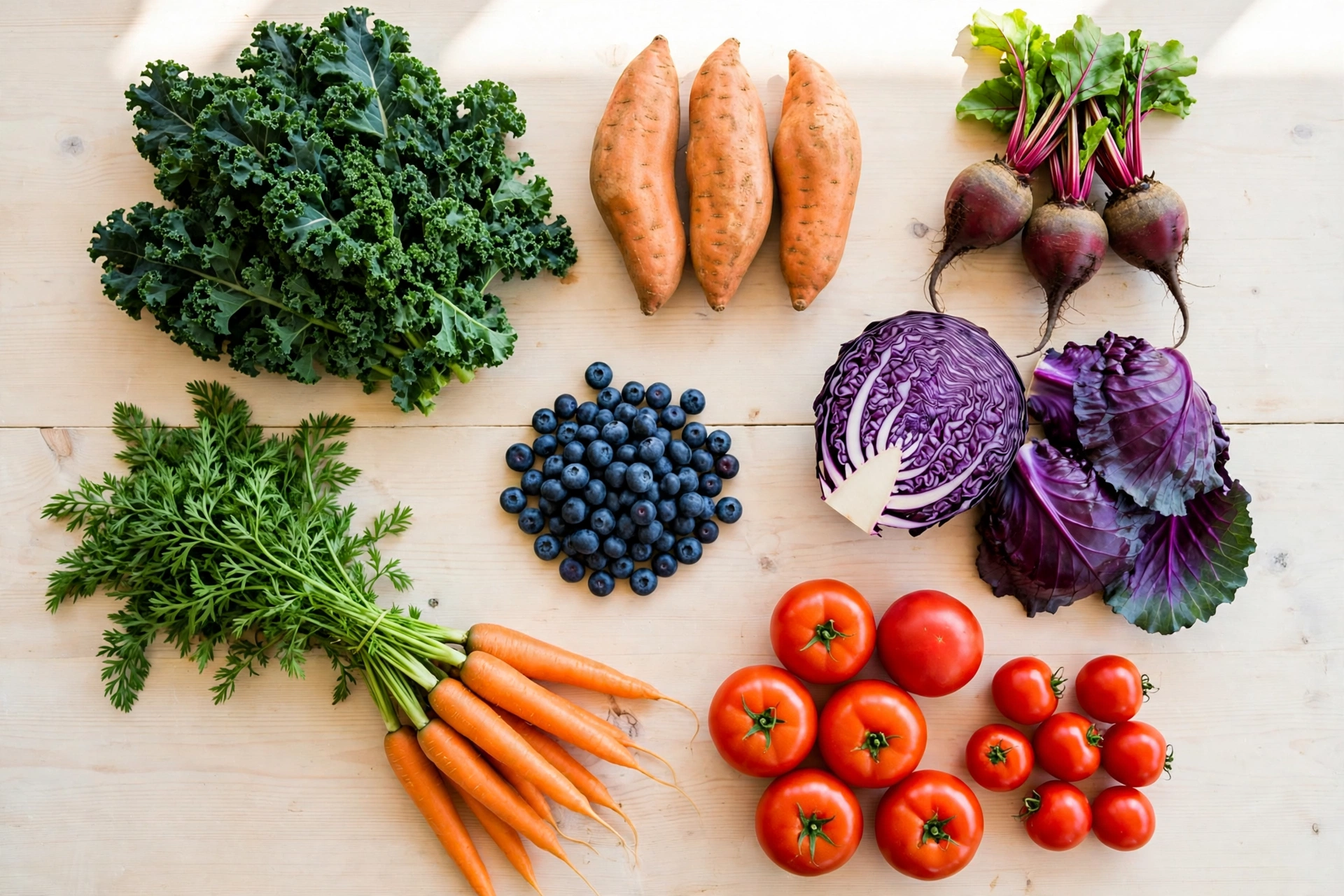
Variety matters more than any single “superfood.” Different colors signal different nutrients: dark leafy greens like spinach and kale bring folate, vitamin K, and calcium; orange vegetables like sweet potatoes and carrots are rich in beta-carotene, which your body converts to vitamin A — a single medium sweet potato can supply several times your daily vitamin A needs; red and purple produce like berries, beets, and red cabbage add anthocyanins and vitamin C. Aim for at least three colors in your cart each week, and rotate what you buy so the same nutrients don’t keep coming from the same two vegetables.
Don’t overlook the humble staples. Onions, garlic, cabbage, and carrots are cheap, keep well, and show up in almost every meal. And if fresh produce feels like a race against the crisper drawer, buy a mix: fresh for the next two or three days, frozen for the rest of the week. Frozen vegetables are picked and frozen within hours of harvest, and a University of California, Davis study found their vitamin C matched or beat fresh produce in all eight foods tested — so the freezer aisle is a nutrient-dense ally, not a compromise.
Read also: How to Create a Healthy Grocery List
Step 2: Pick proteins that pull their weight
Protein foods vary wildly in nutrient density. A cut of meat with a thick rim of fat and a tin of sardines both count as “protein,” but the sardines also deliver omega-3 fats, calcium, and vitamin D, while the fatty cut mostly delivers saturated fat. When you write your list, think of protein as a package deal: what else comes with it?
Beans and lentils are the best value on this measure. Cooked lentils give you about 9 grams of protein and nearly 8 grams of fiber per 100 grams, along with iron and folate, for very few calories and very little money. Canned beans are just as convenient — look for “no salt added” on the label, or give regular canned beans a quick rinse before cooking. Eggs are another strong pick: one large egg has about 6 grams of complete protein plus choline and B vitamins, and they keep for weeks in the fridge. Plain Greek yogurt adds protein and calcium with no added sugar, and canned fish like sardines or tuna is a shelf-stable way to get the oily fish the American Heart Association recommends eating at least twice a week.
Meat still has a place, but choose leaner cuts and let plants carry more of the load. A week built around beans, lentils, eggs, yogurt, and fish — with meat as a supporting player rather than the star of every dinner — is cheaper, higher in fiber, and higher in nutrient density than a meat-centered list.
Step 3: Choose whole grains with the label test
Grains are where the label does the deciding. Whole grains keep the bran, germ, and endosperm together, so they bring fiber, magnesium, and B vitamins that refined grains lose. The difference shows up fast: whole-wheat bread has about 6 grams of fiber per 100 grams, while white bread has about 2.4 grams. Oats are even stronger — dry rolled oats carry about 10.6 grams of fiber per 100 grams, including beta-glucan, the soluble fiber linked to healthier cholesterol levels.
When you shop, use the ingredient list as your test. The first ingredient should be a whole grain — “whole wheat,” “whole oats,” “brown rice” — not “enriched wheat flour” or “wheat flour.” The Whole Grains Council’s 100% Stamp means every grain in the product is whole grain, with at least 16 grams per serving, which is a handy shortcut when you’re in a hurry. Keep your grain list short and versatile: oats for breakfast, brown rice or quinoa for dinners, whole-wheat bread and pasta for everything in between. Three or four whole-grain staples cover nearly every meal, and they keep for months in the pantry.
Read also: How to Eat More Whole Foods
Step 4: Add healthy fats and flavor
Fat isn’t the enemy of a nutrient-dense list — the type of fat is what matters. Olive oil, nuts, seeds, and avocado deliver monounsaturated and polyunsaturated fats along with vitamin E and other nutrients, and a small amount goes a long way toward making plain vegetables taste like something you actually want to eat. A handful of walnuts or a spoonful of olive oil on a salad can turn a bowl of greens from a chore into a meal.
Buy nuts and seeds in small quantities and store them in the fridge or freezer if you won’t use them quickly, since their healthy fats can go stale. Choose natural peanut butter — the kind with peanuts and maybe salt on the ingredient list — over spreads padded with hydrogenated oils and added sugar. And treat butter, coconut oil, and other saturated fats as flavor accents rather than everyday cooking fats; the dietary guidelines cap saturated fat at under 10% of daily calories, and the American Heart Association suggests under 6% for heart health.
Step 5: Let frozen, canned, and dried foods do the heavy lifting
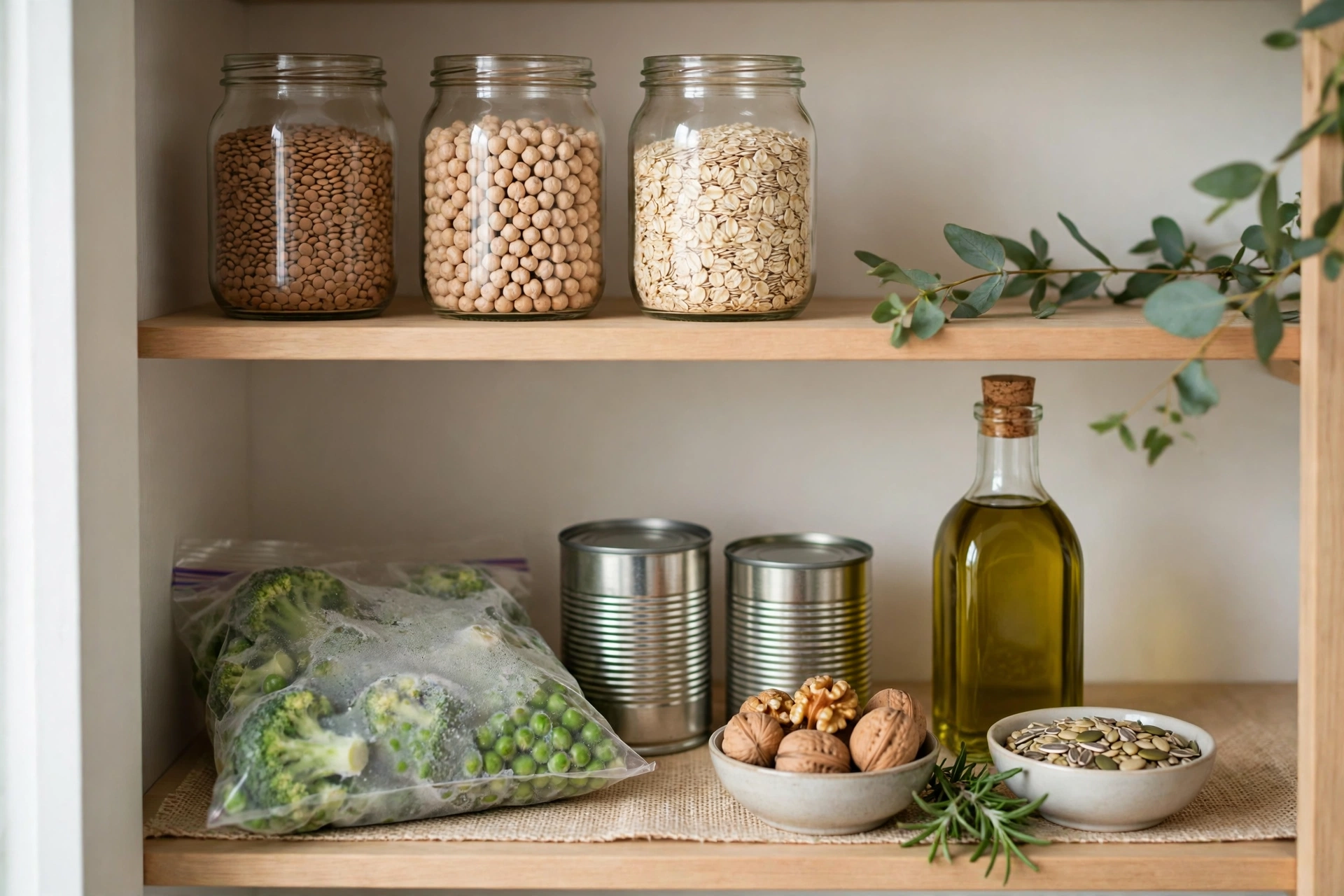
The most nutrient-dense list is the one you can actually afford and actually use before it spoils. That’s where the freezer and pantry aisles earn their keep. Frozen berries, peas, broccoli, and spinach are frozen at peak ripeness, so they hold onto their vitamins — and they cost less than out-of-season fresh produce while lasting months instead of days. The UC Davis comparison found no consistent nutrient disadvantage for frozen produce, and in several cases frozen samples had more vitamin C than fresh produce that had sat in a fridge for days.
Canned tomatoes, beans, and fish are pantry workhorses. Tomatoes are one of the few foods whose key nutrient, lycopene, becomes more available after cooking and canning. Dried lentils, beans, oats, and rice are the cheapest nutrient-dense foods in the store by almost any measure, and they wait patiently in the cupboard until you need them. The rule for all three aisles is the same: check the label for added sugar and sodium, and pick the plainest version you can find.
Step 6: Leave the low-density stuff off the list
A nutrient-dense list is as much about what you don’t buy as what you do. Sugary drinks are the biggest single source of added sugar in many diets — a 12-ounce cola carries about 39 grams of sugar, more than the American Heart Association’s daily limit for most women (25 grams) and close to the limit for most men (36 grams). The World Health Organization advises keeping free sugars under 10% of daily energy, ideally under 5%. If soda, sweet tea, or juice is on your list every week, it’s quietly crowding out foods that would feed you better.
Sodium is the other quiet passenger. The American Heart Association recommends no more than 2,300 mg of sodium a day, moving toward an ideal of 1,500 mg. Most of it doesn’t come from your salt shaker — it comes from processed foods, sauces, and ready meals. That doesn’t mean banning them, but it does mean reading the label before they go in the cart, and choosing the lower-sodium version when the difference is small and the taste is the same.
You don’t need to be strict about this. A list that is nutrient-dense most of the time leaves room for treats. The point is that the treats are a small, deliberate part of the list — not the default that fills the gaps between the good stuff.
Read also: How to Read Food Labels
A ready-made template for your list
If you want a starting point, here is a one-week template built on everything above. Adjust the quantities to your household, swap in what’s in season, and treat it as a skeleton, not a prescription.
Produce: spinach or kale, broccoli, carrots, sweet potatoes, onions, garlic, tomatoes, bananas, apples or pears, berries (fresh or frozen), lemons.
Protein: eggs, plain Greek yogurt, canned sardines or tuna, dried or canned lentils, canned black beans or chickpeas, tofu or tempeh if you eat it, one lean meat or poultry cut.
Whole grains: rolled oats, brown rice, quinoa, whole-wheat bread, whole-wheat pasta.
Healthy fats and flavor: olive oil, walnuts or almonds, ground flaxseed or chia seeds, natural peanut butter, avocado.
Pantry and freezer: frozen peas, frozen broccoli or spinach, canned tomatoes, low-sodium vegetable or chicken broth, herbs and spices, mustard, vinegar.
Shop this list for two or three weeks and it starts to feel automatic. You’ll notice the cart looks different — more color, fewer boxes, and a lot less of the stuff you used to buy on autopilot. That’s the whole idea: a nutrient-dense grocery list isn’t a diet. It’s a set of defaults that makes the healthy choice the easy one, every single week.
Frequently asked questions
Is a nutrient-dense grocery list more expensive?
Not necessarily. The most nutrient-dense foods per dollar are often the cheapest in the store: dried lentils and beans, oats, eggs, cabbage, carrots, bananas, and frozen vegetables. What costs more is buying nutrient-dense foods and then letting them spoil — so plan two or three meals around your fresh produce and lean on frozen and pantry staples for the rest of the week.
Do I need to count nutrients or calories while shopping?
No. The NRF9.3 scoring behind the idea is a research tool, not a shopping tool. In practice, the rule of thumb works: fill half the cart with produce, choose whole grains over refined ones, pick proteins that bring fiber or healthy fats along, and check labels for added sugar and sodium. If most of your cart passes those four tests, it’s nutrient-dense.
Are frozen and canned foods really as nutritious as fresh?
Often, yes — and sometimes more so. Frozen produce is processed within hours of harvest, and a UC Davis study found its vitamin C matched or exceeded fresh produce in all eight foods tested. Canned beans and tomatoes are also strong choices, especially no-salt-added versions. The foods to be careful with are canned items packed in syrup or heavy sauces, where added sugar and sodium do the damage.
How do I handle a family that won’t eat “healthy” foods?
Start with swaps, not speeches. Whole-wheat pasta in a familiar sauce, oats instead of a sugary cereal, berries stirred into yogurt, roasted sweet potatoes alongside the regular potatoes. A nutrient-dense list works best when it changes one or two things at a time — people notice the food, not the lecture, and the new defaults become normal within a few weeks.
Sources
- Drewnowski, A. “Defining nutrient density: development and validation of the nutrient rich foods index.” Journal of the American College of Nutrition, 2009. PubMed
- Drewnowski, A., & Fulgoni, V. L. “Nutrient density: principles and evaluation tools.” The American Journal of Clinical Nutrition, 2014. PubMed
- World Health Organization. “Healthy diet” fact sheet. WHO
- American Heart Association. “How Much Sugar Is Too Much?” AHA
- Bouzari, A., Holstege, D., & Barrett, D. M. “Vitamin retention in eight fruits and vegetables: a comparison of refrigerated and frozen storage.” Journal of Agricultural and Food Chemistry, 2015. PubMed
- U.S. Department of Agriculture, Agricultural Research Service. FoodData Central. USDA FoodData Central
Disclaimer: This article is for general information only and is not medical advice. If you have a health condition or specific dietary needs, talk with your doctor or a registered dietitian before making major changes to how you eat.