Healthy Wrap Ideas for Lunch
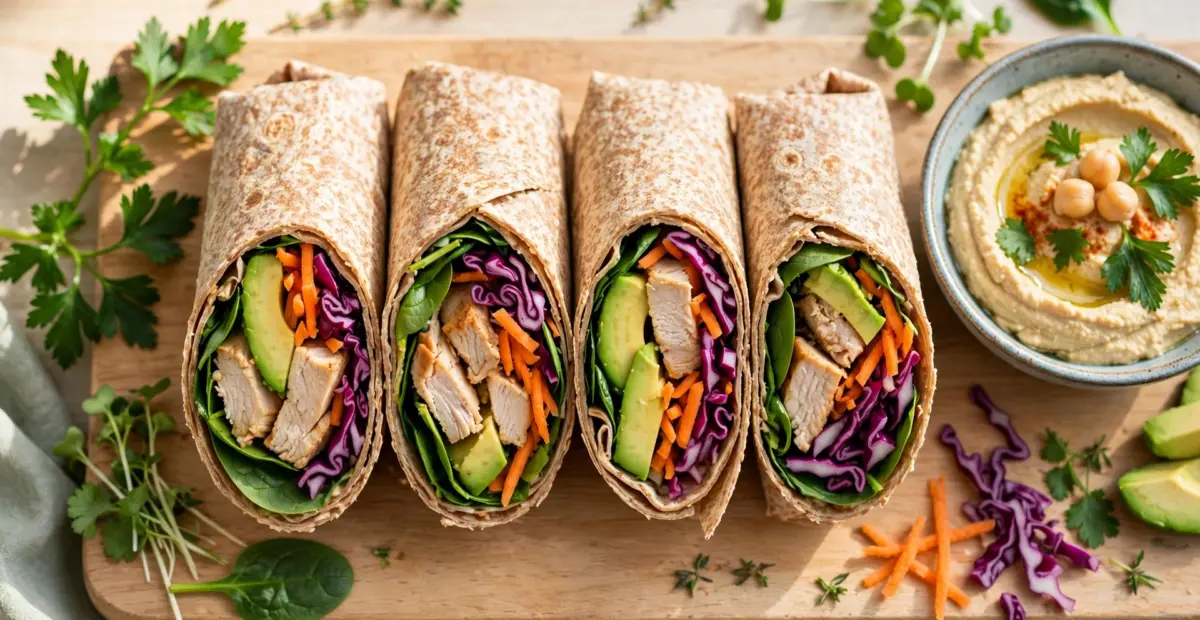
A good wrap is lunch’s best friend. It travels well, it eats with one hand, and it can hold an entire balanced meal — protein, vegetables, whole grains — in a package that fits in a lunchbox. The trouble starts when the wrap itself is mostly refined flour and salt, the filling is a thin smear of deli meat, and the sauce is a flood of mayonnaise. The fix is not complicated. Once you know what to look for in the wrap and how to build the filling, a wrap stops being a compromise and becomes one of the easiest healthy lunches you can make.
Most of us are not eating enough vegetables at lunch. The CDC’s analysis of 2019 survey data found that only about 1 in 10 American adults met the vegetable intake recommendations, and just 12.3% met the fruit recommendations. A wrap is a practical way to close that gap, because it turns vegetables from a side dish you have to remember into the main event.
Why wraps work so well for lunch
A wrap solves the three problems that usually sink packed lunches. First, it holds together: fillings that would slide off an open sandwich stay put. Second, it is portion-controlled by design — one wrap is one serving, so you are less likely to graze your way through a bag of extras. Third, it is endlessly repeatable without being boring, because the same wrap can carry a different filling every day of the week.
The format also makes it easy to hit the balance the current dietary guidelines describe. The Dietary Guidelines for Americans, 2025–2030 recommend about three servings of vegetables and two servings of fruit a day on a 2,000-calorie pattern, along with 1.2–1.6 grams of protein per kilogram of body weight. A wrap built on a whole-grain base, filled with a palm-sized portion of protein and a generous handful of vegetables, covers two of those boxes in a single item — and leaves room for a piece of fruit on the side.
Start with the wrap itself
The wrap you choose matters more than most people think, because it is the biggest single ingredient in the meal. A standard flour tortilla and a whole-wheat one look similar, but their nutrition is not. According to USDA FoodData Central, per 100 grams:
| Wrap (per 100 g) | Calories | Protein | Fiber | Sodium |
|---|---|---|---|---|
| Flour tortilla | 297 kcal | 8.0 g | 2.4 g | 742 mg |
| Whole-wheat tortilla | 310 kcal | 9.8 g | 9.8 g | 617 mg |
| Corn tortilla | 218 kcal | 5.7 g | 6.3 g | 45 mg |
The whole-wheat wrap carries roughly four times the fiber of a flour tortilla — about 9.8 grams per 100 grams, against 2.4. That matters, because the National Academies set the adequate intake for fiber at 25 grams a day for women and 38 grams for men, and most people fall well short. The corn tortilla is the quiet overachiever of the group: fewer calories, solid fiber, and almost no sodium at 45 milligrams per 100 grams, though its smaller size and firmer texture mean it works best for smaller, taco-style wraps rather than big rolled ones.
Sodium deserves a glance at the label, too. A single large flour tortilla can add more than 300 milligrams of sodium before you have added a single filling — over 13% of the 2,300-milligram daily value the FDA uses on Nutrition Facts labels. If the filling is also salty, the total climbs fast. When you compare brands, pick the wrap with “whole wheat” or “whole grain” as the first ingredient and the lowest sodium you can find.
Two more options worth knowing: large lettuce leaves or collard greens make a fine no-grain wrap for lighter days, and a whole-grain pita or flatbread can do the same job with a different texture. The principle stays the same — the wrapper should add fiber, not just calories.
The formula: protein, produce, spread
Every wrap below follows the same simple formula. Start with a protein, add at least two vegetables, and finish with a spread that adds flavor and moisture. That is the whole system — once you have it, you can build a new wrap from whatever is in the fridge.
For protein, aim for a portion about the size of your palm. Cooked chicken breast, canned tuna, hard-boiled eggs, black beans, lentils, tofu and tempeh all work. A cup of black beans brings about 15 grams of protein, lentils about 18, and a 170-gram tub of plain nonfat Greek yogurt — useful as a spread or a filling in its own right — packs around 17 grams of protein for roughly 100 calories. If you use deli meat, keep it occasional rather than daily: the International Agency for Research on Cancer classifies processed meat as carcinogenic to humans, and its working group found that each 50-gram daily portion was linked to an 18% higher risk of colorectal cancer. Freshly cooked meat, beans or eggs are the better everyday choice.
For produce, think color and crunch. Spinach, shredded carrots, sliced cucumber, bell pepper strips, red cabbage and tomatoes all hold up well in a wrap, and each one adds a different vitamin or mineral. Two generous handfuls of vegetables inside the wrap, plus a piece of fruit on the side, can cover most of your produce for the meal.
For the spread, the rule is simple: the spread should contribute something — protein, fiber, healthy fats — rather than just calories. Hummus is the classic example: two tablespoons (about 30 grams) of commercial hummus provide roughly 71 calories, 2.3 grams of protein and 1.7 grams of fiber, according to USDA data. Mashed avocado, plain Greek yogurt with herbs, mustard, and salsa all play the same role. Mayonnaise is not banned, but a thin smear goes further than a thick one.
Read also: How to Add More Vegetables to Your Meals
10 healthy wrap ideas for lunch
Each idea below fills one large wrap and takes under 10 minutes once the ingredients are ready. Amounts are a guide — scale the vegetables up freely.
1. Hummus and roasted vegetables
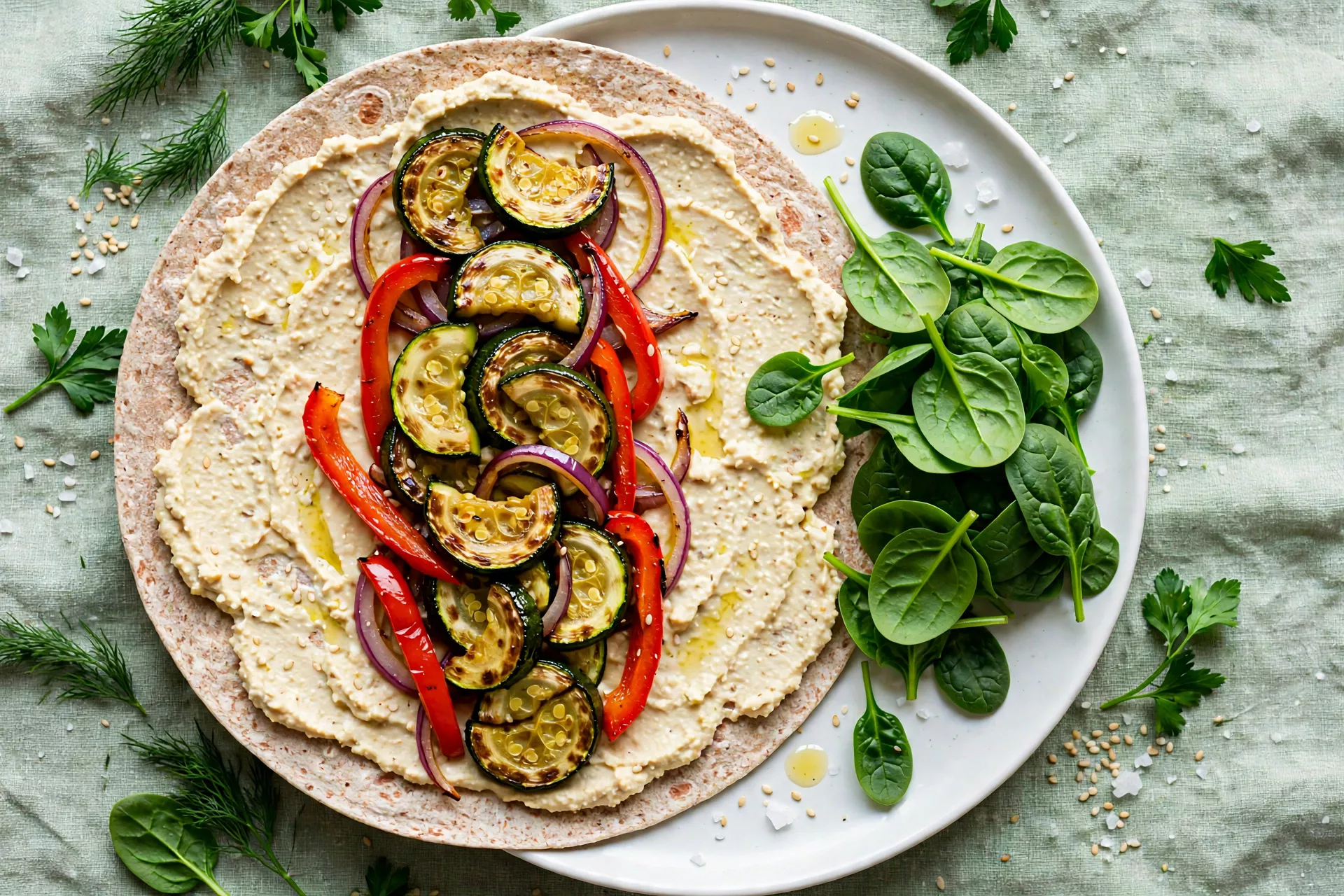
Spread 3–4 tablespoons of hummus over a whole-wheat wrap, then layer roasted zucchini, bell pepper and red onion. The hummus brings protein and fiber, the roasted vegetables bring sweetness and bulk. Add a handful of spinach for crunch.
2. Chicken, avocado and spinach
Sliced leftover roast chicken, a quarter of a mashed avocado, a big handful of baby spinach and a squeeze of lemon. This is the wrap to make the day after a roast chicken dinner — the chicken is already cooked, and the avocado replaces any need for mayonnaise.
3. Black bean and corn
Mashed black beans with cumin and lime, sweetcorn, diced tomato and shredded red cabbage. A cup of black beans gives you about 15 grams of protein and a serious dose of fiber, and the lime keeps the flavors bright. A spoonful of salsa adds moisture without much salt.
4. Tuna salad with Greek yogurt
Mix a small can of tuna with two tablespoons of plain Greek yogurt instead of mayonnaise, plus diced celery and a pinch of black pepper. The yogurt keeps the protein high and the fat low, and the celery adds the crunch tuna salad usually gets from pickles.
5. Egg, spinach and feta
Two sliced hard-boiled eggs, a handful of spinach, crumbled feta and a few slices of tomato. This one works cold straight from the fridge, which makes it a good Monday-morning wrap if the eggs were boiled on Sunday.
6. Turkey, apple and cheddar
Slices of leftover roast turkey, thin apple slices, a little grated cheddar and a smear of mustard. The apple sounds unusual in a wrap until you try it — the sweetness and crunch balance the savory turkey, and mustard ties it together better than mayonnaise does.
7. Tofu and peanut crunch
Cubes of baked or pan-fried tofu, shredded carrot, cucumber sticks and a spoonful of peanut sauce thinned with a little water. This is the most filling plant-based option on the list, and the peanut sauce makes it taste like takeout.
8. Salmon and cucumber with yogurt-dill
Flaked leftover salmon or canned salmon, cucumber ribbons, and a spread of Greek yogurt mixed with dill and lemon zest. Salmon brings omega-3 fats to the table, and the cool yogurt sauce suits it better than anything creamy and heavy.
9. Chickpea smash
Roughly mash a cup of chickpeas with a fork, then stir in diced red onion, lemon juice and a pinch of smoked paprika. Spread it thickly and top with shredded carrot and lettuce. It takes five minutes, costs very little, and keeps well for two days in the fridge.
10. White bean caprese
Cannellini beans, sliced tomato, torn basil and a little mozzarella, finished with a drizzle of olive oil and a pinch of salt. It is the caprese salad you already like, made portable — and the beans turn a light salad into a lunch that actually fills you up.
Read also: How to Create a Healthy Grocery List
Spreads that do the heavy lifting
The spread is where a wrap either stays light or quietly becomes heavy, so it deserves more attention than it usually gets. Hummus, mashed avocado and plain Greek yogurt all add protein, fiber or healthy fats alongside their flavor. Salsa and mustard add almost no calories at all. A spoonful of pesto or a smear of cream cheese is fine in a small amount — the problem is only when the spread becomes the main ingredient.
A useful test: if you can see the spread oozing out of the edges, there is too much of it. Two to three tablespoons is plenty for one large wrap. Spread it edge to edge rather than piling it in the middle, so every bite is moist and the wrap seals properly.
How to roll a wrap that holds together
A wrap that falls apart on the first bite is a lunch that ends up eaten with a fork over the sink. Warm the tortilla first — 15 seconds in a dry pan or 10 seconds in the microwave — so it bends instead of cracking. Lay the filling in a band across the lower third, leaving a couple of centimeters clear on the sides. Fold the sides in first, then roll away from you, tucking the filling in as you go, and keep the roll snug. If you are packing it for later, wrap it tightly in parchment or foil and cut it in half just before eating; a cut wrap dries out faster than a whole one.
Wet ingredients are the usual cause of a soggy wrap. Pat tomatoes and cucumber dry, keep juicy fillings in the center rather than against the tortilla, and put a leaf of lettuce or spinach between the spread and the filling as a moisture barrier. If you are making wraps the night before, choose sturdier fillings — beans, roasted vegetables, cooked chicken — and save anything with a lot of dressing for the morning.
Packing wraps for work or school
Wraps are built for packing, but a few food-safety basics keep them good until lunchtime. Keep the finished wrap in the fridge overnight and carry it in an insulated bag with an ice pack if it will sit at room temperature for more than a couple of hours. Perishable foods should be kept refrigerated at 40°F (4°C) or below, and the USDA advises eating refrigerated leftovers within 3 to 4 days — so a wrap made on Sunday is fine for Monday and Tuesday, but not for Friday.
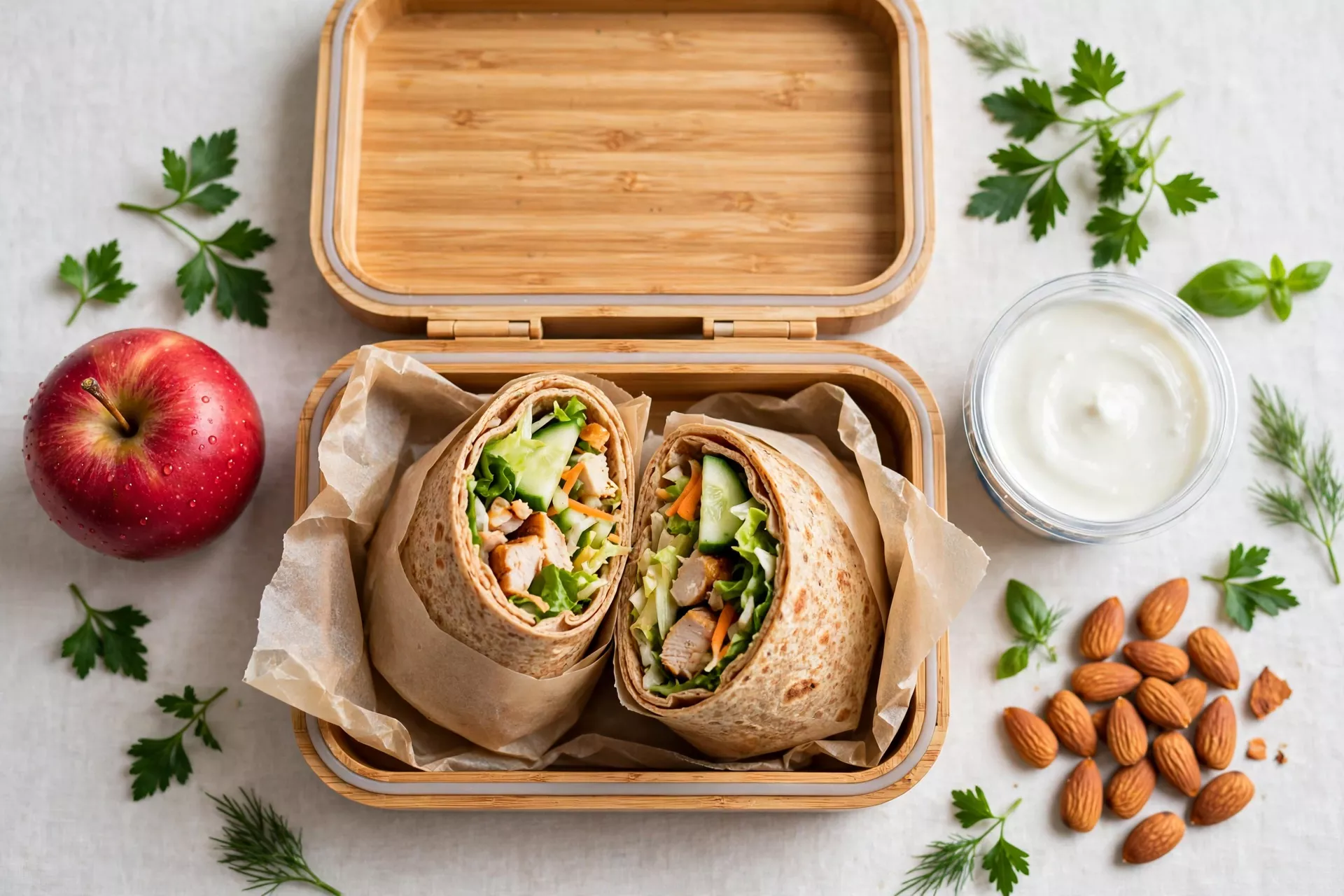
Pack the wrap whole and slice it at lunchtime, and keep any extra sauce or dressing in a small separate container so nothing goes soggy. A piece of fruit, a small tub of yogurt or a handful of nuts on the side rounds out the meal without any extra cooking.
Read also: Weekly Meal Planning for Balanced Meals
Frequently asked questions
Are wraps healthier than sandwiches?
Not automatically. A wrap made with a large refined-flour tortilla can carry more calories and sodium than two slices of whole-grain bread. What makes a wrap healthy is the same thing that makes a sandwich healthy: a whole-grain base, a lean protein, plenty of vegetables and a light spread.
How many calories are in a healthy wrap?
It depends on the filling, but a wrap built on a whole-wheat tortilla with chicken or beans, vegetables and hummus usually lands around 350–500 calories. The tortilla alone contributes roughly 130–150 calories for a standard large one, so the filling — not the wrapper — is where most of the calories come from.
Can I make wraps the night before?
Yes, if you choose the right fillings. Bean, lentil, roasted-vegetable and cooked-chicken wraps hold up well overnight in the fridge. Skip very wet fillings or add them in the morning, and keep the wrap whole until you eat it.
What is the best wrap for weight management?
The one that keeps you full. In practice that usually means a whole-wheat or corn tortilla — the extra fiber helps — filled with a solid protein and plenty of vegetables, with a spread like hummus or Greek yogurt rather than a thick layer of mayonnaise. The fiber and protein are what carry you to dinner without a snack run.
This article is for general information only and is not medical advice. If you have a medical condition or specific dietary needs, talk to your clinician or a registered dietitian before changing how you eat.
Sources
- USDA FoodData Central — tortilla, hummus, black bean, lentil and Greek yogurt nutrition values
- U.S. Department of Agriculture and U.S. Department of Health and Human Services, Dietary Guidelines for Americans, 2025–2030 — vegetable, fruit and protein serving goals
- Academy of Nutrition and Dietetics, Position of the Academy of Nutrition and Dietetics: Health Implications of Dietary Fiber (Journal of the Academy of Nutrition and Dietetics, 2015) — fiber adequate intake, 25 g/day for women and 38 g/day for men
- Wallace, T. C. et al., The Benefits of Including Hummus and Hummus Ingredients into the American Diet (Nutrients, 2020) — hummus nutrient profile
- Mechanistic evidence for red meat and processed meat intake and cancer risk: A follow-up on the IARC Evaluation of 2015 (Chimia, 2018) — processed meat classified Group 1; 18% higher colorectal cancer risk per 50 g daily portion
- Lee, S. H. et al., Adults Meeting Fruit and Vegetable Intake Recommendations — United States, 2019 (MMWR, 2022) — 12.3% of adults met fruit recommendations, 10.0% met vegetable recommendations
- U.S. Food and Drug Administration, Sodium in Your Diet — sodium Daily Value, less than 2,300 mg per day