Smoothies vs. Juice: How They Differ
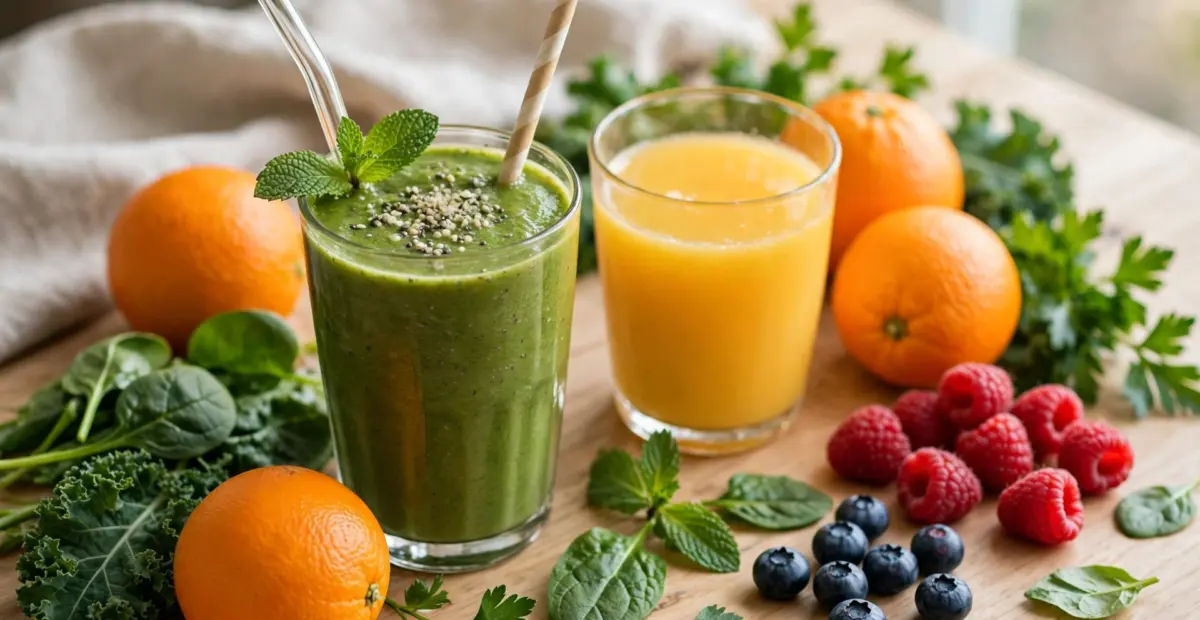
Walk into any café and you will see both on the menu: a thick green smoothie in a tall glass and a bright orange juice beside it. They look like cousins, and both start with real fruit. But once you understand what the blender and the juicer each do to that fruit, the two drinks stop looking alike at all.
The short version: a smoothie keeps almost everything the fruit had. Juice keeps the liquid and leaves the rest behind. That one difference — fiber — changes how full you feel, how fast the sugar hits your blood, and how much fruit you end up drinking without noticing.
This is not a story with a villain. Juice has real uses, and smoothies can go wrong too. What follows is the honest comparison: the numbers, what the research says, and how to build each drink so it works for you rather than against you.
The One Difference That Matters: Fiber
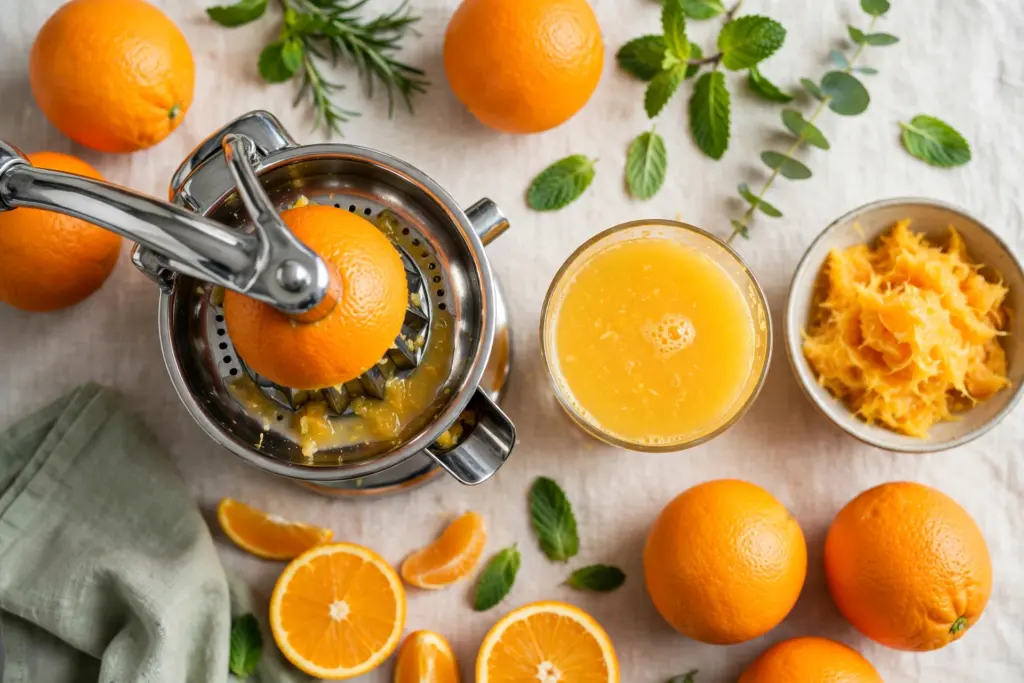
A juicer squeezes the liquid out of produce and throws away the pulp, skin, and membranes. A blender does the opposite — it chops the whole fruit or vegetable into tiny pieces, skin and pulp included, and leaves everything in the glass.
That matters because fiber is where most of the fruit’s staying power lives. Fiber slows digestion, steadies the rise in blood sugar after you eat, and feeds the gut bacteria that dietitians keep talking about. It is also the part that tells your stomach you have actually eaten something.
Strip the fiber out and you get a drink that delivers the fruit’s sugar and much of its vitamin C and potassium, but almost none of its fullness. You can finish a glass of juice in under a minute — the sugar of three oranges gone before your brain has registered that you ate anything at all.
Read also: Benefits of Eating Many Kinds of Fruit
What the Numbers Actually Look Like
Oranges make the clearest example, because the U.S. Department of Agriculture lists both forms in its FoodData Central database. One medium orange (about 131 grams) gives you roughly 62 calories, 12 grams of natural sugar, and 3.1 grams of fiber. One cup of raw orange juice — 8 fluid ounces — gives you about 112 calories, 21 grams of sugar, and just 0.5 grams of fiber.
Read that again: the cup of juice carries nearly twice the sugar of a single orange and about one-sixth of the fiber. The reason is simple — it takes about three oranges to fill that cup, and you would rarely sit down and eat three oranges in one sitting. Juice makes it easy to drink the sugar of three pieces of fruit in the time it takes to eat one.
Smoothies sit on the other side of that trade. Because a smoothie is made from whole blended fruit, its fiber survives. A fruit-and-vegetable smoothie built on whole produce can carry 8 to 10 grams of fiber per glass — a real chunk of the daily target, which the National Academies set at 25 grams for women and 38 grams for men. The catch is that smoothies are also bigger: that same glass can run to 300 or 360 calories, closer to a small meal than a drink. The calories come with fiber, volume, and often protein if yogurt or milk is in the mix — but they are still calories, and they add up if the smoothie is treated as a thirst-quencher rather than a meal.
Blood Sugar and Fullness
Speed is where the difference shows up in your body. In a classic 1977 experiment, researchers fed people apples in three forms: whole, juiced, and stewed. People drank the juice eleven times faster than they ate the whole apples, felt far less full afterward, and showed a sharper insulin response. The fruit was identical — only the form changed.
More recent work points the same way. When the same fruit is served as a chunky fruit salad, people feel fuller than when the identical fruit is blended into a smoothie, probably because chewing itself switches on fullness signals and intact fruit cells slow everything down. Blending still beats juicing on fullness, because the fiber survives — but whole fruit beats both.
None of this makes juice “bad.” It makes juice fast. A fast sugar hit with little fiber is exactly what you do not want on an empty stomach, and it is exactly what can help when you need quick energy or when chewing is difficult. Context is doing most of the work here.
What the Research Says About Juice and Diabetes Risk
The longest-running evidence comes from three large Harvard cohort studies that followed nearly 190,000 health professionals for decades. Published in the BMJ in 2013, the analysis found that eating more whole fruit — especially blueberries, grapes, and apples — was linked with a lower risk of type 2 diabetes, while drinking more fruit juice was linked with a higher risk. Each additional three servings of fruit juice per week was associated with an 8 percent higher risk; swapping those three servings of juice for whole fruit was associated with a 7 percent lower risk.
That is an association, not proof that juice causes diabetes — people who drink a lot of juice may differ in other ways too. But the pattern has held up in later reviews, and the likely mechanism is not mysterious: juice delivers concentrated sugar with almost no fiber, and fiber is what slows sugar’s path into the blood.
People living with diabetes or prediabetes should take this seriously. A glass of juice can raise blood sugar quickly, and the usual portion guidance — one small glass, with a meal, not on its own — exists for exactly that reason. If you manage blood sugar, talk with your clinician about where juice and smoothies fit in your own plan.
What the Guidelines Say
The current U.S. dietary guidelines, the Dietary Guidelines for Americans, 2025–2030, recommend about two servings of fruit a day for adults eating around 2,000 calories. The guidance is explicit about form: favor whole fruit, and limit 100% fruit or vegetable juice — or dilute it with water.
Britain’s NHS takes a similar line and adds a practical cap: juice and smoothies together count as no more than one portion of your 5 A Day, and that portion is 150 ml — about five ounces, a small glass. However much you drink, and however many fruits went into it, it still counts once.
For children the limits are tighter. The American Academy of Pediatrics recommends no juice at all before age one, no more than 4 ounces a day for ages 1 to 3, 4 to 6 ounces for ages 4 to 6, and no more than 8 ounces for ages 7 to 18. Whole fruit is the default; juice is the exception.
When Juice Actually Makes Sense
Juice earns its place in a few specific situations. If you struggle to eat enough fruits and vegetables — after dental work, during an illness, or with a small appetite — a small glass of 100% juice delivers concentrated vitamins and minerals in a form that is easy to swallow. Vegetable-heavy juices, where the sugar load is lower, can also be a useful way to get more produce into the day.
Juice is also the better choice when calories matter more than fullness. A cup of orange juice is about 112 calories; a smoothie built as a meal can be three times that. If you want something light and refreshing alongside breakfast, juice fits. If you want something that keeps you full until lunch, the smoothie is the one doing that job.
How to Build a Better Smoothie
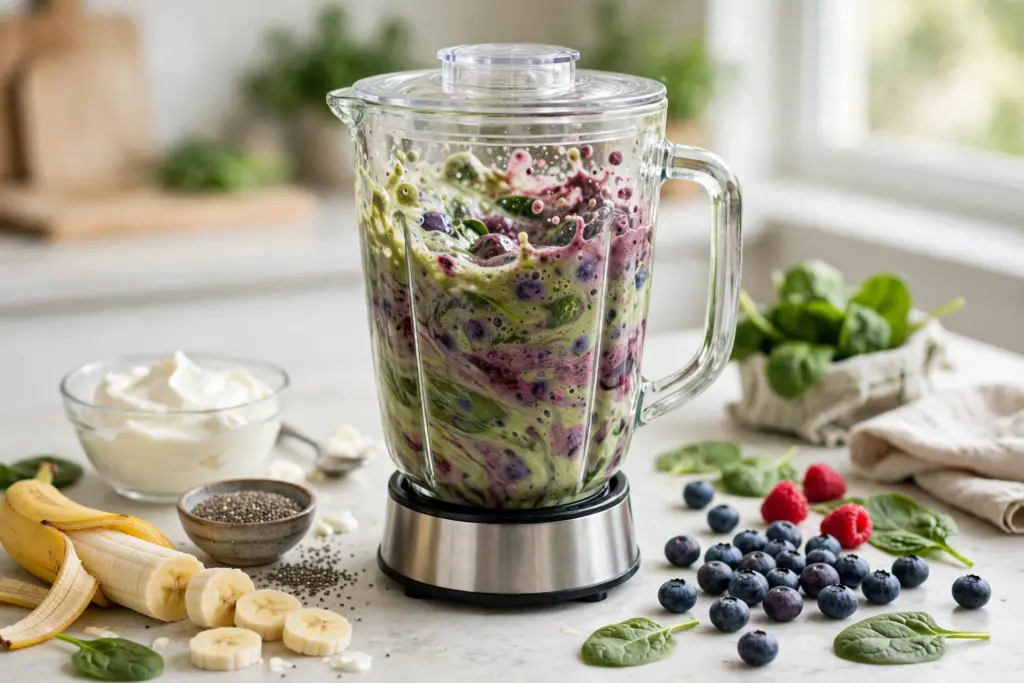
A smoothie is only as good as what goes into the blender. The best ones follow a simple pattern: mostly vegetables and whole fruit, a protein source, and a little healthy fat.
Start with a base of leafy greens or frozen berries — both add fiber and color without much sugar. Add half a banana or a handful of mango for sweetness, then a protein anchor: Greek yogurt, milk, or a scoop of nut butter. A spoonful of chia or flax seeds adds fiber and healthy fats and thickens the drink nicely. Water or unsweetened milk works better than juice as the liquid — using juice as the base quietly doubles the sugar before you have added anything else.
Watch the portion, too. A 12-ounce glass is a meal; a 20-ounce café smoothie with banana, mango, honey, and juice can carry the sugar of five or six pieces of fruit. If you would not eat that much fruit in one sitting, do not drink it either.
Read also: Balanced Breakfast Smoothie Ideas
How to Drink Juice the Smarter Way
If you enjoy juice, keep it small and keep it honest. A small glass — around 150 ml — with a meal, not as a standalone snack, is the pattern every major guideline lands on. Choose 100% juice with no added sugar, and check the label: “juice drink,” “cocktail,” and “nectar” usually mean added sugar and water, not more fruit.
Mixing helps. Half juice and half sparkling water gives you the flavor you want with half the sugar per glass, and the fizz makes a small pour feel like more. Drinking juice with food rather than on an empty stomach also softens the blood sugar rise, because the rest of the meal slows digestion down.
Read also: Water vs. Sparkling Water: Key Differences
The Bottom Line
Smoothies and juice start from the same fruit and end up in different places. A smoothie keeps the fiber, so it fills you up, steadies your blood sugar, and can stand in for a meal. Juice drops the fiber, so it is lighter and faster — a concentrated source of vitamins that is easy to overdo.
Neither one replaces whole fruit, which still beats both on fullness and on the long-term evidence. But if the choice is between the two glasses on the café menu, the smoothie is usually the better bet — as long as it is built on whole fruit and vegetables, not on juice and sweeteners. And if you choose juice, keep the glass small, drink it with food, and let the rest of your fruit come from fruit you can chew.
Frequently Asked Questions
Is a smoothie healthier than juice?
Usually, yes — mainly because smoothies keep the fiber that juicing removes. Fiber slows sugar absorption and helps you feel full. But a smoothie loaded with juice, honey, and sweetened yogurt can carry more sugar than a small glass of plain juice, so the ingredients matter more than the category.
Does juicing destroy vitamins?
Not most of them. Vitamin C, potassium, and folate largely survive juicing — a cup of orange juice still provides more than a day’s worth of vitamin C. What juicing removes is fiber and some of the nutrients that live in the skin and pulp, and it concentrates the sugar.
Can juice count toward my daily fruit intake?
Partly. The U.S. guidelines count 100% juice toward fruit intake but advise limiting it and favoring whole fruit. The NHS counts juice and smoothies as at most one portion of 5 A Day, capped at 150 ml a day. One small glass is the sensible ceiling.
Are smoothies good for weight management?
They can be, if they replace a meal rather than add to one. A smoothie built on vegetables, whole fruit, and protein is filling and can keep you satisfied for hours. But a large, sweet smoothie can run to 400 calories or more, so treat it as food — because it is.
This article is for general information only and is not medical advice. If you have diabetes, prediabetes, or another condition affected by blood sugar, talk with your clinician or a registered dietitian about how juice and smoothies fit into your eating plan.
Sources
- U.S. Department of Agriculture, FoodData Central — Oranges, raw, navel; Orange juice, raw. https://fdc.nal.usda.gov/
- U.S. Department of Agriculture and U.S. Department of Health and Human Services — Dietary Guidelines for Americans, 2025–2030. https://www.dietaryguidelines.gov/
- Muraki I, Imamura F, Manson JE, Hu FB, Willett WC. Fruit consumption and risk of type 2 diabetes: results from three prospective longitudinal cohort studies. BMJ 2013;347:f5001. https://pmc.ncbi.nlm.nih.gov/articles/PMC3978819/
- Harvard T.H. Chan School of Public Health — Eating whole fruits, particularly blueberries, grapes, apples, linked to lower risk of type 2 diabetes. https://news.harvard.edu/gazette/story/2013/08/reduce-type-2-Diabetes-risk/
- National Health Service (UK) — 5 A Day: what counts? https://www.nhs.uk/healthier-families/food-facts/5-a-day/
- Heyman MB, Abrams SA; American Academy of Pediatrics. Fruit Juice in Infants, Children, and Adolescents: Current Recommendations. Pediatrics 2017;139(6):e20170967. https://www.healthychildren.org/English/news/Pages/AAP-Recommends-No-Fruit-Juice-For-Children-Under-1-Year.aspx
- Health.com — Juicing vs. Blending: Which Is Better for You? https://www.health.com/juicing-vs-blending-which-is-healthier-12037712
- Banner Health — How to Make Sure Smoothies and Juices Are Healthy. https://www.bannerhealth.com/healthcareblog/teach-me/smoothies-and-juices-smooth-operators-or-the-real-deal