Healthy Overnight Oats Combinations
Overnight oats are the rare breakfast that asks almost nothing of you in the morning. You stir a jar the night before, slide it into the fridge, and wake up to something creamy, cold, and ready to eat. No stove, no blender, no 6 a.m. decision-making. If your mornings tend to run on autopilot, that alone is worth a lot.
But a jar of oats is only as good as what goes into it. The base is genuinely nutritious — rolled oats bring fiber, including a soluble fiber called beta-glucan, with a modest amount of protein and minerals. What you layer on top decides whether the jar keeps you full until lunch or leaves you hunting for a snack by 10 a.m. This guide covers the base ratio that actually works, eight combinations worth rotating through, and the small mistakes that turn a good idea into a sugar bomb.
The base ratio that works every time
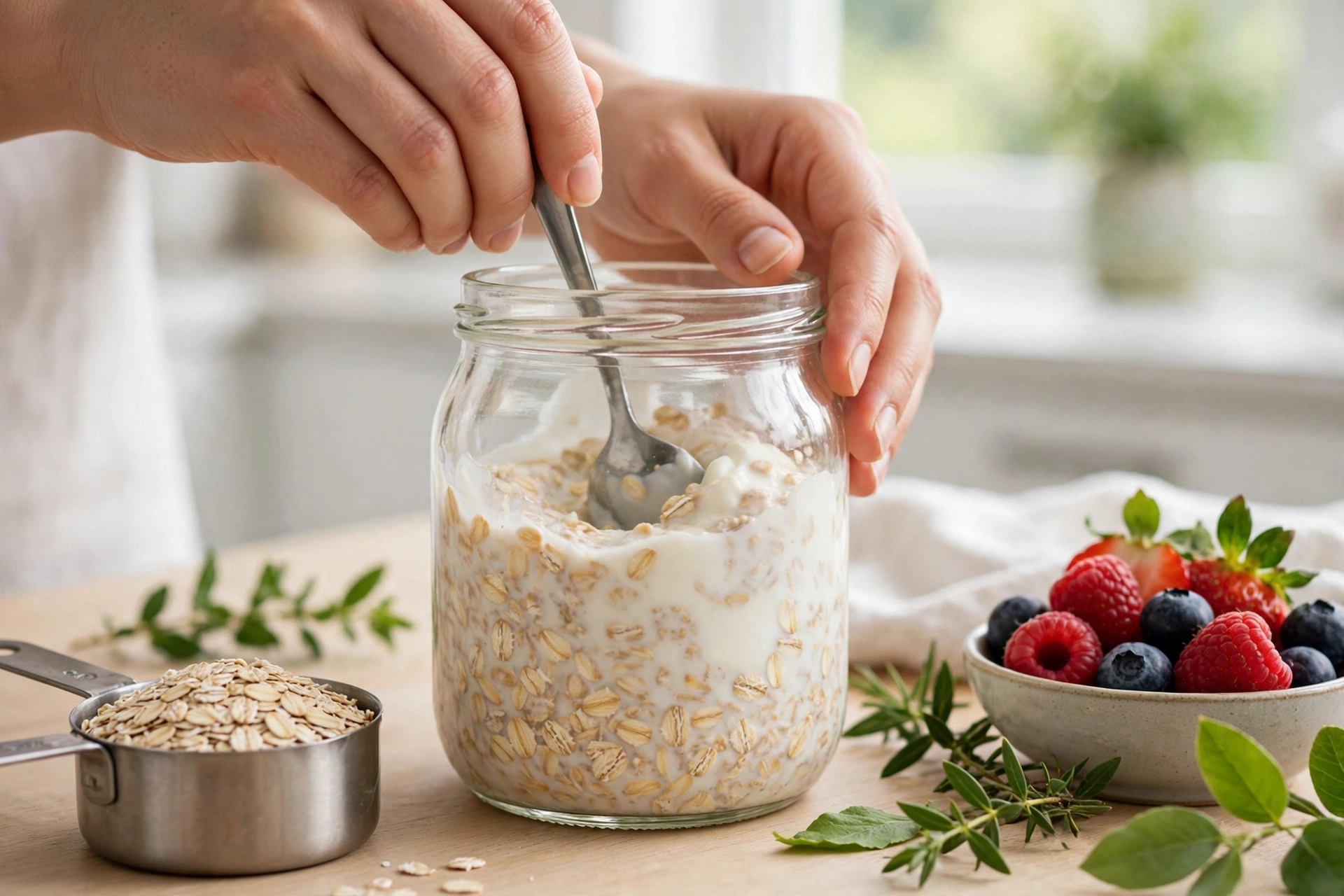
Start with the simplest formula: equal parts oats and liquid, plus a spoonful of something that adds protein. A reliable jar is 1/2 cup (40 g) of rolled oats, 1/2 cup of milk or a fortified plant milk, and 1/4 cup of Greek yogurt. Stir, cover, and refrigerate for at least 4 hours — overnight is better.
That half-cup of dry oats gives you about 150 calories, 4 grams of fiber, and 5 grams of protein, according to USDA FoodData Central. The yogurt adds roughly another 5 to 6 grams of protein per quarter cup, which is what turns oats from a carb-heavy snack into a breakfast that holds you. If you skip the yogurt, add a tablespoon of nut butter or a scoop of protein powder instead — something has to carry the protein, or the jar will not keep you full for long.
Use rolled oats, not instant and not steel-cut. Instant oats go mushy and gluey after a night in liquid. Steel-cut oats stay too firm — they need heat to soften properly, and an overnight soak will not do the job. Rolled oats hit the sweet spot: they soften into something creamy while keeping a little chew.
One more thing the ratio controls: sweetness. The oats and milk are nearly sugar-free on their own. Most of the sugar in overnight oats comes from what you stir in — honey, maple syrup, sweetened yogurt, flavored milk, or dried fruit. Keep added sweeteners to a teaspoon or less, and let the fruit do the sweetening. The American Heart Association suggests keeping added sugars to about 25 grams a day for women and 36 grams for men, and a single tablespoon of honey already uses up 17 grams of that budget.
Read also: How to Build a Better Breakfast
Why oats are worth the hype — with limits
Oats are one of the few foods with an official heart-health claim behind them. The U.S. Food and Drug Administration allows oat products to carry a claim linking soluble fiber from oats to a lower risk of heart disease, based on a daily target of at least 3 grams of oat beta-glucan as part of a diet low in saturated fat and cholesterol (21 CFR 101.81).
The evidence behind that claim is real but modest. A 2014 meta-analysis of 28 randomized controlled trials found that at least 3 grams of oat beta-glucan a day lowered LDL (“bad”) cholesterol by about 0.25 mmol/L — roughly 10 mg/dL, or around 7% — compared with control diets. That is a meaningful contribution, not a cure: it works alongside an overall healthy eating pattern, and it does not replace prescribed cholesterol treatment.
Reaching 3 grams of beta-glucan takes roughly 60 to 70 grams of dry rolled oats — about a generous half-cup, or one and a half standard servings. Your single overnight-oats jar gets you partway there; the rest can come from another oat serving later in the day. There is no need to chase the number precisely. The point is that oats earn their reputation, and a daily jar is a practical way to make them a habit.
Eight combinations that actually taste good
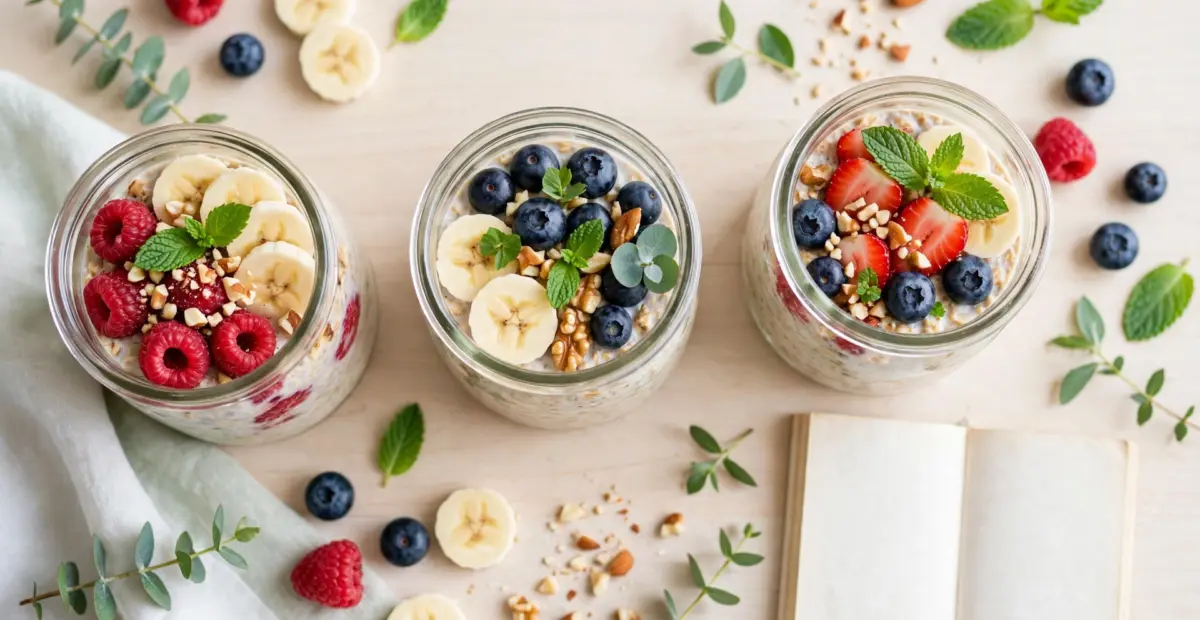
Each combination below starts from the same base — 1/2 cup rolled oats, 1/2 cup milk, 1/4 cup Greek yogurt — then adds its own toppings. Make two or three jars at once and you have breakfast sorted for half the week.
1. Berry and almond
Stir in 1/2 cup of mixed berries and a tablespoon of sliced almonds. Raspberries alone bring about 8 grams of fiber per cup, and the almonds add crunch and a little healthy fat. This is the combination to reach for when you want something light and fresh.
2. Banana and peanut butter
Half a sliced banana and a tablespoon of peanut butter, plus a pinch of cinnamon. The banana sweetens the jar without added sugar, and the peanut butter adds staying power. Keep the peanut butter to one tablespoon — it is nutrient-dense, but two tablespoons nearly doubles the calories.
3. Apple, cinnamon, and walnuts
Half a diced apple, a generous pinch of cinnamon, and a tablespoon of chopped walnuts. It tastes like apple pie filling and keeps well, since apple holds up better than berries after a night in the fridge. A good choice for jars you plan to eat on day three or four.
4. Chocolate and cherry
A tablespoon of cocoa powder stirred into the base, plus 1/2 cup of pitted cherries (fresh or frozen, thawed). The cocoa makes the jar taste like dessert while adding almost no sugar, and cherries bring natural sweetness. Skip the chocolate chips — they add sugar without adding nutrition.
5. Mango and coconut
Half a cup of diced mango and a tablespoon of unsweetened shredded coconut. Use light coconut milk as part of the liquid if you want a stronger tropical flavor, but keep the coconut flakes modest: they are high in saturated fat, so a tablespoon is plenty.
6. Chia and peach
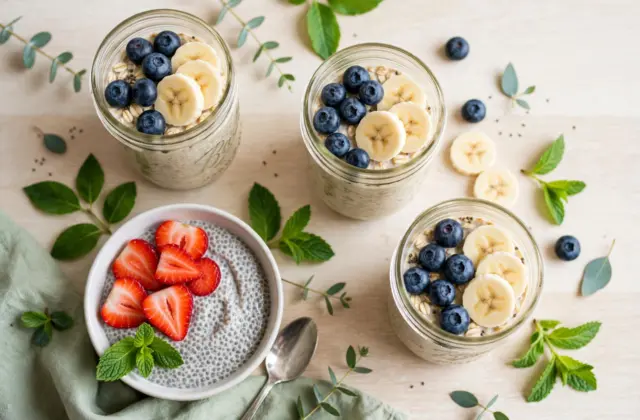
A tablespoon of chia seeds stirred into the base, topped with half a diced peach. Chia seeds are remarkably fiber-dense — about 10 grams of fiber and 5 grams of plant omega-3 (ALA) per ounce (28 grams), according to USDA data. They also thicken the jar, so add a splash more milk if it gets too firm.
7. Pumpkin spice
Three tablespoons of pumpkin purée, a pinch of cinnamon and nutmeg, and a tablespoon of pumpkin seeds. Pumpkin purée adds fiber and vitamin A with very few calories, and the seeds add crunch and minerals. This one works all year, not just in autumn.
8. Savory herb and egg
Not every overnight oat has to be sweet. Try the base with a pinch of salt, chopped herbs, and a soft-boiled egg on top in the morning, plus a drizzle of olive oil. It sounds unusual, but oats are a grain like any other, and a savory jar can be a welcome change if you are tired of sweet breakfasts.
Read also: How to Add Fiber to Your Diet
How to make a week of jars without wasting food
Overnight oats are a meal-prep dream, but only within limits. Once liquid is added, a jar is a perishable food. The USDA Food Safety and Inspection Service advises keeping refrigerated leftovers for 3 to 4 days at 40°F (4°C) or below, and that is a sensible ceiling for overnight oats too. Plain jars may stay good for up to 5 days, but jars with fresh fruit or dairy are best eaten within 3 to 4 days — and never leave a jar out at room temperature for more than 2 hours.
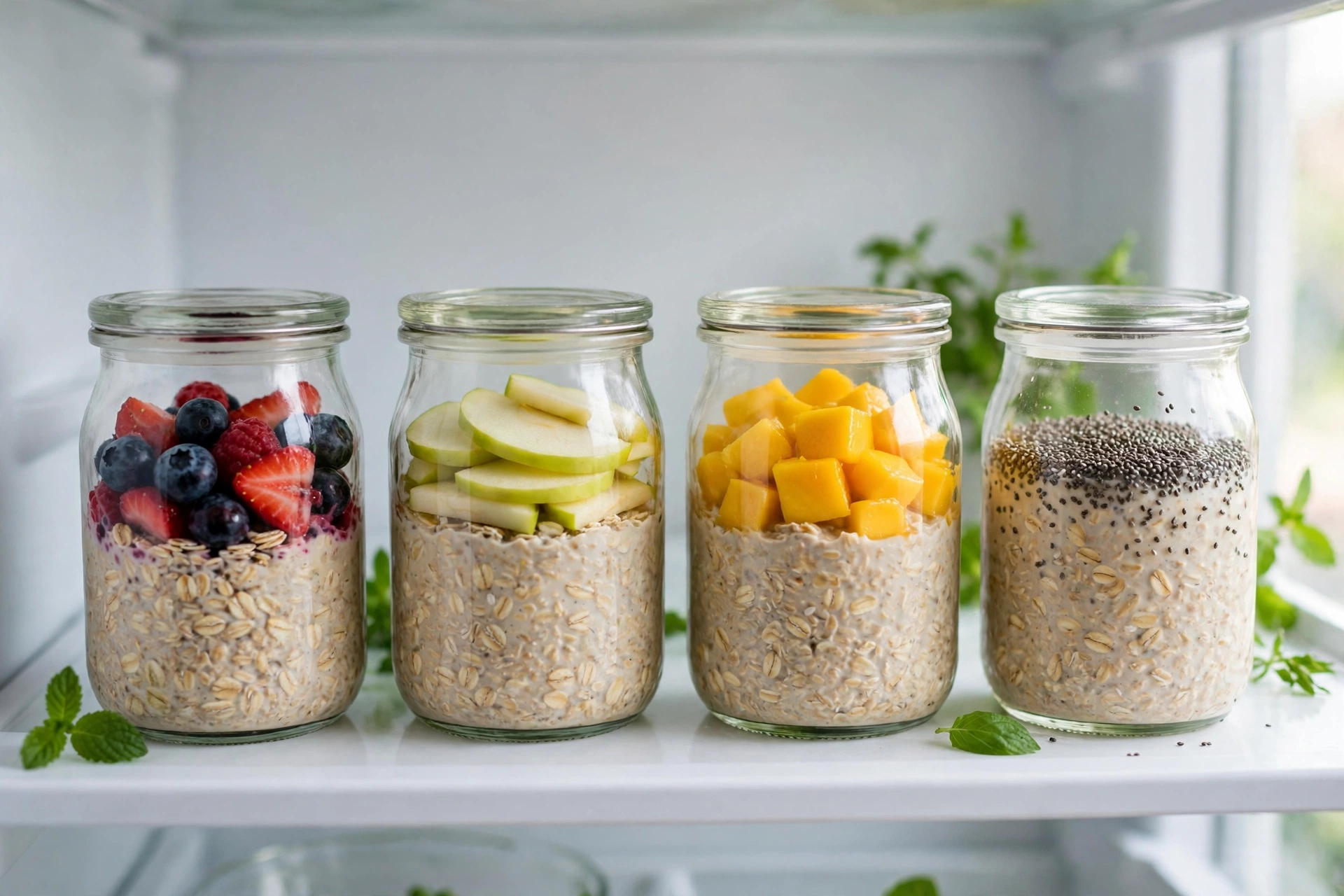
That means a Sunday-night batch of three jars covers Monday through Wednesday. Prep a second small batch on Wednesday evening for Thursday and Friday. Five jars made on Sunday will not all be at their best by Friday, and the ones with berries will be the first to turn.
A few prep habits help. Store jars in sealed containers with lids, not open bowls covered in plastic wrap. Add delicate toppings — sliced banana, fresh berries, crunchy nuts — in the morning rather than the night before, so they stay fresh and crisp. And label the lids if you make several flavors at once; after a night in the fridge, a berry jar and a chocolate jar look surprisingly alike.
Three mistakes that undo a good jar
Too much sweetener. Honey, maple syrup, agave, and brown sugar are all added sugars, and they add up fast. A tablespoon of honey is about 17 grams of sugar — most of the day’s suggested limit in one spoonful. If your jar tastes bland, add more fruit or a pinch of cinnamon and vanilla first.
Too little protein. Oats alone give you about 5 grams of protein per half-cup, which is not enough to carry most people to lunch. The yogurt, nut butter, seeds, or milk in the base matters more than it seems. If you use water instead of milk and skip the yogurt, you have built a carb bowl, and you will feel it by mid-morning.
Too many toppings. A tablespoon of nuts is a topping; a quarter-cup is a meal on top of a meal. The same goes for granola, coconut flakes, and dried fruit, which is far more concentrated in sugar than fresh fruit. Build the jar, then add toppings with a measuring spoon for a week until your eye learns the portion.
Read also: Easy High-Fiber Breakfast Ideas
Overnight oats vs. cooked oatmeal: does it matter?
Nutritionally, the two are nearly identical. The calories, fiber, and protein are the same, because both start from the same dry oats. The differences are texture, temperature, and convenience. Cooked oatmeal is warm and soft; overnight oats are cold and chewy.
Choose whichever version you will actually make. A breakfast you eat four mornings a week beats a theoretically perfect one you never get around to. If you love both, alternate: cooked oatmeal on slow weekend mornings, overnight jars on workdays.
Frequently asked questions
Do overnight oats need to be cooked?
No. Soaking rolled oats in liquid overnight softens them enough to eat safely. Use rolled oats rather than steel-cut oats, which stay too firm without heat, and always refrigerate the jar while it soaks.
How long do overnight oats last in the fridge?
Plan on 3 to 4 days in a sealed container at 40°F (4°C) or below, following the USDA’s guidance for refrigerated leftovers. Jars with fresh fruit or dairy are best within that window; plain jars may keep up to 5 days. Discard any jar left at room temperature for more than 2 hours.
Are overnight oats good for weight management?
They can be, because the fiber in oats supports fullness — but the total calories depend on what you add. A base jar with yogurt and berries runs roughly 250 to 300 calories; adding several tablespoons of nut butter, granola, and honey can push it past 500. Portion the toppings and the jar works well as part of a balanced day.
Can I make overnight oats without dairy?
Yes. Use a fortified plant milk such as soy, oat, or almond milk, and swap the Greek yogurt for a soy-based yogurt or a tablespoon of nut butter plus a tablespoon of chia seeds for protein and thickness. Check that the plant milk is fortified with calcium and vitamin D if it is a regular part of your diet.
The bottom line
Overnight oats work because they remove the morning decision. Pick a base ratio — half a cup of rolled oats, half a cup of milk, a quarter cup of Greek yogurt — and rotate through combinations that keep the week interesting. Watch the sweetener, keep the protein in, and eat each batch within 3 to 4 days. That is the whole system, and it is enough.
This article is for general information only and is not medical advice. If you have a health condition such as diabetes, high cholesterol, or a food allergy, talk with your clinician or a registered dietitian about how overnight oats fit your eating pattern.
Sources
- USDA FoodData Central — oats, regular and quick, not fortified, dry; chia seeds, dried; raspberries, raw (nutrient values per serving)
- U.S. Food and Drug Administration, 21 CFR 101.81 — health claims: soluble fiber from certain foods and risk of coronary heart disease (3 g beta-glucan per day)
- Whitehead A, Beck EJ, Tosh S, Wolever TMS. American Journal of Clinical Nutrition, 2014 — meta-analysis of 28 randomized controlled trials: ≥3 g/day oat beta-glucan lowered LDL cholesterol by ~0.25 mmol/L (PMID 25411276)
- American Heart Association — added sugars: about 25 g per day for women, 36 g for men
- USDA Food Safety and Inspection Service — Leftovers and Food Safety: refrigerate leftovers for 3 to 4 days at 40°F (4°C) or below
- World Health Organization — Healthy diet fact sheet: at least 400 g of fruit and vegetables a day; free sugars below 10% of total energy intake