How to Cut Food Waste When Meal Planning
Open your fridge on a Sunday night and you will probably find the same cast of characters: half a bag of spinach going soft, a container you meant to eat on Tuesday, and a lemon that has seen better days. Most of us do not set out to waste food. It happens in small, ordinary moments — buying a little too much, cooking a little too much, and then forgetting what is already there.
Meal planning is the simplest fix, not because it makes you more disciplined, but because it removes the guesswork. When you know what you already own, what you will actually eat this week, and what happens to the leftovers, far less food slips through the cracks. You also save money, cook with less stress, and still eat well. Here is how to build a plan that wastes less, without turning dinner into a spreadsheet.
First, the scale of the problem
Food waste is not a niche issue. The United Nations Environment Programme’s Food Waste Index Report 2024 estimated that 1.05 billion tonnes of food were wasted in 2022 at the retail, food service and household levels — about 19% of the food available to consumers. Households accounted for the largest share: 631 million tonnes, roughly 60% of the total, or about 79 kilograms per person per year.
In the United States, the USDA’s Economic Research Service estimated that 31% of the food available at the retail and consumer levels in 2010 went uneaten — about 133 billion pounds, worth an estimated $161.6 billion at retail prices. That is a sobering pair of numbers, but it also points to where change is most possible: your kitchen. The U.S. Environmental Protection Agency’s Wasted Food Scale ranks preventing wasted food as the most preferred option, ahead of donation, upcycling, animal feed and composting. In other words, the best thing you can do with food is eat it — and meal planning is how you make sure it gets eaten.
1. Shop your kitchen first
Before you write a list or open a recipe app, take five minutes to look. Open the fridge, the freezer and the pantry, and note what needs using soon: the wilting herbs, the half-used tin of tomatoes, the rice you bought three weeks ago. Then build the week’s meals around those items first.
This one habit does more than any fancy container system. It stops you buying a second bunch of coriander when one is already wilting in the crisper, and it turns “what should I cook?” from a blank-page problem into a much easier one: what can I make with the sweet potatoes, the chickpeas and the feta that are already here?
Keep a note on your phone called “eat first.” When you unpack groceries, move anything that will spoil fastest to the front of the fridge and add it to the list.
2. Plan meals, not a rigid timetable
The plans that waste the most food are often the most detailed ones. A plan that says “Tuesday: salmon, Wednesday: stir-fry, Thursday: soup” falls apart the moment Tuesday runs late, someone eats out, or nobody feels like salmon. The food bought for those exact meals then sits, uneaten, until it has to be thrown away.
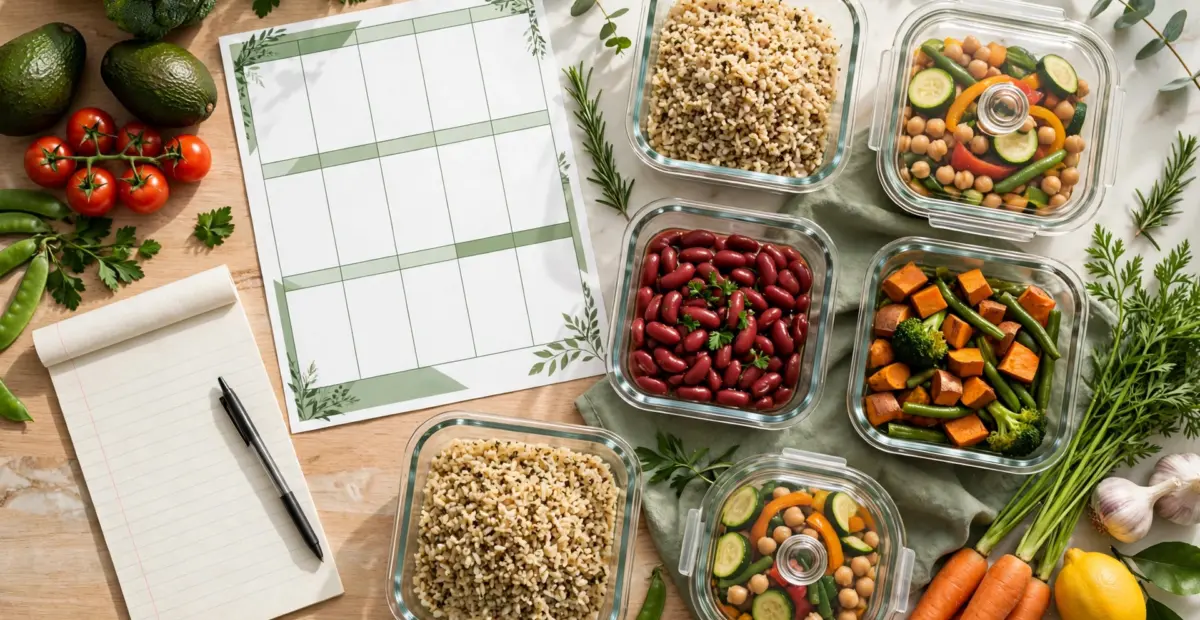
Instead, plan loosely. Pick four or five meals for the week rather than seven, and leave two nights flexible — for leftovers, for a freezer meal, or for eating out. Choose meals that share ingredients: roast a tray of vegetables on Monday and use the rest in a grain bowl on Wednesday; cook a big pot of rice once and use it twice. Overlapping ingredients mean fewer half-used packets lingering at the back of the cupboard.
Be honest about your week. If Thursday will be chaotic, do not plan an ambitious new recipe for Thursday — plan the easy meal. A realistic plan you follow beats a perfect plan you abandon by Wednesday.
Read also: How to Prep Produce for the Week
3. Buy only what you will actually use
Most food waste starts in the shop, not the kitchen. A list helps, but only if it reflects the meals you just planned — not a vague hope that you will suddenly start eating kale every day. Write the list from the plan, check it against what you already have, and stick to it as closely as you can.
Watch the bulk trap. A giant bag of salad leaves looks like a bargain until half of it turns to soup in the drawer. Unless you know you will eat it within a few days, the smaller bag — or the frozen version — is the cheaper choice in practice. The same goes for bread, berries and fresh herbs: buy the amount your week can absorb, not the amount the offer tempts you to take home.
Fresh, frozen and canned all have a place in a low-waste kitchen. Frozen vegetables and berries keep for months and can be used a handful at a time, which makes them ideal for weeks when your schedule is uncertain. Canned beans and tomatoes are the same: they wait patiently until you need them, and they never go soft in the crisper.
4. Store food so it gets eaten
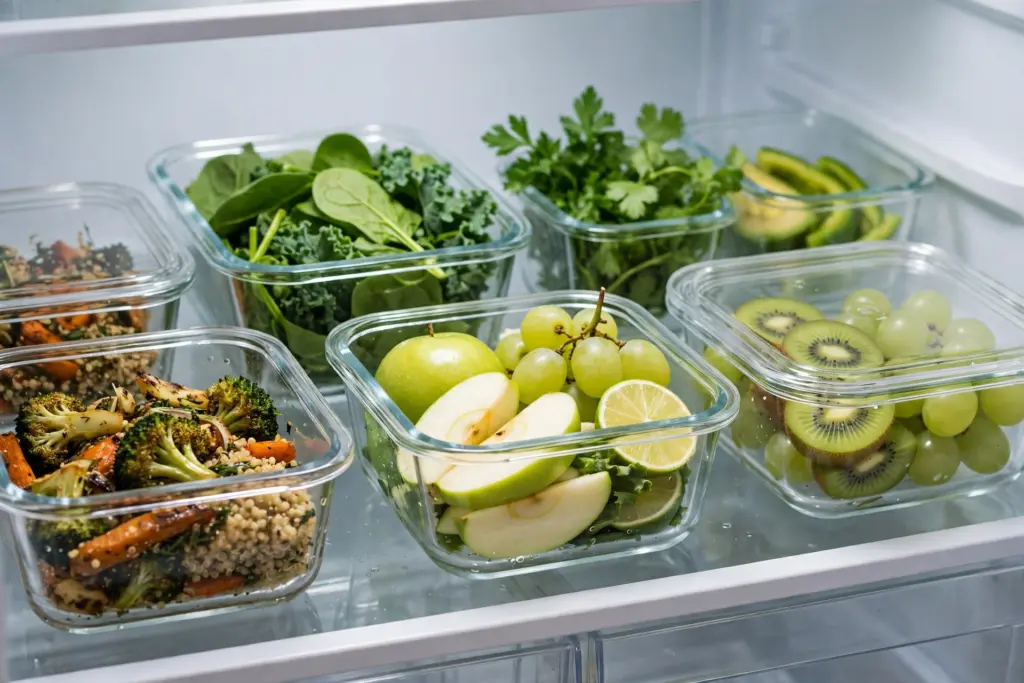
Food you cannot see is food you will forget. Clear containers, food at eye level, and the “eat first” shelf all help, but the basics matter most. Keep your refrigerator at 40°F (4°C) or below, and get leftovers into the fridge within two hours of cooking — within one hour if the room is hotter than 90°F (32°C). The USDA advises that most cooked leftovers keep for three to four days in the refrigerator at that temperature, and frozen leftovers keep their best quality for three to four months.
That window is why planning and storage go together: cook a big batch on Sunday, eat some by Wednesday, and freeze the rest before the window closes.
Label containers with the dish and the date. It takes ten seconds and it ends the fridge archaeology — the sniff test, the guesswork, and the “I think this is from last week, or was it the week before?” moment that usually ends with the whole container in the bin. When in doubt, throw it out: food safety is not the place to economize.
Read also: How to Stock a Healthy Pantry
5. Give leftovers a second act
Leftovers fail when they are treated as a repeat performance. Nobody is excited about the same stew for the third night running. The trick is transformation: roast chicken becomes chicken and vegetable soup, or shredded into tacos with beans and salsa. Cooked rice becomes fried rice with an egg and whatever vegetables need using. Roast vegetables go into a grain bowl, a wrap, or a frittata.
Plan for this deliberately. When you cook a grain, a protein or a tray of vegetables, cook a little extra on purpose — enough for a second, different meal, not just a sad reheated copy. That is batch cooking with a purpose, and it is one of the fastest ways to cut both waste and weeknight cooking time.
When a dish will not be eaten again, freeze it the same day, in single labelled portions. A freezer with three meals you actually want to eat is a weeknight rescue plan.

6. Learn what date labels actually mean
A surprising amount of perfectly good food is thrown away because of a misunderstood date. In the United States, manufacturers generally apply date labels to help retailers and consumers judge when a product is at its best quality — with the exception of infant formula, these dates are not federal safety deadlines. A “best if used by” date on crackers, canned tomatoes or yogurt is about peak flavour and texture, not a sudden switch from safe to unsafe.
Use the date as a prompt, not a verdict. Check the food: does it look, smell and taste normal? Has it been stored properly? For perishable foods like milk, meat and cooked leftovers, follow the storage windows above and be cautious. For shelf-stable foods, a date a few days past is rarely a reason to bin something that is otherwise fine. When you are unsure about a perishable item, though, discard it — the cost of a wasted carton is small compared with a bout of food poisoning.
7. A week that wastes less
Put it together and a low-waste week looks reassuringly ordinary. Sunday: shop your kitchen, plan four or five flexible meals, and write a list from that plan. Monday: cook a grain and a tray of vegetables you will use twice. Midweek: turn the leftovers into something different, and move anything uneaten into the freezer before the three-to-four-day window closes. Friday: eat from the freezer, the pantry or the “eat first” shelf instead of shopping again.
At the end of the week, take thirty seconds to notice what, if anything, you threw away — and why. Was it a vegetable you bought without a plan? A leftover nobody wanted as a repeat? That one observation is the most useful feedback your meal plan can give you, because next week’s plan can fix exactly that one thing.
Read also: Weekly Meal Planning for Balanced Meals
You do not need a perfect system, a bigger fridge, or a new personality to waste less food. You need a plan that starts with what you already have, stays flexible enough to survive a real week, and treats leftovers as ingredients rather than afterthoughts. Start with one change — shopping your kitchen first, or freezing leftovers on day three — and let the rest follow. Your wallet, your weeknights and, on a much larger scale, the planet will notice the difference.
Frequently asked questions
How long do cooked leftovers last in the fridge?
Most cooked leftovers keep for three to four days in a refrigerator at 40°F (4°C) or below, according to the USDA. Eat or freeze them within that window, and reheat them until steaming hot throughout.
Does meal planning really reduce food waste?
It can, because most household waste comes from buying more than a household eats and forgetting food already in the fridge. Planning around what you have, buying only what your week can use, and scheduling a second use for leftovers directly addresses both causes.
Are frozen vegetables as good as fresh ones for a low-waste kitchen?
For waste, frozen vegetables have a clear advantage: they keep for months and can be used a portion at a time, so nothing spoils while you decide what to cook. Nutritionally, frozen produce is generally comparable to fresh, since it is usually frozen soon after harvest.
Should I throw food away on its “best by” date?
Not automatically. On most foods, that date signals best quality rather than safety (infant formula is the exception). Use the date as a prompt to check the food and its storage, and be cautious with perishable items — when in doubt, throw it out.
Sources
- UNEP Food Waste Index Report 2024 — 1.05 billion tonnes wasted in 2022, 19% of food available to consumers, households 631 million tonnes (60%), 79 kg per person per year.
- USDA Economic Research Service, “ERS’s Food Loss Data Help Inform the Food Waste Discussion” — 31% of food at retail and consumer levels uneaten in 2010, 133 billion pounds, $161.6 billion.
- USDA, Food Loss and Waste — U.S. food waste estimated at 30–40% of the food supply, based on the 31% retail and consumer estimate; date labelling and best-quality guidance.
- U.S. EPA, Sustainable Management of Food Basics — the Wasted Food Scale, with preventing wasted food and donating/upcycling food as the most preferred pathways.
This article is for general information only and is not medical advice. If you have concerns about food safety, storage, or a health condition that affects what you can safely eat, talk to a qualified health professional.