Whole Grains vs. Refined Grains: What’s the Difference?
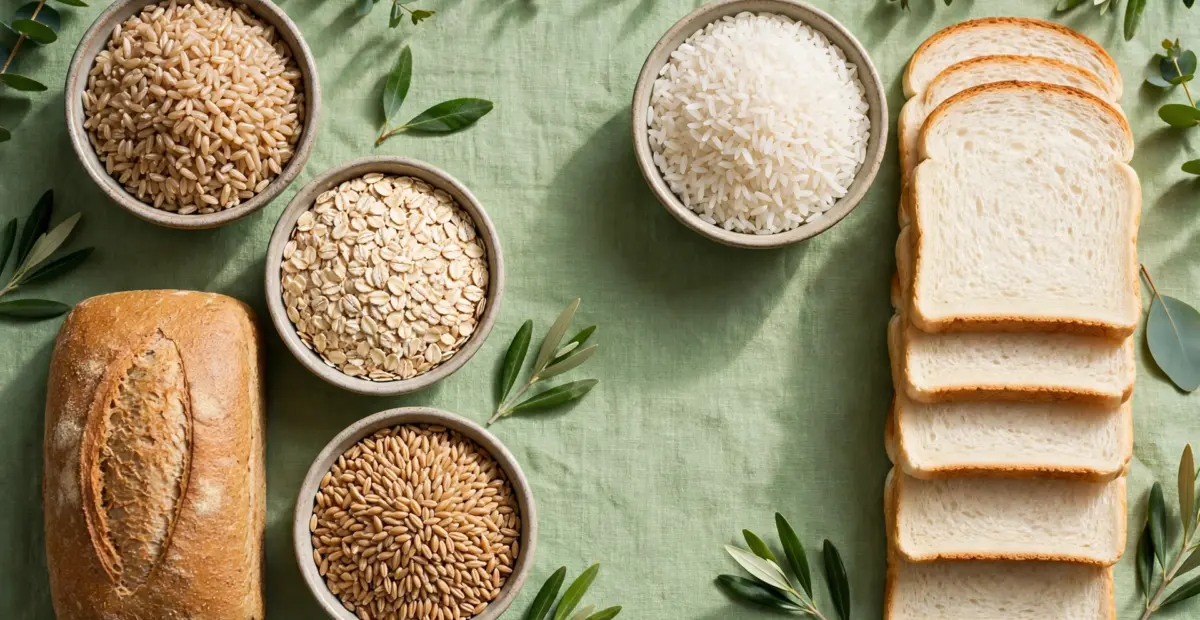
You have probably heard that whole grains are the better choice. Brown rice over white rice, whole-wheat bread over white bread, steel-cut oats over instant. The advice is everywhere, and it is broadly right. But what does “whole” actually mean, and how big is the difference once a grain has been refined? The answer is more interesting than a simple good-versus-bad split, and it helps to know it before you stand in the bread aisle trying to decode a label.
Anatomy of a grain: bran, germ, and endosperm
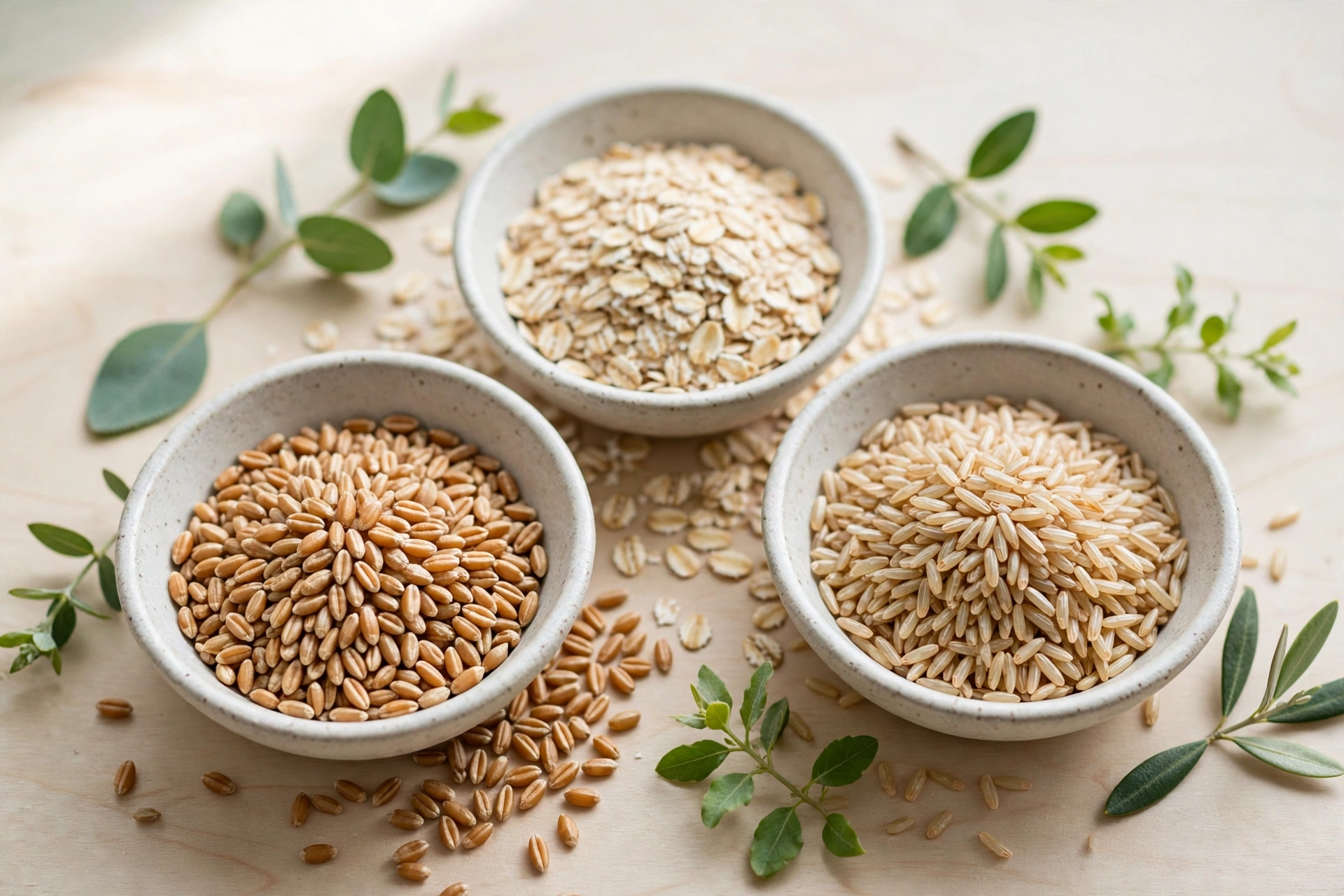
Every grain kernel — wheat, rice, oats, barley, corn — has three parts. The bran is the tough outer layer, and it carries most of the fiber plus some B vitamins and minerals. The germ is the small embryo at the core, the part that would sprout into a new plant; it holds healthy fats, vitamin E, and more B vitamins. The endosperm is the big starchy middle, the grain’s energy store, mostly carbohydrate with a little protein. A whole grain keeps all three parts, in roughly the same proportions nature put them there — that is the Whole Grains Council’s definition, and it covers cracked, rolled, and ground grains too, so whole-wheat flour and rolled oats still count.
A refined grain has been milled to strip away the bran and the germ, leaving mostly the endosperm. White flour, white rice, and most white breads are refined grains. Milling makes the grain softer, milder in flavor, and longer-lasting on the shelf — the fats in the germ can turn rancid, so removing them extends shelf life. The trade-off is that much of the fiber and many micronutrients go with the parts that were removed.
Read also: How to Choose Whole Grains
What refining actually removes
The losses are not small. When wheat is refined into white flour, it loses most of its fiber along with a large share of its magnesium, zinc, and B vitamins. The same happens with rice: milling brown rice into white rice removes the bran and germ, and with them most of the fiber and a good part of the minerals.
That does not make refined grains empty calories. The starchy endosperm still provides energy and some protein, and in the United States most refined grain products are enriched — more on that below. But the parts that were removed are exactly the parts that do the most interesting work in your diet: the fiber that feeds your gut microbes and slows digestion, and the micronutrients that support everything from energy metabolism to blood pressure. Refined grains are not poison, and white rice is a staple for billions of people — the question is proportion, not perfection.
The numbers: brown rice vs. white rice, whole-wheat vs. white bread
Side-by-side numbers make the difference concrete. Per 100 grams cooked, brown rice has about 1.6 grams of fiber while white rice has about 0.4 grams — roughly four times as much. By the cup, the gap looks even bigger (about 3.2 grams versus 0.6 grams), though part of that is because a cup of cooked brown rice simply weighs more than a cup of cooked white rice. Calories per 100 grams are close: around 123 for brown rice and 130 for white.
Bread tells a similar story. Whole-wheat bread provides about 6.0 grams of fiber per 100 grams, compared with about 2.4 grams in white bread. That is more than double the fiber for roughly the same calories, which is why two slices of whole-wheat bread can keep you satisfied noticeably longer than two slices of white.
The glycemic difference is real but modest. Brown rice has a glycemic index of about 68, white rice about 73 — brown rice raises blood sugar a little more slowly, largely because its fiber slows digestion. That is a nudge, not a transformation: pairing white rice with beans, vegetables, and protein blunts its blood-sugar effect far more than swapping the rice alone.
What the research links to whole grains
The strongest evidence for whole grains comes from large observational studies that follow people’s eating habits for years. A widely cited dose-response meta-analysis published in The BMJ in 2016 pooled 45 prospective studies and found that each additional 90 grams of whole grains a day — roughly three servings, like two slices of whole-grain bread plus a bowl of cereal — was associated with a 19% lower risk of coronary heart disease, a 22% lower risk of cardiovascular disease, a 15% lower risk of cancer mortality, and a 17% lower risk of death from any cause.
Those are associations, not proof that whole grains alone cause the benefit. People who eat more whole grains also tend to eat more vegetables, move more, and smoke less, and researchers adjust for those factors as best they can — but no observational study can fully separate a food from the lifestyle around it. Even so, the pattern has held up across many populations and many years.
It is also worth noting what the same analysis found for refined grains: little evidence of a link, in either direction, between refined grains, white rice, or total grain intake and the same outcomes. Refined grains did not show up as harmful on their own — they simply did not carry the benefit that whole grains did.
Fiber, fullness, and blood sugar
Fiber is the headline difference, and it earns the attention. Adults are advised to aim for about 25 grams of fiber a day for women and 38 grams for men under 50, yet most people get roughly half that. Every swap from refined to whole grain closes a bit of the gap: switching your daily bread, rice, and breakfast cereal to whole-grain versions can easily add 5 to 10 grams of fiber a day without changing how much you eat.
Fiber slows the speed at which food leaves your stomach and glucose enters your bloodstream, which is why whole grains tend to keep you full longer and produce a gentler rise in blood sugar. The soluble fiber in oats has an extra trick: the FDA allows an authorized health claim that diets low in saturated fat and cholesterol that include soluble fiber from whole oats may reduce the risk of heart disease. None of this means a whole-grain cookie is a health food — a product can be made with whole grains and still be high in added sugar or sodium. The grain is one ingredient among many.
Enriched is not the same as whole
If you look at a bag of white flour, you will probably see the word “enriched.” Since the 1940s, the U.S. government has required refined grain products to be enriched with thiamin, riboflavin, niacin, and iron — nutrients lost during milling. Since 1998, enriched grains have also been fortified with folic acid, which helps reduce the risk of neural tube defects in pregnancies.
Enrichment was a genuine public-health success, and it is one reason refined grains are not nutritionally empty. But enrichment restores only a handful of nutrients, and it restores them to the level of the original grain — it does not add back the fiber, magnesium, zinc, vitamin E, or the plant compounds that lived in the bran and germ. An enriched white bread and a whole-wheat bread can look similar on a few lines of the nutrition label and still be very different foods.
The practical takeaway is simple: “enriched” on a label tells you some nutrients were added back. It does not tell you the grain is whole.
How to spot real whole grains on a label
Packaging is where this gets tricky, because “made with whole grains” can mean almost anything. A product can carry that phrase while containing only a small amount of whole grain. Here is how to read past the marketing:
Check the first ingredient. Ingredients are listed by weight, so a genuinely whole-grain food should list a whole grain first — look for the word “whole” before the grain, as in “whole wheat flour,” “whole oats,” or “whole-grain cornmeal.” If the first ingredient is “wheat flour” or “enriched flour,” the product is mostly refined, whatever the front of the box says.
Look for the Whole Grain Stamp. The Whole Grains Council’s stamp shows the grams of whole grain per serving. The 100% Stamp means every grain ingredient is whole grain and the serving contains at least 16 grams of whole grain. The 50%+ Stamp and the Basic Stamp both guarantee at least 8 grams per serving, with the 50%+ version meaning at least half the grain is whole.
Watch the word “wheat.” “Wheat bread,” “multigrain,” and “stone-ground” are not the same as “100% whole wheat.” Multigrain only means more than one type of grain was used — all of them could be refined. And brown coloring proves nothing: some breads are darkened with molasses or caramel color.
Check the fiber. A quick reality check is the fiber line on the Nutrition Facts label. A bread with less than 2 grams of fiber per slice is probably not doing much whole-grain work, while one with 3 grams or more per slice usually is.
Read also: How to Read Food Labels
Three easy swaps that actually stick
Knowing the difference is only useful if it changes what lands in your cart. The swaps below are deliberately boring — they work because they slot into meals you already make.
1. Bread: switch your everyday sandwich loaf to 100% whole wheat. It is the single highest-impact swap for most people, because bread shows up daily and the fiber difference per slice is large.
2. Rice: try brown rice, or meet yourself halfway with a half-brown, half-white mix while your taste buds adjust. A 50/50 pot still doubles the fiber of plain white rice, and the texture is familiar.
3. Breakfast cereal: choose oatmeal or a cereal whose first ingredient is whole oats or whole wheat, with at least 3 grams of fiber per serving. Steel-cut oats are the least processed option, but plain instant oatmeal counts as whole grain too — it just digests a little faster.

You do not need to make all three swaps at once. Pick the one that fits your routine, give it two weeks, and then add another. The research benefit builds with the total amount of whole grains you eat over time, not with a single perfect meal.
Frequently asked questions
Is brown rice always better than white rice?
For fiber and micronutrients, yes — brown rice has about four times the fiber per 100 grams and more magnesium and B vitamins. But white rice digests more easily, keeps longer, and is a better fit for some people, including those with certain digestive conditions.
Does whole-wheat bread have fewer calories than white bread?
Not really — the calories are very similar. The advantage of whole-wheat bread is fiber and nutrients, not fewer calories. It tends to keep you full longer, which can help you eat less overall, but slice for slice the energy is about the same.
How much whole grain should I aim for each day?
The Dietary Guidelines for Americans recommend making at least half of your grains whole grains, and the newest guidelines (2025–2030) suggest roughly 2 to 4 servings of whole grains a day depending on your calorie needs. A serving is about one slice of whole-grain bread, half a cup of cooked brown rice or oatmeal, or half a cup of cooked whole-grain pasta.
Sources
- Aune D, Keum N, Giovannucci E, et al. Whole grain consumption and risk of cardiovascular disease, cancer, and all cause and cause specific mortality: systematic review and dose-response meta-analysis of prospective studies. The BMJ, 2016;353:i2716.
- International Food Information Council. The Whole Story on Whole Grains — definition, enrichment, and labeling guidance.
- Whole Grains Council. Stamp Usage Guide for the Whole Grain Stamp (United States) — 100% Stamp minimum 16 g, 50%+ and Basic Stamp minimum 8 g per serving.
- USDA FoodData Central — nutrient data for cooked brown rice, cooked white rice, whole-wheat bread, and white bread.
- FDA authorized health claims, including fiber-containing grain products and cancer (21 CFR 101.76) and soluble fiber and coronary heart disease (21 CFR 101.77).
This article is for general information only and is not medical advice. If you have a medical condition that affects what you can eat — such as diabetes, celiac disease, or a digestive disorder — talk with your clinician or a registered dietitian about the choices that fit you.