High-Protein Lunch Ideas for Everyday Meals
Most of us eat protein backwards. Breakfast is a piece of toast and coffee. Lunch is whatever is closest — a sandwich, a salad with a sprinkle of chicken, a soup that is mostly broth. Then dinner arrives and suddenly there is a full plate of meat, as if one big serving can make up for the rest of the day. It cannot — and that is why lunch deserves more attention than it usually gets.
Lunch is the meal where protein most often goes missing, and the gap matters more than most people realise. Your body does not store protein the way it stores fat or carbohydrate, so what you eat at each meal is, to a large extent, what that meal has to work with. A lunch with almost no protein leaves the afternoon running on fumes — hungrier sooner, and more likely to raid the snack drawer at 3 p.m.
The fix is not a powder or a bar. It is a lunch built around a real protein source, with enough of it to count — and eight such lunches are below.
Why lunch is the protein gap
Researchers at the University of Texas Medical Branch tested this directly: eight healthy adults ate the same total amount of protein — about 90 grams a day — split two different ways. On the skewed pattern, the split mirrored how many people actually eat: about 10 grams at breakfast, 16 at lunch, and 63 at dinner. The result: muscle protein synthesis over 24 hours was 25% higher on the even split, even though total protein and calories were identical — and the advantage held after a full week on each pattern.
A second study, by Areta and colleagues, found the same logic from a different angle. After exercise, 24 trained men received 80 grams of whey protein over 12 hours as eight small 10-gram doses, four moderate 20-gram doses, or two large 40-gram doses. The four moderate doses produced the greatest muscle protein synthesis — 31 to 48 percent more than either extreme.
Lunch sits right in the middle of that pattern. In the skewed pattern above, lunch carried only 16 grams — barely half of what the even pattern gave it. If your breakfast is light and your dinner is the only protein-heavy meal, your lunch is probably doing the same thing. Bringing lunch up to a proper serving is the single easiest correction most people can make.
Read also: High-Protein Breakfast Foods to Keep on Hand
How much protein should lunch actually have?
There is no single number that fits everyone, but the research gives a useful range. The recommended dietary allowance — the minimum to avoid deficiency — is 0.8 grams of protein per kilogram of body weight per day. The 2025–2030 Dietary Guidelines for Americans suggest a higher target for most adults: 1.2 to 1.6 grams per kilogram per day.
Take a 70-kilogram adult (about 154 pounds). At 1.2 to 1.6 grams per kilogram, that is roughly 84 to 112 grams of protein a day. Split across three meals, lunch needs to carry about 28 to 37 grams. That lines up neatly with the feeding studies: around 30 grams per meal, or roughly 0.4 grams per kilogram, is the dose that reliably switches on muscle protein synthesis.
Thirty grams sounds like a lot until you see it on a plate: a palm-sized piece of chicken breast is about 26 grams on its own, and a cup of lentils (18 g) plus half a cup of Greek yogurt (12 g) is 30. The ideas below land in that range without weighing anything fancier than a cup and a palm.
A quick protein cheat sheet
Keep this table in mind when you build a lunch. All values come from the USDA’s FoodData Central database, for the serving shown.
| Food | Serving | Protein |
|---|---|---|
| Chicken breast, cooked | 3 oz (85 g) | 26 g |
| Canned light tuna, drained | 3 oz (85 g) | 17 g |
| Greek yogurt, plain nonfat | 3/4 cup (170 g) | 17 g |
| Lentils, cooked | 1 cup | 18 g |
| Edamame, shelled | 1 cup | 18 g |
| Chickpeas, cooked | 1 cup | 15 g |
| Black beans, cooked | 1 cup | 15 g |
| Cottage cheese | 1/2 cup | 12 g |
| Tofu, firm | 1/2 cup | 11 g |
| Egg, large | 1 | 6 g |
| Hummus | 1/4 cup | 5 g |
| Quinoa, cooked | 1/2 cup | 4 g |
Notice the pattern: animal foods reach the target in one serving, while plant foods usually need a combination — beans plus grains, tofu plus edamame, lentils plus yogurt. Pairing two plant proteins is how vegetarian lunches have always been built.
Eight high-protein lunches that hit the target
1. Chicken and quinoa grain bowl — about 38 g
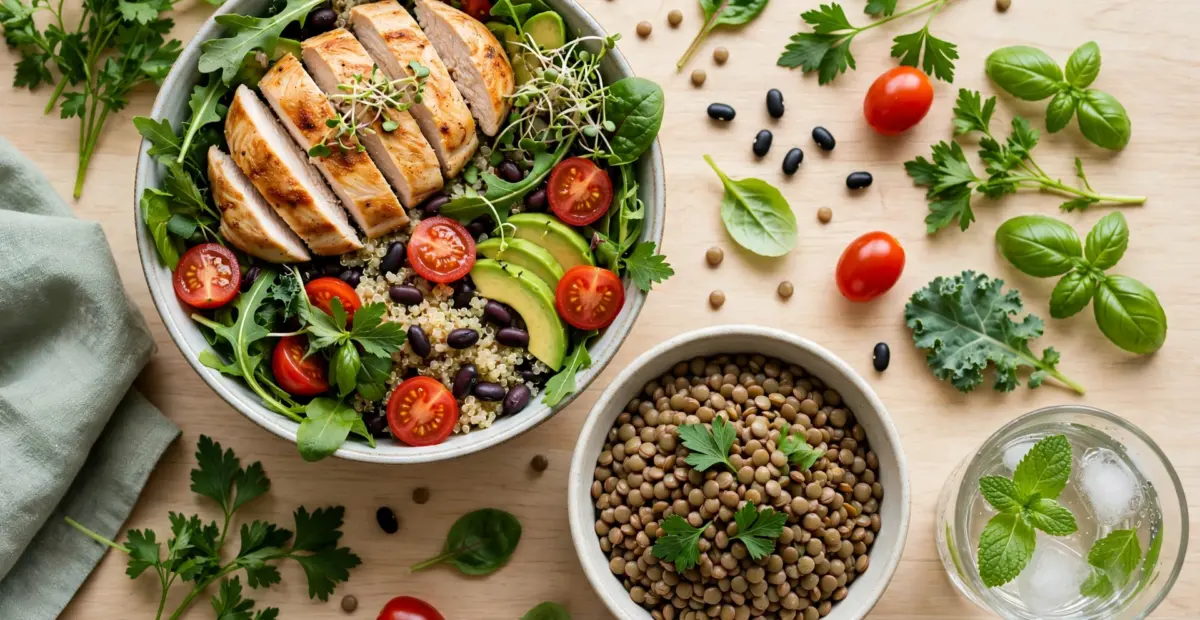
Start with 3 ounces of cooked chicken breast (26 g), add half a cup of cooked quinoa (4 g) and half a cup of black beans (8 g), then fill the rest of the bowl with whatever vegetables you have: cucumber, shredded carrots, cherry tomatoes, a handful of greens. A squeeze of lemon and a spoonful of olive oil is all the dressing it needs. Cook the chicken and quinoa on Sunday and this bowl takes five minutes to assemble all week.
Read also: Healthy Grain Bowl Ideas for Lunch
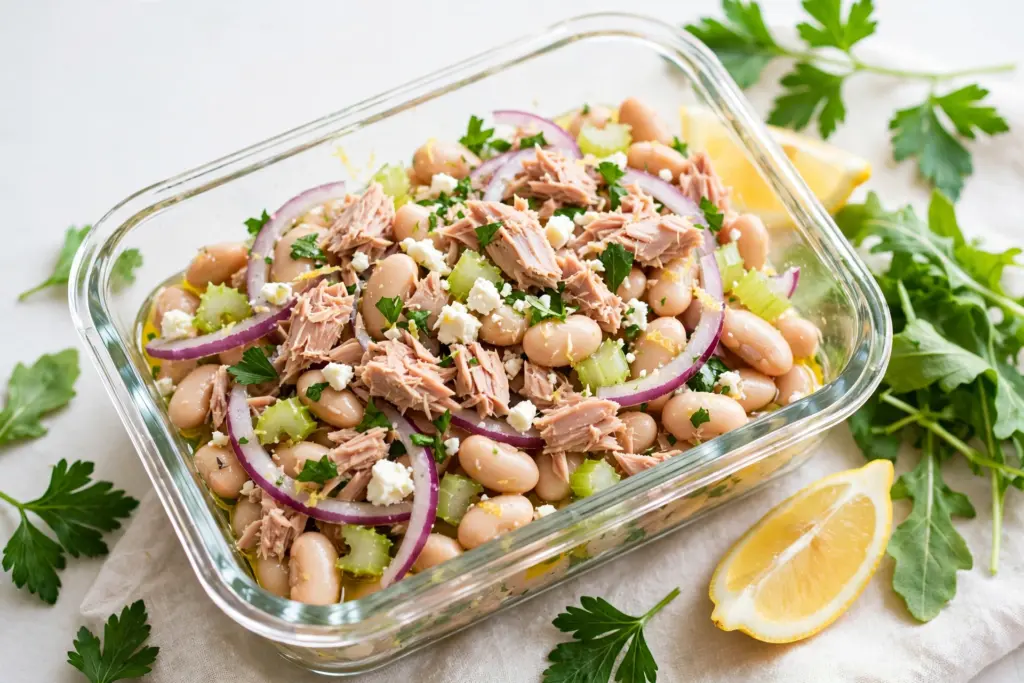
2. Tuna and white bean salad — about 33 g
One 5-ounce can of light tuna in water, drained (about 22 g), tossed with half a cup of white beans (7 g) and an ounce of crumbled feta (4 g), plus diced celery, red onion, and parsley. Olive oil and lemon juice instead of mayonnaise keeps it light and lets the tuna flavour come through. It holds up in the fridge for two days, so make a double batch and lunch is done for tomorrow too.
Read also: Easy Homemade Salad Combinations
3. Lentil soup with Greek yogurt — about 30 g
A cup of cooked lentils (18 g) in a simple soup — onion, garlic, carrots, cumin, vegetable stock — with half a cup of plain Greek yogurt (12 g) spooned on top instead of cream. The yogurt adds protein and a tangy richness. Lentil soup freezes beautifully, so a Sunday pot covers three or four work lunches.
4. Tofu and edamame stir-fry — about 30 g
Half a cup of firm tofu, cubed and pan-fried until golden (11 g), with a cup of shelled edamame (18 g) and whatever vegetables are in the fridge — broccoli, peppers, snap peas — tossed in a little soy sauce, ginger, and sesame oil. Serve it over half a cup of brown rice if you want it more filling; the rice adds a few more grams and, more importantly, keeps you full until dinner.
5. Cottage cheese and egg toast — about 32 g
Two slices of whole-wheat toast (about 8 g) spread with half a cup of cottage cheese (12 g) and topped with two sliced hard-boiled eggs (12 g), plus sliced tomato and a crack of black pepper. It looks like a snack and eats like a meal. Hard-boil a batch of eggs on Sunday and this is a two-minute lunch.
6. Chickpea and feta salad with quinoa — about 26 g
A cup of chickpeas (15 g), half a cup of cooked quinoa (4 g), an ounce of feta (4 g), diced cucumber and tomatoes, and a yogurt-lemon dressing (about 3 g). It is the lunch to make when you have no leftovers and no time: open a can, rinse, chop, mix. If 26 grams feels short for you, add a boiled egg or a small handful of pumpkin seeds and you are past 30.
7. Turkey and hummus wrap — about 34 g
Three ounces of sliced turkey breast (about 24 g) in a whole-wheat wrap (about 5 g) with a quarter cup of hummus (5 g), shredded carrots, and spinach. The hummus replaces mayonnaise and adds protein and fiber at the same time. Roll it tight in foil and it survives a morning in a bag without falling apart.
8. Black bean burrito bowl — about 30 g
A cup of black beans (15 g) over half a cup of brown rice (about 3 g), with a quarter cup of shredded cheese (7 g), salsa, and a dollop of plain Greek yogurt instead of sour cream (about 5 g). Add corn, peppers, or whatever vegetables need using up. It is filling, cheap, and almost entirely pantry food — the kind of lunch that rescues a week when the fridge is empty.
The deli-meat trap
One warning before you reach for the easiest option. Deli turkey, ham, and salami look like a shortcut to a high-protein lunch, but they carry two costs. First, sodium: a hundred grams of deli ham carries about 1,040 milligrams of sodium, and six thin slices can add 750 milligrams or more to a sandwich. The American Heart Association suggests keeping sodium to no more than 2,300 milligrams a day, ideally closer to 1,500 — one deli sandwich can eat half that budget.
Second, processed meat itself. The International Agency for Research on Cancer classified processed meat as carcinogenic to humans in 2015, estimating that each additional 50 grams a day is linked to an 18 percent higher risk of colorectal cancer — a good reason not to make deli meat the daily default.
The practical fix is simple: roast a chicken breast or a turkey breast on Sunday, slice it yourself, and use it through the week. You get the same convenience, more protein per bite, and a fraction of the sodium. Save the deli meat for the occasional sandwich, not the everyday one.
Pack it so it survives the morning
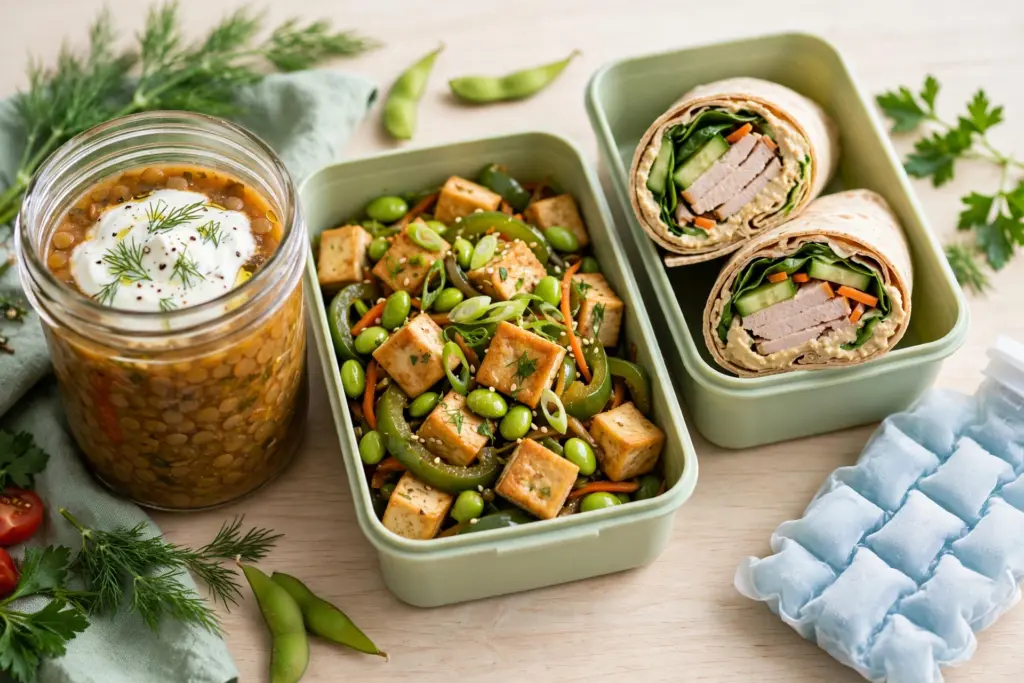
A high-protein lunch only works if it is still safe to eat when lunchtime arrives. FoodSafety.gov’s rule is straightforward: perishable food should not sit at room temperature for more than two hours (one hour if it is above 90°F / 32°C), and the danger zone for bacterial growth is 40 to 140°F (4 to 60°C). A lunch bag with an ice pack keeps cold food cold; a thermos keeps soup hot. If your office has a fridge, use it — and reheat leftovers to 165°F (74°C).
Pack lunch the night before, not in the morning rush. The nights you skip packing are the ones you end up buying lunch — and bought lunches are where the protein gap usually opens back up.
Build your own formula
Remember the formula: one protein anchor, one fiber source, and one or two vegetables. The anchor gets you to 25 to 35 grams. The fiber — beans, lentils, whole grains — stretches the meal and keeps you full. The vegetables add volume, crunch, and part of the 400 grams of fruit and vegetables a day the World Health Organization recommends as a minimum.
Swap the chicken for tofu, the quinoa for brown rice, the chickpeas for black beans — the structure stays the same, and the protein stays in range. Once you have the formula, you do not need a recipe for every lunch. You need a stocked fridge, a can opener, and about ten minutes.
Frequently asked questions
Do I really need 30 grams of protein at lunch?
Not everyone does. The 30-gram figure comes from feeding studies in healthy adults, where meals of about 25 to 40 grams — roughly 0.4 grams per kilogram of body weight — most effectively stimulated muscle protein synthesis. If you are smaller, older, or less active, you may need less; if you are training hard, you may need more. What matters most is the pattern: spread across the day beats the same total crammed into dinner.
Can a vegetarian lunch reach 30 grams of protein?
Yes, with combinations. A cup of lentils (18 g) plus half a cup of Greek yogurt (12 g) is 30 grams. Tofu (11 g per half cup) plus a cup of edamame (18 g) is 29. Beans alone rarely get there — a cup of chickpeas is 15 grams — so pair them with grains, dairy, or soy and the numbers add up fast.
Is canned tuna safe to eat every day?
Light tuna is lower in mercury than white (albacore) tuna, but it still contains some, so variety is the safer habit. The FDA and EPA advise eating a variety of seafood rather than making tuna the only fish you eat. Two or three tuna lunches a week, with beans, eggs, and chicken in between, is a sensible rhythm.
What if I have no time to cook at all?
Then assemble, do not cook. A tub of cottage cheese, a can of chickpeas, a pouch of pre-cooked lentils, a rotisserie chicken, and a bag of pre-washed greens can become a 30-gram lunch in under five minutes with no stove involved. The protein does not care whether you cooked it.
Disclaimer: This article is for general information only and is not medical advice. Protein needs vary with age, body size, activity level, and health conditions. If you have kidney disease, diabetes, or another condition that affects how much protein you should eat, talk to your clinician or a registered dietitian before changing your intake.
Sources
- Mamerow MM, Mettler JA, English KL, et al. Dietary protein distribution positively influences 24-h muscle protein synthesis in healthy adults. Journal of Nutrition, 2014;144(6):876–880.
- Areta JL, Burke LM, Ross ML, et al. Timing and distribution of protein ingestion during prolonged recovery from resistance exercise alters myofibrillar protein synthesis. Journal of Physiology, 2013;591(9):2319–2331.
- U.S. Department of Agriculture. FoodData Central.
- U.S. Department of Health and Human Services and U.S. Department of Agriculture. Dietary Guidelines for Americans, 2025–2030.
- World Health Organization. Healthy diet (fact sheet).
- International Agency for Research on Cancer. IARC Monographs evaluate consumption of red meat and processed meat (press release 240, 26 October 2015).
- FoodSafety.gov. Get an A+ in Food Safety This School Year.