Dairy vs. Plant-Based Milk: Key Nutrients to Compare

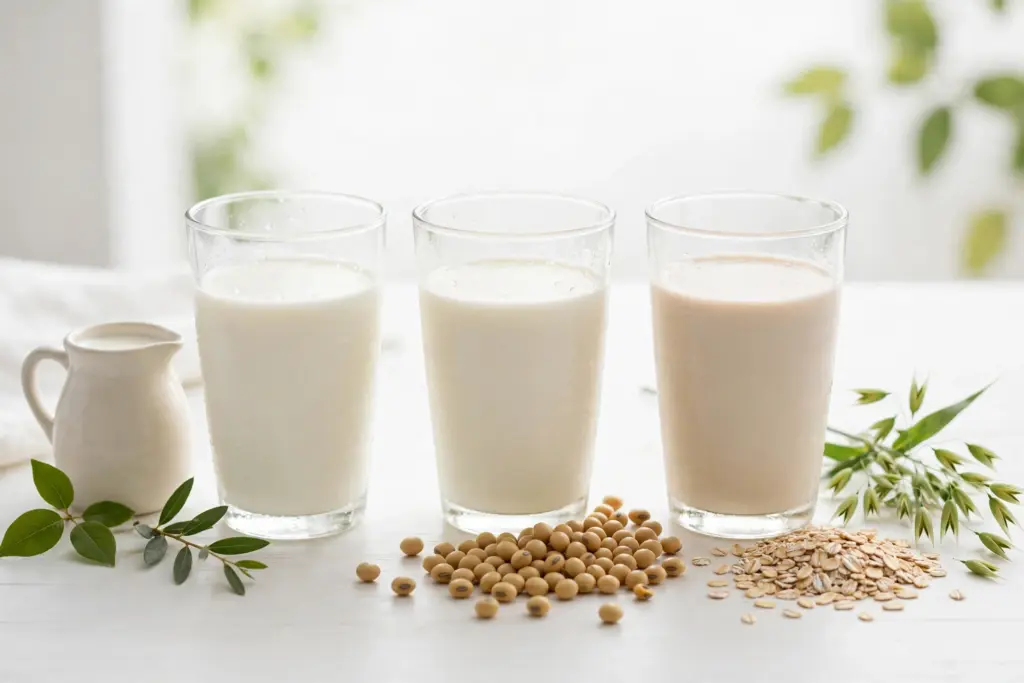
Stand in front of the milk case for thirty seconds and you will see the problem. One shelf holds whole milk, skim milk, and chocolate milk. The next holds soy, almond, oat, coconut, cashew, and pea milk — most of them in cartons that look almost identical to the dairy ones. They all pour white into your coffee. They do not all feed you the same way.
That matters because milk, whatever its source, tends to play the same role in a day: cereal in the morning, a splash in coffee, a glass with dinner, a base for smoothies and sauces. When you swap one for another without checking the label, you can quietly trade away 7 grams of protein, or add 9 grams of sugar you never meant to drink. The good news is that choosing well is mostly a matter of knowing which nutrients to compare — and ignoring the front of the carton, which is advertising, in favor of the Nutrition Facts panel, which is not.
This guide walks through the nutrients that actually differ between dairy milk and the main plant-based options, one at a time, with the numbers behind them. No single milk wins every category. The right choice depends on what you need from it.
First, what counts as “milk” in the guidelines?
The Dietary Guidelines for Americans 2025–2030 recommend about 2 to 3 servings of dairy a day for most adults, with one serving equal to a cup of milk. Fortified soy beverages — soy milk and soy yogurt fortified with calcium, vitamin A, and vitamin D — are included in the dairy group, because their nutrient profile is close enough to milk to stand in for it.
Other plant-based milks are not included. That is not a judgment about taste or ethics; it is a nutritional statement. Almond, oat, rice, and coconut milks vary widely in protein, calcium, and vitamin content, and most of them do not match milk on the nutrients the dairy group is meant to supply. The U.S. Food and Drug Administration made the same point in its February 2023 draft guidance on plant-based milk labeling: products that use the word “milk” but differ nutritionally from dairy should carry a voluntary statement saying so — for example, “contains lower amounts of vitamin D and calcium than milk.” If you have ever seen that kind of note on a carton, that is where it came from.
So the honest way to compare is not “dairy versus plant milk” as two teams. It is one milk at a time, nutrient by nutrient.
Protein: the biggest gap, and the one most people miss
Protein is where the milks split most sharply. A cup of whole milk carries about 8 grams of protein. Skim milk carries about the same — roughly 8 grams — because removing the fat does not remove the protein. That is a meaningful share of a meal: for many people, a glass of milk with breakfast is what turns toast into something that holds them until lunch.
Fortified, unsweetened soy milk is the only common plant milk that keeps up: about 7 grams of protein per cup, and soy protein is complete, meaning it supplies all nine essential amino acids. That is why soy is the one plant milk the dietary guidelines treat as a dairy equivalent.
The others fall well short. Unsweetened almond milk has about 1 gram of protein per cup. Unsweetened oat milk has about 3 grams. Coconut milk drinks (the carton kind, not the canned cooking kind) have close to none. If you pour almond milk over your cereal every morning and count that breakfast as protein-rich, the numbers say otherwise — and the fix is easy, since the protein can come from the food alongside it: an egg, Greek yogurt, nuts, or a spoonful of peanut butter.
None of this makes almond or oat milk “bad.” It makes them a different tool. They are low-calorie liquids that happen to look like milk. Treat them that way and they work fine.
Read also: High-Protein Foods: A Practical Guide
Calcium and vitamin D: check for the word “fortified”
Dairy milk is a reliable source of calcium because calcium is naturally there: about 276 mg per cup of whole milk, close to 300 mg in skim. It is also usually fortified with vitamin D. Together, those two nutrients are a big reason milk sits in the dietary guidelines at all — calcium and vitamin D are both listed as nutrients of public health concern, meaning many people do not get enough.
For reference, the recommended dietary allowance for calcium is 1,000 mg a day for adults aged 19 to 50, rising to 1,200 mg for women over 50 and men over 70. Vitamin D’s allowance is 600 IU (15 mcg) a day through age 70, and 800 IU after that, according to the National Institutes of Health. One cup of milk covers roughly a quarter to a third of the calcium target.
Plant milks contain almost no calcium naturally. What they contain is added by the manufacturer. A fortified soy milk matches dairy at about 300 mg of calcium per cup. Fortified almond milk often lists even more — around 450 mg — because manufacturers add extra. Fortified oat milk lands around 350 mg. So on paper, fortified plant milks can match or beat dairy on calcium.
Two caveats. First, the word “fortified” has to actually be there: an unfortified almond or oat milk may have almost no calcium at all, and the carton will not shout about it. Second, the form of calcium matters. Dairy calcium comes with lactose and a food matrix that the body absorbs well; the calcium carbonate or tricalcium phosphate added to plant milks can settle to the bottom of the carton, which is why the label says “shake well.” Shaking is not a suggestion. It is how the calcium gets into your glass.
Vitamin D follows the same pattern: dairy milk is usually fortified with it, and most major plant milks are fortified too — but the amounts vary by brand, so the label is the only reliable check.
Read also: Vitamin D Food Sources: What to Know
Fat and saturated fat: whole milk is the outlier
A cup of whole milk has about 8 grams of total fat, of which roughly 4.5 to 5 grams is saturated fat. That is the main nutritional cost of whole milk, and it is why the dietary guidelines steer most adults toward fat-free or low-fat dairy: skim milk keeps the protein and calcium with about 0.2 grams of fat.
Plant milks are almost all low in saturated fat. Unsweetened soy milk has about 4 grams of total fat and only about 0.5 grams saturated. Almond milk has about 2.5 grams of total fat and almost no saturated fat. Oat milk has about 5 grams of total fat, mostly unsaturated, and under a gram of saturated fat. The exception is coconut milk drinks, which can carry several grams of saturated fat per cup — and canned coconut milk, used in cooking, is far richer still.
If saturated fat is the nutrient you are watching, most plant milks and skim milk all do well, and whole milk is the one to use in smaller amounts. If you are choosing whole milk for flavor in coffee, that is a reasonable trade; a splash is not a glass.
Read also: How to Compare Dairy Fat Options
Sugar: natural lactose versus added sugar
A cup of plain dairy milk contains about 12 grams of sugar, all of it lactose — the milk sugar your body digests with the enzyme lactase. That sugar is not “added sugar” in the sense the guidelines warn about, and it does not count toward the American Heart Association’s suggested limits of about 25 grams of added sugar a day for women and 36 grams for men.
Unsweetened plant milks contain very little sugar: unsweetened almond milk has about 1 gram per cup, unsweetened soy milk around 1 to 4 grams. The trouble starts with the sweetened and flavored versions. A sweetened soy milk can carry 6 to 9 grams of added sugar per cup; sweetened oat milk 5 to 10 grams; chocolate dairy milk 8 to 16 grams of added sugar on top of its natural lactose. A flavored milk can quietly deliver half a day’s added-sugar budget in one glass.
The fix is boring and effective: buy unsweetened, and add your own flavor — vanilla extract, cinnamon, a spoonful of cocoa — if you want it. You get the taste for a fraction of the sugar.
Calories: a 100-calorie spread in the same glass
Per cup, the range is wide. Unsweetened almond milk sits around 30 to 40 calories. Skim milk is about 83. Unsweetened soy milk is about 80. Whole milk is about 149. Unsweetened oat milk is about 120. Sweetened versions of any plant milk add 20 to 50 calories on top.
That spread cuts both ways. If you are watching calories, almond milk is genuinely useful — it lets you lighten coffee, smoothies, and cereal without changing the recipe. If you are trying to gain weight, or you are feeding a child who needs energy-dense food, the same low-calorie profile is a drawback: a glass of almond milk does not replace the calories of a glass of whole milk, and nobody should expect it to.
Lactose, allergies, and why people switch
Nutrition is not the only reason people reach for a plant milk, and it is often not the main one. Lactose intolerance is common: in most people, lactase production falls after childhood, so a large share of adults worldwide digests lactose poorly, with rates varying widely by ancestry. Symptoms usually appear after more than 8 to 12 ounces of milk, which means many people tolerate a splash in coffee but not a full glass — and lactose-free dairy milk, which has the lactose already broken down, solves the problem while keeping the protein and calcium.
A milk allergy is different from lactose intolerance: it is an immune response to milk proteins, most often appears in the first year of life, and requires avoiding dairy entirely. For those households, a fortified soy milk is usually the closest nutritional stand-in, and a clinician or dietitian can confirm whether the swap covers the nutrients a child needs.
There are also people who choose plant milks for taste, for environmental reasons, or because they eat a vegan diet. Those are legitimate reasons. They just do not change the nutrient math, and the math is worth knowing before the habit is set.
The comparison at a glance
All values are per cup (about 240 ml), unsweetened and fortified where noted, from USDA FoodData Central values. Brands vary, so treat this as a map, not a verdict on any single carton.
| Milk (1 cup) | Calories | Protein | Fat | Calcium | Sugar |
|---|---|---|---|---|---|
| Whole dairy milk | ~149 | ~8 g | ~8 g | ~276 mg | ~12 g (lactose) |
| Skim dairy milk | ~83 | ~8 g | ~0.2 g | ~298 mg | ~12 g (lactose) |
| Soy milk, fortified | ~80 | ~7 g | ~4 g | ~300 mg | ~1–4 g |
| Almond milk, fortified | ~40 | ~1 g | ~2.5 g | ~450 mg | ~1 g |
| Oat milk, fortified | ~120 | ~3 g | ~5 g | ~350 mg | ~0–4 g |
How to pick one in the store
Five checks, in order, take about ten seconds per carton.

1. Unsweetened first. If the front says “original” rather than “unsweetened,” check the added-sugars line. Sweetened milks are the single biggest source of surprise sugar in this aisle.
2. Protein. If the milk is doing real work in your day — breakfast, post-workout, a child’s lunch — look for at least 7 grams per cup. In practice that means dairy milk or fortified soy milk.
3. Calcium and vitamin D. Look for the words “calcium” and “vitamin D” on the Nutrition Facts panel, with at least 20% of the Daily Value for calcium. If a plant milk is not fortified, it is not a calcium source, whatever the carton implies.
4. Saturated fat. Whole milk and coconut milk drinks are the ones to watch here. Everything else in the aisle is low.
5. Shake well, then check the date. Fortified plant milks settle, and opened cartons keep about 7 to 10 days refrigerated. Dairy milk keeps about a week past its sell-by date when stored cold, but smell it before you pour it into anything you cannot unmake.
So, which milk should you buy?
There is no universal winner, and that is the honest answer.
If you want one milk that covers protein, calcium, vitamin D, and potassium with no label detective work, dairy milk — or lactose-free dairy milk — does it, and skim or 1% does it with very little saturated fat. If you avoid dairy, fortified unsweetened soy milk is the closest replacement on the numbers, and it is the only plant milk the dietary guidelines count as a dairy equivalent.
If you love oat milk in coffee or almond milk in smoothies, keep them. Just know what they are: pleasant, low-calorie liquids that are not carrying the protein or the naturally occurring nutrients of milk. Pair them with protein from food, pick a fortified version, and choose unsweetened. That combination gets you the flavor you like without the nutritional gap you did not sign up for.
The milk aisle rewards one habit above all: turning the carton around. The front tells you a story. The back tells you the truth.
Frequently asked questions
Is soy milk as healthy as dairy milk?
On the nutrients that matter most, yes — fortified, unsweetened soy milk is the closest plant milk to dairy, with about 7 grams of protein and about 300 mg of calcium per cup. It is the only plant milk included in the dairy group in the Dietary Guidelines for Americans.
Does almond milk have calcium?
Only if it is fortified. Almonds themselves contain very little calcium per cup of milk, so manufacturers add it — fortified almond milk often lists around 450 mg per cup. Check the label for “fortified” and for calcium on the Nutrition Facts panel, and shake the carton well before pouring.
Is oat milk high in sugar?
Unsweetened oat milk has little or no added sugar, though it contains a few grams of natural sugars from the oats. Sweetened oat milk can add 5 to 10 grams of added sugar per cup, so choose unsweetened if sugar is a concern.
Which milk is best for lactose intolerance?
Lactose-free dairy milk keeps the protein, calcium, and vitamin D of regular milk with the lactose already broken down. Fortified soy milk is the closest dairy-free option. Many people with lactose intolerance also tolerate small amounts of regular dairy, such as a splash in coffee, since symptoms usually appear after larger servings.
Sources
- Dietary Guidelines for Americans, 2025–2030 — dairy group recommendations (2–3 servings daily; fortified soy beverages included in the dairy group)
- U.S. Food and Drug Administration — draft labeling recommendations for plant-based milk alternatives, February 2023
- National Institutes of Health, National Institute of Arthritis and Musculoskeletal and Skin Diseases — calcium and vitamin D recommended intakes
- MSD Manual, Consumer Version — lactose intolerance and lactase decline after childhood
- USDA FoodData Central values, via the Milk nutrition comparison — per-cup calories, protein, fat, and calcium for whole, skim, soy, almond, and oat milks
- Food and Health Communications — milk comparison values based on USDA and manufacturer data
This article is for general information only and is not medical advice. If you have a milk allergy, lactose intolerance, or a medical condition that affects what you can eat or drink, talk with your clinician or a registered dietitian about the best choice for you.