How to Compare Packaged Snack Labels

Two snack bars sit side by side on the shelf. One shouts “high protein” in big letters; the other says “only 100 calories.” Which one is the better pick? The front of the package won’t tell you — the back will. Packaged snack labels all follow the same rules, and once you know how to read them, comparing two snacks takes about a minute.
This guide walks through the Nutrition Facts panel and the ingredient list the way the U.S. Food and Drug Administration (FDA) designed them to be read. The rules below describe U.S. labels, but the habits — serving size first, % Daily Value second, ingredients third — travel well.
Start with the serving size — everything else hangs on it
Every number on a Nutrition Facts panel describes one serving, not the whole package. Eat twice the serving and you get twice the calories, sodium, and sugar on the label. That sounds obvious, but serving sizes are where most comparisons go wrong.
Manufacturers don’t get to pick serving sizes to make their numbers look small. The FDA sets them from Reference Amounts Customarily Consumed (RACCs) — the amount people typically eat in one sitting, drawn from national eating surveys. There are roughly 150 food categories, each with its own RACC: about 30 grams for cookies, 12 fluid ounces (360 mL) for soda, 170 grams for yogurt, two-thirds of a cup for ice cream. A RACC reflects what people actually eat, not what they should eat — and it is the same for every brand in the category.
Two rules matter most. First, a package holding up to twice the RACC counts as a single serving — a small bag of chips at 1.8 times the RACC must list the whole bag as one serving. Second, a package holding two to three times the RACC gets two columns: nutrition per serving and per container, side by side. That 20-ounce soda bottle shows a 12-ounce serving column next to a whole-bottle column, so the full sugar in the bottle is right there, not hidden behind a serving you won’t stick to.
Before you compare anything else, check the serving size in grams or pieces and the servings per container. If one bag lists 28 grams (about 15 chips) and the other lists 40 grams, you’re not comparing like with like — scale the numbers to the amount you’d actually eat.
The % Daily Value shortcut: the 5/20 rule
The % Daily Value (%DV) column is the fastest tool on the label. It tells you what share of a day’s worth of a nutrient one serving provides, based on a 2,000-calorie reference diet. The FDA’s own rule of thumb: 5% DV or less is low, and 20% DV or more is high.
Use it in two directions: for saturated fat, sodium, and added sugars, low is what you’re after; for dietary fiber and the vitamins and minerals at the bottom of the panel, high is a plus. The percentages are calculated against fixed Daily Values:
| Nutrient | Daily Value (100% DV) | What to look for |
|---|---|---|
| Saturated fat | 20 g | Lower is better; 20% DV (4 g) is already high |
| Sodium | 2,300 mg | Lower is better; 20% DV (460 mg) is already high |
| Dietary fiber | 28 g | Higher is better; 20% DV (5.6 g) is a strong serving |
| Added sugars | 50 g | Lower is better; 20% DV (10 g) is already high |
| Total fat | 78 g | Type matters more than total |
| Protein | 50 g | Context-dependent |
Two details people often miss. First, the %DV column doesn’t add up to 100% down the page — each row is its own percentage of its own daily reference. Second, total sugars has no %DV, because no health authority has set a daily reference for sugar in general. Only added sugars carry a Daily Value, which is why the added-sugars line matters so much more than the total.
Read also: How to Read Food Labels
Added sugars: the line that tells the real story
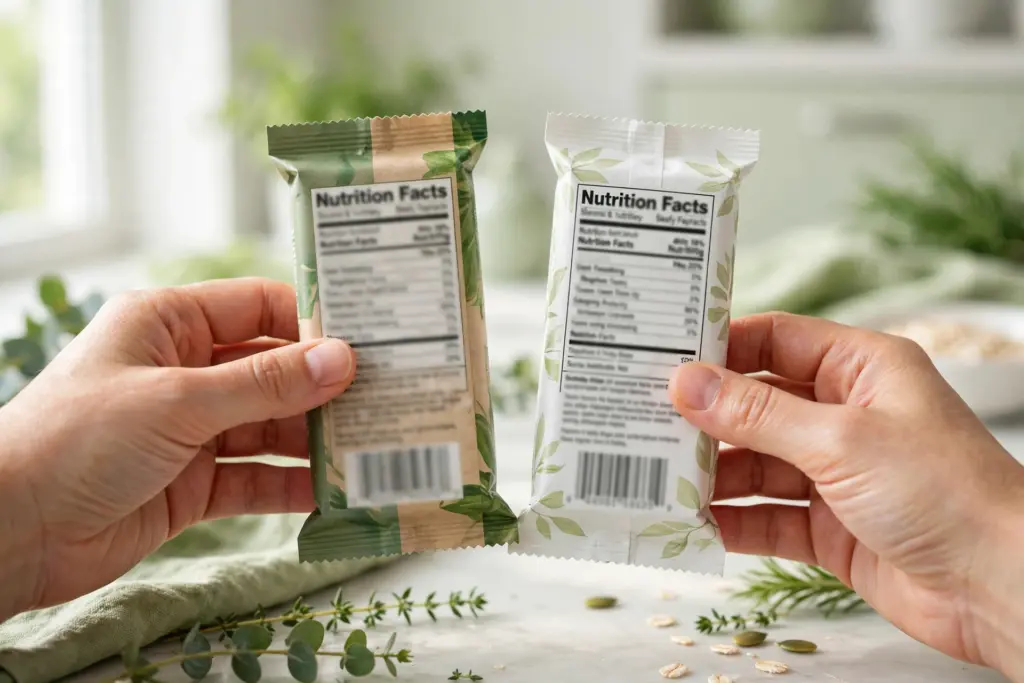
Since the 2016 label redesign, every Nutrition Facts panel has a separate “Includes Added Sugars” line, indented under Total Sugars. It answers a question the old label couldn’t: how much of this sugar was poured in during processing, and how much was already in the food?
The FDA counts as added sugars the sugars added during processing (like sucrose or dextrose), foods packaged as sweeteners (like table sugar), sugars from syrups and honey, and sugars from concentrated fruit or vegetable juices. It does not count the sugars naturally present in milk, fruit, or vegetables. The word “includes” matters: the added grams are already counted inside total sugars, not on top of them. The FDA’s own example is a sweetened yogurt with 15 grams of total sugars — 7 grams added and 8 grams naturally occurring — so the added line reads 7 grams, or 14% of the Daily Value.
That Daily Value is 50 grams a day on a 2,000-calorie diet, which lines up with the Dietary Guidelines advice to keep added sugars under 10% of calories. The American Heart Association goes further — no more than 25 grams a day for women and 36 grams for men — and the World Health Organization recommends keeping free sugars below 10% of energy, ideally below 5% (roughly 25 grams at 2,000 calories). A snack with 10 grams of added sugars already delivers 20% of the FDA’s Daily Value, and 40% of the Heart Association’s limit for women.
Then read the ingredient list, because the grams tell you how much and the ingredients tell you where it came from. Added sugar rarely appears under the single word “sugar” — researchers at the University of California, San Francisco have counted at least 61 different names for it on food labels. The 2025–2030 Dietary Guidelines offer a simple filter: look for ingredients that include the word “sugar” or “syrup,” or end in “-ose” — cane sugar, high-fructose corn syrup, agave syrup, fructose, glucose, dextrose, sucrose, maltose. Honey, molasses, and fruit juice concentrate belong on the same list; “natural” doesn’t mean “not added.”
Watch for the splitting trick, too. Ingredients must be listed in descending order by weight, so the first ingredient is what there is most of. Split one big dose of sweetener into cane sugar, brown rice syrup, and fruit juice concentrate, and each one weighs less than the oats or flour — so all three sink lower on the list while the total sugar stays the same. If you spot three sweeteners in one list, the added-sugars grams tell you the real total.
Sodium, saturated fat, and fiber: the three numbers that separate snacks
After serving size and added sugars, three lines do most of the work in a snack comparison.
Sodium. The Daily Value is 2,300 mg, and the American Heart Association’s ideal limit is no more than 1,500 mg a day. A single small bag of flavored chips can carry 300–400 mg — 13–17% of the day’s value in a handful. Anything at 20% DV (460 mg) or above is a high-sodium serving. A snack can be low in calories and still be a sodium bomb; the two numbers move independently.
Saturated fat. The Daily Value is 20 grams, so 4 grams in a serving already hits 20% DV. Snacks fried in palm oil or coconut oil, and anything with a cheese or chocolate coating, tend to land here. Total fat has a Daily Value of 78 grams, but the type matters more than the total — a handful of nuts is high in total fat and low in saturated fat, while a frosted snack cake is the reverse. The panel tells you the amount; the ingredient list tells you the source.
Dietary fiber. The Daily Value is 28 grams, and most adults fall well short of it — the Institute of Medicine’s adequate intake is 25 grams a day for women and 38 grams for men under 50. A snack with 5.6 grams (20% DV) is a genuinely strong serving. Whole-grain crackers, popcorn, and snacks built on beans or nuts usually clear that bar; refined-flour snacks rarely do.
Run your eye down the %DV column and stop at anything at or above 20%. If the highs are fiber and protein, the snack is pulling its weight. If the highs are sodium, saturated fat, and added sugars, the front-of-pack claims are doing the heavy lifting instead.
What the front-of-pack claims actually mean
The words on the front of a package aren’t marketing free-for-alls — most of them are defined terms with exact thresholds in the FDA’s regulations:
- “Low fat” means 3 grams of fat or less per serving. “Fat free” means less than 0.5 grams. But “reduced fat” only means at least 25% less fat than the regular version — a reduced-fat snack can still be high in fat if the original was very high.
- “Low sodium” means 140 mg of sodium or less per serving. “Very low sodium” is 35 mg or less, and “sodium free” is under 5 mg. A product with 150 mg per serving may be lower in sodium than average, but it cannot legally call itself low sodium.
- “Good source of fiber” means 10–19% of the Daily Value per serving — roughly 3 to 5 grams. “Excellent source” (or “high in”) means 20% or more, about 5.6 grams and up.
- “Sugar free” means less than 0.5 grams of sugar per serving — but the FDA has no legal definition for “low sugar,” so that phrase is a marketing choice, not a regulated claim.
- “Light” or “lite” means one-third fewer calories or 50% less fat than the reference product — a comparison to the original, not an absolute standard.
Two cautions: a claim about one nutrient says nothing about the others — a “low fat” cookie can still be loaded with added sugar. And the FDA updated its definition of “healthy” in late 2024, so older packages may carry the term under the previous criteria. When a claim sounds too good, flip the package and check the panel — the numbers are regulated, the adjectives only as good as their definitions.
Read also: How to Compare Nutrition Labels
The ingredient list: order matters more than length
The ingredient list is short, plain, and brutally honest — if you know its one rule. Ingredients are listed in descending order by weight, so the first ingredient is what there is most of, and the last is what there is least of.
For a snack that calls itself whole grain, the first ingredient should say so: “whole wheat flour,” “whole grain oats,” “whole grain brown rice.” If the first ingredient is “enriched wheat flour” and a whole grain appears third or fourth, the whole-grain claim is mostly window dressing. The same test works for nuts, fruit, and protein: a “peanut butter” bar whose first ingredient is corn syrup and whose peanuts appear halfway down the list is a syrup bar with peanuts, not a peanut bar.

A long ingredient list isn’t automatically a bad sign — bread needs yeast, salt, and oil. What matters is whether you recognize the first three or four ingredients and whether they match what the package promises. Also check the type of oil: the panel tells you how much saturated fat there is; the ingredient list tells you where it came from. Palm and coconut oils are high in saturated fat; sunflower, canola, and olive oils are mostly unsaturated.
A side-by-side comparison in practice
Two granola bars, Bar A and Bar B. Both weigh about 40 grams, both claim to be a wholesome snack, and both cost the same. Bar A lists one bar (40 g) as a serving. Bar B lists half a bar (20 g) as a serving, with two servings per bar — so double its numbers before comparing.
Per whole bar, Bar A runs 5% DV sodium, 10% DV saturated fat, 12% DV fiber, and 16% DV added sugars (8 g). Bar B runs 13% DV sodium, 25% DV saturated fat, 4% DV fiber, and 36% DV added sugars (18 g). The ingredient lists confirm it: Bar A starts with whole grain oats, almonds, and honey, while Bar B starts with brown rice syrup, cane sugar, and enriched flour, its sweetness split across three names so none sits at the top. And Bar B’s front says “low fat” — true at 2.5 grams — but low fat didn’t stop it from carrying 18 grams of added sugar. Same shelf, same price, same size, and the labels tell you everything in under a minute.
A 60-second label routine for the snack aisle
You don’t need to memorize the Daily Values — the %DV column does the arithmetic. Keep this order and it becomes automatic:
- Serving size. Is it the amount you’ll actually eat? If not, multiply.
- Added sugars. Under 5% DV is low; 20% DV (10 g) or more is high. Check the ingredient list for sugar, syrup, and “-ose” names — and count split sweeteners together.
- Sodium and saturated fat. Run the 5/20 rule: 20% DV or more is a high serving of something you usually want less of.
- Fiber. Look for 10% DV (about 3 g) as a decent serving and 20% DV (about 5.6 g) as a strong one.
- First three ingredients. Do they match what the package promises? Whole grains, nuts, or fruit up top is a good sign; syrups and refined flour up top is not.
- Claims, last. Translate each front-of-pack claim into its definition and check whether it describes the snack in your hand.
None of this makes any single snack “good” or “bad.” A snack with 12 grams of added sugar isn’t a problem on a day when the rest of your food is mostly whole and unsweetened. Labels are comparison tools, not verdicts — serving first, %DV second, ingredients third — and the rules behind them are the same for every brand on the shelf.
Frequently asked questions
What is the difference between total sugars and added sugars?
Total sugars include everything: sugars naturally present in milk, fruit, and vegetables, plus sugars added during processing. Added sugars are only the added part, and they are the ones with a Daily Value (50 grams). A plain yogurt and a sweetened yogurt can have similar total sugars but very different added sugars.
Is a snack with 0 grams of added sugar automatically healthy?
Not necessarily. Zero added sugar is a good sign, but the snack can still be high in sodium or saturated fat and low in fiber — a plain salted cracker with no added sugar can still carry 20% of your day’s sodium in one small serving.
Do “natural” sweeteners like honey and agave count as added sugars?
Yes. The FDA counts honey, maple syrup, agave, molasses, and fruit juice concentrates as added sugars when they’re used to sweeten a product. “Natural” describes where the sweetener came from, not whether it was added — on the panel it counts exactly the same as table sugar.
This article is for general information only and is not medical advice. If you have diabetes, heart disease, kidney disease, or another condition that makes sodium, sugar, or fat intake a medical concern, talk with your clinician or a registered dietitian about targets that fit your situation.
Sources
- U.S. Food and Drug Administration — How to Understand and Use the Nutrition Facts Label
- U.S. Food and Drug Administration — Daily Value on the Nutrition and Supplement Facts Labels
- U.S. Food and Drug Administration — Added Sugars on the Nutrition Facts Label
- American Heart Association — Added Sugars
- World Health Organization — WHO calls on countries to reduce sugars intake among adults and children
- Dietary Guidelines for Americans, 2025–2030