Meal Prep for Beginners: A Simple Sunday System
You do not need twenty identical containers. Two batch-cooked bases and a reliable formula cover most weekday dinners.
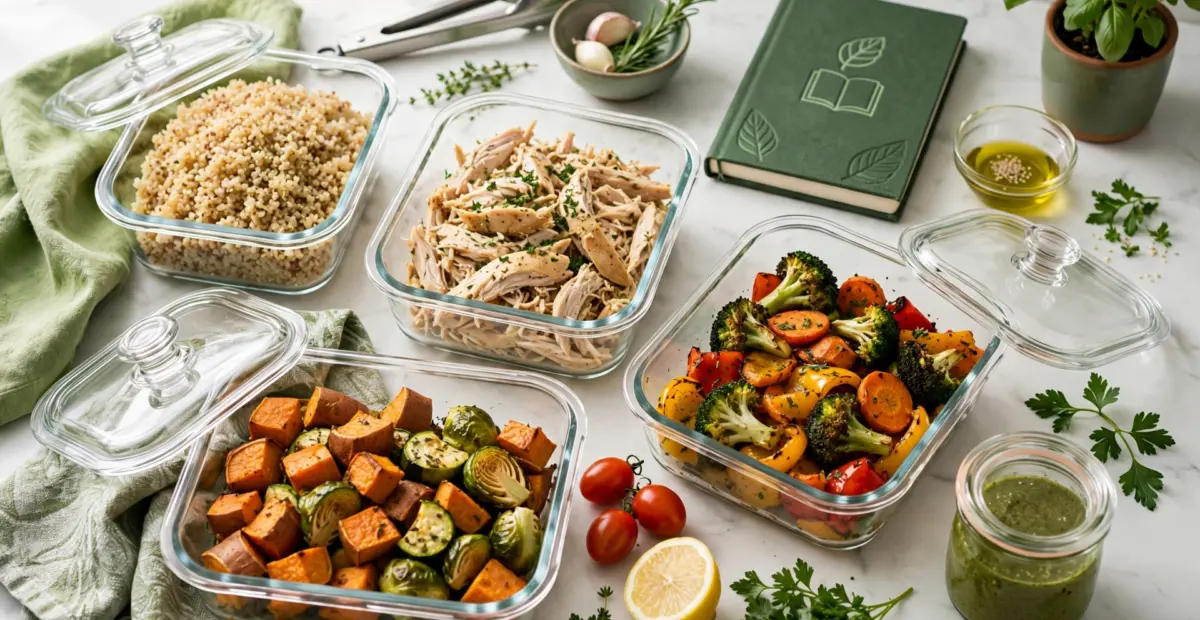
Most meal-prep advice fails beginners for the same reason most diets fail: it asks too much on day one. Cook twelve finished meals on Sunday! Spend your whole weekend in the kitchen! Then week two arrives, the containers are still dirty, and you’re back to ordering in. There is a gentler way that actually sticks. Instead of prepping finished plates, prep components — a few batch-cooked bases you can assemble into different meals all week in under five minutes. Two hours on Sunday, four calm weeknights. That is the whole system.
This guide walks you through it step by step: the weekly rhythm, the component formula, exactly what to cook, the food-safety numbers that keep you safe, and how to keep it interesting without cooking more. No special equipment required, and you don’t need to be a “cook” to start.
Why prep beats willpower
You don’t eat badly because you lack discipline. You eat badly because by 7 p.m. you’re hungry, tired, and faced with twenty decisions: what to cook, whether you have the ingredients, how long it’ll take. Hungry people pick the fastest option, not the best one. Meal prep works because it moves the decisions to a calmer moment. On Sunday afternoon, with a cup of tea and no growling stomach, “salmon and quinoa” sounds completely doable. On Thursday night, it just needs assembling — which takes less time than deciding what to order.
There’s a second benefit too: your grocery bill shrinks. Shopping from a list cuts impulse buys, and prepped food rarely becomes waste because it already has a job.
The Sunday system in six steps
Block two hours. Put on music or a podcast. The order matters because it stacks your time: while the grains cook, you prep the vegetables; while the vegetables roast, you make the protein.
1. Pick three dinners, not seven. Choose three dinners you’ll happily eat twice each. Breakfast and lunch can repeat or stay simple. Write the three dinners on your phone.
2. Write the grocery list from those meals. Work backward: chicken thighs, quinoa, two bell peppers, tahini, eggs, oats. This list replaces browsing the store and it’s what saves the money.
3. Start with what cooks itself. Grains and eggs go first — quinoa or brown rice on the stove, roasted vegetables in the oven, eggs boiling in a second pot. Almost no attention needed.
4. Cook one or two proteins. While the oven runs, bake chicken thighs, pan-fry tofu, or simmer lentils. Two proteins keeps the week from feeling repetitive.
5. Make one sauce. Five minutes. A lemon-tahini dressing, a simple pesto, or a yogurt sauce. Sauce is what turns the same grain and vegetable into four different meals.
6. Cool, portion, label. Let everything cool, pack into containers, label with the date, and refrigerate. Done in under two hours — under ninety minutes with practice.
The component formula: protein + carb + vegetable + flavor
Forget finished recipes. Every dinner you eat this week builds from the same four-part formula: a protein, a carbohydrate, a vegetable, and something flavorful — a sauce, a spice, a squeeze of citrus. A bowl of shredded chicken + quinoa + roasted peppers + lemon-tahini is one meal. The same chicken + brown rice + cucumber + a spoonful of harissa is a completely different dinner. The formula keeps nutrition balanced without measuring anything: protein keeps you full, the carb gives energy, the vegetable covers fiber and micronutrients, and the flavor component makes you actually want to eat it.
Breakfast gets an even simpler formula: overnight oats with frozen berries and yogurt, or boiled eggs with fruit and toast. Prep them while the oven runs and breakfast handles itself.
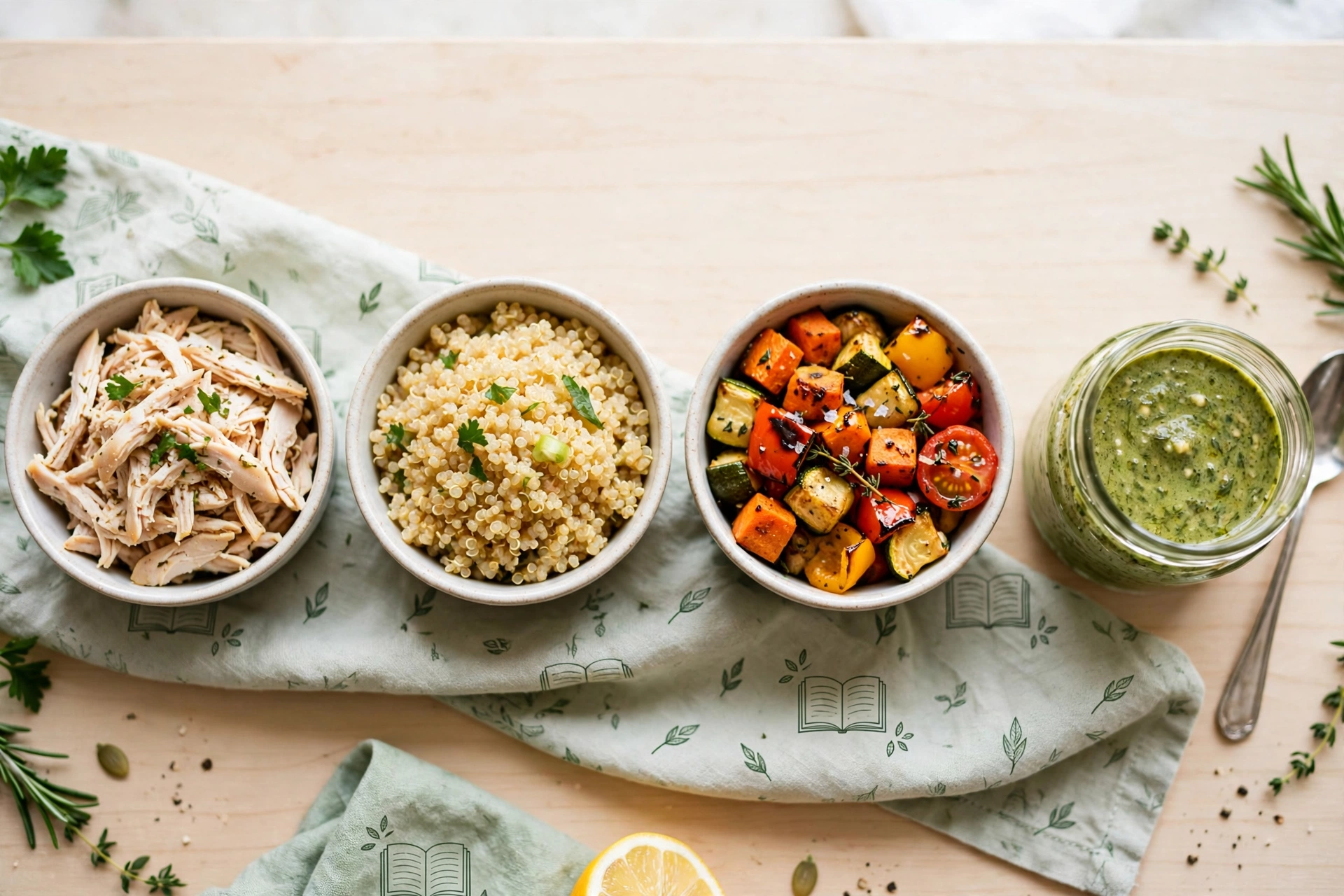
What to batch-cook: the beginner’s shopping and cook list
Keep your first few weeks boring on purpose. These are the foods that cook in bulk, store well for days, and forgive small mistakes.
Grains (cook once, eat for days): brown rice, quinoa, or farro. They hold texture for four to five days in the fridge and reheat well with a splash of water. Quinoa adds protein (about 8 grams per cooked cup); brown rice is the cheapest option.
Proteins (pick two): shredded chicken thighs, baked tofu, hard-boiled eggs, or lentils. Chicken thighs stay juicier than breasts on reheating. Lentils and chickpeas are the budget heroes — pennies per serving and rich in fiber.
A roasted vegetable tray: bell peppers, zucchini, red onion, carrots, broccoli. Toss with olive oil and salt, roast at 200°C (400°F) for 20–25 minutes. Roasting concentrates flavor, which matters when you’re eating the same tray on day three.
One sauce (the secret weapon): lemon-tahini (tahini + lemon juice + garlic + water), a simple pesto, or yogurt with lemon and salt. Sauces are what turn bland into interesting. Keep one “flavor jar” per week.
Extras that need no cooking: bagged salad greens (add fresh, never prepped — see storage below), canned tuna, hummus, nuts, frozen berries, wraps.
Food safety: the numbers that matter
This is the part of meal prep that actually matters for your health, and it’s refreshingly concrete. Follow these rules and your five-day-old food is safe food.
Read also: How to Cook More Meals at Home
The two-hour rule. Get cooked food into the fridge within two hours of cooking. Perishable food sitting between 40°F and 140°F (4°C and 60°C) — the “danger zone” — grows bacteria quickly, so don’t leave your Sunday spread on the counter while you watch TV. On a hot day above 90°F (32°C), the window shrinks to one hour. USDA guidance
Three to four days in the fridge. Cooked leftovers stay safe refrigerated for 3 to 4 days, according to the USDA Food Safety and Inspection Service. That means Sunday’s cooking is good through Wednesday or Thursday — which is why anything you won’t reach by Thursday should go in the freezer on Sunday. University of Illinois Extension, citing USDA FSIS
Fridge and freezer temperatures. Keep your refrigerator at 40°F (4°C) or below and your freezer at 0°F (−18°C) or below. Frozen food stays safe indefinitely at 0°F, but quality declines — frozen leftovers hold their best quality for about 2 to 3 months, cooked chicken up to 4 months. FoodSafety.gov storage guidance
Reheat to 165°F (74°C). When you reheat leftovers — on the stove, in the oven, or in the microwave — bring them to a steaming 165°F (74°C) internal temperature, and reheat only once. Don’t reheat the same portion repeatedly through the week. University of Illinois Extension, citing USDA FSIS
Cool big pots fast. Never put a steaming pot straight into the fridge — it warms everything around it. Divide large batches into smaller, shallow containers so they cool quickly, then refrigerate. And thaw frozen preps in the refrigerator overnight, not on the counter.
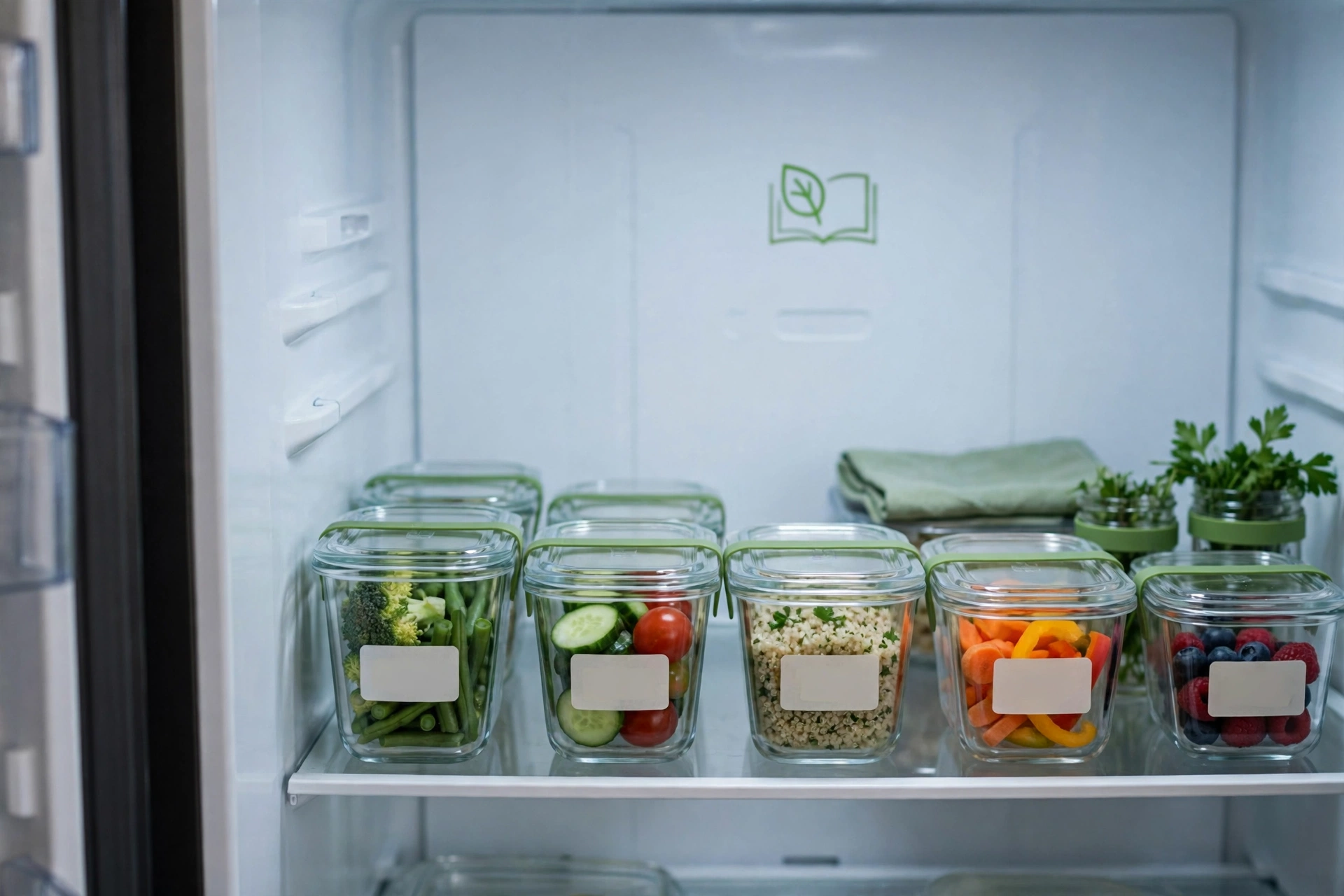
Containers and labeling: the boring stuff that makes it work
You do not need a matching set of twenty glass containers from a lifestyle brand. What matters: containers that actually seal (leaks ruin fridges), are microwave-safe if you’ll reheat in them, and are shallow enough to cool food quickly. Glass reheats without staining and doesn’t absorb smells; basic plastic is cheaper and lighter — either works if it seals well.
Label every container with what’s inside and the date you cooked it. A piece of masking tape and a marker is enough. This sounds fussy until it’s Thursday and you’re staring at three identical containers wondering which is the oldest. Date labels are also how you honor the 3–4 day rule without keeping a mental spreadsheet.
Keep it interesting without cooking more
The number one reason people quit meal prep is boredom, and the fix is not cooking more food — it’s varying the flavor. One batch of chicken, quinoa, and roasted vegetables becomes: a Mediterranean bowl with lemon-tahini and olives; a burrito bowl with salsa and black beans; an Asian bowl with soy sauce and sesame; a curry bowl with curry paste stirred through. Same base, four dinners. Change the sauce, not the base.
Texture helps too. Keep something crunchy to add fresh: toasted nuts, seeds, raw cucumber, a handful of greens at assembly. One crunchy element fixes the soft-on-soft problem of reheated meals.
And start small on purpose. Two proteins, one grain, one vegetable tray, one sauce — that’s a complete week. Add variety in week three, once the habit exists.
When it goes wrong: quick fixes
Soggy greens: never store greens mixed into hot food. Keep salad components in a separate container and add them fresh at assembly — thirty seconds of work, completely different result.
Dry chicken: switch to chicken thighs instead of breasts, and reheat with a splash of water and the container lid cracked, not sealed. Better yet, shred it and mix it into sauced dishes.
Mushy reheated rice: rice dries out in the fridge. Sprinkle a tablespoon of water over it before microwaving, cover loosely, and it steams back to life.
You skip week two: normal. The system isn’t broken, you just overbuilt week one. Scale back to two proteins and one grain. A half-prepped week beats an unprepped one.
Frequently asked questions
How long does the Sunday session actually take? About two hours the first time, shrinking to ninety minutes with practice. The trick is the cooking order — grains and eggs first, vegetables in the oven while proteins cook. If two hours still sounds like a lot, start with a “mini prep”: a grain, a protein, and a sauce. Even forty-five minutes of prep changes your week.
Is meal prep safe for the whole work week? Yes, with the 3–4 day rule. Sunday’s cooking is safe through Wednesday or Thursday in a fridge at 40°F (4°C) or below. For Friday, freeze portions on Sunday and thaw overnight — or plan Friday as your fresh-cooking night.
Do I need special containers? No. Any container that seals tightly, is microwave-safe, and is shallow enough to cool food quickly works. Glass doesn’t stain or hold smells; plastic is cheaper and lighter. What matters most is a marker and tape to label dates.
Is meal prep actually cheaper? For most people, yes. Shopping from a list cuts impulse buys, batch cooking wastes less food, and five home-prepped dinners replace five takeout orders. Once the system runs itself, the Sunday grocery trip becomes your only food shopping of the week.
Sources
- USDA — “Leftovers: The Gift that Keeps on Giving” (two-hour rule, danger zone, 3–4 days, 165°F reheat)
- University of Illinois Extension — Leftovers and food safety (USDA FSIS storage and reheating guidance)
- FoodSafety.gov cold storage charts — safe internal temperatures, fridge and freezer temperatures
Disclaimer: This article is for general nutrition information only and is not medical advice. If you have a health condition that affects food safety or diet, talk to a qualified health professional.