How to Make Nutrition Fit Your Lifestyle
If healthy eating keeps falling apart on busy days, the problem may not be your willpower. It may be the plan. A routine built for someone else’s schedule, kitchen, budget, or taste will always feel like a fight — and fights are hard to repeat every day. Nutrition that fits your life looks different: it bends around early shifts, school runs, late meetings, small kitchens, and tight weeks, without asking you to start over each Monday.
The goal here is not perfection. It is a way of eating that survives real life. You keep a few steady anchors, you make the easy choice the healthy one more often, and you let the rest stay flexible. That is enough — and, over time, it adds up to far more than a strict plan you abandon by Wednesday.
Start with your life, not a rulebook
Before you change what you eat, look at how your days actually run. When do you eat? Where? Who cooks, and how much time is there really? Do you eat at a desk, in a car, at a canteen, or standing in the kitchen while dinner finishes?
Write down three honest facts about a normal week. For example: breakfast happens in ten minutes, lunch is bought near the office, and dinner is cooked at home four nights a week. Those facts are your design brief. A plan that ignores them will fail no matter how sound its nutrition advice is. A plan built on them has a chance, because it works with the grain of your week instead of against it.
It also helps to name your constraints without judging them. A small fridge, a shared kitchen, a limited budget, a partner who dislikes spicy food, a child who eats only five things — these are not excuses. They are the conditions your eating pattern has to live inside. Design for them, and the pattern lasts.
Use a plate, not a spreadsheet
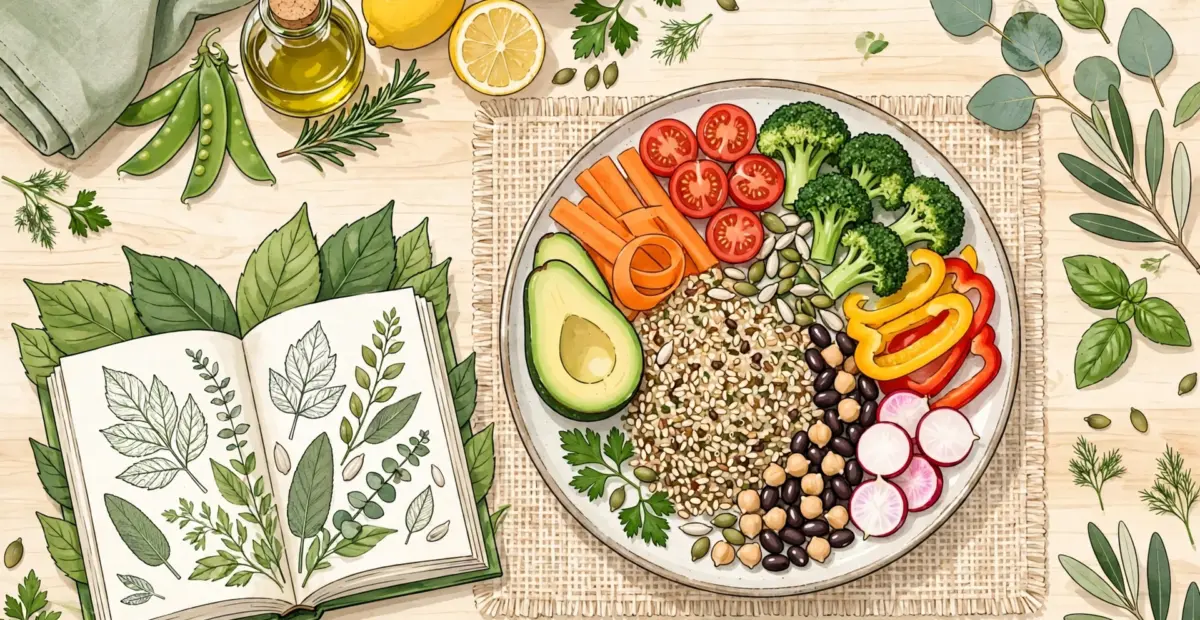
Counting every gram works for some people, but for most busy lives a visual guide is easier to keep. The Harvard Healthy Eating Plate suggests a simple shape: about half the plate vegetables and fruit, about a quarter whole grains, and about a quarter healthy protein, with water as the default drink and healthy oils such as olive oil in cooking. No weighing, no app, no maths at the table.
That shape travels well. At home, it is a bowl of rice, beans, and roasted vegetables. At a canteen, it is a salad base with a grain and a protein on top. At a sandwich shop, it is a whole-grain roll with a protein filling and as much salad as will fit. The foods change; the shape stays recognisable, and that recognition is what makes it repeatable.
Read also: How to Build a Balanced Plate
The World Health Organization (WHO) gives the same direction in numbers: at least 400 grams — about five portions — of fruit and vegetables a day, free sugars below 10% of daily energy (ideally below 5%, which is about 50 grams, or 12 teaspoons, at 2,000 calories a day, and 25 grams at the 5% level), and salt below 5 grams a day, roughly a teaspoon. You do not need to hit those numbers exactly every day. They are a compass, not a daily exam. A plate that is mostly plants, with a whole grain and a protein, points in the right direction most of the time.
Pick a few defaults and let them carry the week
Decision fatigue is real. If every meal needs a fresh decision, you will eventually pick whatever is closest and fastest. Defaults fix that. A default is a meal you can make without thinking, from things you usually have at home.
Choose two or three for each part of the day. Breakfast might be oats with fruit and yogurt, or eggs on whole-grain toast with tomato. Lunch might be a grain bowl with beans and frozen vegetables, or leftovers from dinner. Dinner might rotate through three reliable templates: a bean and vegetable soup with bread, a stir-fry with rice and tofu or chicken, and pasta with vegetables and lentils. None of these needs a recipe search. They need a stocked shelf and a little practice.
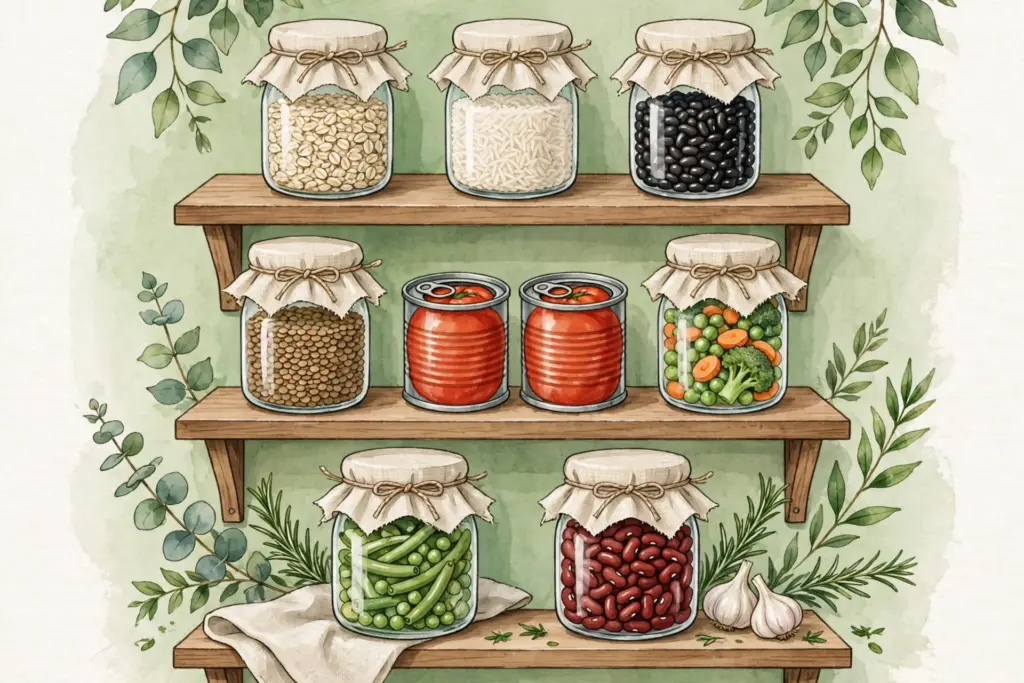
Defaults also protect your budget. When the default is built from pantry staples — oats, rice, beans, lentils, canned tomatoes, frozen vegetables — it costs less than improvising at a takeaway counter. Keep those staples topped up, and the healthy choice stops being the expensive one.
One more thing about defaults: keep them food you actually like. A kale smoothie you dread will not survive a tired evening. A vegetable soup you enjoy will. Taste is not a bonus feature of a sustainable eating pattern; it is the feature that keeps it going.
Shape your surroundings so the easy choice helps you
You eat what is within reach. That simple fact can work for you or against you, and rearranging the reach is often easier than rearranging your appetite.
Put fruit in a bowl on the counter and washed vegetables at eye level in the fridge. Keep a water bottle where you work. Store the foods you want less often a little further away — on a high shelf, in a box, out of the direct line of sight. At work, keep a small stash of sensible snacks — nuts, fruit, whole-grain crackers — in a drawer, so a vending machine is not your only option at 4 p.m.
The same logic applies to time. A ten-minute prep the night before — washing salad leaves, cooking a pot of rice, portioning leftovers into lunch boxes — removes the morning scramble that so often ends in a pastry. You are not adding discipline. You are removing friction from the choice you already wanted to make.
Fit nutrition to your schedule, not the other way round
Different weeks need different shapes, and that is fine. The point is to have a version of healthy eating for each kind of day you actually have.
On rushed mornings, keep breakfast portable: overnight oats made the night before, a yogurt and fruit pot, or a banana with a handful of nuts. Eating something steady beats skipping breakfast and arriving at lunch ravenous, even if the breakfast is simple.
On desk-lunch days, build lunch around the plate shape with foods that travel: a grain, a protein, and vegetables that do not wilt by noon. A chickpea and vegetable salad, a lentil soup in a flask, or a wrap packed with salad and beans all hold up well.
Read also: How to Keep Healthy Eating Simple
On late or shift-work days, plan the meal that comes after the shift rather than leaving it to chance. A light, balanced meal before a night shift and something easy to reheat afterwards beats a large takeaway at 2 a.m. simply because nothing else was ready. If your sleep pattern shifts, keep regular meal times within each shift block where you can — your body handles routine better than chaos, even if the routine itself is unusual.
On family days, cook one meal with flexible parts rather than two separate dinners. A taco night where everyone fills their own, a pasta base with vegetables on the side, or a roast vegetable tray with bread, cheese, and beans lets each person build a plate that suits them from the same table.
On eating-out days, use the same plate idea: look for a vegetable-rich starter or side, pick a whole grain or a vegetable-based side where you can, and choose water or an unsweetened drink. You do not need to interrogate the menu. One or two better choices in a meal you enjoy are worth more than a perfect order you resent.

When the plan breaks, shrink it — don’t scrap it
Every eating pattern breaks sometimes. A holiday, an illness, a deadline, a celebration. The difference between people who keep going and people who stop is rarely the break itself. It is what happens the next day.
When a week goes sideways, shrink the habit instead of abandoning it. If a full home-cooked dinner is too much, make a simple plate: bread, cheese or beans, and a salad. If a week of meal prep is impossible, prep one thing — a pot of rice, a tray of roasted vegetables — and let it carry two meals. A smaller version of the habit keeps the thread alive, and picking it back up feels easy rather than daunting.
Research on habit formation backs up this patience. In a study of 96 volunteers building a new daily habit, the average time to reach a plateau of automaticity was 66 days, but the range ran from 18 to 254 days — and missing a single day did not materially affect the process (Lally et al., 2010). In other words, one off day is not a reset. It is a normal part of a pattern that is still forming. Give a new routine weeks, not days, before you judge it.
Read also: How to Build Better Food Habits Gradually
A simple weekly rhythm you can copy
If it helps to see one concrete week, here is a rhythm many busy households find workable. It is a template, not a prescription — swap the foods for ones you like and can afford.
- Two batch-cook slots: one on a weekend day, one midweek. Cook a grain, a bean or lentil dish, and a tray of vegetables. These become lunches and quick dinners for days.
- Three default dinners you can cook without a recipe, rotating through the week.
- One flexible night for eating out, takeaway, or whatever is in the freezer — planned, not guilty.
- One restock moment: a short list built from your defaults, so the staples never run out at the worst time.
Notice what is missing: no banned foods, no calorie target, no separate “diet” meals. The structure does the work, so your willpower does not have to.
Money, culture, and taste are part of nutrition too
A pattern that ignores your budget or your food culture will not last, however good it looks on paper. Frozen and canned vegetables count toward your daily total, and they are often cheaper and less wasteful than fresh produce that spoils. Beans and lentils give protein and fibre at a fraction of the price of meat. Seasonal fruit, store-brand whole grains, and cooking in larger batches all stretch a food budget without shrinking nutrition.
Food culture matters just as much. The plate shape works with rice and dal, with tortillas and beans, with couscous and chickpeas, with noodles and tofu and vegetables. Keep the dishes that mean something to you, and adjust the proportions — more vegetables, a whole grain where you can, a protein you enjoy — rather than replacing your food with someone else’s idea of healthy eating.
Read also: Small Diet Changes That Last
Frequently asked questions
Do I need to meal prep every week to eat well?
No. Meal prep helps, but a few defaults and a stocked pantry can carry you just as well. Even one batch-cooked item a week — a pot of soup, a tray of vegetables — makes several later meals easier. Start with whatever level of prep fits your week, and add more only if it genuinely helps.
What if my family eats differently from me?
Cook shared meals with flexible parts: one base, several toppings or sides, so everyone builds their own plate. That avoids cooking twice and avoids making one person’s food feel like a punishment. Small proportion shifts — more vegetables on the table, a whole grain alongside — benefit everyone without a separate menu.
Is eating out incompatible with healthy eating?
Not at all. Eating out is part of life, and a pattern that cannot survive a restaurant meal is too fragile to keep. Use the plate shape loosely, enjoy the meal, and return to your defaults at the next meal. One meal does not define your eating pattern; the overall shape across weeks does.
How long until this feels normal?
Longer than the slogans suggest, and that is normal. In the Lally et al. (2010) study, daily habits took an average of 66 days to feel automatic, with wide variation between people. Judge a new routine after several weeks of mostly keeping it, not after one difficult week — and shrink it on hard days rather than dropping it.
The bottom line
Nutrition fits your lifestyle when it is built from your actual days: a plate shape you can recognise anywhere, a few defaults you enjoy, surroundings that make the better choice easy, and a smaller fallback version for the weeks that go wrong. You do not need a new life to eat well. You need an eating pattern that fits the life you already have — and the patience to let it settle in.
This article is for general information only and is not medical advice. If you have a health condition, food allergy, or specific dietary needs, talk to a qualified health professional or registered dietitian about what suits you.
Sources
- World Health Organization — Healthy diet: at least 400 g of fruit and vegetables a day; free sugars below 10% of energy, ideally below 5%; salt below 5 g a day.
- Harvard T.H. Chan School of Public Health — Healthy Eating Plate: half vegetables and fruit, a quarter whole grains, a quarter healthy protein.
- Lally, P., van Jaarsveld, C. H. M., Potts, H. W. W., & Wardle, J. (2010). How are habits formed: Modelling habit formation in the real world. European Journal of Social Psychology, 40(6), 998–1009: average 66 days to automaticity, range 18–254 days, 96 volunteers; missing one day did not materially affect formation.