How to Build a Balanced Smoothie
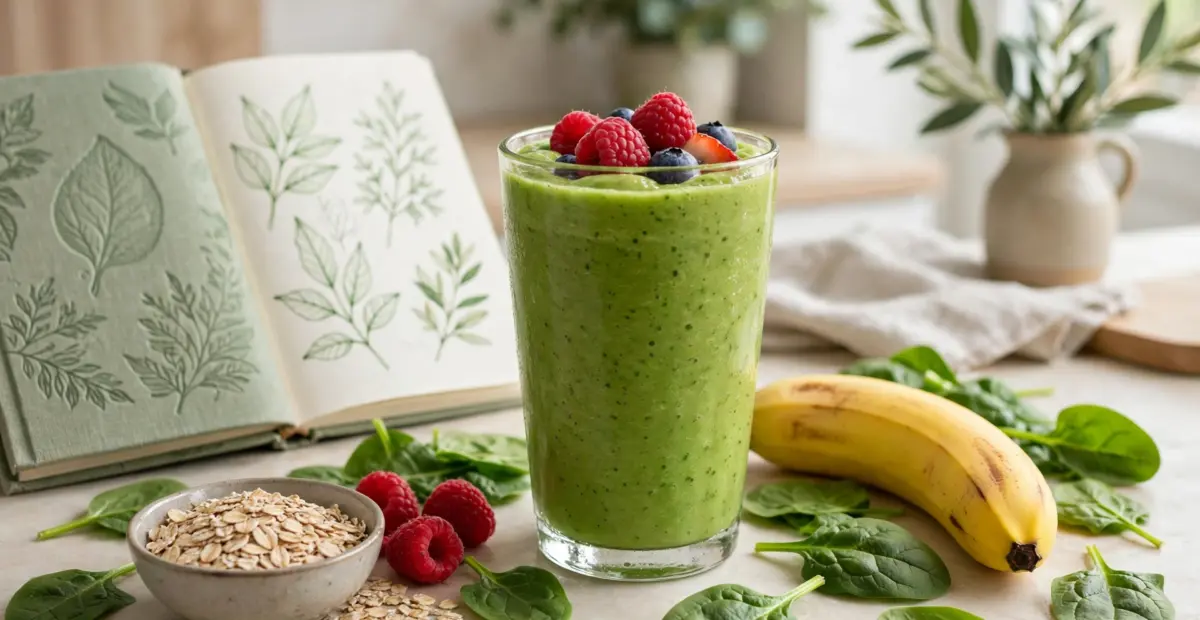
A good smoothie takes about three minutes to make and about three seconds to drink — which is exactly why it deserves a little more thought than most of us give it. Toss in whatever is in the fridge and you can end up with something genuinely nourishing. Toss in whatever is in the fridge without a plan and you can just as easily end up with a milkshake wearing a health halo.
The difference between the two isn’t willpower or expensive superfoods. It’s structure. A balanced smoothie has a job to do: keep you full, cover a meaningful share of your fruit and vegetable intake, and taste good enough that you’ll make it again tomorrow. Once you know the formula, you can build one from almost anything in your kitchen.
What makes a smoothie “balanced” anyway?
Think of a smoothie the same way you’d think of a plate. The classic plate method — half vegetables and fruit, a quarter protein foods, a quarter whole grains — still works as a mental model, even though the USDA retired the MyPlate graphic in January 2026 and replaced it with a new dietary graphic. In a blender, that plate becomes four parts:
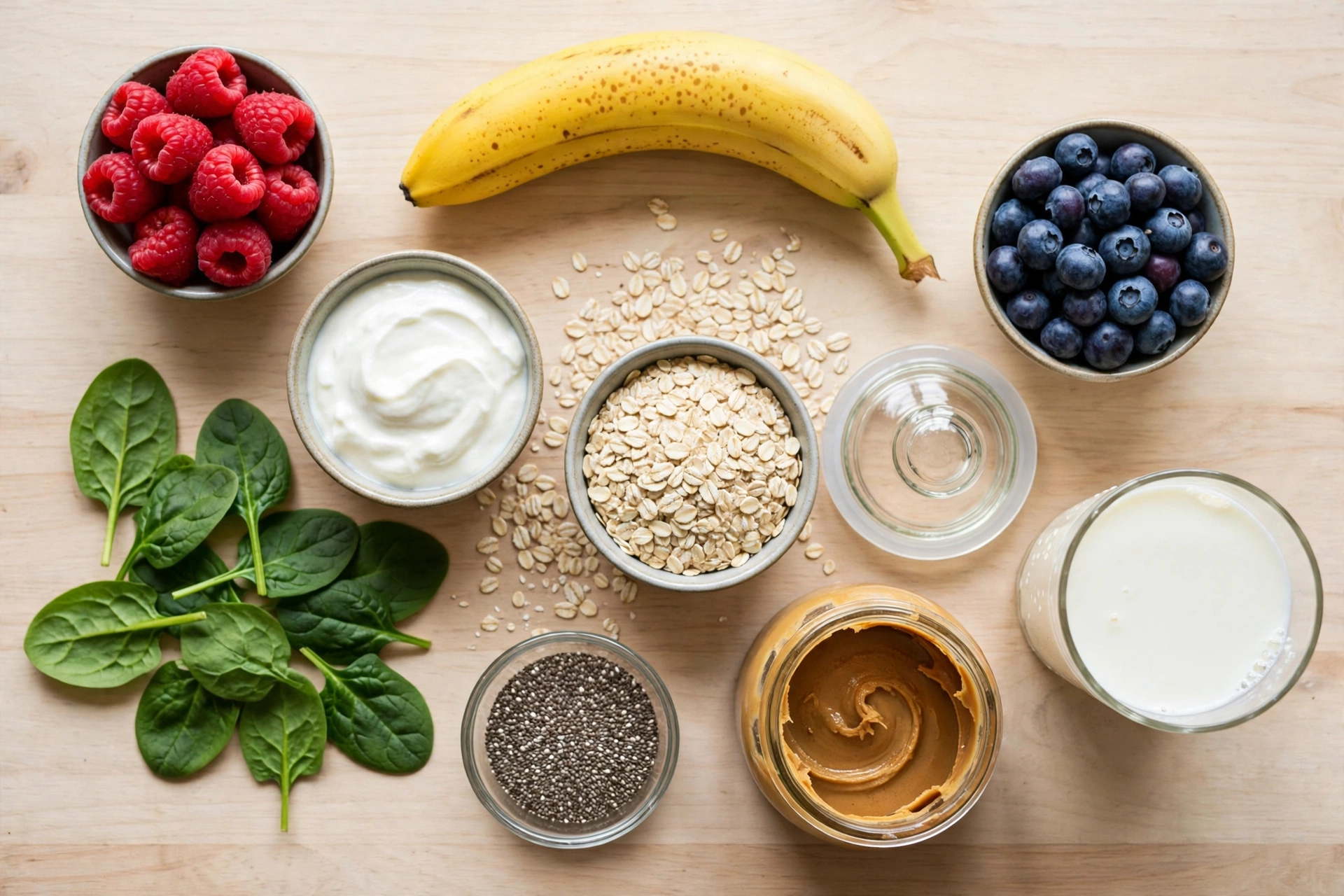
- Produce (about half the blender): fruit for sweetness and flavor, plus a handful of greens or other vegetables. This is where most of the fiber, vitamin C, potassium, and color come from.
- Protein (one part): Greek yogurt, milk, soy milk, tofu, or a scoop of nut butter. Without it, a smoothie is a snack, not a meal — you’ll be hungry again in an hour.
- Fiber and staying power (one part): oats, chia seeds, flaxseed, or more fruit. Fiber slows digestion and keeps the energy from your smoothie arriving all at once.
- Healthy fat (a small part): a spoonful of peanut butter, a few nuts, half an avocado, or a drizzle of seeds. Fat carries flavor and helps your body absorb the fat-soluble vitamins in all that produce.
Then a liquid to bring it together — water, milk, or unsweetened plant milk. That’s it. No magic ingredient, no powder that costs more than the groceries.
The numbers behind the formula
A smoothie is one of the easiest ways to close the gap most of us have on produce. The Dietary Guidelines for Americans 2025–2030 recommend about 3 servings of vegetables and 2 servings of fruit a day on a 2,000-calorie pattern — and most adults fall well short. One generous smoothie with a cup of berries and a big handful of spinach covers a full fruit serving and a good chunk of a vegetable serving before you’ve even had breakfast.
Fiber is the other gap a smoothie can quietly fix. The Academy of Nutrition and Dietetics recommends about 14 grams of fiber for every 1,000 calories you eat — roughly 25 grams a day for women and 38 for men. Most adults get about half that. A cup of raspberries alone brings 8 grams of fiber for 64 calories, according to USDA FoodData Central values; a medium banana adds about 3 grams. Blend whole fruit instead of juice and you keep that fiber. Juice it, and the fiber is gone — which is the main reason whole fruit beats juice almost every time.
Protein is the piece people skip most often. The recommended dietary allowance for protein is 0.8 grams per kilogram of body weight per day, and the 2025–2030 Dietary Guidelines suggest most adults aim higher, around 1.2 to 1.6 grams per kilogram, spread across meals. A single-serve container of plain nonfat Greek yogurt (170 g) gives you about 17 grams of protein for around 100 calories — that alone can turn a fruit drink into a breakfast that holds you until lunch.
Read also: Balanced Breakfast Smoothie Ideas
Three combos that actually work
Recipes help, but formulas help more. Here are three starting points — each one hits all four parts of the formula, and each one is easy to adjust with what you have.
1. The green starter
One banana, a big handful of spinach, ¾ cup plain Greek yogurt, a tablespoon of peanut butter, and a cup of water or milk. The banana and spinach cover produce; the yogurt and peanut butter bring roughly 20 grams of protein; the peanut butter adds healthy fat. If the spinach makes you nervous, start with half a handful — you genuinely cannot taste it behind the banana, and the color is the only giveaway.
2. The berry and oat bowl-drinker
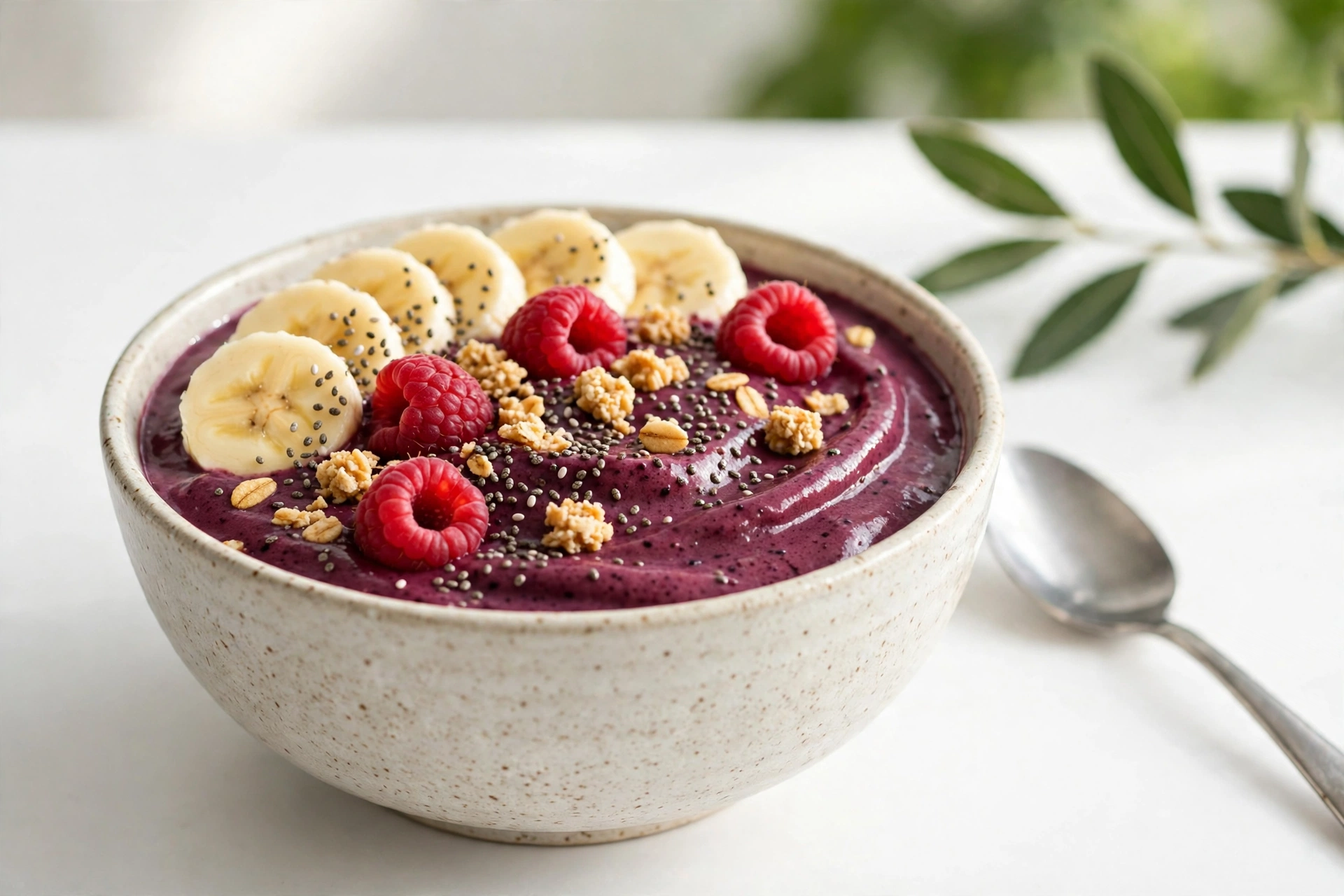
One cup of frozen raspberries or mixed berries, ¼ cup dry rolled oats, a tablespoon of ground flaxseed, a single-serve container of plain Greek yogurt, and a cup of unsweetened almond milk. Blend the oats and flaxseed with the milk first, then add the rest — it comes out smoother. This one lands around 10 grams of fiber and 24 grams of protein, and the oats make it thick enough to eat with a spoon if you pour it into a bowl and add a few toppings.
3. The tropical, no-dairy version
One cup of frozen mango, half a cup of frozen pineapple, a handful of kale, half a block of silken tofu, and a cup of soy milk. The tofu disappears completely into the texture and adds around 8 grams of protein per half cup, while the soy milk adds another 7 or 8 grams per cup. Frozen fruit does double duty here: it sweetens, it thickens, and it costs less than fresh out of season.
The five mistakes that turn a smoothie into dessert
Most smoothies go wrong in the same five ways. None of them is hard to fix.
1. Too much fruit, not enough of anything else. Three bananas and a cup of mango is a fruit salad in a glass — sweet, and gone from your stomach in forty minutes. Keep fruit to about one to one-and-a-half cups total and let vegetables, protein, and fiber do the rest.
2. Juice as the liquid. A cup of orange juice adds sugar without fiber and quietly turns a 250-calorie smoothie into a 400-calorie one. Water, milk, or unsweetened plant milk does the blending job just as well.
3. Sweeteners you don’t need. Honey, agave, maple syrup, and sweetened yogurt are all added sugar, and the American Heart Association recommends keeping added sugar to no more than 25 grams a day for most women and 36 grams for most men. A ripe banana or a handful of berries usually sweetens a smoothie on its own — taste it before you reach for the honey.
4. No protein. A smoothie made of fruit and juice alone is a snack, not a meal. If you’re drinking it in place of breakfast or lunch, it needs a protein anchor — yogurt, milk, soy milk, tofu, or nut butter.
5. Portion creep. A blender holds a lot. A 20-ounce smoothie with nut butter, oats, and two kinds of fruit can easily pass 500 calories — fine if that’s your meal, less fine if it’s “just a snack” alongside breakfast. Build it in a glass you can see, not straight from the blender jar.
Read also: How to Make a Balanced Snack With Protein
Smoothie vs. juice vs. just eating the fruit
People ask this a lot, and the answer is simpler than the internet makes it. Eating whole fruit is the gold standard: you get the fiber, you chew, and the sugar arrives slowly. A smoothie made from whole fruit is a close second — the fiber is still there, because blending doesn’t remove it, it just chops it smaller. Juice is the outlier: it strips the fiber out and leaves the sugar behind, which is why a glass of orange juice spikes blood sugar faster than eating the oranges would.
There’s one more difference worth knowing. Liquid calories don’t satisfy the way solid food does — studies on satiety consistently find that we feel fuller after chewing than after drinking the same nutrients. So a smoothie is best when it has something to chew on the side (a slice of whole-grain toast, a handful of nuts) or when it’s thick enough to eat with a spoon. That small bit of chewing makes a real difference to how long you stay full.
Read also: How to Build a Balanced Plate
Make it a habit, not a project
The best smoothie routine is the boring one. Keep frozen fruit in the freezer — it never goes bad, it’s cheaper than fresh out of season, and it makes the smoothie cold and thick without ice. Wash your greens the day you buy them so a handful is always ready. Pre-portion oats and seeds into small jars on a Sunday, and the whole thing becomes a two-minute job on a weekday morning.
And keep it flexible. The formula stays the same; the ingredients rotate with the season, the sales, and whatever is about to go soft in the fruit bowl. That’s not sloppy cooking — that’s the point. A balanced smoothie isn’t a recipe you follow perfectly. It’s a pattern you can use with almost anything, on almost any morning.
Frequently asked questions
Are smoothies actually healthy?
They can be — it depends entirely on what’s in them. A smoothie built on whole fruit, vegetables, a protein source, and fiber is a genuinely nutritious meal. A smoothie built on juice, sweetened yogurt, and honey is dessert. The blender doesn’t decide; the ingredients do.
Can a smoothie replace a meal?
Yes, if it has enough protein and fiber to keep you full — roughly 15 to 20 grams of protein and at least 5 grams of fiber is a good benchmark for a meal-sized smoothie. A fruit-only blend won’t hold you, so add yogurt, milk, soy milk, tofu, or nut butter.
Is it better to use fresh or frozen fruit?
Either works. Frozen fruit is picked and frozen at peak ripeness, so its nutrient content is comparable to fresh, and it makes smoothies thick and cold without ice. Fresh fruit is better when it’s in season and affordable. Use whichever you have.
Do I need protein powder?
No. Greek yogurt, milk, soy milk, tofu, and nut butters all add plenty of protein without powder. Protein powder is a convenience, not a requirement — and it adds cost and often added sweeteners. If you use one, check the label for added sugar and keep the serving to one scoop.
This article is for general information only and is not medical advice. If you have diabetes, kidney disease, or any condition that affects how you eat, talk with your clinician or a registered dietitian before changing your diet.
Sources
- Dietary Guidelines for Americans, 2025–2030 — U.S. Department of Agriculture and U.S. Department of Health and Human Services (fruit, vegetable, and protein recommendations; added sugar under 10% of calories)
- Dietary Fiber — Academy of Nutrition and Dietetics (14 g fiber per 1,000 calories; ~25 g women, ~38 g men)
- How Much Sugar Is Too Much? — American Heart Association (added sugar limits: 25 g women, 36 g men per day)
- Dietary protein intake and human health — Food & Function, 2016 (protein RDA 0.8 g/kg/day)
- USDA FoodData Central — U.S. Department of Agriculture (raspberries 8 g fiber per cup; banana ~3 g fiber; plain nonfat Greek yogurt ~17 g protein per 170 g container)