How to Make a Balanced Snack With Protein
You know the pattern. It’s 3:30 in the afternoon, lunch feels like a distant memory, and your stomach is already negotiating for something — anything — from the vending machine. You grab a granola bar or a handful of crackers, feel better for about twenty minutes, and then the hunger comes back louder than before.
That cycle isn’t a willpower problem. It’s a design problem. Most snacks are built almost entirely from fast-digesting carbohydrates, so they spike your blood sugar, crash it, and leave you hunting for food again. A snack that actually holds you until your next meal needs a different blueprint: protein as the anchor, fiber for staying power, and a little healthy fat to slow everything down.
Here’s how to build snacks that work — no calorie counting required, no special products, and nothing you can’t assemble in five minutes.
Why most snacks leave you hungry again
A snack’s job is simple: bridge the gap between meals without derailing your appetite. The trouble is that the foods we reach for most often — pretzels, rice cakes, a banana on its own, a muffin — are mostly refined starch and sugar. They digest quickly, so your stomach empties fast and your blood sugar rises and falls in a steep curve. Hunger returns within the hour, and the second snack is usually bigger than the first.
Protein changes that curve. Compared with carbohydrate and fat, protein is the most satiating macronutrient — gram for gram, it keeps you fuller for longer. It slows stomach emptying, and it nudges the gut hormones that signal fullness to the brain, including GLP-1 and PYY, while dialing down ghrelin, the hormone that drives hunger. In a well-known 2005 trial published in the American Journal of Clinical Nutrition, 19 adults who raised protein from 15% to 30% of their calories — with carbohydrate held steady — reported markedly greater fullness, and when they were later free to eat as much as they liked, they spontaneously ate about 441 fewer calories a day and lost an average of 4.9 kg over 12 weeks.
That doesn’t mean every snack needs to be a protein shake. It means protein should be the anchor, and the rest of the snack should support it.
The three-part formula: protein, fiber, and a little fat
Think of a balanced snack as three parts working together:
1. Protein (the anchor). This is what keeps you full. Aim for roughly 10 to 20 grams in a snack — enough to trigger a real satiety signal without turning the snack into a meal. A full meal might target 20 to 30 grams, but a snack between meals can do its job with less.
2. Fiber (the volume). Fiber adds bulk, slows digestion, and steadies blood sugar. Aim for 3 to 5 grams per snack. Most adults fall well short of the daily fiber target — 25 grams a day for women and 38 grams for men under 50, according to the National Academies — so a fiber-rich snack quietly closes a real gap.
3. A little healthy fat (the staying power). A spoonful of peanut butter, a small handful of nuts, or a few slices of avocado slows digestion further and carries flavor. Fat isn’t the enemy of a snack; a snack with no fat at all often feels thin and unsatisfying. Keep it modest — roughly 5 to 10 grams is plenty.
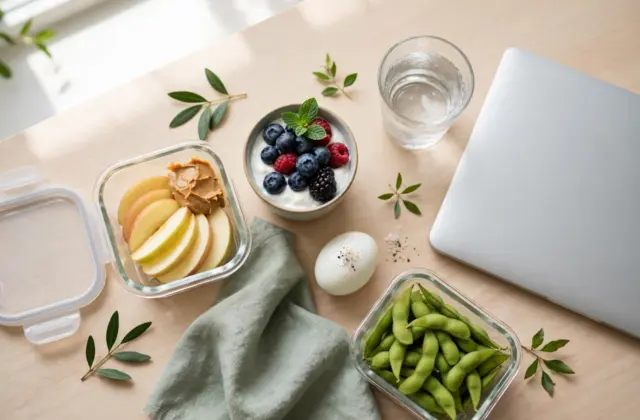
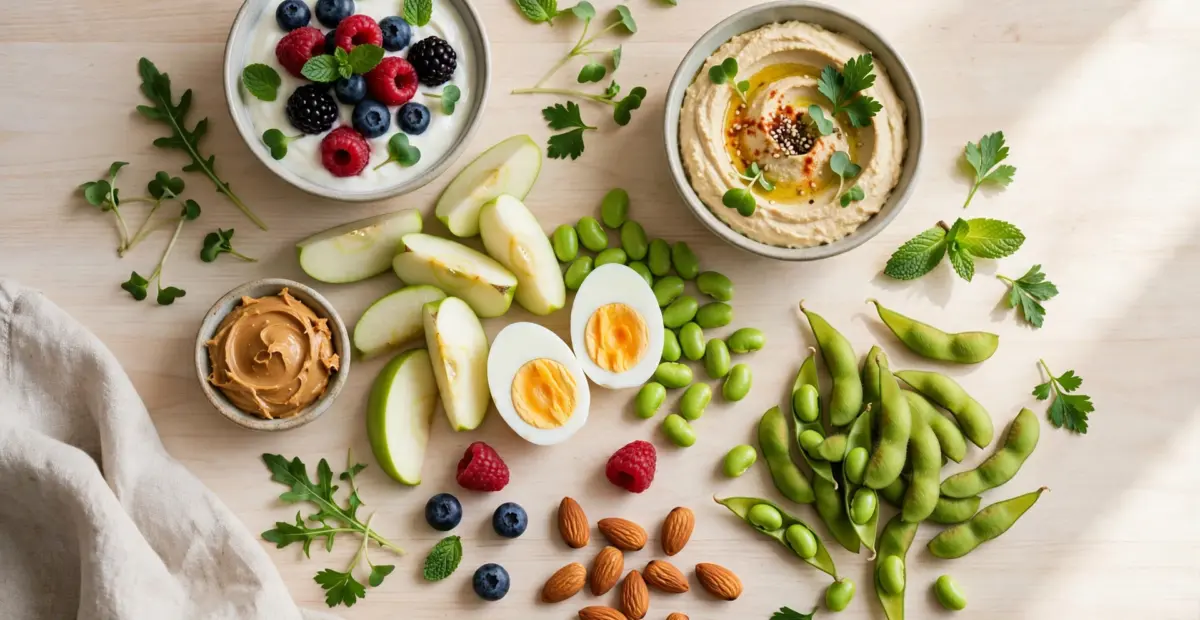
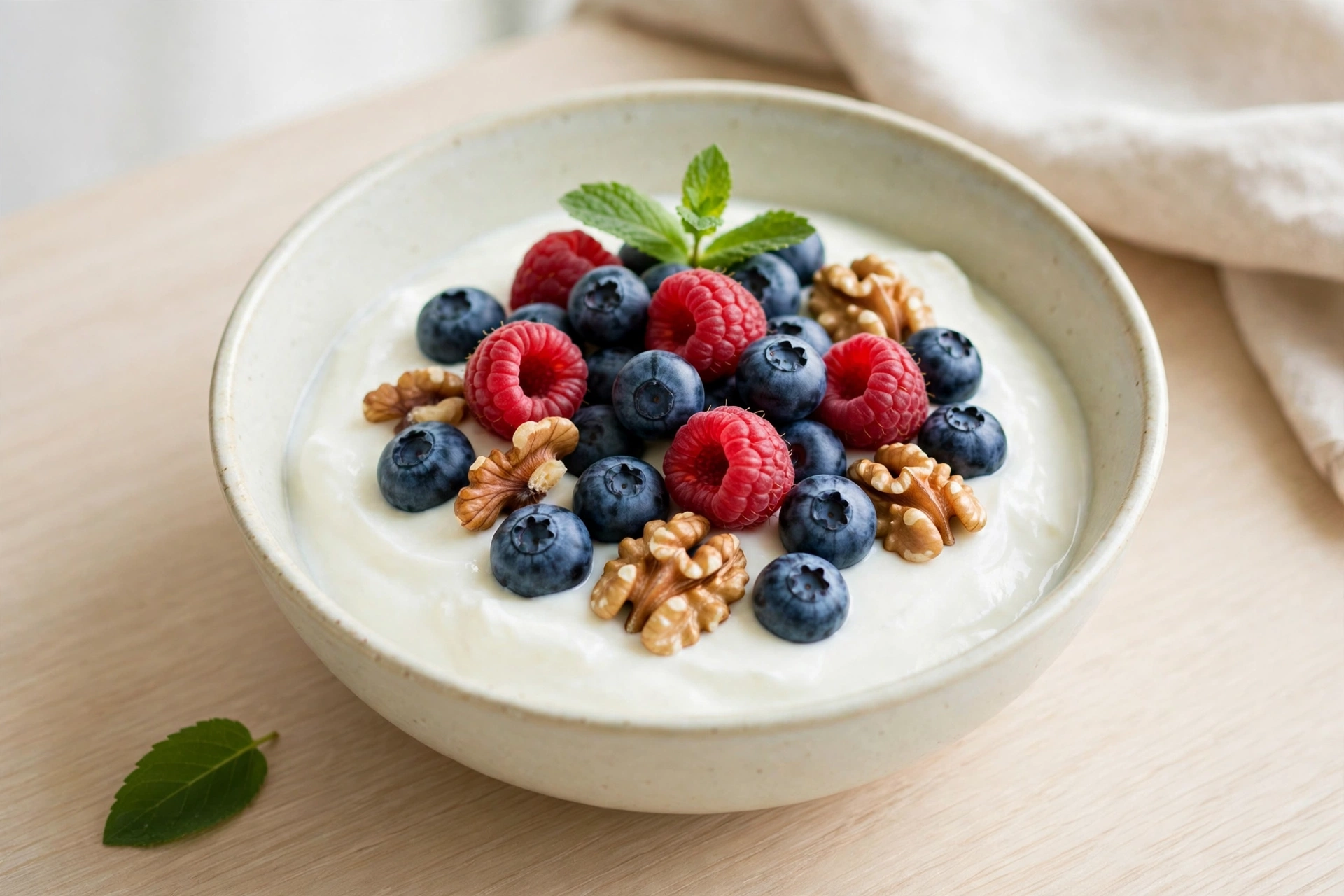
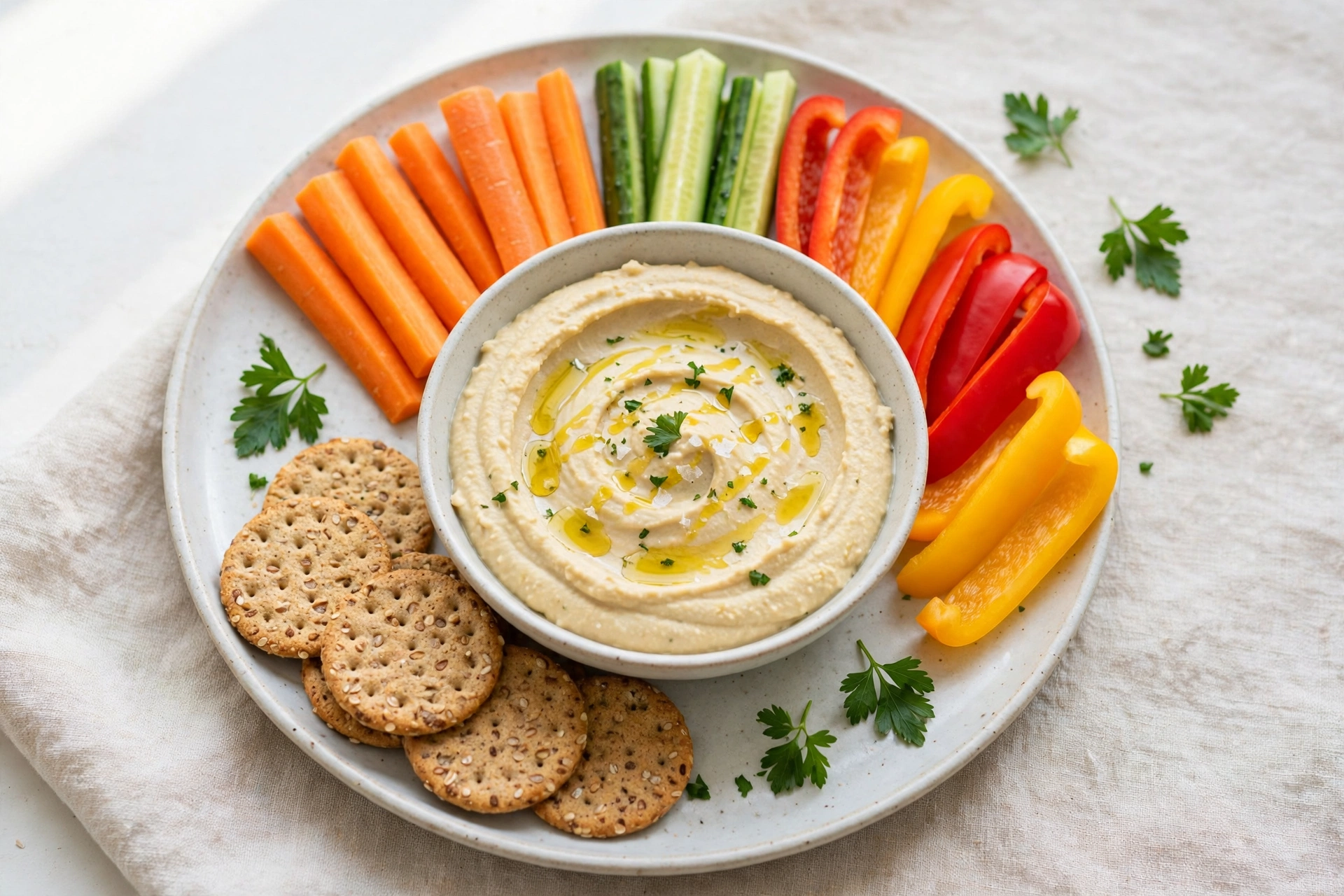
Put together, the formula looks like this: a protein source, plus something plant-based for fiber, plus a small amount of fat. Greek yogurt with berries and walnuts. An apple with peanut butter. Hummus with vegetables and a whole-grain pita. Once you see the pattern, you can build a snack out of whatever’s in the fridge.
Read also: How to Choose Healthier Snacks
How much protein does a snack actually need?
Start with your daily target, then work backward. The recommended dietary allowance for protein is 0.8 grams per kilogram of body weight per day — about 56 grams for a 154-pound man and 46 grams for a 125-pound woman. That figure is a floor, set to prevent deficiency, not an ideal. The 2025–2030 Dietary Guidelines for Americans suggest a higher range of 1.2 to 1.6 grams per kilogram per day for most adults, with protein prioritized at every meal.
For a 70-kilogram (154-pound) adult, that works out to roughly 84 to 112 grams a day. Spread across three meals and one or two snacks, each eating occasion lands at about 15 to 25 grams. So a snack with 10 to 20 grams of protein fits neatly into the day — it contributes a meaningful share without crowding out your meals.
It also helps to know what a serving of protein actually looks like. A large egg has about 6 grams. A 170-gram tub of plain nonfat Greek yogurt has around 17 grams. Half a cup of cottage cheese has roughly 12 grams. A cup of edamame has about 18 grams of protein and 8 grams of fiber. Two tablespoons of peanut butter have about 7 grams of protein, and a quarter cup of hummus adds about 5 grams. None of these numbers require a scale — they’re the portions printed on the package or the serving you naturally scoop.
10 balanced snack combos that actually keep you full
Every combo below follows the three-part formula and takes five minutes or less. Protein and fiber figures are approximate, based on USDA FoodData Central values for standard servings.
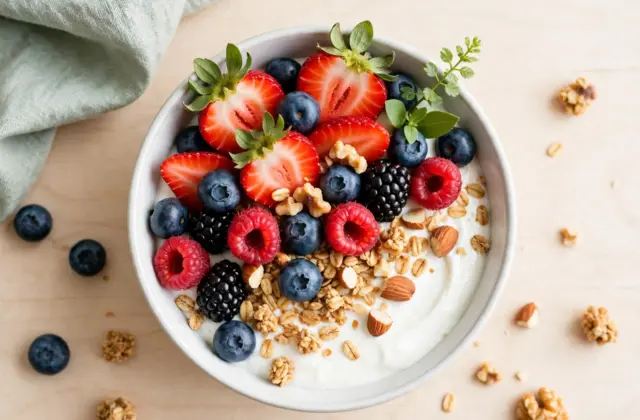
1. Greek yogurt, berries, and walnuts. About 20 grams of protein and 4 grams of fiber. The yogurt anchors it; the berries add fiber and volume; the walnuts bring healthy fat and crunch. Choose plain yogurt — flavored versions can carry as much added sugar as a dessert. The American Heart Association suggests limiting added sugars to about 25 grams a day for women and 36 grams for men, and a single sweetened yogurt can eat up half of that.
2. Apple slices with peanut butter. About 7 grams of protein and 5 grams of fiber. The apple alone would fade fast; the peanut butter’s protein and fat stretch it into a real snack. Two tablespoons is the sweet spot — more than that, and the calories climb quickly.
3. Hummus with vegetables and whole-grain crackers. About 8 to 10 grams of protein and 6 grams of fiber. The chickpeas in hummus deliver protein and fiber together, and the crunch keeps it satisfying. Pre-cut carrot sticks, cucumber, and bell pepper make this a grab-and-go option.
4. Cottage cheese with peach slices or pineapple. About 14 grams of protein and 2 grams of fiber. Add a tablespoon of ground flaxseed and the fiber climbs to about 5 grams. It tastes like dessert and behaves like a meal.
5. A hard-boiled egg and a small handful of almonds. About 12 grams of protein and 3 grams of fiber. Two eggs and a few whole-grain crackers turn this into a mini-meal for a long afternoon. Eggs keep in the fridge for a week, so batch-cook them on Sunday.
6. Edamame with a pinch of sea salt. About 18 grams of protein and 8 grams of fiber per cup — one of the strongest protein-to-effort ratios in the snack world. Frozen edamame microwaves in three minutes.
7. Tuna or salmon on whole-grain toast. About 15 grams of protein and 3 grams of fiber. A small pouch of tuna with a squeeze of lemon on toast is faster than ordering takeout, and the omega-3 fats in oily fish are a bonus your brain will appreciate.
8. Overnight oats with milk and chia seeds. About 12 grams of protein and 8 grams of fiber. Make it the night before in a jar: oats, milk, a spoonful of chia, and whatever fruit you have. It travels well and eats like breakfast at any hour.
Read also: How to Add Protein to Everyday Meals
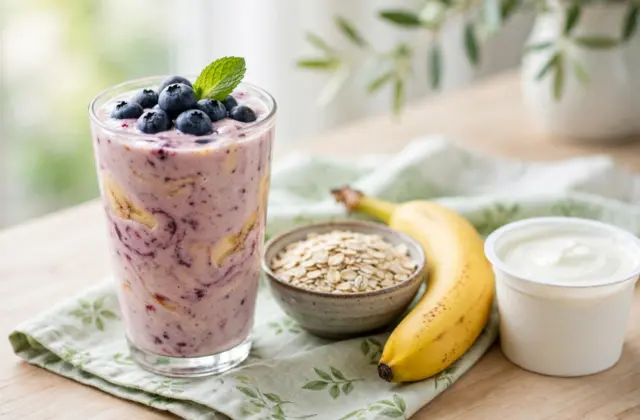
9. A small smoothie with Greek yogurt and spinach. About 17 grams of protein and 4 grams of fiber. Blend a cup of milk, half a cup of Greek yogurt, a banana, and a handful of spinach. The yogurt — not the fruit — is what makes it a snack instead of a sugar drink. Skip the honey; the banana is sweet enough.
10. Roasted chickpeas with a cheese stick. About 12 grams of protein and 6 grams of fiber. Roast a can of chickpeas with olive oil and paprika until crisp, and keep a bag at your desk. The cheese adds protein and a little fat; the chickpeas add fiber and crunch.
Snacks that look healthy but aren’t
Some of the most common “healthy” snacks fail the formula entirely. A protein bar can be a fine tool in a pinch, but many are candy bars with a protein label — check the numbers before you trust the wrapper. If a bar has 15 grams of protein but 18 grams of added sugar, it’s a dessert with a gym membership.
Flavored yogurt is another trap. Plain Greek yogurt is a protein powerhouse; the fruit-on-the-bottom version often carries 12 to 15 grams of added sugar per tub. Granola looks wholesome and is usually sweetened and oil-heavy — a quarter cup can pack 200 calories before you’ve noticed. And rice cakes with nothing on them are almost pure refined starch: light in the hand, gone from your stomach in minutes.
The fix is rarely to ban these foods. It’s to pair them. Granola becomes a reasonable snack when it’s a sprinkle on Greek yogurt instead of the main event. A rice cake works when it’s topped with peanut butter and banana. The label is your friend here: look for at least 5 grams of protein, at least 3 grams of fiber, and added sugars in single digits.
Building snacks for different moments
Not every snack serves the same purpose, and the formula flexes to fit the moment.
At your desk. You need something that doesn’t smell, doesn’t crumble into your keyboard, and doesn’t require a fridge. Roasted chickpeas, a small bag of almonds with dried apricots, or a cheese stick with an apple all fit. Prep them on Sunday so the choice is already made.
After a workout. This is the one time a snack leans closer to a mini-meal — aim for 20 to 25 grams of protein and some carbohydrate to replenish energy. Chocolate milk, a yogurt parfait, or a tuna sandwich all do the job. The old idea that you must eat within 30 minutes is overstated, but eating within a couple of hours supports recovery.
Late at night. Keep it small and gentle: a few hundred calories at most. Cottage cheese with berries, a small bowl of yogurt, or warm milk with a slice of whole-grain toast are all easy on digestion and won’t leave you lying awake with heartburn.
For kids. The same formula applies, with portions scaled down. Apple slices with peanut butter, cheese and crackers, or yogurt with berries all beat the vending machine — and kids who help assemble their snacks are far more likely to eat them.
Read also: Healthy Work Snacks to Pack
A five-minute weekly snack prep
The difference between a balanced snack and a vending-machine run is almost always preparation. Spend five minutes on Sunday and the whole week gets easier:
- Hard-boil six eggs and keep them in the fridge.
- Wash and cut vegetables — carrot sticks, cucumber rounds, bell pepper strips — and store them in water-filled containers.
- Portion nuts into small bags so you never eat from the big bag.
- Make two jars of overnight oats.
- Keep hummus, Greek yogurt, and cottage cheese stocked as your protein anchors.
That’s it. With those five things ready, every snack on the list above is a 60-second assembly job, and the 3:30 slump stops being a decision point at all.
Frequently asked questions
How much protein should a snack have?
For most adults, 10 to 20 grams is a good target — enough to trigger a real satiety signal without turning the snack into a meal. If the snack is standing in for a missed meal, aim closer to 25 grams, and add carbohydrate and fiber to match.
Can a snack be too high in protein?
For healthy adults, protein from food is very unlikely to be a problem at snack-sized amounts. The National Academies have not set an upper limit for protein from food. If you have kidney disease, though, your care team should set your protein target — check with them before increasing your intake.
Are protein bars a good snack?
They can be, but read the label first. A good bar has at least 10 grams of protein, at least 3 grams of fiber, and under 5 grams of added sugar. Many popular bars are closer to candy, with more sugar than protein. Whole foods usually win on both nutrition and price.
What if I don’t eat dairy or meat?
Plenty of plant snacks hit the formula: edamame, hummus with vegetables, roasted chickpeas, peanut butter on whole-grain toast, or soy yogurt with nuts and seeds. Soy foods, quinoa, and combinations like beans with grains provide complete protein across the day.
This article is for general information only and is not medical advice. If you have a medical condition such as kidney disease, diabetes, or a food allergy, talk to your doctor or a registered dietitian before changing your diet.
Sources
- National Institutes of Health, Office of Dietary Supplements — Protein: Fact Sheet for Health Professionals
- Weigle DS, Breen PA, Matthys CC, et al. A high-protein diet induces sustained reductions in appetite, ad libitum caloric intake, and body weight. American Journal of Clinical Nutrition. 2005;82(1):41–48.
- USDA FoodData Central
- American Heart Association — How Much Sugar Is Too Much?
- World Health Organization — Healthy Diet (fact sheet)
- U.S. Department of Agriculture and U.S. Department of Health and Human Services — Dietary Guidelines for Americans, 2025–2030