How to Add Variety to Your Diet
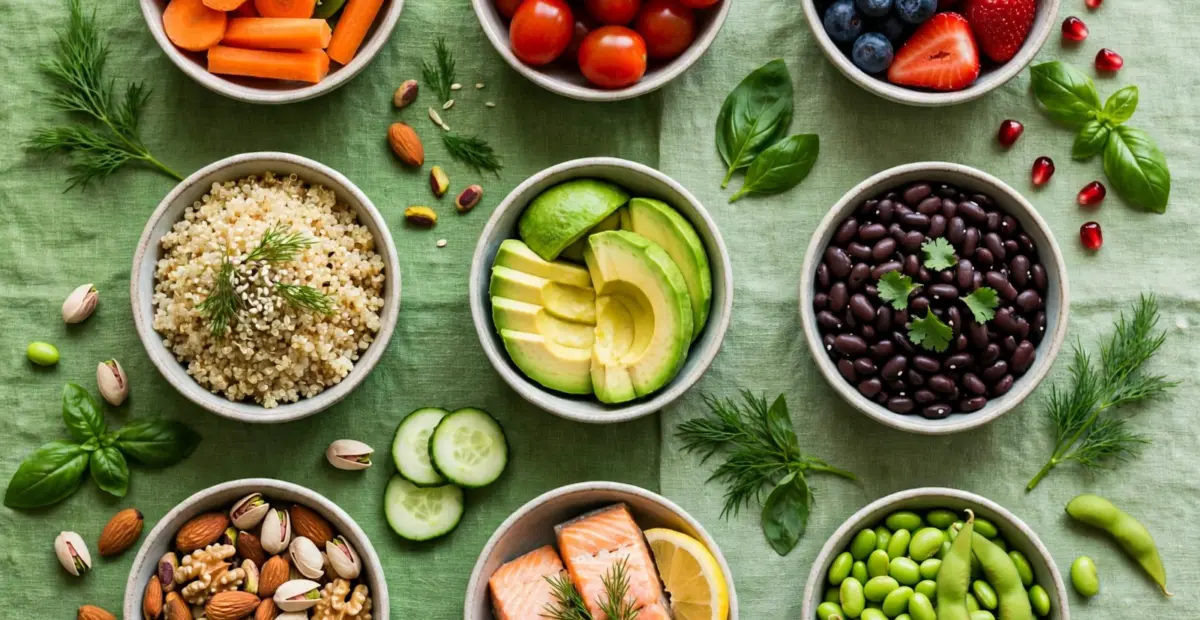
If your grocery cart looks almost identical every week, you are not alone. Most of us settle into a handful of meals we know, we like, and we can cook half-asleep. That routine is comforting — and it works, until it quietly narrows what your body gets. Adding variety to your diet does not mean cooking exotic dishes every night or throwing out everything you already enjoy. It means widening the cast of foods in your regular rotation, one small swap at a time, so you cover more nutrients without thinking about nutrition all day.
Think of it this way: no single food contains everything you need. Spinach is rich in folate and vitamin K but gives you almost no vitamin B12. Lentils bring fiber and plant protein but little vitamin C. Salmon offers omega-3 fats but not the fiber of a bean stew. When you eat a wider mix across the week, those gaps start filling each other in — and meals get a lot less boring in the process.
Why variety matters more than a perfect meal
Health guidelines keep returning to the same idea because the evidence keeps pointing there. The World Health Organization’s healthy diet guidance lists eating a variety of foods daily — vegetables, fruits, legumes, nuts, and whole grains — as a core principle, alongside at least 400 grams (about five portions) of fruits and vegetables a day and at least 25 grams of naturally occurring dietary fiber. Variety is not decoration on top of a healthy diet; in the WHO’s framing, it is part of what makes a diet healthy.
Research on dietary diversity backs that up. In the PREDIMED-Plus study of 6,587 Spanish adults aged 55 to 75, people in the lowest quartile of dietary diversity had a far higher risk of inadequate nutrient intake than those in the highest quartile — an odds ratio of 28.56 for inadequacy across at least four of 17 nutrients. The link was strongest for vegetables, fruits, dairy foods, and protein foods: the narrower the range within those groups, the more likely intake fell short. That is a study of older adults with metabolic syndrome, not a promise that variety alone fixes everything, but it shows why “eat the same healthy meal every day” can still leave holes.
Variety also helps in a quieter way: it makes healthy eating easier to keep doing. A routine built on three meals on repeat is fragile — one busy week, one ingredient out of stock, and the whole plan collapses into takeout. A routine built on a dozen flexible ingredients survives real life much better.
What variety actually looks like
Forget the idea that variety means a different cuisine every night. It works on two levels, and both count.
First, variety across food groups: vegetables, fruits, whole grains, protein foods, and dairy or fortified alternatives each bring something the others do not. The 2025–2030 Dietary Guidelines for Americans reflect that balance for a 2,000-calorie pattern — three servings of vegetables and two of fruit a day, two to four servings of whole grains, three servings of dairy, and protein from a mix of animal and plant sources at 1.2 to 1.6 grams per kilogram of body weight per day. You do not need to hit those numbers exactly to benefit; the point is the spread, not the score.
Second, variety within each group. This is where most people have the most room to grow, and where the smallest changes pay off. Eating “vegetables” every day is good. Eating broccoli on Monday, carrots on Tuesday, cabbage on Wednesday, and spinach on Thursday is better — each one leans toward different vitamins, minerals, and plant compounds. The same goes for grains (oats, brown rice, quinoa, barley), proteins (chicken, fish, eggs, beans, tofu), and fruits (berries, citrus, apples, bananas).
Read also: How to Build a Balanced Plate
Eat the rainbow, without overthinking it
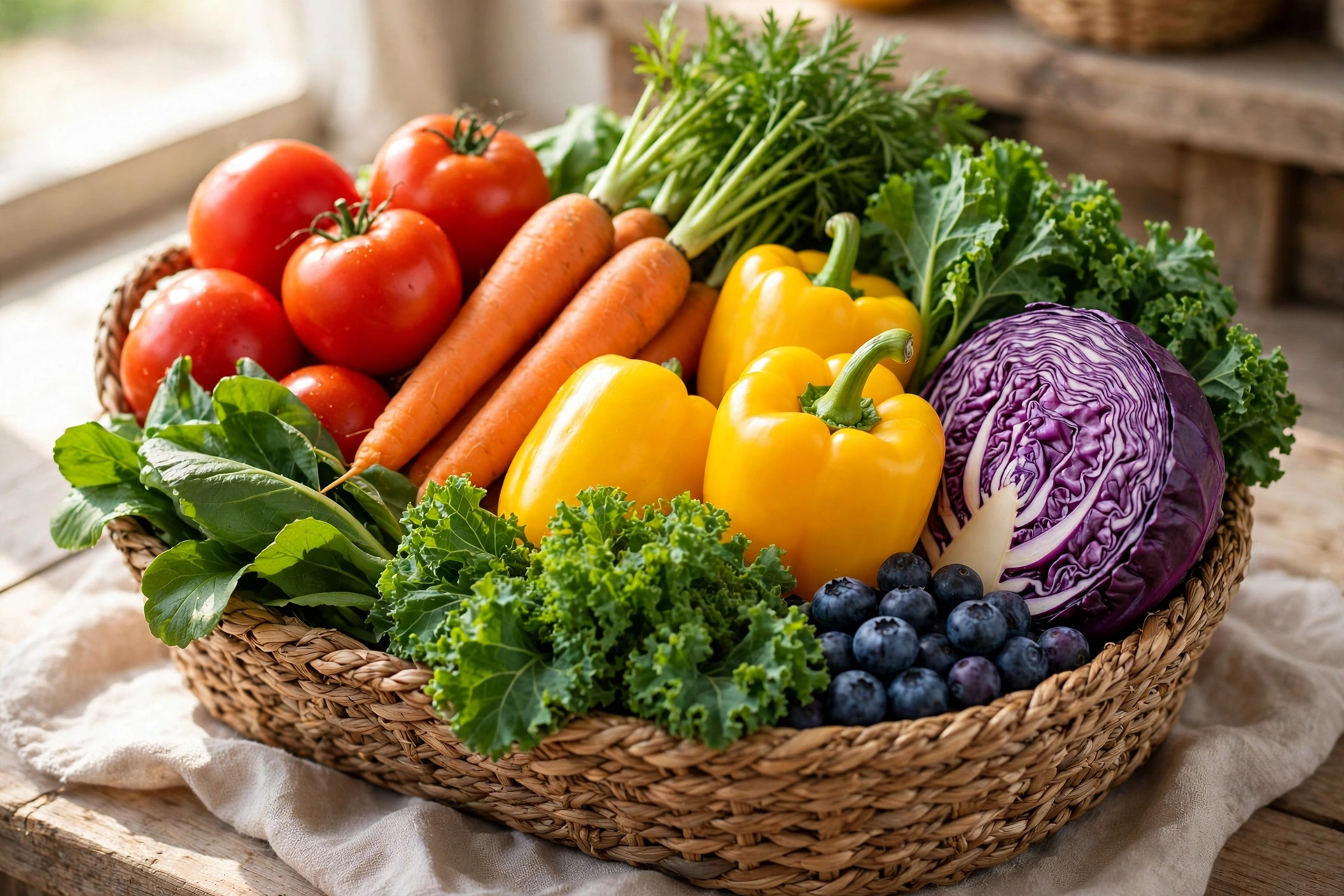
You have probably heard “eat the rainbow” before, and it survives as advice because it is a genuinely useful shortcut. Different colors in produce tend to signal different nutrients: deep greens like spinach and kale for folate and vitamin K, orange vegetables like carrots and sweet potatoes for beta-carotene (which your body converts to vitamin A), red foods like tomatoes for lycopene, purple foods like blueberries and red cabbage for anthocyanins, and white and brown foods like garlic, mushrooms, and onions for their own sulfur compounds and B vitamins.
You do not need every color at every meal. Aim for two or three colors on your plate at dinner, and let the mix shift across the week. A practical trick: pick one color you rarely buy and add it to next week’s list. If your cart is always green and orange, try purple — red cabbage, eggplant, or a punnet of blueberries. If you live on bananas and apples, try a mango, a kiwi, or a bag of frozen mixed berries (frozen fruit counts, and it keeps far longer than fresh).
And a note that surprises people: canned and frozen produce count toward variety too. The dietary guidelines accept frozen, dried, or canned vegetables and fruits with no or very limited added sugars as good options. A bag of frozen stir-fry vegetables on a night you cannot face chopping is not a failure — it is the reason you still ate vegetables that night.
Read also: How to Add More Vegetables to Your Meals
Rotate your proteins and grains
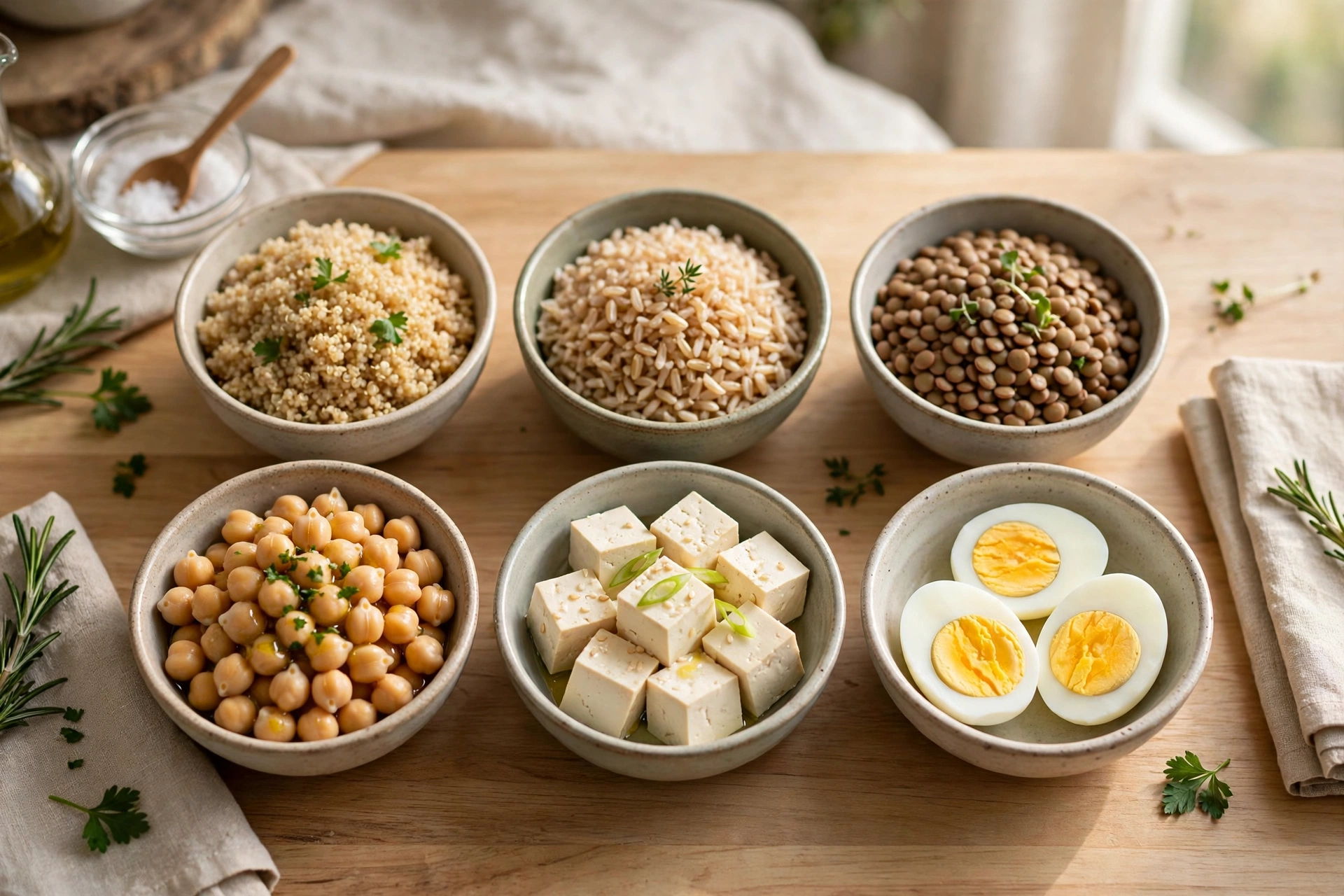
Protein is the easiest place to get stuck. Chicken breast, again, forever. Nothing is wrong with chicken — but rotating proteins widens both nutrients and flavor. Try this kind of rotation across a week: fish once or twice, eggs a couple of mornings, beans or lentils in one main meal, tofu or tempeh in a stir-fry, and yogurt or cottage cheese as a snack or breakfast base. Each swap changes the amino acid mix, the fats, and the minerals on your plate, and it usually costs less than another pack of meat.
Grains deserve the same treatment. If white rice is your default, keep it — and add brown rice one night, oats for breakfast, whole-wheat bread for sandwiches, and quinoa or barley in a grain bowl another night. Whole grains at two to four servings a day, as the current U.S. guidelines suggest, is a target to move toward, not a test to pass on day one. Start with one whole-grain swap a week and notice which ones you actually like; the ones you like are the ones that will stay.
Read also: How to Choose Whole Grains
The one-swap-a-week system
Big overhauls fail because they ask too much at once. One swap a week works because it barely asks anything. Here is how to run it:
Pick one slot. Choose a single meal or ingredient you repeat most — say, your weekday lunch sandwich, your breakfast, or your dinner vegetable. Changing one slot is manageable; changing all of them is a project.
Swap within the same family first. New foods feel less risky when they sit close to something you already like. If you like rice, try barley. If you like apples, try pears. If you like chicken stir-fry, try the same sauce with tofu. Familiar seasoning carries unfamiliar ingredients a long way.
Write it on the list before you shop. Variety dies in the supermarket aisle when you shop on autopilot. Put the new item on your list by name — “red cabbage,” not “a vegetable” — and buy a small amount. A single bunch of a new herb or one new grain is a low-stakes experiment, not a commitment.
Keep a running “liked it” list. On your phone or on the fridge, note the swaps that worked: “barley in soup — yes,” “roasted chickpeas — yes,” “kale raw — no, cooked — yes.” After a month you will have a personal rotation that is wider than the one you started with, built entirely from foods you already know you enjoy.
Variety on a budget (and a busy schedule)
Variety does not have to mean expensive or time-consuming. In fact, some of the cheapest foods are the ones that add the most variety: dried lentils, canned beans, oats, cabbage, carrots, eggs, and frozen vegetables all cost little and store well. Seasonal produce is usually cheaper and tastes better, so letting the season steer one or two choices each week adds variety almost for free — squash in autumn, berries in summer, citrus in winter.
Time is the other common barrier. A few habits help: cook a grain in bulk and use it three ways across the week (barley in soup, then in a salad, then as a side); keep two or three frozen vegetables and a tin of beans on hand for nights when fresh produce runs out; and use herbs, spices, citrus, and vinegar to make familiar ingredients taste different. A chickpea dish with cumin tastes nothing like the same chickpeas with lemon and oregano, and that counts as variety your taste buds will notice even before your nutrient intake does.
When variety does not help
One honest caveat: variety only helps when the new foods are mostly nutrient-dense. Eating ten different kinds of biscuits, crisps, and sugary drinks is technically variety, but it adds sugar, salt, and saturated fat rather than nutrients. The WHO’s limits still apply here — free sugars below 10% of daily energy, total fat below 30%, saturated fat below 10%, and salt below 5 grams a day. Think of variety as widening the healthy part of your diet, not widening everything equally.
Also, variety is not a reason to ignore allergies, intolerances, or medical advice. If a food makes you unwell, it does not belong in your rotation no matter how nutritious it is, and there are almost always alternatives within the same group. If you follow a restricted diet for medical reasons, a dietitian can help you find variety inside your safe foods rather than outside them.
A simple week to start from
If you want a template rather than a theory, try this shape for a week. Breakfasts rotate between oats, eggs, and yogurt with fruit. Lunches rotate between a grain bowl, a sandwich on whole-grain bread, and leftovers remade with a new vegetable. Dinners rotate proteins — fish, beans, chicken, tofu — with a different grain and two vegetables each night. Snacks rotate between fruit, nuts, yogurt, and roasted chickpeas. Nothing here is exotic, and nothing requires a specialty shop. Yet across seven days you will have touched every food group several times over, in forms you can actually repeat.
Start this week with just one change: one new vegetable, one new grain, or one new protein. Next week, add another. By the end of a month, your diet will look — and feel — noticeably wider, and you will not have dieted, counted, or overhauled anything to get there. That is the whole point of variety: not perfection, but a plate that keeps changing just enough to cover what a single routine cannot.
Frequently asked questions
How much variety is enough?
There is no official “number of foods per week” target. A useful rule of thumb is to cover every food group most days and to vary within each group across the week — different vegetables, different grains, different proteins — rather than repeating the same few items daily. If your week includes several colors of produce, two or three grains, and a mix of plant and animal proteins, you are in good shape.
Does frozen or canned produce count toward variety?
Yes. Frozen, dried, and canned vegetables and fruits with no or very limited added sugars are accepted options in current dietary guidance. They are especially useful for variety because they let you keep foods on hand that are out of season or that you use only occasionally, without waste.
Is variety more important than eating “superfoods”?
For most people, yes. No single food, however nutrient-dense, covers every nutrient you need. A varied diet of ordinary healthy foods — vegetables, fruits, whole grains, beans, fish, eggs, nuts — delivers a broader nutrient mix than a narrow diet built around a few celebrated foods.
What if I am a picky eater or cook for a family with different tastes?
Start inside your comfort zone: swap within food families you already like, use familiar sauces and seasonings on new ingredients, and let each person pick one new item a week. Variety built on foods people actually enjoy lasts; variety imposed as a chore does not.
This article is for general information only and is not medical advice. If you have a medical condition, food allergy, or specific dietary needs, talk to your doctor or a registered dietitian before changing your diet.
Sources
- World Health Organization — Healthy diet fact sheet (variety as a core principle; at least 400 g of fruits and vegetables and at least 25 g of dietary fiber per day; fat, sugar, and salt limits)
- American Academy of Family Physicians — Dietary Guidelines for 2025–2030: Recommendations From the USDA and HHS (vegetables 3 servings, fruit 2 servings, whole grains 2–4 servings, dairy 3 servings, protein 1.2–1.6 g/kg/day)
- PREDIMED-Plus study — Dietary Diversity and Nutritional Adequacy among an Older Spanish Population with Metabolic Syndrome (6,587 adults; lowest dietary-diversity quartile vs. highest, odds ratio 28.56 for inadequate nutrient intake)