Healthy Food Swaps That Actually Work

You probably already know which foods you “should” eat more of and which you should eat less of. That knowledge rarely changes what lands in your trolley on a tired Tuesday evening. Healthy eating fails most often not on information, but on friction: the healthier choice feels like more work, less flavour, or a lecture in disguise.
That is why swaps work better than overhauls. A swap keeps the meal you already like and changes one part of it. You still get tacos on Friday, toast in the morning, and something crunchy at 4 pm. The difference is quieter: less added sugar here, more fibre there, a little less sodium, a little more protein to keep you full. Do that a few times a day, most days, and the pattern of your diet shifts without a single dramatic diet day.
This guide sticks to swaps that pass three tests. They have to taste good enough that you would repeat them. They have to be easy — no special shop, no 40-minute prep. And they have to change something meaningful on the plate, not just swap one ultra-processed food for a fancier version of the same thing.
Start with the ground rules
Before the list, three habits make any swap stick. First, change one thing at a time. If you change your breakfast, your drink, your snack, and your cooking oil in the same week, you will not know what helped, and you will probably abandon all four. Second, keep the swap in the same “job” as the original: a drink should still feel refreshing, a snack should still feel crunchy, a dip should still feel creamy. Third, read the label once, not forever. Check added sugars, sodium, and fibre on the new product, decide if it is genuinely better, then stop second-guessing it every shop.
A useful shortcut comes from the U.S. Food and Drug Administration’s guide to the Nutrition Facts label: 5% Daily Value or less is low, and 20% or more is high. That quick filter helps you spot a sauce that is quietly high in sodium or a cereal that is low in fibre, without doing maths in the aisle.
1. Swap the drink first — it is the easiest win
Drinks are where added sugar hides in plain sight. A 12-ounce can of Coca-Cola Original contains 140 calories and 39 grams of added sugars — more than the American Heart Association’s suggested daily limit for most women (about 6 teaspoons, or 25 grams) and above the limit for most men (about 9 teaspoons, or 36 grams). You do not have to give up fizz to fix that. Sparkling water with lemon, lime, or mint gives you the cold, bubbly ritual with no added sugar at all.
If plain sparkling water feels too bare at first, try a half-and-half step: half juice, half sparkling water, over ice. You keep the flavour, halve the sugar, and your taste buds adjust gradually. The World Health Organization recommends keeping free sugars below 10% of total energy intake, and ideally below 5% for extra benefit — on a 2,000-calorie day, 10% works out to about 50 grams. One daily sugary drink can eat up most of that budget before you have eaten anything.
Read also: How to Read Food Labels

2. Make breakfast work harder
Breakfast is a good place for a swap because you eat it on autopilot. Sugary cereals and pastries spike and fade quickly. Rolled oats, made the night before or cooked in five minutes, give you a slower, steadier start — and oats are a whole grain, the kind of carbohydrate the WHO recommends as the backbone of the diet, alongside vegetables, fruit, and pulses.
Try these morning exchanges. White toast becomes whole-grain toast, which adds fibre and keeps you full longer. A flavoured yogurt cup becomes plain yogurt with your own berries — you control the sweetness, and the berries add fibre and colour. A fried-egg-and-butter start becomes eggs with vegetables and a slice of whole-grain toast: same protein, more produce, and you are already part of the way toward the WHO’s target of at least 400 grams of fruit and vegetables a day for adults, plus at least 25 grams of naturally occurring fibre.
If you love cereal, do not ban it. Mix it: half your usual cereal, half plain oats or a higher-fibre cereal, then top with fruit. It tastes familiar, costs less sugar, and you have not declared war on your own mornings.
3. Upgrade lunch without rebuilding it
Lunch swaps work best when they keep the structure of the meal. A sandwich stays a sandwich; a bowl stays a bowl. White bread becomes whole-grain bread. Mayonnaise becomes mashed avocado, hummus, or mustard — you keep the creaminess or the tang, but you trade mostly saturated fat for fibre, unsaturated fats, or simply fewer calories, depending on the pick. Processed meat becomes grilled chicken, canned tuna in water, tofu, or beans a few times a week. Beans are a quiet hero here: cheap, filling, high in fibre, and they turn a light salad into a meal that actually lasts until dinner.
Salad dressing is another small lever with a big effect. A creamy bottled dressing can be high in sodium and saturated fat. A simple olive oil and lemon dressing, or yogurt whisked with herbs and lemon, gives you flavour for far less. And when you buy a ready meal or a sauce, glance at sodium: the American Heart Association recommends no more than 2,300 milligrams of sodium a day, moving toward an ideal of no more than 1,500 milligrams for most adults. One salty sauce should not use up half that budget.
4. Fix the snack, not the craving
Snacking is not the problem. Snacking on foods that leave you hungry again in twenty minutes is. Crisps give crunch and salt, then fade. A swap that keeps the crunch works far better than willpower. Try air-popped popcorn with a pinch of salt instead of crisps, roasted chickpeas instead of salted nuts coated in flavouring, or apple slices with peanut butter instead of a biscuit: you still get sweet, salty, and crunchy, plus fibre and protein that keep you going.
Dips deserve the same treatment. Sour cream is the classic creamy dip, but plain non-fat Greek yogurt does the same job with far more protein and far fewer calories — roughly 10 grams of protein and about 59 calories per 100 grams, compared with about 2.4 grams of protein and about 198 calories per 100 grams for sour cream, according to USDA FoodData Central figures. Stir in lemon, garlic, and herbs and most people will not notice the change — they will notice they feel full longer.
Read also: How to Choose Healthier Snacks
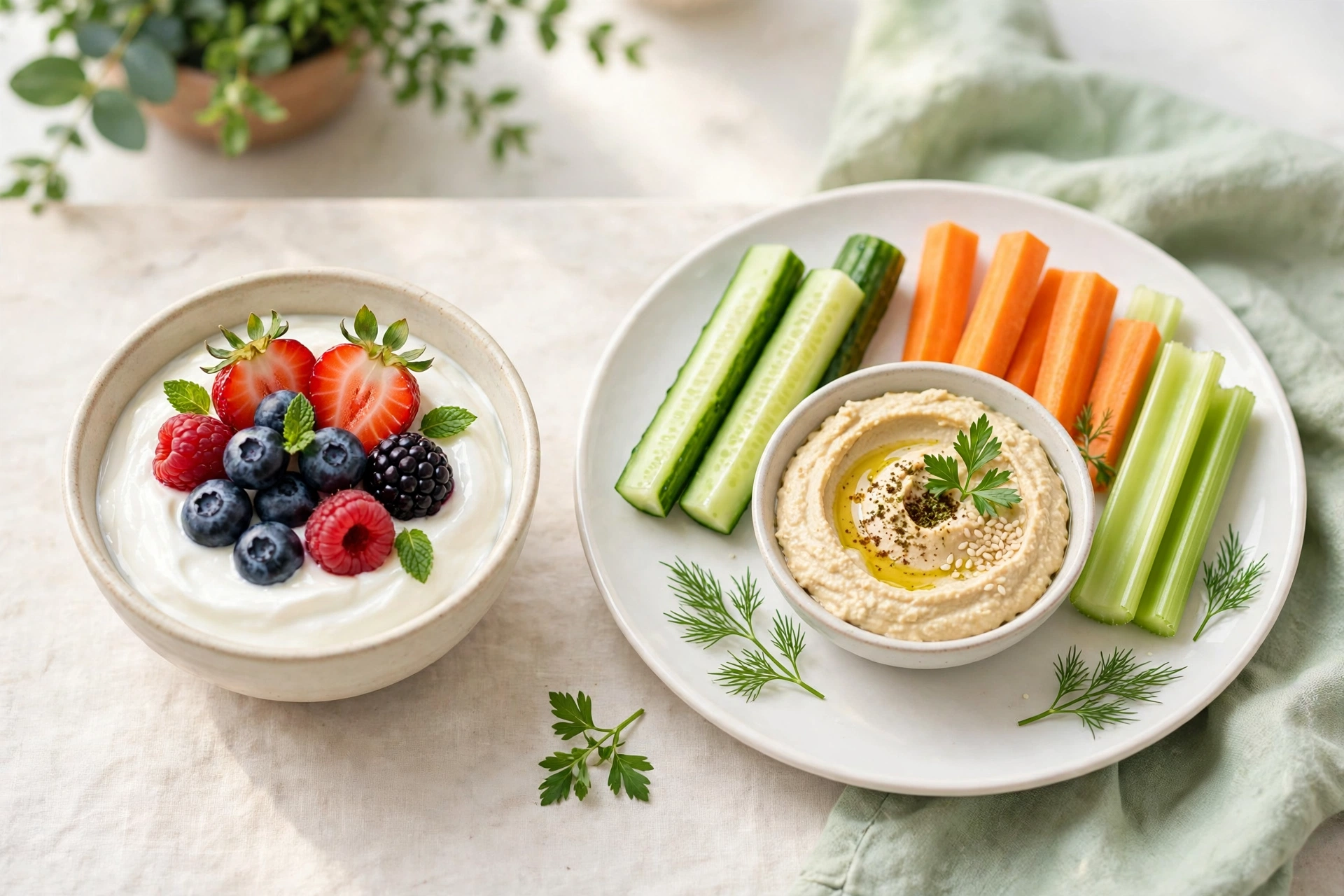
5. Cook with swaps, not rules
In the kitchen, the best swaps are the ones nobody announces. Butter in a pan becomes olive oil for sautéing vegetables. Cream in a soup becomes blended beans or a swirl of yogurt stirred in off the heat. White rice becomes brown rice or a mix of rice and lentils — the lentils add fibre and protein, and the texture stays familiar. Minced meat in a pasta sauce becomes half meat, half lentils or mushrooms: the sauce stays rich, the meal stays satisfying, and the plate gains fibre and vegetables without a lecture.
Cheese deserves a gentler approach: a smaller amount of a stronger-flavoured cheese, with lemon or vinegar brightening the dish instead of extra salt.
6. Swaps that sound healthy but change little
Not every swap earns its reputation. Swapping white sugar for honey, maple syrup, or coconut sugar still adds free sugars — the WHO counts sugars in honey and syrups as free sugars, so the total matters more than the source. Swapping regular crisps for “veggie” crisps often changes little: many are still fried, salty, and low in fibre. And swapping a sugary drink for a large sweetened juice is not a fix either, since juice concentrates the sugars of several pieces of fruit without their fibre.
The test is simple: does the new version add fibre, protein, vegetables, or whole grains, or cut added sugar, sodium, or saturated fat in a meaningful way? If the answer is no, it is marketing, not a swap. Keep the original, enjoy it properly, and spend your swap energy somewhere it counts.
7. Build your own swap list in one shop
Pick three swaps, not thirty. One for drinks, one for breakfast, one for snacks is a good starting set. Write them on your shopping list as the new default: sparkling water, rolled oats, plain yogurt. Buy the old version only if you genuinely prefer it after trying the new one for a week. Most people find one or two swaps become automatic within a fortnight, and that is the point — a swap only works if you still do it when you are busy, tired, or shopping in a hurry.
At home, make the swap the easy option. Keep sparkling water cold, fruit washed and visible, and popcorn kernels or roasted chickpeas where the crisps used to live. Healthy eating is often just a question of what is closest when you open the cupboard.
Read also: Small Diet Changes That Last
Frequently asked questions
Do I need to swap everything at once to see a benefit?
No. Small, repeated changes add up because they change your daily pattern. One sugary drink swapped for sparkling water every day removes roughly 39 grams of added sugar a day — more than a week’s worth of the AHA’s suggested limit for many adults, saved in a single habit.
Are “healthy” swaps more expensive?
Some are, some are not. Oats, beans, lentils, frozen vegetables, and tap or sparkling water are usually among the cheapest options in the shop. Where a swap costs more, try it in one meal first — a yogurt swap at breakfast, for example — rather than changing the whole week’s shop at once.
What if my family will not eat the swapped version?
Do not announce it as a health project. Serve the mixed version — half old cereal, half oats; half meat, half lentils — and let taste do the persuading. Kids and partners tend to accept a familiar meal with a quiet tweak far more readily than a brand-new “healthy” dinner.
Can I still enjoy the original foods sometimes?
Yes, and you should. A swap is a default, not a ban. Keeping a favourite food as an occasional pleasure, eaten slowly and enjoyed, is far more sustainable than a rule you break and then abandon altogether.
Disclaimer: This article is for general information only and is not medical advice. If you have a health condition, food allergy, or specific dietary needs, talk to your doctor or a registered dietitian before changing your diet.
Sources
- World Health Organization — Healthy diet fact sheet (free sugars below 10% of energy, ideally below 5%; at least 400 g fruit and vegetables and 25 g fibre a day for adults)
- American Heart Association — How Much Sodium Should I Eat Per Day? (no more than 2,300 mg a day, ideal no more than 1,500 mg for most adults)
- American Heart Association — Added sugars guidance (about 6 teaspoons a day for most women, 9 teaspoons for most men)
- U.S. Food and Drug Administration — What’s on the Nutrition Facts Label (5% Daily Value or less is low; 20% or more is high)
- Coca-Cola — Coca-Cola Original nutrition facts (12 fl oz: 140 calories, 39 g added sugars)