Added Sugars on Labels: How to Decode Them
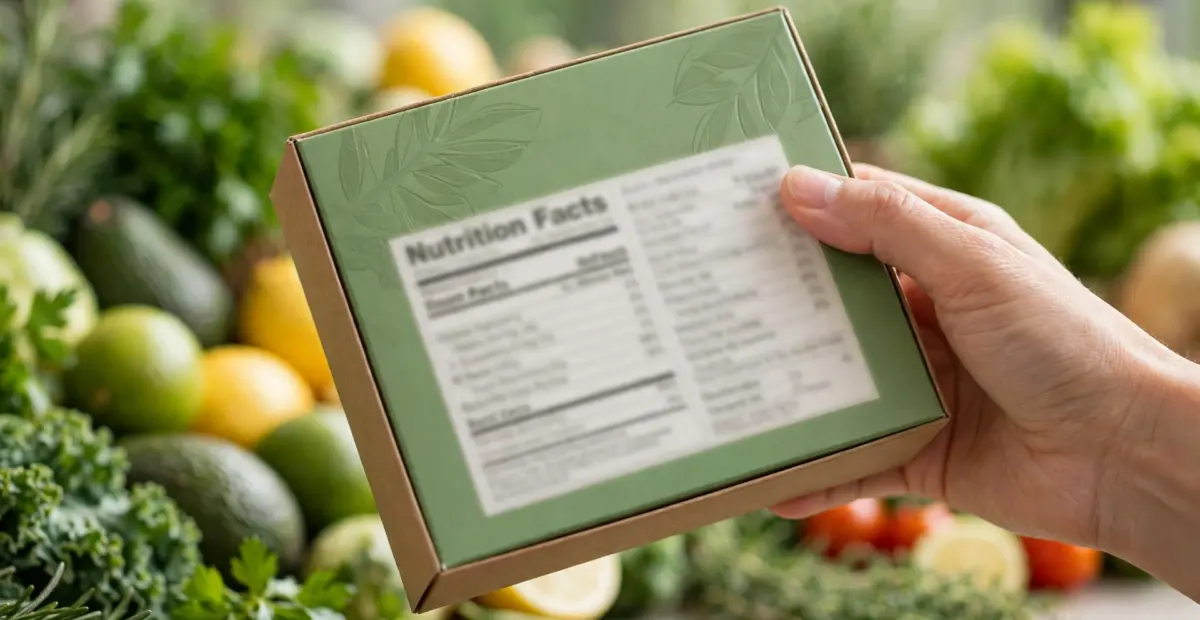
You have probably stood in a grocery aisle, box in hand, trying to work out whether a cereal is a reasonable breakfast or dessert in disguise. The front of the pack says “made with whole grains” or “a good source of fiber,” but the real answer sits on the back, in two short lines: Total Sugars and Added Sugars. Once you know how to read those lines, the whole label gets easier — and a lot of marketing loses its power over you.
Added sugars are not a reason to fear a food, and they are not the only thing that matters about it. They are one useful signal, and the label now gives you that signal directly. This guide shows you where to find it, what the numbers actually mean, and how to compare two products in about twenty seconds.
First, find the two sugar lines
On a US Nutrition Facts panel, look under Total Carbohydrate. You will see Dietary Fiber, then Total Sugars, and indented just below it, a line that reads “Includes X g Added Sugars.” That little word “includes” does real work: the added sugars are part of the total, not extra on top of it.
Here is how that plays out. The US Food and Drug Administration (FDA) gives this example: a product with 15 grams of Total Sugars and 7 grams of Added Sugars has 7 grams that were added during processing and 8 grams that were already in the food — from fruit, milk, or another ingredient. So if you only looked at Total Sugars, you would overstate the added part. If you only looked at Added Sugars, you would miss the naturally occurring part. You need both lines, and now you have them.
What counts as added? According to the FDA, added sugars include sugars added during processing, sugars packaged as sweeteners such as table sugar, sugars from syrups and honey, and sugars from concentrated fruit or vegetable juices. They do not include sugars that occur naturally in milk, fruits, and vegetables. That distinction is why plain yogurt and sweetened yogurt can look similar in Total Sugars but very different in Added Sugars — and why the second line is the one to watch when you are comparing.
Read also: How to Read Food Labels
What the % Daily Value actually tells you
Next to the grams of Added Sugars you will see a percentage: the % Daily Value (%DV). The Daily Value for added sugars is 50 grams per day, based on a 2,000-calorie daily diet. That figure comes from the Dietary Guidelines for Americans, which recommend limiting added sugars to less than 10% of total calories per day — 200 calories, or 50 grams, on a 2,000-calorie diet.
Think of the %DV as a quick rating scale. The FDA’s own rule of thumb is simple: 5% DV or less is low, and 20% DV or more is high. A product with 3 grams of added sugars per serving is 6% DV — low. A product with 12 grams is 24% DV — high, nearly a quarter of the day’s reference amount in one serving.
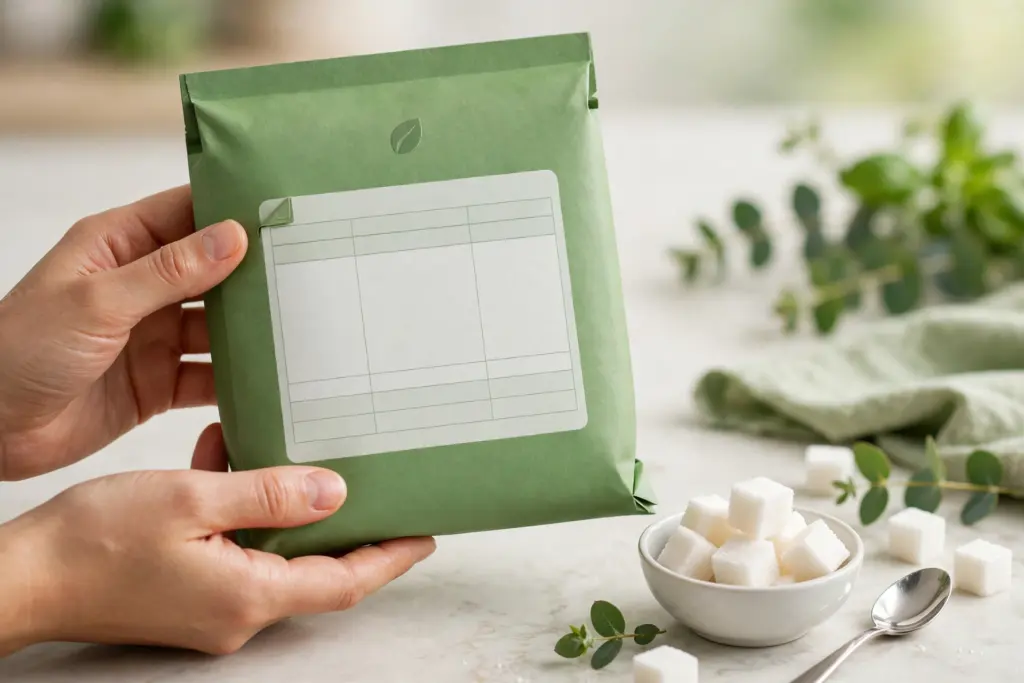
Grams become more concrete when you turn them into teaspoons. Four grams of sugar is about one teaspoon. So 12 grams of added sugars is roughly 3 teaspoons, and a drink with 40 grams of added sugars carries about 10 teaspoons — more than the stricter daily limits many health groups suggest (more on those below). You do not need to do this math every time you shop, but doing it once or twice trains your eye: 25 grams stops looking like a small number.
Two cautions keep the %DV honest. First, it is a labeling reference for a 2,000-calorie diet, not a personal prescription. If you eat fewer calories, your own ceiling is lower; if you eat more, it is higher. Second, there is no %DV for Total Sugars, because no recommended daily total has been set — so do not go hunting for one. The added-sugars percentage is the comparison tool the label gives you. Use it for that.
How much is “too much”? Three reference points
The 50-gram Daily Value is a ceiling for label comparison, not the only guidance out there. Two other reference points help you judge your whole day, not just one serving.
The American Heart Association (AHA) recommends limiting added sugars to no more than 6% of calories each day. For most women, that works out to no more than about 100 calories per day from added sugars, or about 6 teaspoons (25 grams). For most men, it is about 150 calories per day, or about 9 teaspoons (36 grams). Children aged 2 to 18 are also advised to stay under 6 teaspoons a day, and children under 2 should not consume foods or beverages with added sugars at all.
The World Health Organization (WHO) frames it slightly differently, in terms of “free sugars” — added sugars plus sugars naturally present in honey, syrups, and fruit juices. Its strong recommendation is to keep free sugars below 10% of total energy intake, with a conditional suggestion to go below 5% — roughly 25 grams, or 6 teaspoons, a day on a 2,000-calorie diet — for additional benefit, particularly for dental health.
Notice what these numbers share: they all point in the same direction, and they are all well below what a single large sweetened drink can contain. You do not need to memorize all three. Pick the one that sticks — for many people, the AHA’s 6 teaspoons for women and 9 for men is the easiest to carry into the store — and use the label’s %DV to check servings against it.
Watch the serving size before you trust the grams
Here is the trap that catches even careful readers. Every number on the panel — including Added Sugars — is per serving, and the serving on the package is not always the amount you will actually eat.
A bag of granola might list 8 grams of added sugars per serving, which sounds modest at 16% DV. But if the serving is a quarter cup and you pour a full cup, you have just eaten four servings: 32 grams of added sugars, or 64% of the Daily Value, before you have left the kitchen. A bottle of juice marked as two servings works the same way — drink the whole bottle and you double the label’s numbers.
So make this a habit: check the serving size first, then the servings per container, then the Added Sugars line. Ask yourself, honestly, how much you will eat in one sitting, and multiply if needed. The label is not trying to trick you here — it is standardized so products can be compared — but only you know your portion.
Read also: How to Shop the Grocery Store Perimeter
Sugar’s many names on the ingredient list
The Nutrition Facts panel tells you how much added sugar is in a serving. The ingredient list tells you where it came from — and it is where manufacturers have the most room to be creative. Ingredients are listed in descending order by weight, so a sweetener near the top of the list makes up more of the product than one buried at the end.
Train your eye for these patterns. Anything with the word “sugar” — cane sugar, brown sugar, raw sugar, invert sugar — counts. Anything ending in “-ose” — sucrose, dextrose, glucose, fructose, maltose — is a sugar. Anything with “syrup” — corn syrup, high-fructose corn syrup, rice syrup, maple syrup, malt syrup — is a sugar. Then there are the ones that sound wholesome: honey, molasses, agave nectar, fruit juice concentrate, evaporated cane juice. A sweetener that sounds more natural is still an added sugar when it is added to sweeten a product.
Two details are worth knowing. First, a product can list three or four different sweeteners, each one small enough to sit further down the list, while together they add up to a lot of sugar. If you spot several sugar names scattered through the ingredients, add them up in your head — the Added Sugars line already did, so cross-check it. Second, sugar alcohols such as erythritol, sorbitol, and xylitol are not classified as added sugars by the FDA; they appear on their own line when a product declares them, which is why a “sugar-free” sweetened product can still list them.
You do not need to memorize dozens of names. The shortcut is this: scan for “sugar,” “-ose,” “syrup,” honey, and juice concentrate. If one of those appears in the first few ingredients, the product is sweetened in a meaningful way, whatever the front of the pack says.
Claims that sound better than they are
The front of a package is advertising; the back is information. A few claims deserve a second look.
“No added sugar” means no sugars were added during processing — but the product can still be high in total sugars from fruit juice concentrate used as an ingredient in some contexts, from dried fruit, or from naturally occurring sugars. A “no added sugar” juice can still contain as much sugar as a sweetened drink; it just got there differently. Check the Total Sugars line before you celebrate.
“Made with real fruit” tells you almost nothing about sugar. A fruit snack made with real fruit puree can still carry a large amount of added sugars from syrups added alongside it. Again, the Added Sugars line settles it in seconds.
“Low sugar” and “reduced sugar” are comparisons, not absolutes. A “reduced sugar” cookie may have 25% less sugar than the original version and still be high in added sugars overall. Compare it against the %DV, not against its own previous recipe.
None of this means you should never buy a sweetened product. It means the claim should never be the end of your check — it should be the reason you turn the package over.
A 20-second routine you can use every trip
Put it together and the routine is short enough to use while you are actually shopping:
1. Check the serving size and how many servings you will really eat.
2. Find “Includes X g Added Sugars” under Total Sugars.
3. Read the %DV: 5% or less is low, 20% or more is high.
4. Glance at the ingredient list for sugar, “-ose,” syrup, honey, or juice concentrate near the top.
5. Compare like with like — the same kind of yogurt, cereal, or sauce — and pick the lower Added Sugars option that you will actually enjoy.
That last point matters. A lower-sugar option you dislike will sit in the pantry until it expires, and then you will buy the sweet one anyway. The goal is a swap you can live with: plain yogurt with your own fruit instead of a pre-sweetened one, a pasta sauce at 4 grams of added sugars instead of 12, a cereal at 6% DV instead of 30%. Small, repeatable swaps move your daily total far more than one perfect shopping trip.
Read also: How to Navigate the Frozen Food Aisle

Comparing two products, side by side
Imagine two granola bars. Bar A lists 12 grams of added sugars per bar — 24% DV, about 3 teaspoons. Bar B lists 3 grams — 6% DV, under a teaspoon. Neither bar is “good” or “bad” on its own; the bars are otherwise similar in fiber and protein. But if you eat one most afternoons, Bar A uses up nearly a quarter of the 50-gram reference amount every day, while Bar B uses about a twentieth. Over a week, that choice alone is a difference of 63 grams of added sugars — roughly 16 teaspoons — without changing anything else about your snack.
This is the real power of the Added Sugars line. It turns a vague feeling — “this seems sweet” — into a number you can compare, and it lets small choices compound in your favor. You are not auditing your diet for perfection. You are making the better of two real options, most of the time.
Frequently asked questions
Is “Total Sugars” or “Added Sugars” the number I should watch?
Watch both, for different reasons. Total Sugars tells you all the sugars in a serving, including those naturally in fruit and milk. Added Sugars tells you how much was added during processing. When you are deciding between similar products, Added Sugars is usually the more useful comparison, because it isolates the part you can most easily reduce.
Does honey count as an added sugar?
Yes. The FDA counts sugars from syrups and honey as added sugars, even though honey is a natural product. The same goes for maple syrup, agave nectar, and concentrated fruit juice added as a sweetener. “Natural” describes where a sweetener came from, not whether it counts.
If a label says 0 g Added Sugars, is the food sugar-free?
Not necessarily. It means no sugars were added, but the food can still contain naturally occurring sugars — a glass of milk or a serving of fruit has sugars with 0 grams added. Check Total Sugars if you want the full picture, and check the ingredient list if you want to know why.
Should I worry about the sugar in whole fruit?
The guidance from WHO and others focuses on free and added sugars, not on the sugars inside whole fruit, which come packaged with fiber, water, and other nutrients. Whole fruit is not what the Added Sugars line is designed to flag — and in general, eating more whole fruit is a different decision from drinking a sweetened beverage. If you are choosing between a piece of fruit and a fruit-flavored snack, the fruit is almost always the better trade.
This article is for general information only and is not medical advice. If you have diabetes, a condition that affects how you process sugar, or specific dietary needs, talk with your clinician or a registered dietitian about targets that fit you.
Sources