How to Navigate the Frozen Food Aisle
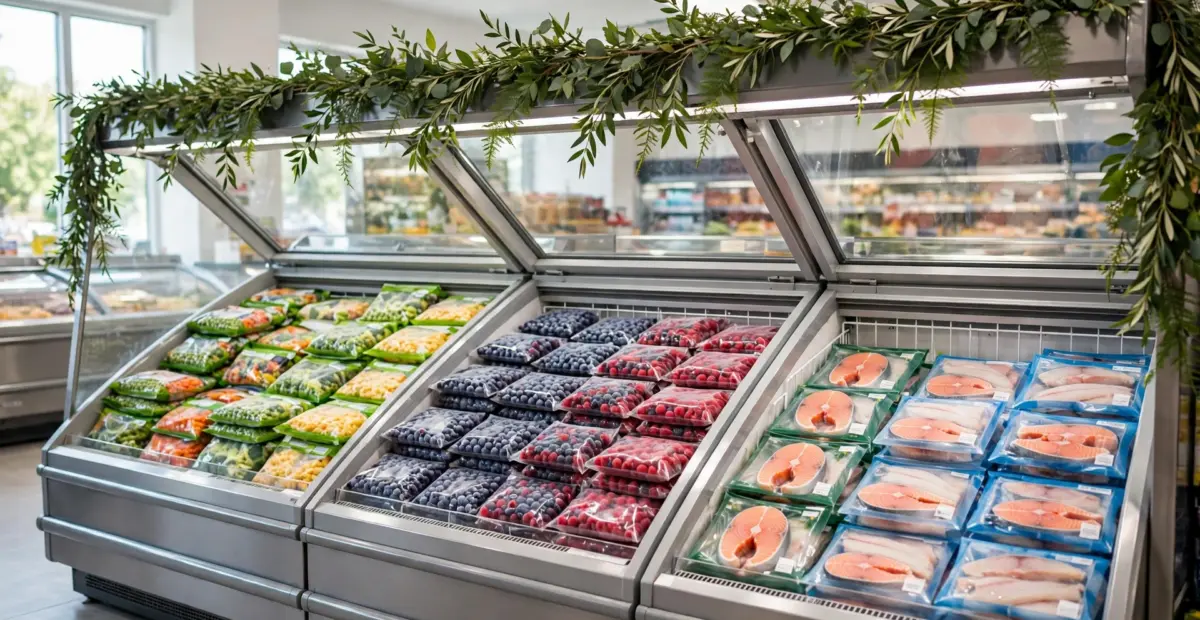
Stand in front of the freezer cases on a tired Tuesday evening and the choice can feel endless: plain broccoli next to cheese-covered broccoli, wild blueberries beside syrupy fruit blends, a simple bag of shrimp across from a breaded seafood platter drowned in sauce. The frozen food aisle is not one category. It holds some of the most useful foods in the store — and some of the saltiest, sweetest ones too. Once you know how to sort them, it becomes one of the easiest places to shop well.
That matters because frozen food solves a real everyday problem. Fresh produce wilts, fish goes off in a day or two, and a busy week can turn good intentions into takeout. A stocked freezer buys you time without forcing you to start from zero every night. The trick is to fill it mostly with foods that were frozen close to their natural state, then use sauces, breading, and ready meals as the extras rather than the base.
Frozen does not mean second-best
Many shoppers assume fresh always beats frozen. The research tells a more mixed — and more reassuring — story. Vegetables and fruit for freezing are usually picked at peak ripeness and frozen within hours, which locks in much of their nutrition before the long trip to your kitchen. Fresh produce, by contrast, can spend days in transport and display, then more days in your fridge, losing delicate vitamins along the way.
A University of California, Davis study compared eight fruits and vegetables under refrigerated and frozen storage. Overall, the vitamin content of the frozen produce was comparable to, and occasionally higher than, that of its fresh counterparts. Vitamin C showed no significant difference for five of the eight foods and was higher in the frozen samples for the other three. A separate two-year study reached a similar conclusion: in most comparisons there was no significant difference, and when a difference did show up, frozen produce beat produce stored in a fridge for five days more often than the other way around.
Freezing is not magic, and it is not perfect. Blanching — the quick hot-water step before freezing — can cause small losses of water-soluble vitamins, and some nutrients fade during very long storage. But for plain frozen vegetables and fruit, the gap with fresh is small, and on a week when the fresh broccoli in your fridge has gone limp, the frozen bag in your freezer is clearly the better vegetable. Nutrition is what you actually eat, not what looked perfect on day one.
That is also why the World Health Organization’s target still fits here so neatly: at least 400 grams, or about five portions, of fruits and vegetables a day. Frozen vegetables count toward that total just as fresh ones do, and they make the target reachable on nights when you have no fresh produce left at all.
Start with the plain stuff
The simplest rule in the aisle is also the most reliable: the shorter the ingredient list, the safer the bet. A bag that lists only “broccoli” is broccoli. A bag that lists broccoli, cheese sauce, modified starch, and salt is a different food wearing broccoli’s name.
Build your freezer around these plain staples first:
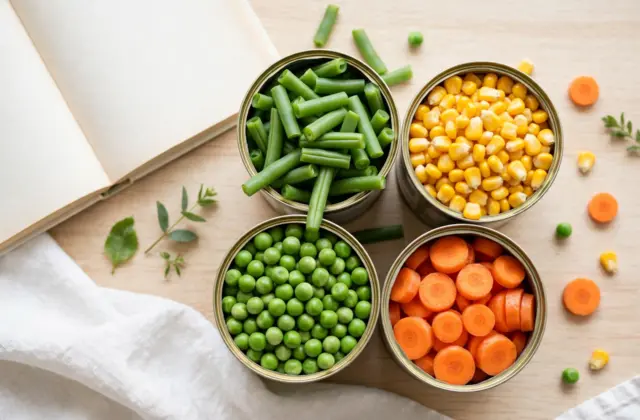
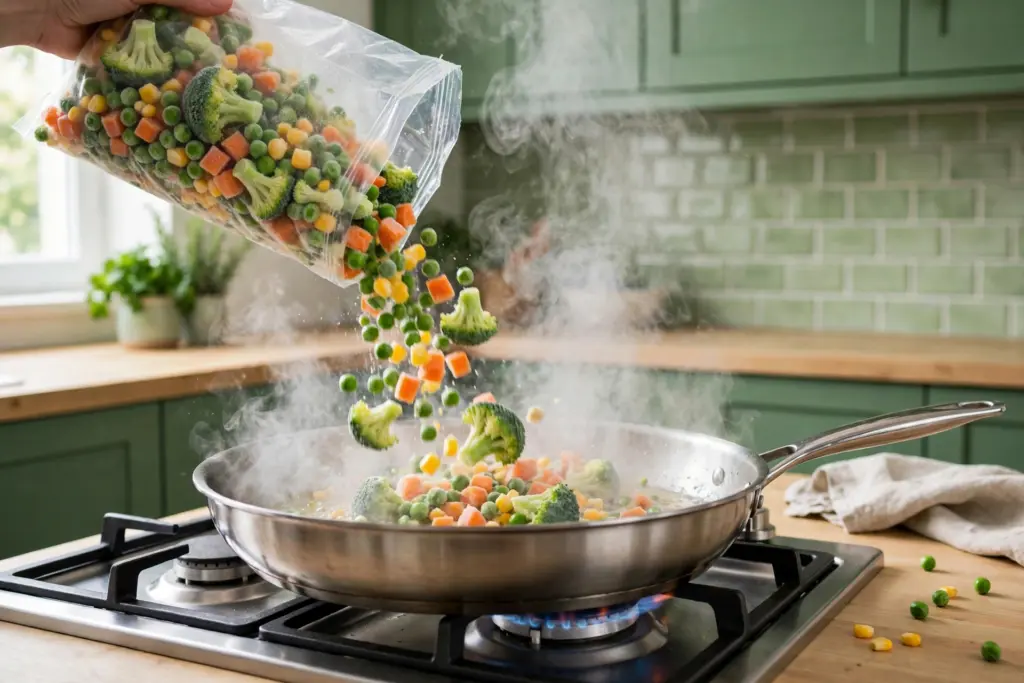
- Vegetables: broccoli, green beans, peas, mixed vegetables, cauliflower, spinach, edamame, and stir-fry mixes without sauce packets. They cook in minutes and pair with almost anything.
- Fruit: wild blueberries, mixed berries, mango chunks, and cherries with no added sugar. Check the ingredients — frozen fruit should usually list only the fruit itself.
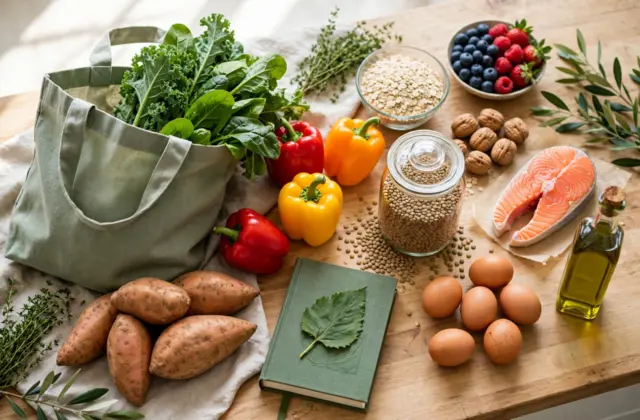
- Protein: plain shrimp, salmon fillets, chicken breast, and frozen beans or edamame. Unbreaded, unmarinated options give you control over salt and seasoning.
- Grains and bases: frozen brown rice, quinoa, and whole-grain bread. They turn a bag of vegetables into a meal without a second trip to the store.
Keep one or two convenience items you genuinely enjoy — a favourite pizza, a ready meal for a truly chaotic night — but let them be the exception. When the plain staples are already home, you will reach for them first, because they are just as fast.
Read also: How to Prep Produce for the Week
Walk the aisle zone by zone
Freezer cases are usually grouped by type, and each zone has its own traps. A quick tour helps you shop with a plan instead of drifting.
Vegetables. This is the strongest zone in the aisle. Plain bags are the win; sauce packets and butter blends are where sodium and saturated fat creep in. If you love a sauced version, compare it with the plain bag and add your own olive oil, garlic, or lemon at home — you will usually use less salt and get more flavour for it.
Fruit. Look for “unsweetened” on the front and fruit alone in the ingredients. Fruit in syrup, sweetened berry blends, and smoothie mixes with added sugar can carry as much added sugar as a dessert, even though the fruit itself is nutritious. Frozen fruit is brilliant for smoothies, oatmeal, and yoghurt, as long as the sweetness comes from the fruit.
Seafood and meat. Plain fillets and shrimp are excellent freezer staples. Breaded fish sticks, chicken nuggets, and pre-marinated meats are a different story: breading adds refined grains and oil, and marinades can add a surprising amount of sodium before you cook anything. If you buy them, treat them as an occasional food, not your default protein.
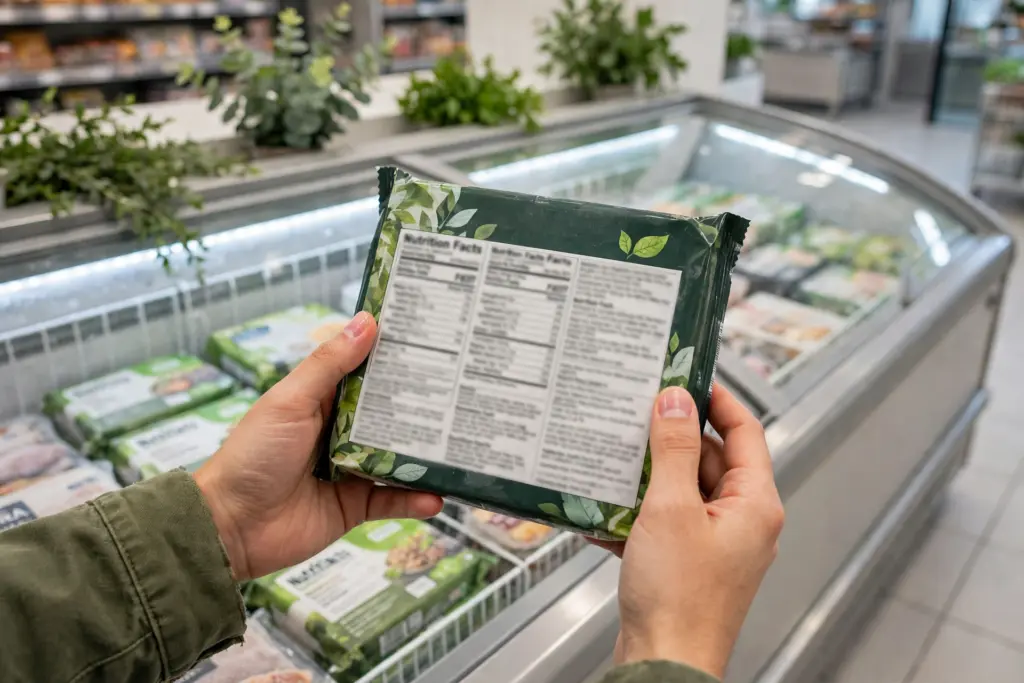
Ready meals. This is where labels matter most. A frozen dinner can look balanced on the front of the box — a photo of chicken, rice, and vegetables — while delivering most of a day’s sodium in one tray. That does not make every ready meal a bad choice, but it does make comparison essential. Hold two boxes side by side and let the label, not the photo, decide.
Desserts, breads, and snacks. Ice cream, pastries, garlic bread, and frozen appetizers live here too. Enjoy them when you want them, buy them on purpose rather than by habit, and keep portions in mind — a box that looks like one serving often holds two or three.
Read the label in 20 seconds
You do not need to study every frozen box like an exam. Four checks, done in order, tell you most of what you need.
1. Serving size first. Everything else on the label refers to one serving, not the whole box. If the box holds three servings and you eat the whole thing, triple the numbers. This single check prevents more surprises than any other.
2. Sodium. The Daily Value for sodium is 2,300 mg. The U.S. Food and Drug Administration’s quick guide is handy here: 5% of the Daily Value or less is low, 20% or more is high. A frozen meal at 40% or 50% of the Daily Value for sodium has used up nearly half your day in one tray. The American Heart Association suggests an ideal limit of 1,500 mg a day for most adults, so a meal that leaves room for the rest of your day is worth more than a meal that spends it all at once.
3. Added sugars. Look for the “Added Sugars” line under Total Sugars, not just the total. The Daily Value for added sugars is 50 grams. The American Heart Association recommends limiting added sugars to about 6 teaspoons a day for most women and 9 teaspoons for most men — roughly 25 and 36 grams. A sweetened fruit blend or a dessert-style meal can use up that budget before you notice.
4. Saturated fat and fibre. The Daily Value for saturated fat is 20 grams, and the same 5%-low, 20%-high guide applies. For fibre, higher is better: the World Health Organization recommends at least 25 grams of naturally occurring fibre a day for adults and older children, and a frozen meal built on vegetables, beans, or whole grains will usually clear that bar more easily than one built on refined grains and cheese.
Then glance at the ingredient list. Ingredients appear in order of weight, so if salt, sugar, or a syrup shows up in the first few spots, the food leans heavily on it. Short lists with foods you recognise — vegetables, fish, rice, beans — are usually the better sign.
Read also: How to Read Food Labels
Build a frozen meal in minutes
The fastest way to use the aisle well is to stop thinking in single products and start thinking in combinations. One plain protein, one or two vegetables, and one base will carry you through most weeknights.
Try these patterns, and swap ingredients freely:
- Stir-fry night: frozen stir-fry vegetables plus frozen shrimp or tofu, tossed with garlic, ginger, and a splash of soy sauce, served over frozen brown rice.
- Soup from the freezer: frozen mixed vegetables, frozen spinach, and canned or frozen beans simmered in low-sodium broth with herbs. It tastes slow-cooked and takes about 20 minutes.
- Sheet-pan dinner: frozen broccoli and cauliflower roasted with salmon fillets, olive oil, and lemon. Everything cooks at once, and the washing-up is one tray.
- Breakfast rescue: frozen berries stirred into oatmeal or yoghurt, with a handful of nuts. No chopping, no waste, and the berries are often cheaper than fresh out of season.
Seasoning does the heavy lifting here. Herbs, citrus, garlic, chilli, and a good olive oil make plain frozen food taste finished without leaning on salt or sugar. If a meal tastes flat, add acid — lemon juice or vinegar — before you reach for the salt shaker.
Read also: How to Shop the Grocery Store Perimeter
Thawing and storing safely
Good frozen food still needs good handling. Food kept continuously at 0°F (-18°C) or below stays safe indefinitely — the storage times you see on charts are about quality, not safety. What fades with months in the freezer is texture and flavour, not safety, as long as the temperature held. Freezer burn, those dry pale patches, is a quality problem, not a danger sign, though it does mean the food will taste drier.
Thawing is where care matters, because bacteria that were dormant in the freezer wake up as food warms. The U.S. Department of Agriculture points to three safe routes: in the refrigerator, under cold running water, or in the microwave with immediate cooking. Cooking straight from frozen is also safe, though it takes roughly one and a half times longer. What you should avoid is thawing on the counter, where the outside of the food can sit in the danger zone — between 40°F and 140°F — while the centre is still frozen.
A few habits keep the whole system working. Keep your fridge at 40°F (4°C) or below and your freezer at 0°F (-18°C) or below, and use a thermometer if you are unsure — dials can be optimistic. Move frozen food to the fridge the night before when you can; ground meat and poultry thawed this way should be cooked within a day or two, while red meat keeps for three to five days. Once cooked, leftovers belong in the fridge and should be eaten within three to four days. And never refreeze food that sat out for more than two hours — when in doubt, throw it out.
At the store, shop the freezer aisle last so bags stay frozen on the way home, and skip any package that feels soft, puffy, or covered in large ice crystals — those are signs it thawed and refroze somewhere along the way. At home, label bags with the date, use older stock first, and squeeze air out before resealing to slow freezer burn.
A freezer that works for you
Before your next shop, take five minutes to look at what is already in your freezer. Toss anything unlabelled and ancient, note the gaps — usually vegetables or a plain protein — and write a short list from this article’s plain-staple section. Shopping with that list turns the aisle from a maze into a quick errand: in for the staples, a careful look at any ready meal, and out.
The frozen aisle rewards a simple approach. Favour plain over sauced, compare sodium before you compare brands, and let the freezer do what it does best — hold good food ready until the night you need it. Your future self, standing in the kitchen at seven in the evening with no fresh food left, will be glad you did.
Frequently asked questions
Are frozen vegetables as healthy as fresh?
Usually, yes — and sometimes better. Studies comparing frozen and refrigerated produce found vitamin levels broadly comparable, with frozen produce often holding its own or winning after several days of fridge storage. Plain frozen vegetables with no sauce are a strong choice.
How long does frozen food last?
At 0°F (-18°C) or below, frozen food stays safe indefinitely; recommended storage times are about quality. For best taste, use most frozen vegetables and meals within a few months, and keep the freezer cold and the packages sealed.
What should I avoid in the frozen aisle?
Watch for high sodium (20% of the Daily Value or more per serving is high), added sugars in fruit blends and meals, and long ingredient lists built on breading, cheese sauce, and syrups. None of these are forbidden — they are just foods to buy on purpose, not by default.
Is it safe to cook food straight from frozen?
Yes. Cooking from frozen is safe as long as the food reaches a safe internal temperature, though it takes about one and a half times longer than cooking thawed food. For microwave-thawed food, cook it immediately rather than letting it sit.
Sources
- World Health Organization — Nutrition for a healthy life (at least 400 g of fruits and vegetables a day; salt under 5 g a day; free sugars under 10% of energy; fibre at least 25 g a day)
- Bouzari, Luo & Barrett (2015), Journal of Agricultural and Food Chemistry — Vitamin retention in eight fruits and vegetables
- Li et al. (2017), Journal of Food Composition and Analysis — Selected nutrient analyses of fresh, fresh-stored, and frozen fruits and vegetables
- U.S. Food and Drug Administration — How to understand and use the Nutrition Facts label (5% Daily Value is low, 20% is high; Daily Values: sodium 2,300 mg, added sugars 50 g, saturated fat 20 g)
- American Heart Association — Added sugars (about 6 teaspoons a day for most women, 9 teaspoons for most men; ideal sodium limit 1,500 mg a day)
- FoodSafety.gov — Cold food storage charts (freezer at 0°F / -18°C or below; fridge at 40°F / 4°C or below; cooked leftovers 3–4 days)
Disclaimer: This article is for general information only and is not medical advice. If you have a health condition, food allergy, or specific dietary needs, talk to your doctor or a registered dietitian about what fits you.