Nutritious Sandwich Ideas for Work
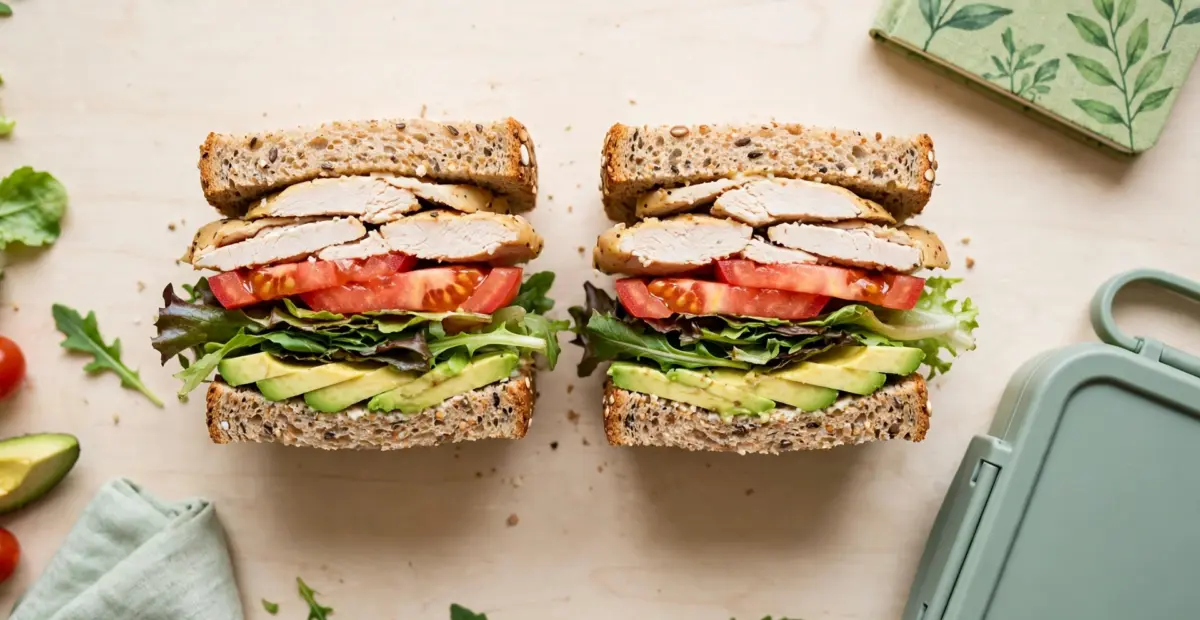
A good work sandwich does three jobs at once: it keeps you full until dinner, it survives a morning in a bag without turning to mush, and it doesn’t leave you staring at the vending machine by three o’clock. Most sandwiches fail at least one of those. The usual deli counter version is heavy on sodium and light on fiber, and the white-bread-and-mayo default fades fast — you eat it at noon and you’re hungry again by two.
The fix isn’t complicated. A sandwich is really a formula, and once you know the formula you can build a different one every day of the week without thinking hard about it. This article gives you the formula, the numbers behind it, and ten ideas you can actually pack on a Sunday night.
The formula: bread, protein, produce, spread
Every sandwich worth packing has four parts. Bread is the structure. Protein is what keeps you full. Produce adds fiber, crunch, and volume without many calories. And the spread is where the flavor lives — and where most sandwiches quietly go wrong, because a thick layer of full-fat mayonnaise adds about 90 calories per tablespoon with almost nothing else in it.
Start with that frame and the choices get easy. Swap the spread and you change the sandwich. Swap the protein and you change the week. The ten ideas below all follow the same frame, so you can mix and match parts freely: the bread from one, the protein from another, the spread from a third.
Pick a bread that works as hard as you do
Bread is the part people think about least and the part that matters most, because it’s usually the biggest ingredient by weight. Two slices of whole wheat bread carry about 6 grams of fiber per 100 grams, while white bread carries about 2.7 grams — and the calories are nearly identical, around 252 versus 266 per 100 grams, according to USDA FoodData Central. The fiber difference is the whole story: fiber slows digestion, steadies blood sugar, and is the reason a whole-grain sandwich keeps you full two hours longer than a white-bread one.
Check the first ingredient when you shop. It should say “whole wheat flour” or another whole grain, not “enriched wheat flour” — that word “enriched” means the bran and germ were stripped out and a few vitamins added back, while the fiber stayed gone. The 2025–2030 Dietary Guidelines for Americans recommend 2–4 servings of whole grains a day at a 2,000-calorie level, and a sandwich on whole-grain bread covers two of them before you’ve even added the filling.
One more thing to watch on the label: sodium. A single slice of bread can contain anywhere from 80 to 230 mg of sodium, according to the CDC, so two slices can quietly add 300 mg before the filling even starts. If your loaf is on the salty end, balance it with a low-sodium filling rather than deli meat and cheese together.
Read also: Healthy Wrap Ideas for Lunch
The protein question — and the deli-meat trap
Protein is what makes a sandwich a meal instead of a snack. The current Dietary Guidelines suggest 1.2 to 1.6 grams of protein per kilogram of body weight per day, spread across meals — for a 70 kg person, that’s roughly 84 to 112 grams a day, or about 25 to 35 grams at lunch. A sandwich built on leftover roast chicken (about 31 grams of protein per 100 grams), a couple of eggs (about 6 grams each), or a pouch of tuna (roughly 20 grams) gets you there without trying.
Deli meat is the convenient option, and it’s also the one to treat with the most care. Sliced ham from USDA FoodData Central carries about 1,040 mg of sodium per 100 grams, and the CDC notes that a serving of around six thin slices of lunch meat can contain 750 mg of sodium or more. That’s a third of the daily limit of less than 2,300 mg before you’ve counted the bread, the cheese, or the condiments. The average American already eats about 3,400 mg of sodium a day, and sandwiches and cold cuts sit in the top ten sources of it.
There’s a second reason to rotate deli meat out of the daily slot. In 2015, the World Health Organization’s cancer research agency classified processed meat as carcinogenic to humans, estimating that each 50-gram portion eaten daily — about two slices of ham — is linked to an 18% higher risk of colorectal cancer. That is a relative increase on a small absolute risk, not a reason to panic over one sandwich, but it is a solid reason to make deli meat a sometimes food rather than the everyday default. Cooked chicken, eggs, tuna, beans, and tofu give you the same protein with far less sodium and none of that baggage.

Ten sandwiches that hold up until lunch
Each idea below is built on whole-grain bread unless noted, and each one is designed to be made the night before.
1. The Sunday roast chicken, rebuilt
Leftover roast chicken is the best sandwich protein there is — cheap, low in sodium, and already cooked. Slice it thin, add a smear of mustard, sliced cucumber, and a handful of spinach. A spoonful of plain Greek yogurt mixed with a little mustard makes a creamy spread with about 17 grams of protein per 170 grams and a fraction of the fat of mayonnaise.
2. Egg salad, lightened up
Mash two hard-boiled eggs with two tablespoons of plain Greek yogurt instead of mayonnaise, plus mustard, chopped celery, and a pinch of black pepper. You keep the familiar comfort and cut most of the fat. Add a slice of tomato and lettuce for crunch. This one travels well and costs almost nothing.
3. Tuna, white beans, and lemon
Mix a pouch of tuna with a few spoonfuls of canned white beans, lemon juice, olive oil, and chopped red onion. The beans stretch the tuna, add fiber, and turn a familiar sandwich into something that actually fills you up. Spoon it onto whole-grain bread with arugula. Roughly 20 grams of protein from the tuna, plus the beans’ fiber on top.
4. Hummus and roasted vegetables
Spread hummus thickly on both slices — about two tablespoons adds roughly 5 grams of protein and 4 grams of fiber — then layer roasted zucchini, bell pepper, and red onion, made in a batch on Sunday. This one is vegan, keeps for days in the fridge, and tastes better the second day as the flavors settle.
5. Turkey and avocado, with a twist
If you do use deli turkey, keep it to two or three slices and let avocado do the heavy lifting: half an avocado adds about 5 grams of fiber and the kind of monounsaturated fat that makes a sandwich feel satisfying. Add sprouts or shredded carrot for crunch, and skip the cheese — the sodium adds up fast when deli meat and cheese share a sandwich.
Read also: Healthy Lunch Plates: How to Build Them
6. Chickpea “tuna” salad
Mash a can of chickpeas with a fork, then mix with diced celery, red onion, a spoonful of yogurt, mustard, and a squeeze of lemon. It has the same creamy, savory profile as tuna salad, with more fiber and no fishy smell in the office. This is the sandwich to make when you want a plant-based lunch that doesn’t feel like a compromise.
7. Peanut butter, banana, and a handful of spinach
It sounds like a childhood lunch, and it is — but it works. Natural peanut butter (ingredients: peanuts, salt) on whole-grain bread with sliced banana gives you protein, fiber, and potassium, and the spinach wilts slightly against the bread in a way that adds iron and folate without changing the flavor. Two tablespoons of peanut butter carry about 7 grams of protein.
8. The caprese, upgraded
Fresh mozzarella, tomato, and basil is a classic for a reason, but on its own it’s light on protein and fiber. Fix that by using whole-grain bread, adding a drizzle of olive oil instead of a thick layer of mayo, and tucking in a handful of white beans or a sliced boiled egg. A slice of mozzarella adds about 200 mg of calcium; the egg or beans make it a real lunch.
9. Salmon and cream cheese, the lighter way
Smoked salmon on whole-grain bread with a thin spread of light cream cheese, cucumber, and dill is the closest thing to a café lunch you can pack at home. Keep the portion modest — about 60 grams — and let the cucumber and a squeeze of lemon carry the freshness.
10. The fridge-cleanout sandwich
Friday’s sandwich is whatever is left: a smear of hummus or mustard, the last of the roast vegetables, a sliced boiled egg, and whatever greens haven’t wilted yet. The formula is what makes it work, not the specific ingredients. If it has whole-grain bread, a protein, produce, and a spread with actual flavor, it’s a proper lunch — and it keeps good food out of the bin.
Pack it so it survives the morning
A great sandwich can still be a sad lunch if it sits warm for four hours. FoodSafety.gov’s rule is simple: perishable food should not sit at room temperature for more than two hours — one hour if it’s above 90°F — because bacteria multiply fastest between 40°F and 140°F. Pack your sandwich in an insulated lunchbox with at least two cold sources, like a frozen gel pack and a frozen water bottle, and keep it in the fridge overnight before you leave.

A few packing habits make a real difference. Wrap the sandwich snugly in beeswax wrap or foil so air can’t dry it out. Put wet ingredients — tomato, pickles, sauerkraut — in the middle, away from the bread. If you love tomato, slice it thick and salt it lightly, or pack it separately and add it at lunchtime. And if your mornings are chaotic, freeze the sandwich the night before: FoodSafety.gov notes that freezing sandwiches helps them stay cold, and by noon it will have thawed into a perfectly chilled lunch. Just skip freezing anything with fresh lettuce or mayonnaise, which don’t thaw gracefully.
Read also: No-Cook Healthy Lunch Ideas
A week of work sandwiches, planned in ten minutes
Sunday night, cook one batch of protein and one batch of vegetables, and the week builds itself:
- Monday: Roast chicken and spinach (idea 1) — use the freshest ingredients first.
- Tuesday: Egg salad (idea 2) — boil the eggs while the chicken cooks on Sunday.
- Wednesday: Hummus and roasted vegetables (idea 4) — the flavors are best by midweek.
- Thursday: Tuna and white beans (idea 3) — a pantry lunch for the day the fridge runs low.
- Friday: The fridge-cleanout sandwich (idea 10) — nothing wasted, nothing bought twice.
One shopping list covers all five: a loaf of whole-grain bread, a roast chicken, a dozen eggs, two cans of beans, hummus, tuna pouches, and whatever vegetables look good.
Frequently asked questions
Is a sandwich a healthy lunch?
It depends entirely on what’s in it. A sandwich on whole-grain bread with a real protein source, vegetables, and a spread like hummus or mustard can be one of the most balanced lunches you can pack. A sandwich on white bread with processed meat, cheese, and full-fat mayonnaise is mostly refined carbs, sodium, and saturated fat. Same format, very different meal.
How much sodium is too much in a sandwich?
The daily limit for most adults is less than 2,300 mg of sodium, and the average American already eats about 3,400 mg. A sandwich with two slices of bread, three slices of deli ham, and a slice of cheese can easily pass 1,200 mg — more than half the day’s limit in one meal. Swapping deli meat for leftover chicken or eggs, and cheese for avocado or hummus, typically cuts several hundred milligrams without changing the sandwich’s character.
Can I make sandwiches the night before?
Yes — most of the ideas above are better made the night before, because the flavors settle and the bread softens slightly. Keep the finished sandwich refrigerated, use an insulated bag with a cold source in the morning, and add wet ingredients like tomato at lunchtime if you want the bread to stay firm. Perishable sandwiches should not sit out for more than two hours.
What is the healthiest bread for sandwiches?
Look for a loaf whose first ingredient is a whole grain, such as whole wheat flour, and that carries at least 2–3 grams of fiber per slice. Whole wheat bread has about 6 grams of fiber per 100 grams against white bread’s 2.7 grams, with nearly the same calories. A “wheat bread” label without the word “whole” is usually just white bread in a darker color.
This article is for general information only and is not medical advice. If you have a medical condition, food allergy, or specific dietary needs, talk with your doctor or a registered dietitian before changing your diet.
Sources
- USDA FoodData Central — nutrient values for whole wheat bread, white bread, deli ham, and other foods cited.
- Woodruff RC et al., “Top Food Category Contributors to Sodium and Potassium Intake — United States, 2015–2016,” MMWR 2020 — average US sodium intake 3,397 mg/day; sandwiches and deli meats among the top contributors.
- International Agency for Research on Cancer, press release 240 (26 October 2015) — processed meat classified as carcinogenic to humans; each 50 g daily portion linked to an 18% higher colorectal cancer risk.
- FoodSafety.gov, “Get an A+ in Food Safety This School Year” — the two-hour rule, danger zone 40–140°F, insulated lunchbox and cold-source guidance.
- Tufts Food Lab, “Link Between Nutrition and Flour” — whole-grain versus refined flour and what the first ingredient tells you.