Electrolytes in Drinks: General Nutrition Basics

You have probably seen the word on the side of a brightly coloured bottle: electrolytes. It shows up on sports drinks, flavoured waters, powders you stir into a glass, and tablets that fizz. The marketing makes it sound like a secret ingredient your body is always running low on. The reality is calmer — and more useful. Electrolytes are ordinary minerals you already eat every day, and most of the time, plain water and regular meals cover your needs completely. The trick is knowing when a drink with electrolytes genuinely helps and when it is just flavoured sugar water.
What electrolytes actually are
Electrolytes are minerals that carry an electrical charge when they dissolve in your body fluids. That charge is what lets them do their work: they help move water in and out of cells, send nerve signals, contract muscles, and keep your blood pressure and acid–base balance steady.
The main ones you will hear about are sodium, potassium, chloride, magnesium, calcium, phosphate, and bicarbonate. Each has its own job, and they work as a team rather than alone. Sodium sits mostly in the fluid outside your cells and helps hold on to water there. Potassium sits mostly inside your cells and balances sodium out. Calcium and magnesium help muscles contract and relax. None of them provides energy — a drink only gives you calories when it also contains carbohydrate. The minerals themselves are regulators, not fuel.
Your body is very good at keeping these minerals in a narrow range. Your kidneys adjust what you keep and what you pass, and your thirst and appetite do the rest. That is why, for most people on most days, electrolytes are a background system you never need to think about.
How much do you actually need?
Daily targets for the main electrolytes are set by the National Academies, and they are worth knowing because they show how much food already provides. The adequate intake for sodium is 1,500 mg per day for adults, with a chronic-disease risk reduction level of 2,300 mg — the number the U.S. Food and Drug Administration uses as the Daily Value on nutrition labels. The World Health Organization recommends keeping sodium below 2,000 mg per day, about 5 grams of salt.
Potassium runs the other way: the adequate intake is 3,400 mg per day for adult men and 2,600 mg for adult women, and most people fall short. Magnesium has a recommended dietary allowance of 400–420 mg per day for men and 310–320 mg for women, while calcium sits at 1,000 mg for most adults and 1,200 mg for older adults. The upper limit for supplemental magnesium is 350 mg per day — that limit applies to supplements, not to magnesium in food, which has not been shown to cause harm.
Put together, the picture is clear: sodium is the one most of us get too much of, while potassium and magnesium are the ones many of us under-consume. That imbalance is a food problem, not a drink problem — and it is fixed at the table, not at the drinks aisle.
Read also: How Much Water Do You Need? a General Guide
What happens when you sweat
Sweat is mostly water, but it carries minerals out with it — mostly sodium and chloride, with smaller amounts of potassium and very small amounts of magnesium and calcium. How much sodium you lose varies a lot from person to person: sweat sodium concentration typically ranges from roughly 200 mg to more than 2,000 mg per litre, and most people sit somewhere in the middle, around 400–1,100 mg per litre.
For a short workout, those losses are small and your next meal replaces them without any effort. The math changes when exercise runs long or the heat is serious. The American College of Sports Medicine (ACSM) recommends including sodium in drinks for exercise lasting longer than about an hour — around 0.5 to 0.7 grams of sodium per litre of fluid — because sodium helps you hold on to the fluid you drink, keeps you drinking, and reduces the risk of blood sodium dropping too low.
That last point matters more than most people realise. Drinking large volumes of plain water during very long efforts can dilute blood sodium, a condition called exercise-associated hyponatremia. It is uncommon, but it is the reason consensus guidance says to drink to thirst rather than forcing a fixed schedule, and to include some sodium when a session runs past an hour or two.
When water is enough — and when it is not
Here is the simple rule of thumb, and it covers most situations:
- Under 60 minutes of light to moderate exercise: plain water is enough. There is little evidence of a performance difference between water and a carbohydrate–electrolyte drink for short sessions.
- 60–90 minutes or more, or any long session in heat and humidity: a drink with sodium starts to earn its place, especially if you are a heavy sweater.
- Endurance events, two-a-day training, or outdoor labour in extreme heat: electrolyte replacement becomes genuinely important, and sodium is the priority.
For everyday life — a desk job, a school day, a 30-minute walk, a gentle gym session — an electrolyte drink is mostly paying for flavour. Your meals already supply the minerals. A salty lunch or a banana after your workout does the same job as a sports drink, with more nutrients attached.
Read also: How to Stay Hydrated on a Busy Day

What is actually in the bottle?
Not all electrolyte drinks are the same, and the label tells the story if you know what to look for. A typical commercial sports drink provides around 110–160 mg of sodium per 8-ounce serving, along with roughly 14 grams of carbohydrate — and a 20-ounce bottle can carry about 30 grams of added sugar. That carbohydrate is not an accident: glucose helps the small intestine absorb sodium and water faster, which is genuinely useful during long endurance efforts. The problem is that most people sipping a sports drink are not running a half-marathon, so the sugar becomes calories they did not need.
Electrolyte powders and tablets vary even more. Some are mainly sodium and flavouring with almost no calories. Others add potassium, magnesium, or caffeine, and a few pack in several supplements at once. Coconut water sits in its own corner: it is naturally rich in potassium — around 600 mg per cup — but low in sodium, so it is a poor match for replacing heavy sweat losses, even though it works fine as a refreshing drink.
When you compare labels, check four things: sodium per serving, total sugar, serving size (bottles often hold two), and whether caffeine or other stimulants are listed. A drink with 100 mg of sodium per serving is not going to replace the 500–1,000 mg per litre that a long, sweaty session can cost you.
Food first: the everyday electrolyte sources
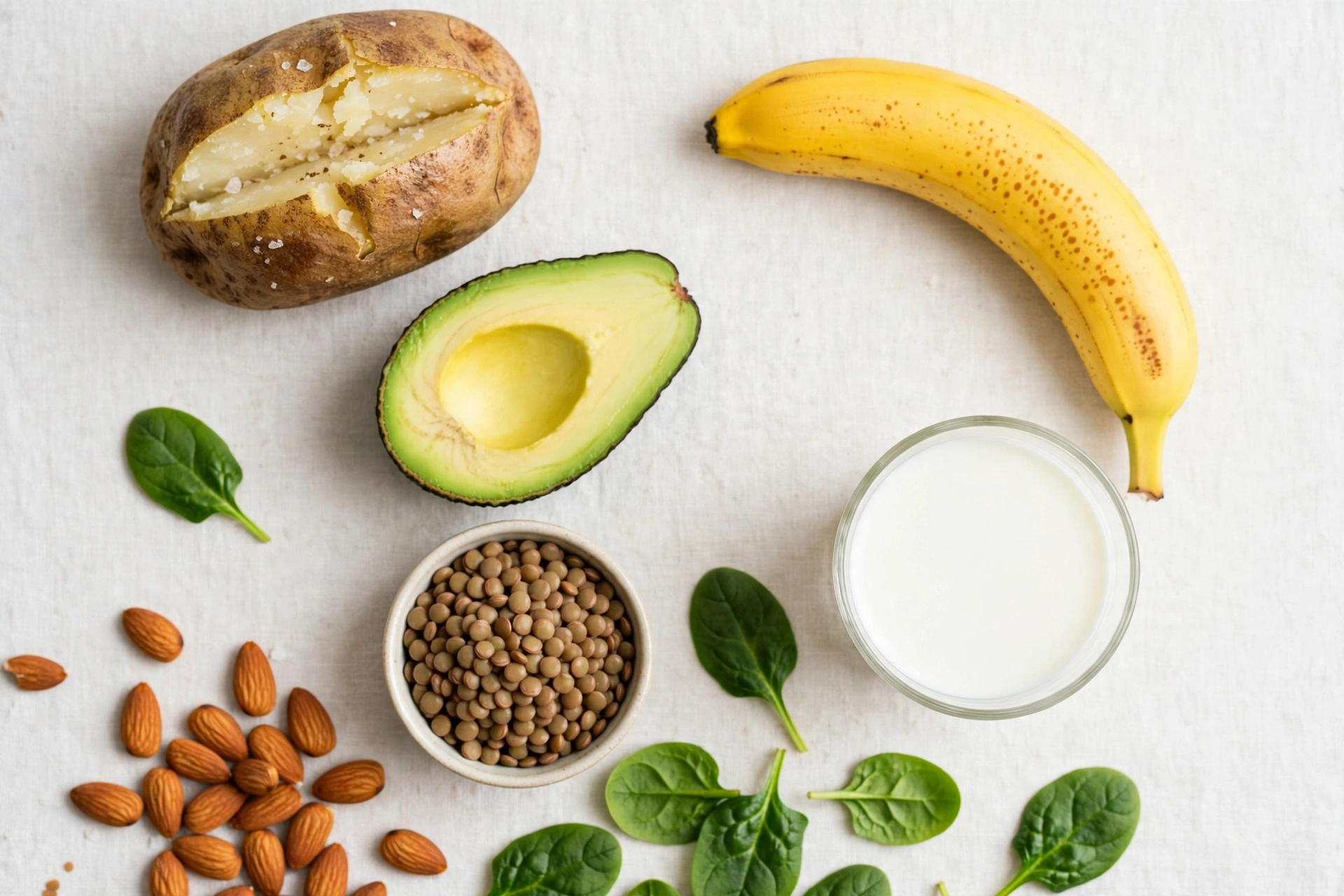
The most reliable electrolyte drink is, arguably, not a drink at all. Food supplies every one of these minerals in useful amounts, and it does so alongside fibre, vitamins, and other nutrients a bottle cannot offer.
| Electrolyte | Everyday food sources | Why it helps |
|---|---|---|
| Sodium | Salt, bread, cheese, soups, pickles, olives | Replaces sweat losses; helps retain fluid |
| Potassium | Potatoes, beans, lentils, bananas, avocado, tomatoes, dairy | Balances fluids inside cells; supports blood pressure |
| Magnesium | Nuts, seeds, legumes, whole grains, leafy greens | Muscle relaxation; hundreds of enzyme reactions |
| Calcium | Dairy, fortified plant milks, leafy greens, canned sardines | Muscle contraction; bone health |
| Chloride | Table salt, seaweed, tomatoes, celery | Works with sodium on fluid and acid–base balance |
A baked potato with beans, a handful of almonds, or a glass of milk after training covers potassium, magnesium, and calcium in one go. That is why dietitians keep saying the same thing: for most people, the electrolyte strategy that works is a varied diet plus water, with a sports drink reserved for the sessions that actually demand one.
Do kids need sports drinks?
Short answer: usually not. The American Academy of Pediatrics recommends water — not sports drinks — as the principal source of hydration for children and adolescents. A sports drink can make sense for a young athlete doing prolonged, vigorous exercise in hot, humid conditions, but for routine practices and ordinary activity, water is the better choice. Routine sports drinks add sugar and calories that can contribute to overweight and tooth decay, and energy drinks, which contain stimulants such as caffeine, have no place in the diet of children or adolescents at all.
Can you have too much?
Yes, in a few specific ways. Too much sodium over the long term is linked to higher blood pressure, which is why public health guidance caps it at 2,300 mg per day for most adults. Too much magnesium from supplements can cause diarrhoea, nausea, and cramping, which is why the 350 mg per day upper limit exists for non-food sources. And drinking far more fluid than you sweat out during a long event can dilute blood sodium — the hyponatremia risk mentioned above. Potassium has no upper limit set for healthy people, but anyone with kidney disease or taking certain blood pressure or heart medicines should talk to a clinician before using potassium-rich supplements or salt substitutes.
The practical takeaway is not to fear electrolytes, but to match the tool to the job: water and food for ordinary days, a sodium-containing drink for long, sweaty efforts, and a conversation with a clinician if you have a medical condition that affects fluid or mineral balance.
Read also: How to Compare Sugary and Unsweetened Drinks
How to choose an electrolyte drink
If you do need one — a long run, a tournament day, a shift working outdoors in the heat — keep it simple:
- Match the duration. Under an hour, water. Over an hour, look for sodium on the label.
- Check the sodium. Aim for roughly 300–600 mg of sodium per hour of prolonged exercise, or about 500–700 mg per litre of fluid.
- Watch the sugar. During long efforts, some carbohydrate helps absorption. Outside those efforts, a zero- or low-sugar option avoids empty calories.
- Skip the caffeine for kids. Children and teenagers should not be using caffeinated electrolyte or energy drinks.
- Do not overdrink. Drink to thirst, and let pale yellow urine be your guide rather than a rigid hourly quota.
You can also make a simple version at home: water with a pinch of salt and a squeeze of lemon or orange gives you fluid and sodium for almost nothing, and a banana alongside it covers potassium. It will not look as exciting as the bottle, but your body cannot tell the difference.
Frequently asked questions
Do I need electrolytes every day?
No. If you eat regular meals and drink water, your daily sodium, potassium, magnesium, and calcium needs are already covered by food. Electrolyte drinks are a tool for long, sweaty efforts — not a daily requirement.
Is coconut water a good electrolyte drink?
It is high in potassium, at around 600 mg per cup, but low in sodium. That makes it a pleasant everyday drink, but a weak choice for replacing heavy sweat losses, where sodium is what you lose most.
Can electrolytes help with muscle cramps?
Muscle cramps have several possible causes, and the evidence linking ordinary cramps to electrolyte loss is mixed. Staying hydrated, warming up, and eating a varied diet are the more reliable strategies. If cramps are frequent or severe, talk to a clinician rather than relying on a supplement.
Are zero-sugar electrolyte drinks as effective?
For hydration and sodium replacement, yes — the minerals do the work, not the sugar. Carbohydrate helps absorption during long endurance exercise, but for shorter efforts or everyday heat, a sugar-free option works just as well without the extra calories.
The bottom line
Electrolytes are essential minerals, not a magic ingredient. Your body regulates them tightly, food supplies them generously, and plain water handles most days. Reach for a drink with electrolytes when a workout runs past an hour, the heat is serious, or the sweat is pouring — and check the label for sodium first, sugar second. For everything else, a glass of water and a decent meal will do the job better, for less.
Disclaimer: This article is for general nutrition education only and is not medical advice. If you have kidney disease, heart disease, high blood pressure, or take medication that affects fluid or mineral balance, talk to your clinician before changing your electrolyte or fluid intake.
Sources
- National Academies of Sciences, Engineering, and Medicine — Dietary Reference Intakes for Sodium and Potassium (2019)
- National Institutes of Health, Office of Dietary Supplements — Potassium: Fact Sheet for Health Professionals
- National Institutes of Health, Office of Dietary Supplements — Magnesium: Fact Sheet for Health Professionals
- American College of Sports Medicine — Exercise and Fluid Replacement (Position Stand, 2007)
- American Academy of Pediatrics — Sports Drinks and Energy Drinks for Children and Adolescents: Are They Appropriate? (Pediatrics, 2011)