Healthy Work Snacks to Pack
It’s 3 p.m. Your stomach is growling, your focus is slipping, and the vending machine down the hall is starting to look like a reasonable lunch plan. You know the feeling — the afternoon slump hits, and whatever is closest wins.
Here’s the thing: a work snack isn’t a failure of willpower. It’s a normal part of a long day. The trick isn’t skipping it. It’s having something better within reach before the craving decides for you.
Packing your own snacks takes about five minutes the night before, and it changes the whole afternoon. You spend less, you feel steadier, and you stop negotiating with a machine full of candy bars. This guide walks through what makes a snack actually keep you going, which combinations work best at a desk, and how to build a small rotation you won’t get bored of by Wednesday.
What makes a snack work at your desk
A good work snack does three things: it fills you up for a couple of hours, it doesn’t spike and crash your energy, and it survives a bag, a drawer, or a shared office fridge. That combination usually comes down to two nutrients working together — protein and fiber.
Protein slows digestion and helps you feel full. Fiber does the same while feeding the gut microbes that researchers keep linking to better metabolic health. The National Academies set the adequate intake for fiber at 25 grams a day for adult women and 38 grams for adult men, and most people fall well short — a snack that adds 3 to 5 grams is doing real work, not just killing time.
The other half of the formula is what the snack doesn’t do. A snack that’s mostly added sugar — a pastry, a sweetened granola bar, a flavoured latte — tends to leave you hungrier an hour later than you started. The American Heart Association suggests keeping added sugars to about 25 grams a day for women and 36 grams for men, and a single vending-machine snack can eat most of that budget in one go.
So the simple test for any desk snack: does it pair protein or fiber with something you actually enjoy eating? If yes, it probably works. If it’s sugar alone, it’s a dessert wearing a snack’s name tag.
Five packable snacks that actually keep you full
These five are the backbone of the rotation. Each one travels well, needs no reheating, and pairs protein with fiber or healthy fats.
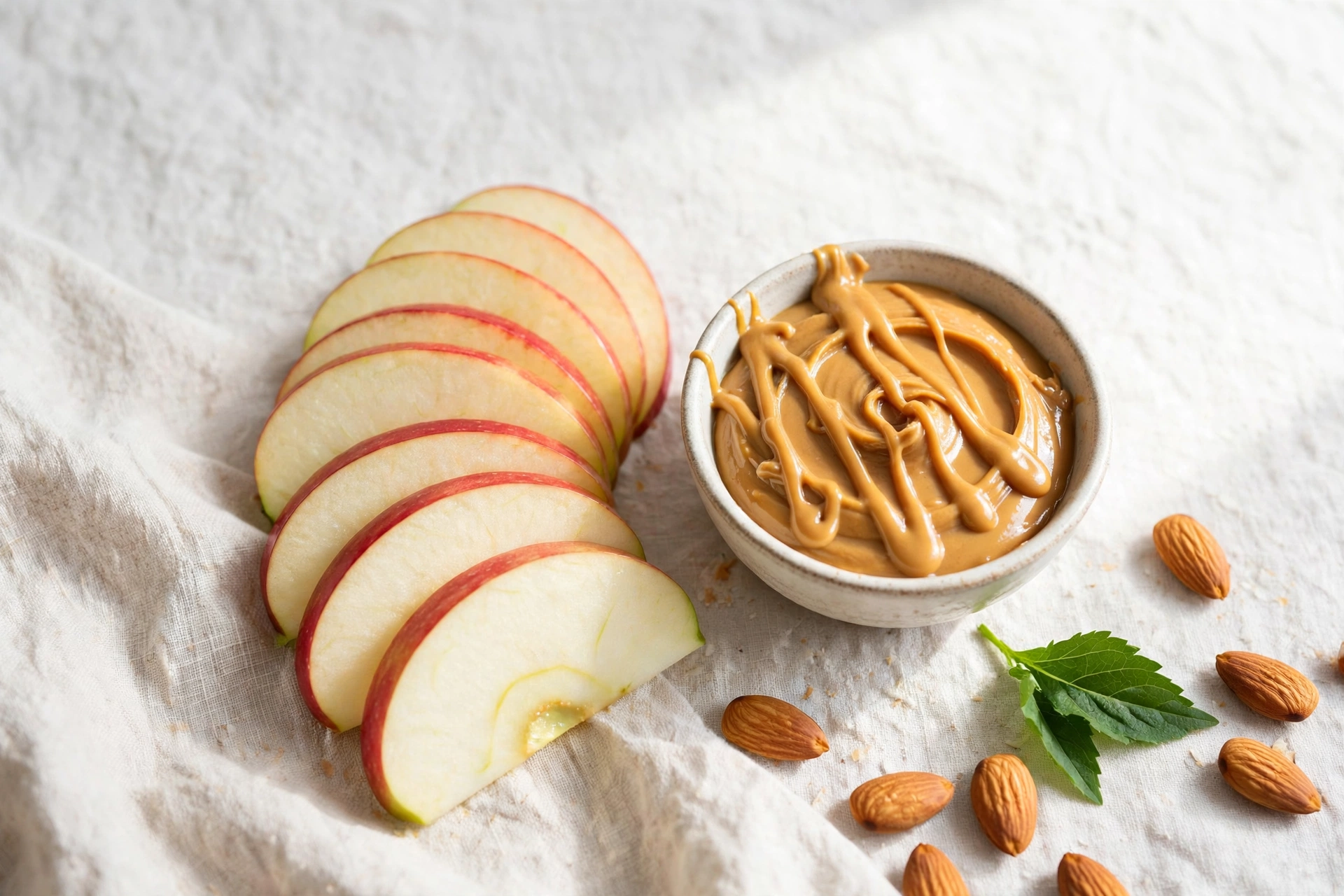
1. Apple slices with peanut butter
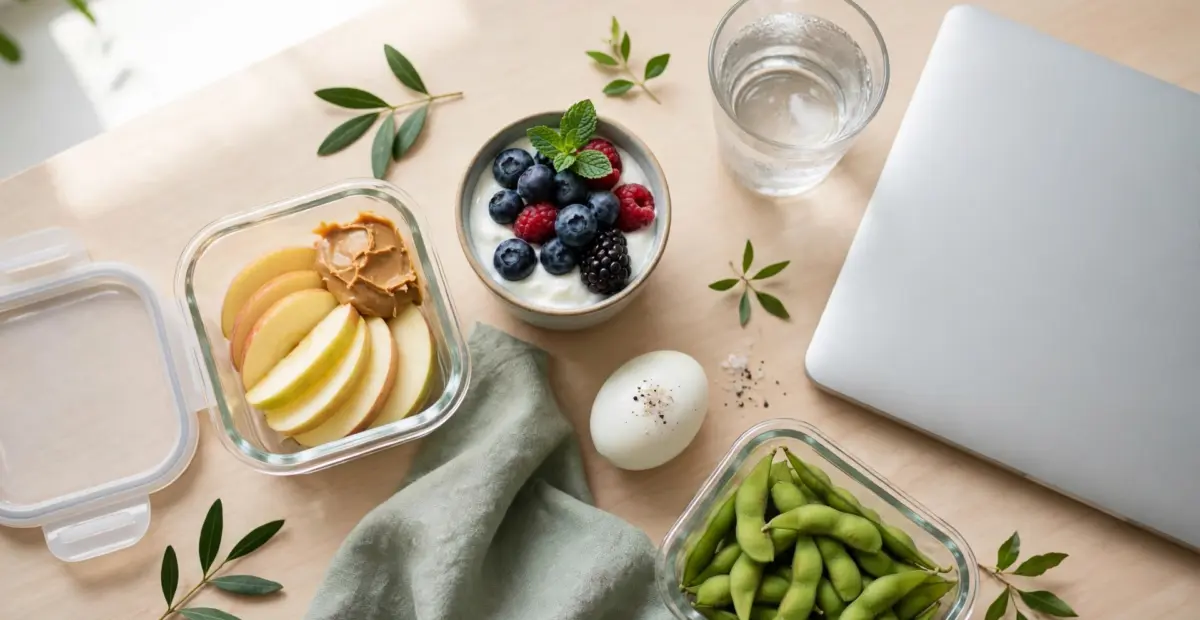
The classic for a reason. A medium apple brings about 4 grams of fiber and natural sweetness; two tablespoons of peanut butter add around 7 grams of protein and the fat that keeps you satisfied. Slice the apple at home and squeeze a little lemon over it so it doesn’t brown by mid-afternoon. If peanut butter isn’t your thing, almond butter works the same way — about 6 grams of protein and 3.5 grams of fiber per ounce of almonds, according to USDA data.
2. Greek yogurt with berries
Plain nonfat Greek yogurt is one of the most protein-dense snacks you can buy: a 170-gram serving carries roughly 17 grams of protein for about 100 calories. Add a small handful of berries and you get fiber, colour, and just enough sweetness to make it feel like a treat. Keep the yogurt in the office fridge and the berries in a small container, and assembly takes ten seconds. Watch the flavoured yogurts, though — some pack 15 grams of added sugar into a single pot, which turns a protein snack back into dessert.
3. A hard-boiled egg and a piece of fruit
One large egg gives you about 6 grams of complete protein for roughly 78 calories, and it comes in its own packaging. Cook a batch on Sunday — they keep in the fridge for up to a week — and grab one on your way out. Pair it with a banana or a small orange and you’ve covered protein, fiber, and potassium in a snack that fits in one hand. A pinch of salt and a crack of pepper make it feel like actual food instead of a chore.
4. Edamame with sea salt
Edamame is the rare plant snack that brings both nutrients in serious amounts: a cup of cooked shelled edamame has about 18 grams of protein and 8 grams of fiber. Buy it frozen, steam a portion the night before, and toss it with a little sea salt. It eats well at room temperature, which makes it perfect for a desk drawer or a commute. If soy isn’t for you, roasted chickpeas offer a similar crunch with protein and fiber of their own.
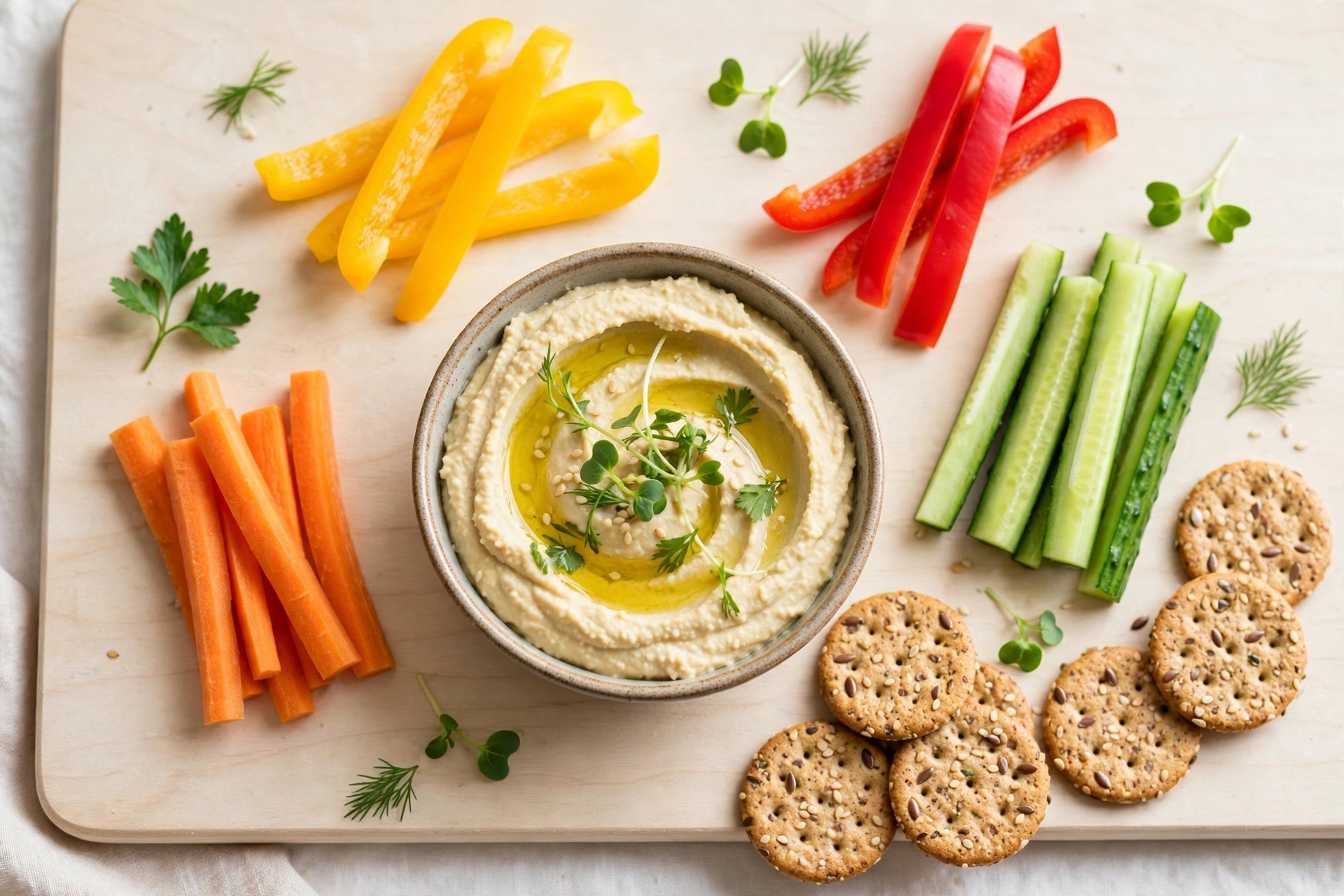
5. Hummus with vegetable sticks and whole-grain crackers
Hummus is chickpeas in disguise — a quarter cup gives you roughly 5 grams of protein and a few grams of fiber, plus the kind of creamy texture that makes raw vegetables feel like a snack instead of a punishment. Carrot sticks, cucumber rounds, and bell pepper strips hold up well in a container, and a small handful of whole-grain crackers adds crunch and staying power. Check the label on the crackers: look for “whole wheat” or “whole grain” as the first ingredient, and a sodium level under 140 milligrams per serving, which the FDA defines as “low sodium.”
Read also: How to Choose Healthier Snacks
How to build your own snack rotation
Five snacks are plenty for a week, but only if you actually rotate them. Eating the same almonds every day gets old fast, and boredom is the number-one reason people drift back to the vending machine. Here’s a simple way to keep it fresh without thinking too hard.
Pick one anchor from each group. Think of snacks in three groups: protein-led (yogurt, eggs, cottage cheese), produce-led (fruit, vegetables, edamame), and crunch-led (nuts, popcorn, crackers). A satisfying snack usually pulls from two groups at once — yogurt plus berries, apple plus nuts, hummus plus vegetables. Pick one favourite from each group and you have nine combinations without buying anything exotic.
Prep on Sunday, pack the night before. Wash and cut vegetables, boil eggs, and portion nuts into small containers on Sunday evening. Then each night, it takes about two minutes to grab one protein item and one produce item and drop them in your bag. The whole system falls apart when packing becomes a morning decision, because mornings are already full.
Keep a desk-drawer backup. Some days you forget to pack. That’s normal, not a failure. A small stash of shelf-stable options — single-serve nut packs, roasted chickpeas, air-popped popcorn bags — covers those days. Air-popped popcorn is a surprisingly solid choice: three cups give you about 3.5 grams of fiber for roughly 90 calories, and the volume makes it feel like a real snack. Just check the label, because butter-flavoured microwave versions can add a lot of sodium and saturated fat.
Read also: How to Add More Vegetables to Your Meals
Reading snack labels without a nutrition degree
Most snack bars, trail mixes, and “healthy” crisps are marketed hard and labelled confusingly. Three checks on the Nutrition Facts panel will tell you most of what you need to know.
First, the serving size. A bag of trail mix might list 160 calories per serving — and contain three servings. The number that matters is what you’ll actually eat, so multiply before you decide. This is the single most common label trap, and it catches everyone.
Second, added sugars. Look for the “Added Sugars” line under total sugars. A granola bar with 12 grams of added sugar is giving you half a day’s worth in a snack. Dried fruit counts as sugar too, even when no sugar was added — a small box of raisins has about 25 grams of natural sugar, so pair it with nuts rather than eating it alone.
Third, the ingredient list. Shorter is usually better, and the first ingredient matters most. If sugar, corn syrup, or enriched flour leads the list, the product is built on them, no matter what the front of the pack claims. Whole foods — nuts, seeds, fruit, yogurt — don’t need a health claim on the front, because there’s nothing to hide.
None of this means you need to be perfect. A snack that’s a little sweet and a little processed is fine sometimes. The goal is a default that leans toward protein and fiber, so the occasional treat is a choice rather than a habit.
Read also: How to Read Food Labels
Snacks for special situations
Long meetings. You can’t crunch through a meeting. A small container of yogurt, a banana, or a cheese stick works quietly and doesn’t leave you rustling packaging while someone presents.
Post-gym workdays. If you train before work, your morning snack may need more protein than usual. Cottage cheese — about 12 grams of protein per half cup — with fruit, or a second egg, covers it without a protein bar.
Shared office snacks. Birthday cake and doughnuts in the break room are part of work life. Enjoy them when you want them; just don’t let them become the default afternoon snack. Having your own packed snack in the drawer makes the break-room tray a genuine choice instead of the only option.
Food allergies. Nuts are a common workplace allergen, and some offices are nut-free. If yours is, lean on seeds — pumpkin and sunflower seeds bring similar protein, fiber, and healthy fats without the nut risk — and always check whether colleagues have allergies before bringing strong-smelling foods like eggs into a shared space.
Frequently asked questions
How many calories should a work snack have?
For most adults, 150 to 250 calories is a useful range — enough to take the edge off hunger without replacing lunch. If you do physical work or train hard, you may need more. Let your hunger and your next meal guide you rather than a strict number.
Are protein bars a good work snack?
Some are, most aren’t. A decent bar has at least 10 grams of protein, at least 3 grams of fiber, and under 5 grams of added sugar. Many popular bars have more sugar than a candy bar and less protein than an egg. Read the label before trusting the wrapper.
Can I snack and still lose weight?
A planned snack usually helps, because it prevents the ravenous 5 p.m. dinner where portion control disappears. The research on meal timing is mixed, but the practical pattern is clear: people who plan a mid-afternoon snack tend to eat more moderately at dinner than people who white-knuckle it until they’re starving.
What if I don’t have access to a fridge at work?
Stick to shelf-stable options: whole fruit, single-serve nut packs, roasted chickpeas, popcorn, and whole-grain crackers with individual peanut butter packets. An insulated lunch bag with a small ice pack opens up yogurt and hummus too, and costs less than a week of vending-machine snacks.
Sources
- USDA FoodData Central — nutrient values for almonds, Greek yogurt, eggs, edamame, popcorn, peanut butter, hummus, and cottage cheese
- National Academies of Sciences, Engineering, and Medicine — Dietary Reference Intakes for fiber (25 g/day women, 38 g/day men)
- American Heart Association — added sugars limits (25 g/day women, 36 g/day men)
- Mayo Clinic — dietary fiber recommendations and food sources
- U.S. Food and Drug Administration — how to read the Nutrition Facts label, including sodium claims
Disclaimer: This article is for general information only and is not medical advice. If you have a medical condition, food allergy, or specific dietary needs, talk with your clinician or a registered dietitian before changing your eating habits.