Balanced Breakfast Smoothie Ideas
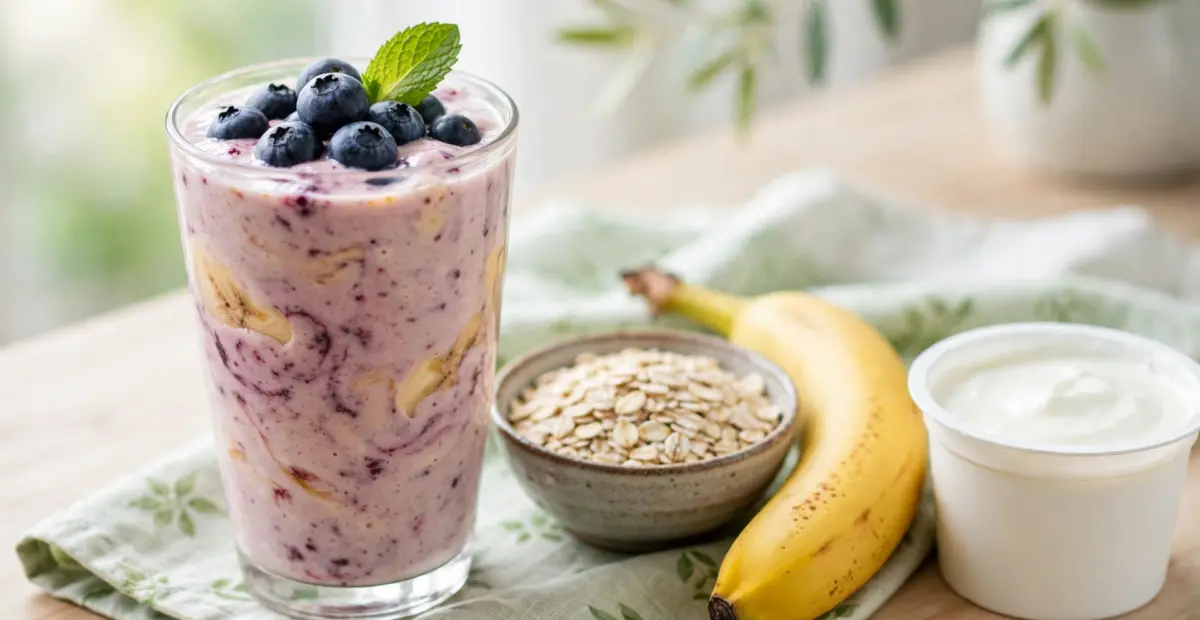
A good breakfast smoothie feels like a small win: fruit, yogurt, and oats in a glass, ready in three minutes, no pan to wash. A bad one feels like a win too — until you check the numbers and realize you’ve just drunk 600 calories of fruit juice, honey, and peanut butter before 8 a.m.
The difference between the two isn’t the blender. It’s the formula. A balanced breakfast smoothie has four jobs to do: give you enough protein to stay full, enough fiber to slow the sugar down, enough fruit or vegetables to make it worth making, and a calorie count that still leaves room for lunch. Get those four right and a smoothie is a genuinely useful breakfast. Get them wrong and it’s dessert with a health halo.
This guide covers the formula, six recipes that follow it, and the five mistakes that quietly undo most homemade smoothies.
First, the honest truth: whole fruit still wins
Before you blend anything, it’s worth knowing what blending does — and doesn’t do — to fruit. Harvard’s Nutrition Source puts it plainly: when you blend most or all of a piece of fruit, skin, pulp, and flesh included, the nutrients and fiber are preserved. A smoothie is not juice. Juicing strips the fiber away; blending keeps it in the glass.
But keeping the fiber isn’t the whole story. The structure of the food changes, and structure matters. In a classic 1977 study published in The Lancet, researchers fed people apples in three forms — whole, puréed, and juiced — with the same amount of available carbohydrate. The whole apples emptied from the stomach most slowly and kept people fullest. The purée sat in the middle, and the juice was gone fastest, with the sharpest blood-sugar rise. A 2025 review of the same question reached a similar conclusion: the same fruit eaten as a chunky fruit salad satisfied people more than the identical fruit blended into a smoothie, because chewing itself switches on fullness signals.
None of this means smoothies are a bad idea. It means they’re a supporting player, not a replacement. Harvard’s own takeaway is that whole fruits and vegetables are the best choice, and smoothies “should not replace eating them in their whole form.” A smoothie is at its best when it helps you eat fruit and vegetables you would otherwise skip — a handful of spinach you’d never eat raw at 7 a.m., berries that are going soft in the fridge — rather than when it replaces the apple you would happily have eaten anyway.
There’s also a numbers problem hiding in big smoothies. Harvard warns that milk, fruit juice, sweeteners, seeds, and protein powders added on top of several cups of fruit can push a single serving to 700–800 calories. That’s more than many people’s entire breakfast budget. The UK’s NHS takes a similar line: juice and smoothies together count as no more than one portion of your five-a-day, capped at 150 ml, because blending frees the fruit’s sugars from their cell walls.
So the goal isn’t to make the biggest smoothie. It’s to make a modest one, built the right way.
The 4-part formula for a balanced breakfast smoothie
Every recipe below follows the same skeleton. Once you know it, you can build your own without a recipe at all.
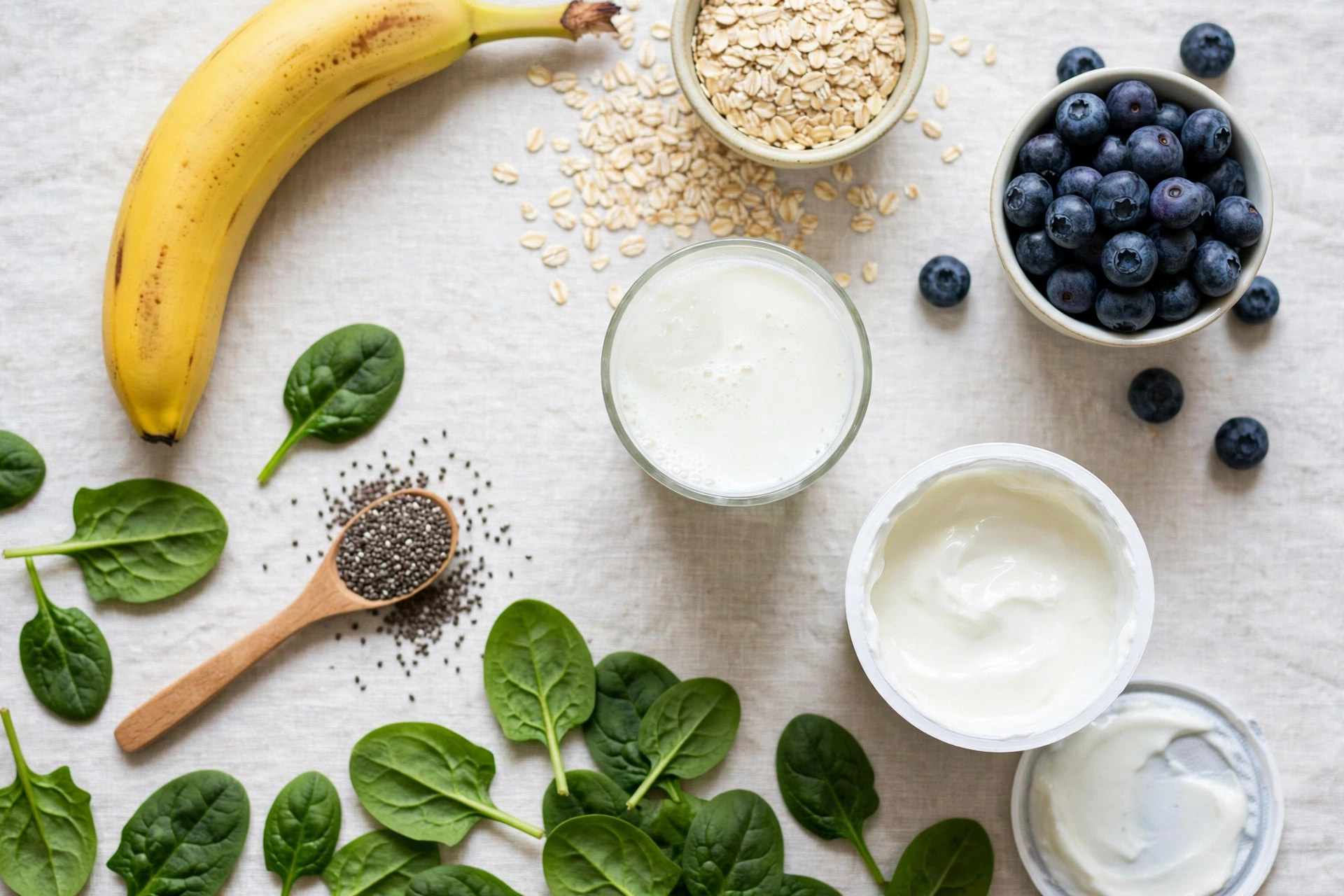
1. One to two servings of fruit or vegetables. A medium banana plus a cup of berries, or a cup of mango plus a handful of spinach. That’s enough for flavor and nutrients without stacking the sugar of three or four whole fruits into one glass.
2. A protein anchor — aim for 15 to 20 grams. Fruit on its own has almost no protein, and protein is what keeps you full until lunch. Plain nonfat Greek yogurt is the easiest anchor: USDA FoodData Central lists it at 10.2 g of protein per 100 g, so a single 170 g tub gives you about 17 g for roughly 100 calories. Milk works too — a cup of whole milk adds about 8 g of protein and 149 calories — as does a scoop of plain protein powder if that’s already part of your routine.
3. A fiber source beyond the fruit. The Institute of Medicine sets adequate intakes for fiber at 25 g a day for women and 38 g for men, and most people fall well short. A quarter-cup of dry rolled oats adds about 4 g of fiber for roughly 76 calories (USDA lists oats at 10.1 g of fiber per 100 g dry), and a tablespoon of chia seeds adds around 3 g more. Fiber is what slows the natural sugars in the fruit and stretches the fullness out over the morning.
4. Liquid, not juice. Water, milk, or unsweetened soy milk. A cup of orange juice adds about 112 calories and half a gram of fiber, while a whole orange has about 62 calories and 3 g of fiber — the fruit beats its own juice every time. Save juice for the glass, not the blender.
That’s the whole formula. Fruit, protein, fiber, liquid. Everything else — a spoonful of nut butter, a pinch of cinnamon, a few ice cubes — is garnish.
Read also: How to Build a Better Breakfast
6 balanced breakfast smoothie ideas
Each recipe makes one serving, roughly 250–400 calories, with 15–20 g of protein and 5–9 g of fiber. Nutrition figures are approximate, added up from USDA FoodData Central values for each ingredient. Blend everything until smooth, adding a splash more liquid if it comes out too thick.
1. The classic: berry-banana yogurt
What goes in: 1 medium banana, 1 cup frozen blueberries, 170 g plain nonfat Greek yogurt, ½ cup milk, a few ice cubes.
This is the smoothie most people picture, and it works because the yogurt does the heavy lifting. The banana (about 105 calories, 3.1 g of fiber, and 422 mg of potassium per medium fruit, per USDA) brings sweetness and body; the berries add color and fiber for very few calories — a cup of blueberries is roughly 84 calories and 3.6 g of fiber. The yogurt brings about 17 g of protein and 110 mg of calcium per 100 g, so the whole glass lands around 350 calories with close to 20 g of protein. If you use sweetened yogurt instead of plain, you’ve added sugar for nothing — check the label, and keep it plain.
2. Peanut butter banana oat
What goes in: 1 banana, 1 tablespoon peanut butter, ¼ cup dry rolled oats, ½ cup milk, a pinch of cinnamon.
The oats are doing quiet work here. A quarter-cup of dry rolled oats is about 76 calories and adds roughly 4 g of fiber plus staying power — this is the smoothie for mornings when lunch is four hours away. Keep the peanut butter to one tablespoon, not two: two tablespoons run close to 190 calories and 16 g of fat, and at that point the nut butter stops being a flavor and becomes the meal. One tablespoon gives you the taste for about 95 calories. Cinnamon adds warmth without sugar, and it makes the whole thing taste sweeter than it is.
3. The green one that doesn’t taste green
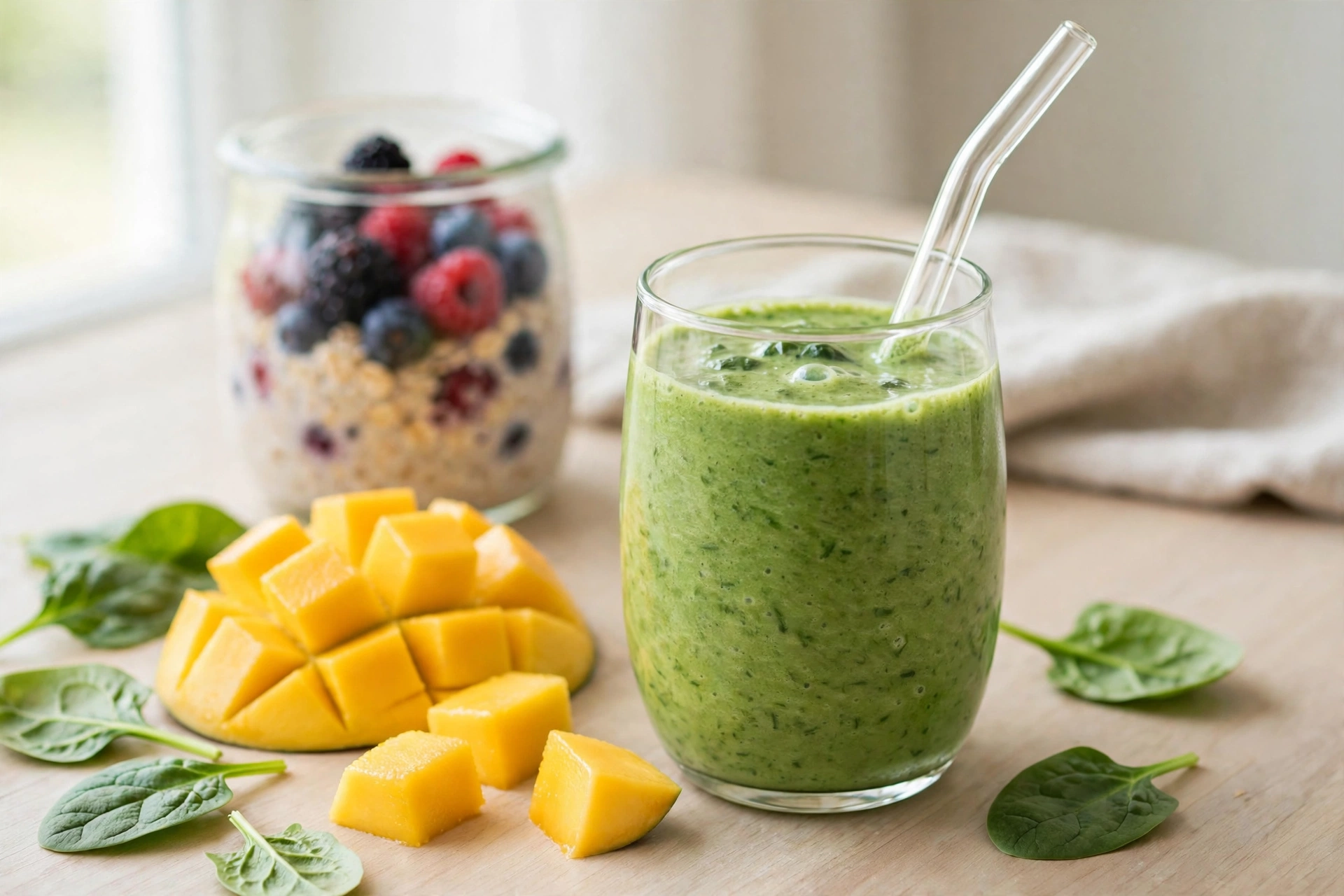
What goes in: 1 cup fresh spinach, 1 cup frozen mango chunks, ½ banana, 170 g plain nonfat Greek yogurt, ½ cup water.
If the idea of spinach at breakfast makes you pause, this is the recipe that changes your mind. A cup of raw spinach is about 7 calories — it disappears into the mango completely, adding folate and vitamin K while the fruit does all the flavor work. Mango is sweet enough that you won’t miss honey, and the yogurt keeps the protein around 18 g. This is the easiest way to get a vegetable into breakfast without cooking anything, and it’s the smoothie to make when the spinach in the fridge is one day from the bin.
4. Tropical pineapple-mango
What goes in: 1 cup frozen pineapple, ½ cup frozen mango, 170 g plain nonfat Greek yogurt, ½ cup milk, juice of half a lime.
Frozen fruit is the secret weapon of smoothie people: it’s picked ripe, it makes the drink thick and cold without ice, and it costs less than fresh out of season. Research comparing frozen and fresh produce has found vitamin C levels hold up well in frozen fruit. Pineapple brings the tang, mango brings the sweetness, and the lime at the end lifts the whole thing. Skip the coconut milk here — a splash of it sounds tropical, but full-fat coconut milk can add 100-plus calories and a big dose of saturated fat to a drink that was doing fine without it.
5. Chocolate cherry
What goes in: 1 cup frozen cherries, 1 tablespoon unsweetened cocoa powder, 170 g plain nonfat Greek yogurt, ½ cup milk, ½ teaspoon vanilla extract.
For the mornings when you want breakfast to feel like a treat. Unsweetened cocoa is about 12 calories a tablespoon and gives you a real chocolate flavor with no added sugar — the difference between this and a chocolate milkshake is exactly that tablespoon versus the syrup. Cherries are one of the lower-sugar fruits, and frozen ones blend thick. If it’s still too tart, add half a banana rather than honey; the banana’s sweetness comes with fiber and potassium attached.
6. The make-ahead overnight oats smoothie
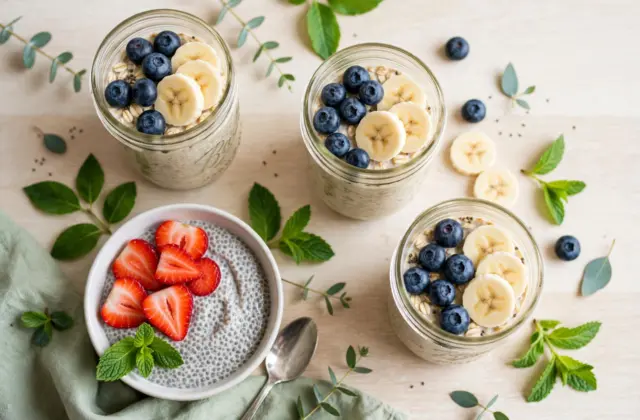
What goes in (the night before): ¼ cup rolled oats, 1 tablespoon chia seeds, ½ cup milk. In the morning: add 1 cup frozen mixed berries and 170 g plain nonfat Greek yogurt, then blend.
Soaking the oats and chia overnight does two things: it softens the oats so they blend silky instead of gritty, and it gives you a breakfast that’s ready in sixty seconds. A tablespoon of chia seeds adds roughly 3 g of fiber and some healthy fats for about 50 calories. Make two jars on Sunday night and Monday and Tuesday are already handled. This is the recipe to reach for when you know the morning will be rushed — the decision was made the night before, when you had time to think.
Read also: How to Add Fiber to Your Diet
5 mistakes that turn a smoothie into dessert
1. Starting with juice instead of liquid. Juice is the fastest way to blow the calorie budget — and the fiber, which is the whole point, is gone before you start. Use water, milk, or unsweetened plant milk.
2. Adding honey, maple syrup, or agave “because it’s natural.” The American Heart Association suggests keeping added sugars to no more than 25 g a day for women and 36 g for men, and honey counts — it’s an added sugar on the FDA’s definition, however natural it feels. A ripe banana or a handful of mango sweetens a smoothie just as well, and brings fiber with it. The World Health Organization goes further, recommending free sugars stay below 10% of daily energy, ideally below 5% — about 25 g on a 2,000-calorie day.
3. Stacking three or four fruits. Two bananas, a cup of mango, a cup of pineapple, and a handful of berries is a fruit salad in a glass — and you’d never sit down and eat that much fruit in one sitting. One or two servings is the sweet spot.
4. Forgetting the protein. A smoothie of fruit and juice alone is mostly sugar and water, and you’ll be hungry again by 9:30. Without a yogurt, milk, or protein anchor, the drink has no staying power. If your smoothie leaves you hungry an hour later, protein is almost always the missing piece.
5. Drinking it too fast, standing up, while doing something else. This one sounds like a joke, but it’s the Haber study in disguise: part of what makes whole fruit satisfying is the time it takes to eat it. Give your smoothie the same respect — sit down, take five minutes, and let your body register it. A breakfast you actually notice keeps you fuller than one you gulp on the way out the door.
Make-ahead tips that actually help
Freeze fruit in single-serving bags, already portioned, so the blender step is just “dump and go.” Peel and freeze bananas when they go spotty — they’re sweeter then, and frozen banana is what makes a smoothie thick and creamy without ice cream. Keep a tub of plain Greek yogurt and a bag of rolled oats in the kitchen at all times; with those two and any frozen fruit, you’re never more than three minutes from a balanced breakfast. And wash the blender right away. Dried smoothie is a special kind of punishment, and a blender that takes thirty seconds to rinse is a blender you’ll use again tomorrow.
Read also: Easy High-Protein Breakfast Ideas
Frequently asked questions
Are breakfast smoothies actually healthy?
They can be. A smoothie made from whole fruit, a protein source like plain Greek yogurt, and a fiber source like oats — with no juice and no added sweetener — is a genuinely balanced breakfast. A smoothie made from juice, sweetened yogurt, honey, and three fruits is mostly sugar. The word “smoothie” tells you nothing; the ingredients tell you everything.
Does blending destroy the fiber in fruit?
No. Blending keeps the pulp, and the fiber stays in the glass — unlike juicing, which removes it. What blending does change is the food’s structure: the sugars become easier to access and the drink empties from the stomach faster than the same fruit eaten whole, which is why whole fruit keeps you fuller for longer. Keep portions modest and add protein and extra fiber, and the difference shrinks.
How many calories should a breakfast smoothie have?
For most people, roughly 250–400 calories works as a breakfast on its own, with 15–20 g of protein. Above 500, check what’s driving it — usually it’s a second fruit, a second spoonful of nut butter, or juice as the base. Harvard notes that loaded smoothies can reach 700–800 calories, which is a full meal and then some.
Can I make smoothies the night before?
You can, but blend them fresh if you can. Some vitamin C and plant compounds decline during storage, so a smoothie blended in the morning keeps more of its nutrition than one that sat in the fridge overnight. The better overnight move is to prep the dry ingredients — oats and chia in a jar — and blend in the morning. It takes sixty seconds and tastes better.
Sources
- Harvard T.H. Chan School of Public Health — The Nutrition Source: Common Questions About Fruits and Vegetables (smoothies vs. whole fruit; 700–800 calorie warning)
- USDA FoodData Central (banana, plain nonfat Greek yogurt, rolled oats, blueberries, milk, peanut butter, chia seeds — nutrition values per 100 g)
- American Heart Association — How Much Sugar Is Too Much? (added sugars: 25 g/day women, 36 g/day men)
- World Health Organization — Guideline: Sugars Intake for Adults and Children (free sugars below 10% of energy, ideally below 5%)
- National Academies Press — Dietary Reference Intakes for Energy, Carbohydrate, Fiber, Fat, Fatty Acids, Cholesterol, Protein, and Amino Acids (fiber adequate intakes: 25 g/day women, 38 g/day men)
- Harvard Health Publishing — Eating Fruit Is Better for You Than Drinking Fruit Juice (Muraki et al., BMJ 2013: fruit juice and type 2 diabetes risk)
Disclaimer: This article is for general information only and is not medical advice. If you have diabetes, kidney disease, or another condition that affects what you eat or drink, talk to your doctor or a registered dietitian before changing your breakfast routine.