How to Choose Whole-Grain Bread
Stand in front of the bread shelf for thirty seconds and you will see the problem. Loaves promise “wheat,” “multigrain,” “stone-ground,” “made with whole grains,” and “12-grain” — and most of them are still mostly refined white flour. The words on the front of the bag are marketing. The truth is on the back, in the ingredients list and the Nutrition Facts panel. Once you know what to look for, choosing a genuinely whole-grain loaf takes about ten seconds.
This guide walks through exactly that: what “whole grain” actually means, the label traps that catch most shoppers, and a simple checklist you can use on any loaf.
What makes bread whole-grain?
A whole grain contains all three parts of the grain kernel in their natural proportions: the fiber-rich bran, the nutrient-dense germ, and the starchy endosperm. Refined grains strip away the bran and germ, which is why white bread loses much of the fiber, B vitamins, magnesium, and iron that the original wheat carried.
That difference shows up in the numbers. According to USDA FoodData Central, whole-wheat bread delivers about 6.0 grams of fiber per 100 grams, compared with 2.4 grams for white bread — roughly two and a half times as much. A typical slice works out to around 1.7 grams of fiber for whole wheat versus about 0.7 grams for white. Calories are nearly identical (about 71 versus 74 per slice), so the upgrade is about nutrients and staying power, not calories.
The fiber matters because it slows digestion and helps you feel full longer, and it feeds the gut microbes that researchers keep linking to better metabolic health. Whole grains also carry magnesium and B vitamins that refined flour largely loses. And the evidence for eating more of them is unusually consistent: a large BMJ meta-analysis of 45 prospective studies (Aune and colleagues, 2016) found that each additional 90 grams of whole grain per day — about three servings, such as two slices of bread plus a bowl of cereal — was associated with a 19% lower risk of coronary heart disease, a 22% lower risk of cardiovascular disease, and a 17% lower risk of death from any cause. These are associations from observational research, not proof of cause and effect, but the pattern has held up across many populations.
The label traps: words that sound whole-grain but aren’t
Bread packaging is full of words that sound healthy and mean very little. Here are the ones to watch for.
“Wheat bread” is not whole-wheat bread. If the label says “wheat bread” or “100% wheat,” it only tells you the flour came from wheat — the same wheat white bread is made from. The word you need is “whole.” Look for “100% whole wheat” or “100% whole grain” in the product name.
“Multigrain” says nothing about whole grains. It only means the loaf contains more than one type of grain. Those grains can all be refined. A multigrain loaf can be nutritionally closer to white bread than to whole-wheat bread. The same goes for “seven-grain,” “12-grain,” and “cracked wheat” — the number of grains is not the point; whether they are whole is.
“Made with whole grains” can mean a sprinkle. A loaf can carry this claim while whole grains make up a small fraction of its flour. The U.S. Food and Drug Administration’s draft guidance advises manufacturers to use the words “whole grain” in a product name only when all the grain in the product is whole grain, and the authorized whole-grain health claim requires at least 51% whole grain by weight. But the looser “made with” phrasing is not held to that bar, so check the ingredients list rather than trusting the front of the bag.
“Stone-ground” and “unbleached” are about process, not nutrition. Stone-ground flour can still be refined, and unbleached white flour is still white flour. Neither word tells you whether the bran and germ survived.
Read also: How to Choose Whole Grains
The 10-second label check
Flip the loaf over and run through these three steps.
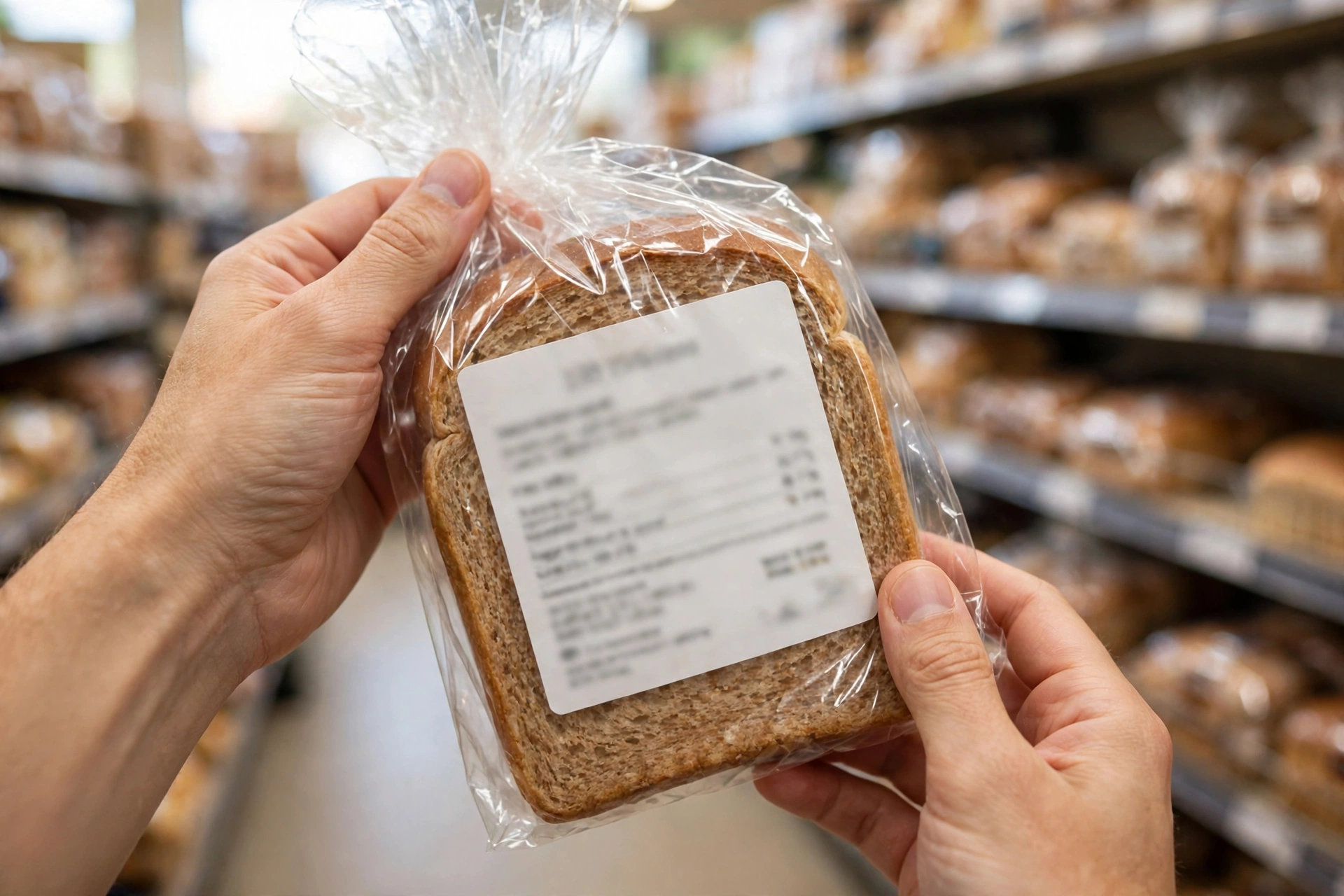
1. Read the first ingredient. Ingredients are listed in descending order by weight, so the first one is the biggest share of the loaf. For a truly whole-grain bread, the first ingredient should be a whole grain — “whole wheat flour,” “whole grain oats,” or “whole rye flour.” If the first ingredient is “wheat flour,” “enriched flour,” or “unbleached enriched wheat flour,” the loaf is mostly refined flour, no matter what the front of the bag says. A good rule: if the word “whole” does not appear before the first grain, put it back.
2. Look for the Whole Grain Stamp. The Whole Grains Council’s stamp tells you the grams of whole grain per serving at a glance. The 100% Stamp means all the grain in the product is whole grain and the serving contains at least 16 grams of whole grain. The 50%+ Stamp means at least half the product by weight is whole grain, with at least 8 grams per serving. The Basic Stamp means the product contains at least 8 grams of whole grain per serving, even if refined grains make up more than half. Any stamp beats no stamp, and the 100% Stamp is the strongest signal.
3. Check fiber and sodium. Aim for at least 2 grams of fiber per slice — most genuine whole-wheat loaves land between 2 and 4 grams, while white bread typically offers under 1 gram. Then glance at sodium. Bread is a surprisingly large source of salt in many diets: a single slice of whole-wheat bread typically carries around 130 to 170 milligrams of sodium, and two slices for a sandwich can add up to roughly 300 milligrams before you add any filling. If you are watching your blood pressure, compare loaves and pick the lower-sodium one; the difference between brands can be 50 milligrams a slice or more. The American Heart Association suggests most adults aim for no more than 2,300 milligrams of sodium a day, moving toward an ideal limit of 1,500 milligrams.
Read also: How to Read Food Labels
What about rye, sourdough, and sprouted bread?
Not every good loaf says “whole wheat” on the front. A few common varieties are worth knowing.
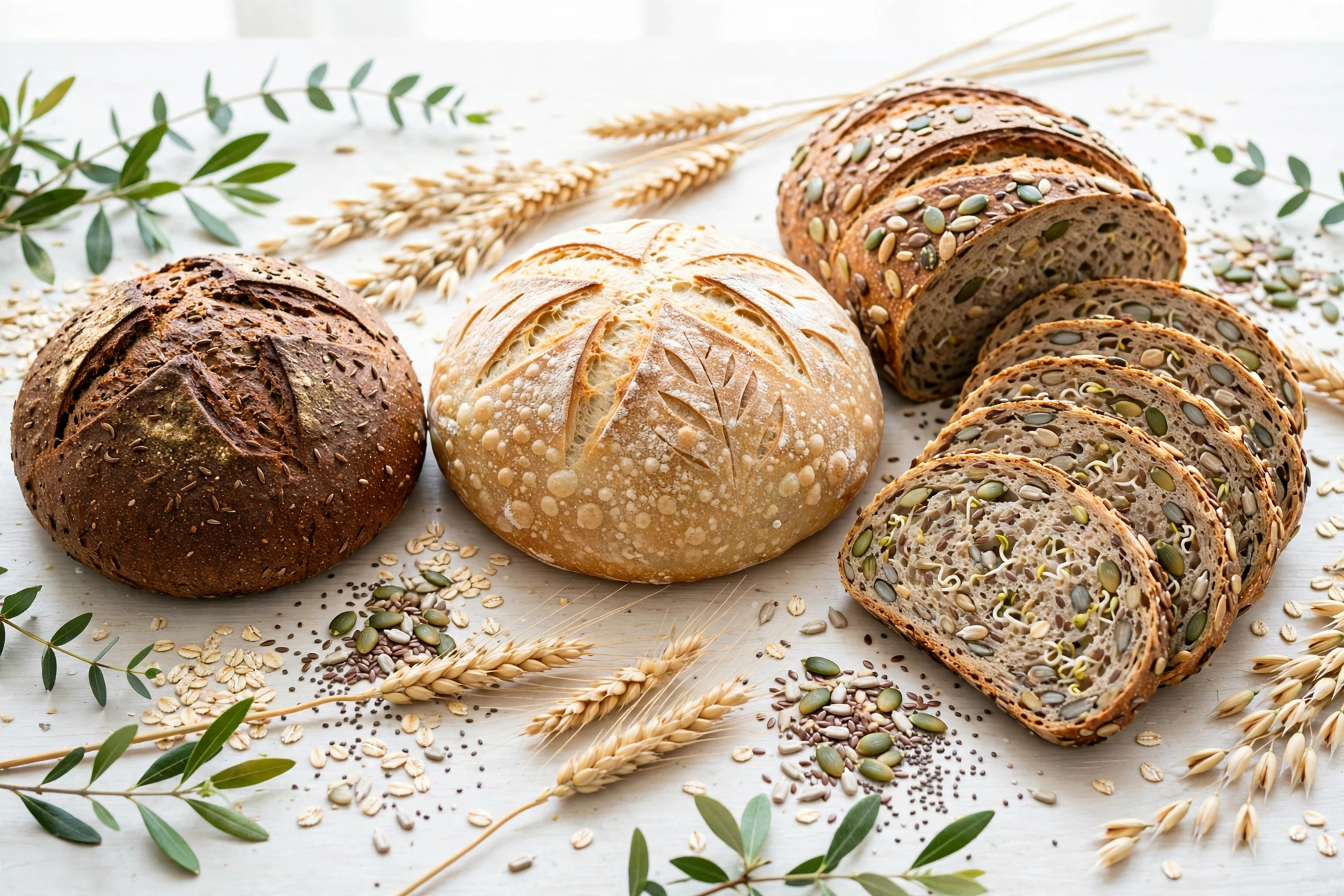
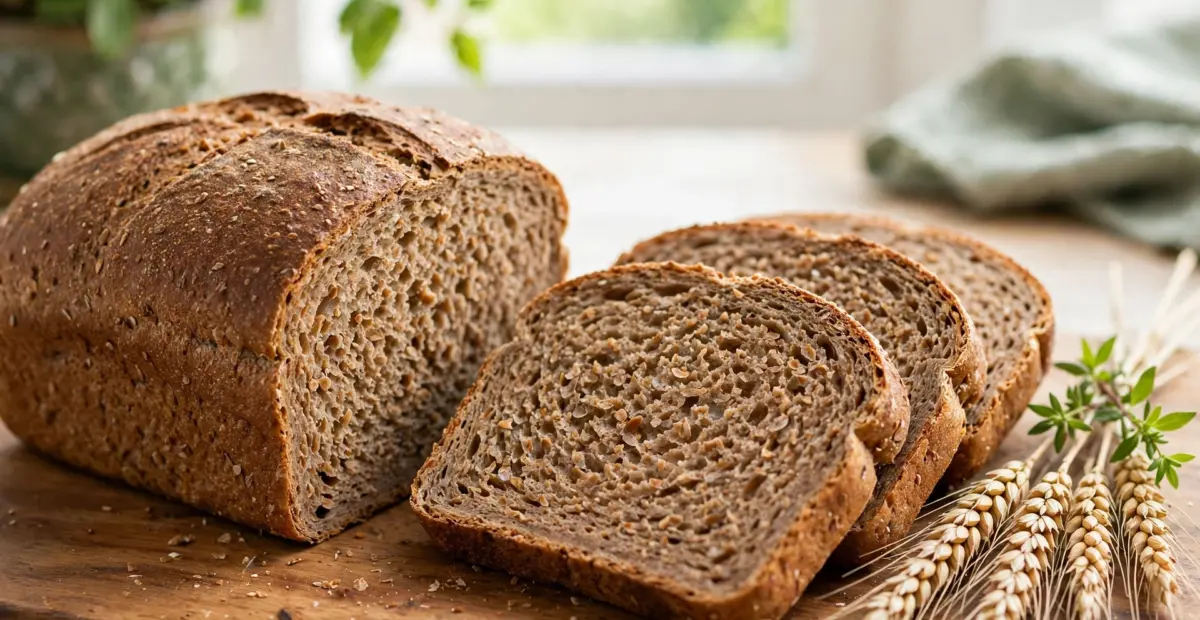
Whole rye bread is a strong choice when whole rye flour is the first ingredient. Rye is naturally high in fiber — USDA data puts rye bread at about 5.8 grams of fiber per 100 grams, close to whole wheat — and its dense crumb tends to keep people full. Watch out for light rye and deli rye, which are often mostly refined wheat flour with a little rye and caraway for flavor.
Sourdough earns its reputation from fermentation, not from fiber. A white sourdough has roughly the same fiber as white bread (about 2.2 grams per 100 grams), and it can be higher in sodium than sandwich bread. The best of both worlds is a whole-grain sourdough: whole-wheat or whole-rye flour plus the slow fermentation that may make the bread easier to digest and give it a lower glycemic response. If you love sourdough, choose the whole-grain version.
Sprouted-grain bread is made from whole grains that have begun to sprout before milling. The sprouting process may make some nutrients more available, and these loaves are usually made from intact whole grains with no added flour — but check the label anyway, since “sprouted” is not a regulated term and some loaves mix sprouted grains with refined flour.
Oat bread and barley bread can be excellent, but only when whole oats or whole barley lead the ingredients list. Both grains are rich in soluble fiber, the type linked to healthier cholesterol levels. A loaf that lists “wheat flour” first and oats somewhere in the middle is an oat-flavored white bread, not an oat bread.
How much whole grain do you actually need?
Current U.S. dietary guidance recommends 2 to 4 servings of whole grains a day as part of a 2,000-calorie pattern, with at least half of all grain servings coming from whole grains. One serving is a slice of bread, so a two-slice sandwich on genuine whole-wheat bread already covers one to two servings. Add a bowl of oatmeal or a side of brown rice later in the day and you are most of the way there.
If your household is used to white bread, you do not have to switch overnight. A practical path is to start with a 50/50 loaf — half whole wheat, half white — for a week or two, then move to 100% whole wheat once the taste feels normal. Kids and picky eaters usually adjust faster than adults expect, especially when the bread is toasted or used for a favorite sandwich. White whole-wheat bread, made from a lighter-colored wheat variety, is another useful bridge: it has the same fiber as regular whole wheat but a milder flavor and paler crumb.
Read also: How to Add Fiber to Your Diet
Storing bread so it stays good
Whole-grain bread goes stale faster than white bread because its natural oils can turn rancid and its fiber absorbs moisture. Keep a loaf you will finish within a few days in a cool, dry place in its bag, sealed. For longer storage, slice the loaf and freeze it — frozen slices toast straight from the freezer and keep for months. Refrigerating bread actually speeds up staling, so the fridge is the worst of the three options for a loaf you plan to eat soon.
As with all perishable foods, use your senses and the date on the bag: discard bread with visible mold rather than cutting around it, since mold roots can spread through soft bread beyond what you can see.
Frequently asked questions
Is whole-wheat bread gluten-free?
No. Whole-wheat bread contains gluten, just like white wheat bread. People who need to avoid gluten should look for certified gluten-free loaves made from grains such as rice, sorghum, or buckwheat, and check that the label says “gluten-free” rather than assuming a whole-grain loaf qualifies.
Does whole-grain bread have fewer calories than white bread?
Barely. A slice of whole-wheat bread has about 71 calories versus about 74 for white bread, according to USDA data — a difference too small to matter. The real advantage is fiber and nutrients, not calories.
What if a loaf says “whole grain” but the first ingredient is enriched flour?
Then it is mostly refined flour with some whole grain added. Trust the ingredients list over the front of the bag: the first ingredient tells you what the loaf is mostly made of.
Is bread with seeds on top automatically whole-grain?
No. Seeds on the crust are a topping, and they add a little nutrition, but they do not change the flour underneath. A white loaf with sunflower seeds is still a white loaf.
The bottom line
Choosing whole-grain bread comes down to three habits: check that the first ingredient is a whole grain, look for the Whole Grain Stamp, and compare fiber and sodium. A loaf that passes all three — “whole wheat flour” first, at least 2 grams of fiber per slice, and a sodium level you are comfortable with — is a genuinely whole-grain choice. The rest of the claims on the bag are decoration.
This article is for general information only and is not medical advice. If you have celiac disease, a wheat allergy, or a condition that affects how you handle carbohydrates or sodium, talk with your clinician or a registered dietitian about the bread choices that fit your needs.
Sources
- Aune D, Keum N, Giovannucci E, et al. Whole grain consumption and risk of cardiovascular disease, cancer, and all cause and cause specific mortality: systematic review and dose-response meta-analysis of prospective studies. BMJ. 2016;353:i2716.
- Whole Grains Council — Government Guidance on Whole Grain Labeling (FDA draft guidance; Whole Grain Stamp definitions)
- U.S. Department of Agriculture, Agricultural Research Service. FoodData Central — Bread, whole-wheat, commercially prepared; Bread, white, commercially prepared; Bread, rye; Bread, French or Vienna (includes sourdough).
- American Heart Association — How Much Sodium Per Day?