How to Build Better Food Habits Gradually

Most food advice fails in the same quiet way: it asks you to change everything at once. A new shopping list, a new cooking routine, a new set of rules for snacks, weekends, and eating out — all starting Monday. For a few days, willpower carries it. Then life gets busy, one meal slips, and the whole plan feels broken. If that pattern sounds familiar, the problem is probably not your discipline. It is the size of the change.
Building better food habits gradually works differently. You pick one small, specific change, tie it to something you already do every day, and repeat it until it stops feeling like a decision. Then you add the next small change. The progress looks unimpressive week by week, which is exactly why it lasts: nothing in your day has to be rebuilt for it to work.
Why a gradual approach beats a full overhaul
Food choices are not made once a day. They happen at the fridge, at the checkout, at the office snack table, and in the ten minutes after you get home hungry. Each one draws on attention and energy, and both run low by evening. A plan that demands constant attention is fragile by design. A habit, by contrast, runs on a cue: you see the fruit bowl, you pour the coffee, you sit down to dinner, and the next step follows without a debate.
That is also why “all or nothing” thinking is so costly. Miss one workout or eat one takeaway meal, and an overhaul plan gives you a reason to quit for the week. A gradual plan gives you a much smaller question: did you do today’s one small thing? If not, you can still do it tomorrow, because the habit is only one step, not a whole identity you have just failed to live up to.
Think of it like learning a route. The first few times, you check every turn. After enough repetitions, you arrive without thinking about the road at all. Food habits follow a similar path from effortful to automatic — but only if the behaviour is repeated in a stable context, often enough, for long enough.
How long does a habit actually take?
Forget the old 21-day promise. In a well-known field study, 96 volunteers chose a simple daily behaviour — an eating, drinking, or activity habit — and repeated it in the same context for 12 weeks, rating how automatic it felt each day. The median time to reach 95% of their peak automaticity was 66 days, with a range from 18 to 254 days depending on the person and the behaviour (Lally et al., 2010). In other words, two months is a reasonable middle expectation for a simple habit, and some habits will honestly take much longer.
A 2024 systematic review of 20 studies with 2,601 participants reached a similar conclusion: median estimates for habit formation were 59 to 66 days, with individual estimates ranging from 4 to 335 days (Singh et al., 2024). Simpler behaviours tended to become automatic sooner; more complex ones took longer. That range matters because it reframes a slow start. If a new habit still feels effortful after three weeks, that is not evidence that it will never stick. It is normal.
There is a practical lesson here: judge a habit by its repetition, not by how motivated you feel on a given day. Motivation will rise and fall. A clear cue and a tiny action can carry you through the low-motivation days, which are precisely the days that build the habit.
Step 1: Pick one tiny change, not five
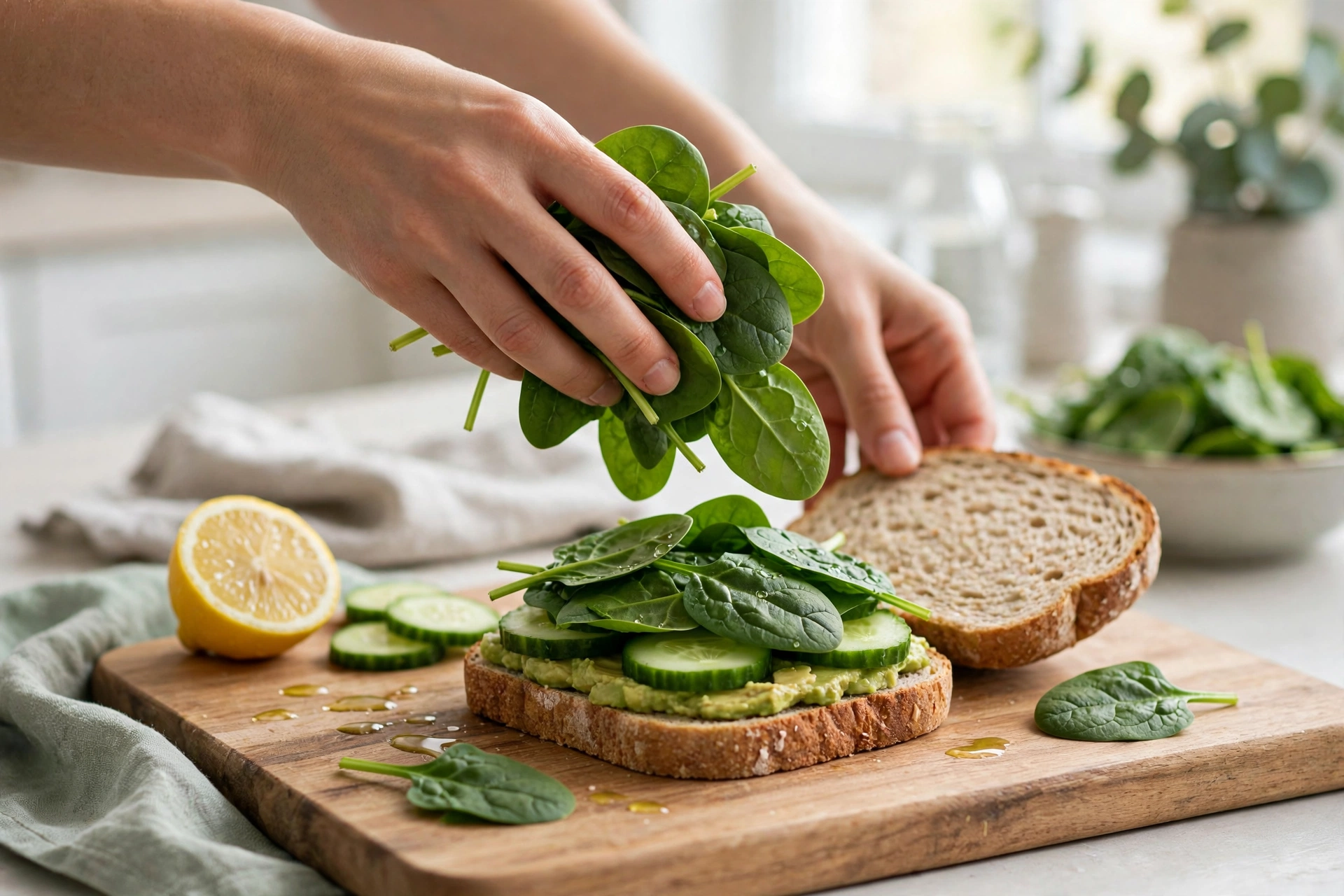
Start with a change so small that it feels almost too easy. “Eat healthier” is not a habit — it is a wish. “Add a handful of spinach to my lunch sandwich” is a habit. So is “drink a glass of water before my afternoon coffee,” “put fruit on the counter where I can see it,” or “swap one sugary drink a day for sparkling water.”
A good first habit has three qualities: it is specific, it happens daily (or nearly daily), and it takes less than two minutes. Daily repetition is what builds automaticity, so a habit you can only practise twice a week will take far longer to feel natural. If you are choosing between an impressive change and a repeatable one, choose the repeatable one every time.
It also helps to pick a change that solves a real friction in your day, rather than one that sounds virtuous in theory. If breakfast is your rushed meal, a breakfast habit will pay off more than a perfect dinner plan you rarely have time to cook. If late-night snacking is the pattern, a habit built around the evening routine — a planned snack, a smaller bowl, a closed kitchen after dinner — addresses the moment that actually matters.
Read also: Small Diet Changes That Last
Step 2: Anchor it to something you already do
A habit needs a reliable cue, and the most reliable cues are already in your day. This is the idea behind habit stacking: attach the new behaviour to an existing routine, so the old routine reminds you to do the new thing. “After I start the kettle, I will put a banana and a yoghurt on the counter for breakfast.” “After I sit down for lunch, I will eat the vegetables first.” “After I brush my teeth at night, I will set out tomorrow’s lunchbox.”
Write the plan as one sentence with the cue and the action together. Research on implementation intentions — specific “if–then” plans — has found they can help people follow through on healthy eating intentions, with a stronger effect for adding healthy foods than for cutting back on less healthy ones (Adriaanse et al., 2011). The wording does not need to be fancy. It needs to be precise enough that, when the cue happens, you know exactly what to do.
Choose anchors that happen every day and are hard to skip: making coffee, sitting down to a meal, opening the fridge, packing a bag. Avoid anchors that only happen sometimes, like “after I go to the gym,” because a shaky anchor makes a shaky habit. And keep the new action small enough that the anchor routine itself is not disrupted — if the addition doubles the time a routine takes, you will start skipping both.
Step 3: Make the good choice the easy choice
Willpower is a poor kitchen designer. Environment is a much better one. If fruit sits in a bowl on the counter, it gets eaten. If vegetables are washed and cut on Sunday, they make it into Monday’s lunch. If the biscuits live in a tin at the back of a high cupboard, you have to want them quite deliberately to eat them.
Do a quick audit of the three places where most of your food decisions happen: the kitchen, the desk, and the car or bag. In each place, ask one question: what is within arm’s reach right now? Move one healthy option into that spot and move one tempting option one step further away. You do not need to banish anything from the house to change the odds — you only need to change what you meet first when you are hungry and tired.
The same logic applies to shopping. A short list built around meals you actually cook beats a long list of aspirational ingredients. Keep a few reliable staples on hand — canned beans, frozen vegetables, whole grains, eggs, tinned fish — so that a busy night has a balanced option that is faster than ordering in. When the easy meal is also a decent meal, the habit has far less competition.
Read also: Healthy Eating Habits for Beginners

Step 4: Track the streak, not the perfection
A simple tracking method helps a new habit survive its first month, when it still depends on memory. A tick on a calendar, a note in your phone, or a tally on the fridge all work. The point is not to collect a perfect record. It is to see the pattern: most days, you did the thing, and the days you missed are gaps, not endings.
Set a rule for missed days before they happen. The “never miss twice” rule is a useful one: a single miss is just a missed day, but two misses in a row is the start of a new pattern. If you miss today, the only job tomorrow is to do the small thing once, in its usual spot, at its usual time. Shrinking the habit on a hard day — half a portion of vegetables instead of a full one, a short walk to the shop instead of a cooked meal — still counts as a repetition, and repetitions are what build automaticity.
Review the habit weekly, not hourly. Ask: did the cue happen? Was the action small enough? Did anything keep getting in the way? If the same obstacle appears three times, change the plan, not your self-judgment. A habit that keeps colliding with real life is a badly fitted habit, and the fix is usually to make it smaller, move its cue, or change its location — not to try harder at a plan that does not fit.
What to eat more of, gradually
Gradual habits work best when they point toward a clear nutritional direction. The World Health Organization recommends at least 400 grams — about five portions — of fruits and vegetables a day, keeping free sugars below 10% of total energy (ideally below 5%) and salt below 5 grams a day (WHO, 2026). You do not need to hit every target in week one. A habit like “add one vegetable to dinner” moves you toward the 400-gram goal without requiring a spreadsheet. A habit like “choose water at one meal a day” moves you away from sugary drinks without a ban on anything.
Other small habits with a good payoff include adding a protein food to breakfast so the meal keeps you full longer, swapping refined grains for whole grains at one meal, and keeping a fruit or a handful of nuts as the default afternoon snack. None of these will transform your diet overnight, and that is the point. Each one, repeated daily, changes the average of what you eat — and the average is what matters most for health over time.
A simple four-week starter plan
Week one is for choosing and anchoring. Pick one habit, write your cue-and-action sentence, and set up the environment so the action is easy. Do not add anything else yet, even if you feel enthusiastic. Enthusiasm is a poor predictor of week four.
In week two, keep the same habit and start tracking it with a daily tick. Notice where it sticks and where it slips, and adjust the cue or the size if needed. If the habit feels easy by the end of week two, resist the urge to add three more. Let easy be easy for a little while.
Week three is a good time to add a second habit — but only if the first one is happening most days without much thought. Attach the second habit to a different anchor so the two do not compete, and keep it just as small as the first. Two small habits you actually do beat five impressive ones you abandon.
Week four is for review. Which habit feels automatic? Which still needs a reminder? Keep the automatic one, keep practising the other, and decide whether a third habit makes sense or whether consolidating two is the smarter move. Remember the research: many habits take around two months to feel automatic, so week four is a checkpoint, not a finish line.
Read also: How to Build a Flexible Healthy Eating Routine
When a habit slips — and it will
Slips are part of habit formation, not proof that it failed. In the Lally study, participants missed days and still formed habits; what mattered was returning to the behaviour in its usual context, not maintaining an unbroken streak. Treat a slip as information: was the cue missing, was the day unusual, or was the action too big for that moment?
Watch out for the two most common traps. The first is expanding too fast: a habit that worked as “one vegetable at dinner” becomes “a fully balanced plate, cooked from scratch, every night,” and collapses under its own weight. The second is moralising a normal week: a holiday, illness, or busy stretch interrupts the routine, and the interruption gets read as failure instead of as a pause. A habit that can survive a pause — because its cue is still there when life calms down — is a habit built to last.
If a habit has truly stopped working, retire it without guilt and pick a smaller version. “Cook a vegetable side every night” can become “keep a bag of frozen vegetables ready and add a handful to whatever is cooking.” The goal was never the specific version. It was the direction: a little more of the foods that support your health, a little more often, with a little less effort each time.
Frequently asked questions
How many habits should I build at once?
One at a time is the safest start, especially if the habit is new. Once the first habit happens most days with little thought — often after several weeks — add a second. Stacking many changes at once spreads your attention thin and makes every habit harder to repeat in the same context.
Does it really take 66 days to form a habit?
Sixty-six days was the median in one well-known study, not a rule for everyone. The range in that study was 18 to 254 days, and a later review found median estimates of 59 to 66 days with wide individual variation. Use two months as a rough expectation for a simple daily habit, and give more complex habits more time.
What if I miss a day?
Miss one day, then do the habit the next day in its usual spot. A single gap does not erase the repetitions you have already built. The pattern to avoid is two misses in a row, which can quietly become the new routine. If you miss, shrink the action for the next day rather than skipping it again.
Is habit stacking proven to work?
Attaching a new behaviour to an existing routine is a sensible way to supply a reliable cue, and specific if–then plans have supportive evidence for healthy eating. Direct evidence for habit stacking as a named technique is still limited, so treat it as a practical way to remember and repeat a behaviour — not as a guaranteed shortcut.
Sources
- Lally, P., van Jaarsveld, C. H. M., Potts, H. W. W., & Wardle, J. (2010). How are habits formed: Modelling habit formation in the real world. European Journal of Social Psychology, 40(6), 998–1009.
- Adriaanse, M. A., et al. (2011). Do implementation intentions help to eat a healthy diet? A systematic review and meta-analysis of the empirical evidence. Appetite, 56(1), 183–193.
- Singh, B., et al. (2024). Time to form a habit: A systematic review and meta-analysis of health behaviour habit formation and its determinants. Healthcare, 12, 2488.
- World Health Organization. Nutrition for a healthy life – WHO recommendations.
This article is for general information only and is not medical advice. If you have a health condition, take medication, or need personalised nutrition guidance, talk to a qualified health professional or registered dietitian.