How Much Water Should You Really Drink?
The eight-glasses rule is not evidence-based. Your needs depend on body size, climate and activity — and about a fifth of your fluid comes from food.
You have probably been told to drink eight glasses of water a day. It is catchy, easy to remember, and printed on water bottles everywhere. It is also not based on any real evidence. The actual science behind how much water you need is messier, more interesting, and — thankfully — more forgiving than the bottle label suggests.
Here is what the research actually says about daily water intake, how to tell if you are getting enough, and the situations where water — yes, plain water — can genuinely be overdone.
Your body is mostly water, and it runs on balance
Roughly 60 percent of an adult’s body weight is water. It cushions your joints, ferries nutrients around your bloodstream, helps your kidneys filter waste, and keeps your core temperature steady through sweat. You are constantly losing it — through urine, sweat, breath, and even your skin — and the losses add up to about 2.5 liters on an ordinary day.
That constant loss is why your body has a finely tuned system for keeping things in equilibrium. Drink more and your kidneys simply excrete more urine — a healthy pair can flush roughly 0.7 to 1 liter of water per hour. Fall behind and hormones like ADH signal the kidneys to concentrate your urine, while thirst nudges you toward a glass of water. For most healthy adults, this system works quietly in the background without any counting at all.
What the guidelines actually say
Because water needs vary so much between people, experts do not set a single daily requirement. Instead, the U.S. National Academies (formerly the Institute of Medicine) set an Adequate Intake (AI) — a target that should keep most people well hydrated. The numbers: about 3.7 liters of total water per day for men and 2.7 liters for women. That figure covers water from every source — drinks and food combined.
Europe’s food safety authority, EFSA, lands in a similar place with adequate intakes of 2.5 liters per day for men and 2.0 liters per women. So where does that leave the eight-glasses rule? Eight 8-ounce glasses is only about 1.9 liters — below both reference points — and it also ignores food entirely.
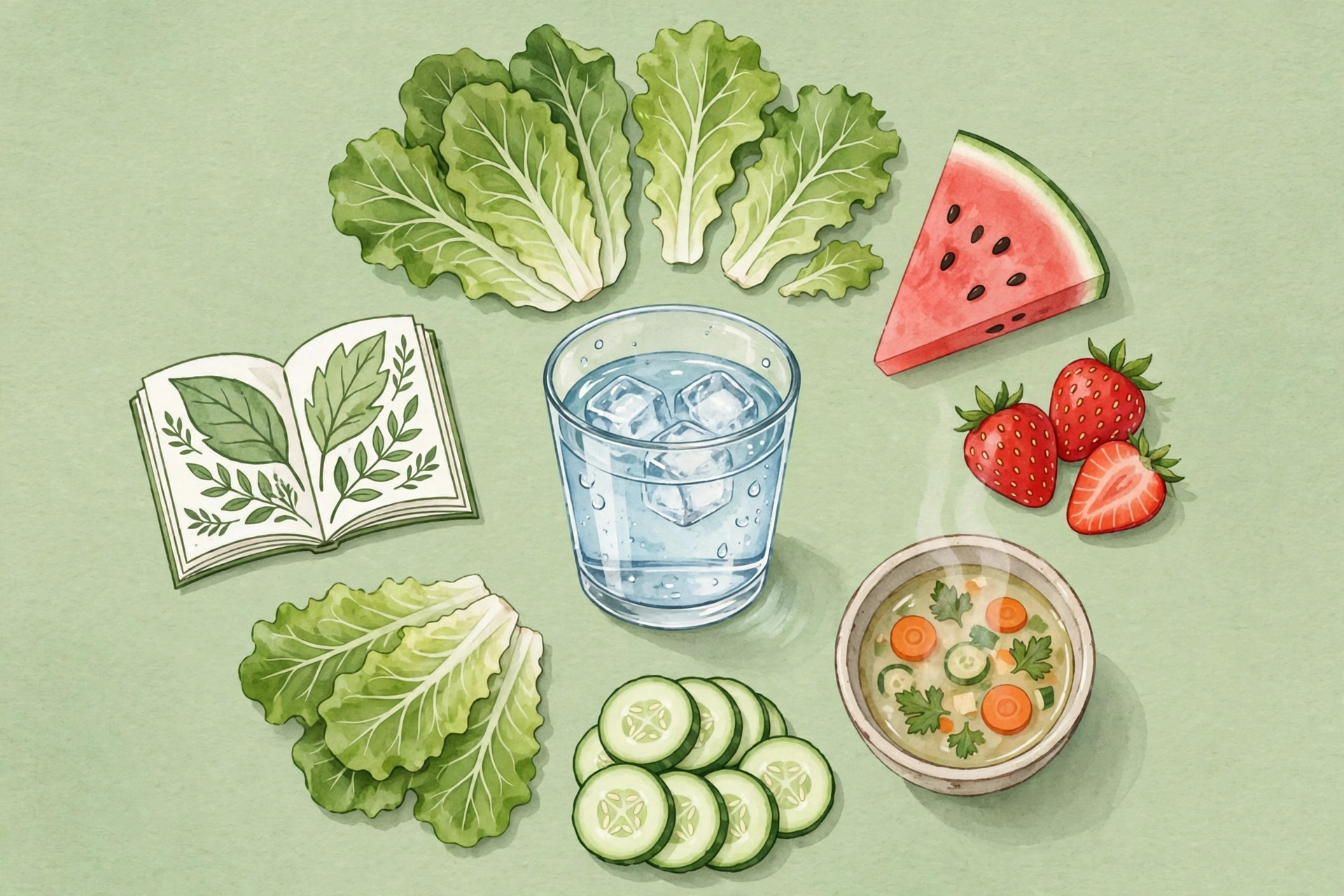
Food matters more than most people realize. Around 20 percent of your daily water typically comes from food, and some foods are essentially drinkable: cucumber, lettuce, watermelon, and strawberries are all more than 90 percent water by weight. Once you subtract the food contribution, the beverage target shrinks to roughly 3.0 liters for men and 2.1 liters for women — and even those are starting points, not prescriptions.
Why one number can’t fit everyone
Ask a 55-kilogram office worker in an air-conditioned room and a 95-kilogram construction worker in tropical heat how much water they need, and you will get two very different answers. The science backs that up. Your water needs shift with:
- Body size: larger bodies have more tissue to hydrate and generally need more water.
- Activity: an hour of hard exercise can cost you 1 to 2 liters of sweat — and in serious heat, even more.
- Climate: hot, humid weather drives sweat losses up; high altitude increases fluid loss through faster breathing.
- Diet: salty meals pull extra water into circulation to balance sodium, and high-protein diets raise urine output slightly.
- Pregnancy and breastfeeding: both raise fluid needs — breastfeeding alone adds about 700 milliliters of water output per day, which needs replacing.
- Health conditions: fever, vomiting, diarrhea, and some medications (including diuretics) all change the equation.
This is exactly why rigid daily targets fall apart. A number that fits a sedentary day in October will miss badly on a training day in August.
Coffee counts (and other hydration myths)
One of the most stubborn hydration myths is that coffee and tea are dehydrating. Caffeine is a mild diuretic, but at the amounts most people drink, the water in the cup far outweighs any extra fluid lost. Mayo Clinic and other major sources confirm that tea, coffee, milk, juice, and even soda all contribute to your daily fluid total. They are not as ideal as water — sugary drinks carry their own baggage — but they do count.
Water-rich foods count too. A big salad, a bowl of soup, a couple of pieces of fruit — all of it moves you toward your target without a single sip from a bottle.
Can you trust your thirst?
For most healthy adults, yes — probably more than you have been led to believe. Thirst is an early warning system, kicking in well before dehydration becomes a performance or health problem. Research and the consensus of exercise-medicine specialists agree that drinking to thirst is a reliable strategy for day-to-day life, and even during most exercise.
There are exceptions worth knowing:
- Older adults: the thirst response dulls with age, so people over 65 or 70 should drink on a gentle schedule rather than waiting to feel thirsty.
- Long endurance events: during marathons, ultramarathons, and all-day hikes, it is smart to plan your fluids rather than relying on thirst alone — especially in the heat.
- Illness: fever, vomiting, or diarrhea drain fluids fast, and waiting for thirst can leave you behind.
One persistent piece of advice deserves to die: the idea that “if you’re thirsty, you’re already dangerously dehydrated.” That is not how the physiology works. Thirst arrives early, with plenty of margin.
Three simple checks that beat any app
You do not need a smart bottle or a hydration-tracking app. These low-tech checks are what clinicians and sports dietitians actually use:
- Urine color: aim for pale straw. Consistently dark yellow means you are behind; completely clear all day means you may be overdoing it.
- Frequency: emptying your bladder roughly every two to four hours during the day is a good sign of healthy turnover.
- Body weight: for athletes, weighing yourself before and after exercise is the gold standard — each kilogram lost is roughly a liter of fluid to replace.
Notice what is missing from that list: forcing a fixed number of glasses. The goal is a pattern of steady, comfortable intake — not a scoreboard.
Read also: Electrolytes Explained: Sodium, Potassium and Magnesium
When too much water is the problem
It sounds strange, but overdrinking is a real hazard — particularly in endurance sports. Exercise-associated hyponatremia happens when athletes drink far beyond thirst, diluting blood sodium to dangerous levels. It has hospitalized marathon runners and, in rare cases, proved fatal. The Wilderness Medical Society’s clinical guidelines and the international EAH consensus are unambiguous on prevention: drink to thirst, and include electrolytes during long sessions rather than water alone.
Outside of sports, rapid intake of very large volumes can overwhelm even healthy kidneys. That 0.7-to-1-liter-per-hour excretion capacity is generous, but drinking several liters in a short window — especially with little food or salt — can lead to water intoxication. The pattern to avoid is forcing fluids “just in case.” If you are not thirsty and your urine is already pale, more water is not more health.
A practical system for real days
Forget the scoreboard. Here is a rhythm that works for most people:
- Morning: a glass of water when you wake up. You lose fluid overnight through breath and sweat, and this replaces it.
- With meals: a glass or two of water (or another drink) with each meal. Food-plus-fluid together also slows eating slightly, which most of us need.
- Around exercise: drink before you feel the need, sip during, and replace losses afterward. For sessions longer than about 90 minutes, reach for something with electrolytes, not plain water.
- Evening: keep a glass nearby, but ease off right before bed if nighttime bathroom trips are an issue.
- In the heat: add a glass or two proactively — do not wait until you feel wrung out.
Keep a bottle or glass visible during the day. Most under-drinking is not a motivation problem; it is an out-of-sight problem.
Read also: Healthy Eating Habits for Beginners
Frequently asked questions
Is 8 glasses a day enough?
For many smaller, sedentary adults it is roughly in range, but it is not evidence-based and it sits below the official adequate intakes. Use it as a rough starting point if you like, then adjust with the urine-color check above.
Does sparkling water hydrate as well as still?
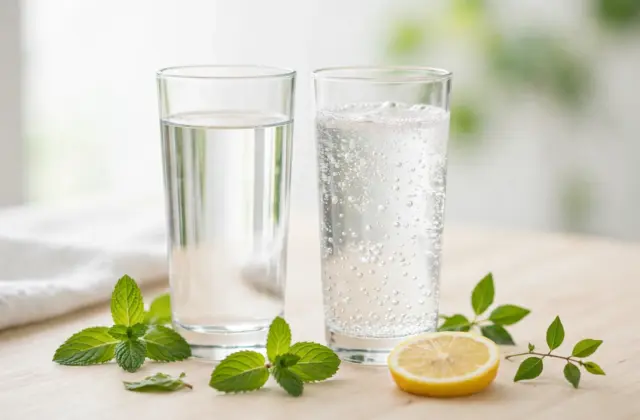
Yes. Carbonation does not change water’s hydrating effect — the only caveat is that some people find it fills them up or causes bloating, which can make them drink less overall.
Should I drink more water to lose weight?
Water can help indirectly: a glass before meals may slightly reduce how much you eat, and replacing sugary drinks with water cuts calories without any downside. But water itself is not a fat-loss strategy — no amount of extra hydration melts body fat.
How much water do kids need?
Children need less than adults and should generally follow thirst too. As a rough guide, EFSA suggests around 1.1–1.3 liters of total water per day for younger children, rising to 1.5–2 liters for adolescents — with food contributing a share of that.
This article is for general information and is not medical advice. If you have kidney disease, heart failure, or a condition that restricts fluids, follow your clinician’s guidance — not a general article.
Sources
- Daily Fluid Intake Behaviors and Associated Health Effects — PMC
- How Much Water Do You Actually Need? The IOM Guidelines — Calculatorian (citing Mayo Clinic)
- Chapter 9: Water in Health — Nutrition for Consumers (University of North Texas)
- Patients with Exercise-Related Hyponatremia Advised to ‘Drink to Thirst’ — ScienceDaily (Wilderness Medical Society guidelines)
- Exercise-Associated Hyponatremia — Third International EAH Consensus summary