The Mediterranean Diet: A Practical Starter Guide
The most consistently researched eating pattern in the world, translated into a week of ordinary meals you can actually cook.
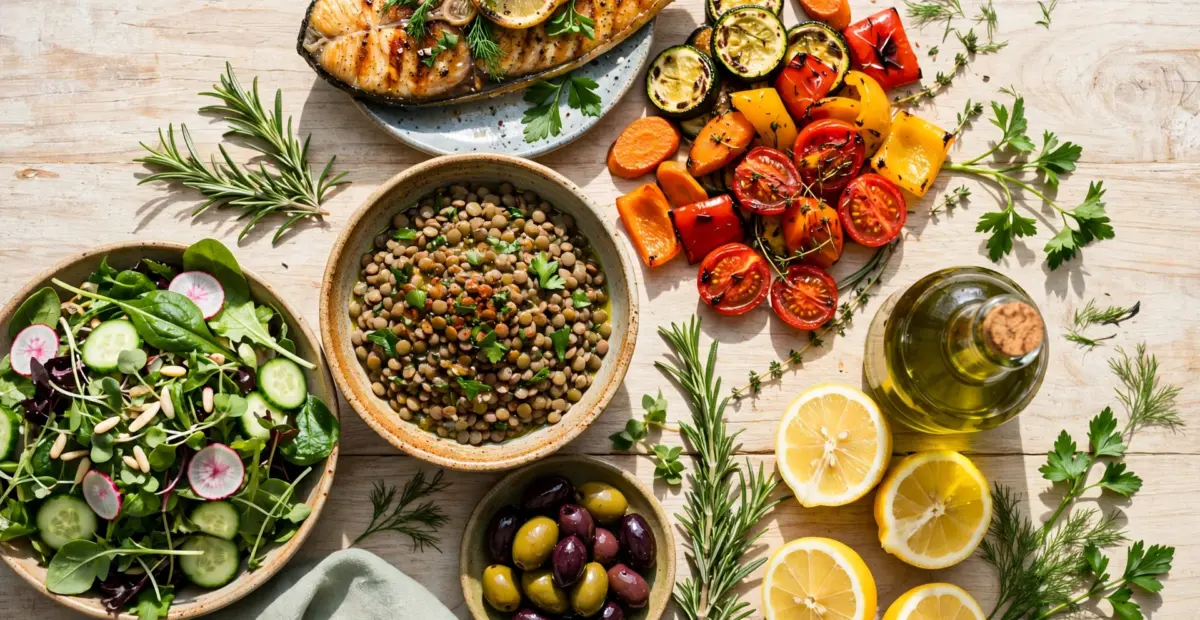
If you have ever felt worn down by food rules — count this, cut that, fear the carbs, fear the fat — the Mediterranean way of eating feels like someone finally opened a window. No points to track, no food groups to banish. Just the way people around the Mediterranean Sea have eaten for generations: vegetables cooked until sweet, bread dipped in good olive oil, fish twice a week, a handful of nuts in the afternoon, fruit for dessert. Scientists studied it because people in places like Crete and southern Italy were living longer with healthier hearts — and the research turned out to be remarkably strong.
It’s a pattern, not a diet plan
The first thing to understand is that the “Mediterranean diet” isn’t a branded program with a meal chart. It’s a pattern — a set of defaults researchers formalized so they could test it. Olive oil replaces butter and most other added fats. Plants take up most of the plate. Legumes, nuts and fish do much of the protein work. Red meat shows up rarely: a Sunday thing, not a Tuesday thing.
That flexibility is a feature. Nobody in the landmark trials was told to cut calories or give up foods they loved. Dietitians simply coached people toward foods to eat more of and a shorter list to eat less of. What makes this pattern special is that it was tested in real randomized trials, not just observed in surveys.
What the trials actually showed
The centerpiece is the PREDIMED trial, run in Spain and republished in the New England Journal of Medicine in 2018. It randomized 7,447 adults aged 55 to 80 — all with major cardiovascular risk factors but no established heart disease — into three groups: a Mediterranean diet with free extra-virgin olive oil (a liter per household per week), a Mediterranean diet with 30 grams of mixed nuts supplied daily, or a low-fat control diet.
After a median follow-up of 4.8 years, both Mediterranean diet groups had about 30% lower risk of a major cardiovascular event — heart attack, stroke or cardiovascular death — than the control group (hazard ratios 0.69 and 0.72; roughly three fewer events per 1,000 person-years). In the interest of honesty: the original 2013 paper was retracted after randomization departures surfaced in a subset of participants, then republished with corrected analyses — and the conclusions held, an approximately 30% relative risk reduction versus the low-fat control diet (reviewed here).
Benefits went beyond heart events: in a substudy, the olive-oil group developed new type 2 diabetes at a lower rate (hazard ratio 0.60). And the earlier Lyon Diet Heart Study tested a Mediterranean-style diet in heart-attack survivors and reported a 50–70% lower risk of recurrent heart disease — a smaller trial, but a striking result. The trial record is reviewed in detail for anyone who wants the primary literature. In short: one of the most credible eating patterns nutrition science has produced — achieved without calorie counting, and without guaranteeing outcomes for anyone.
The core foods, in plain terms
The trial researchers scored adherence with a 14-point checklist — which doubles as a practical shopping guide:
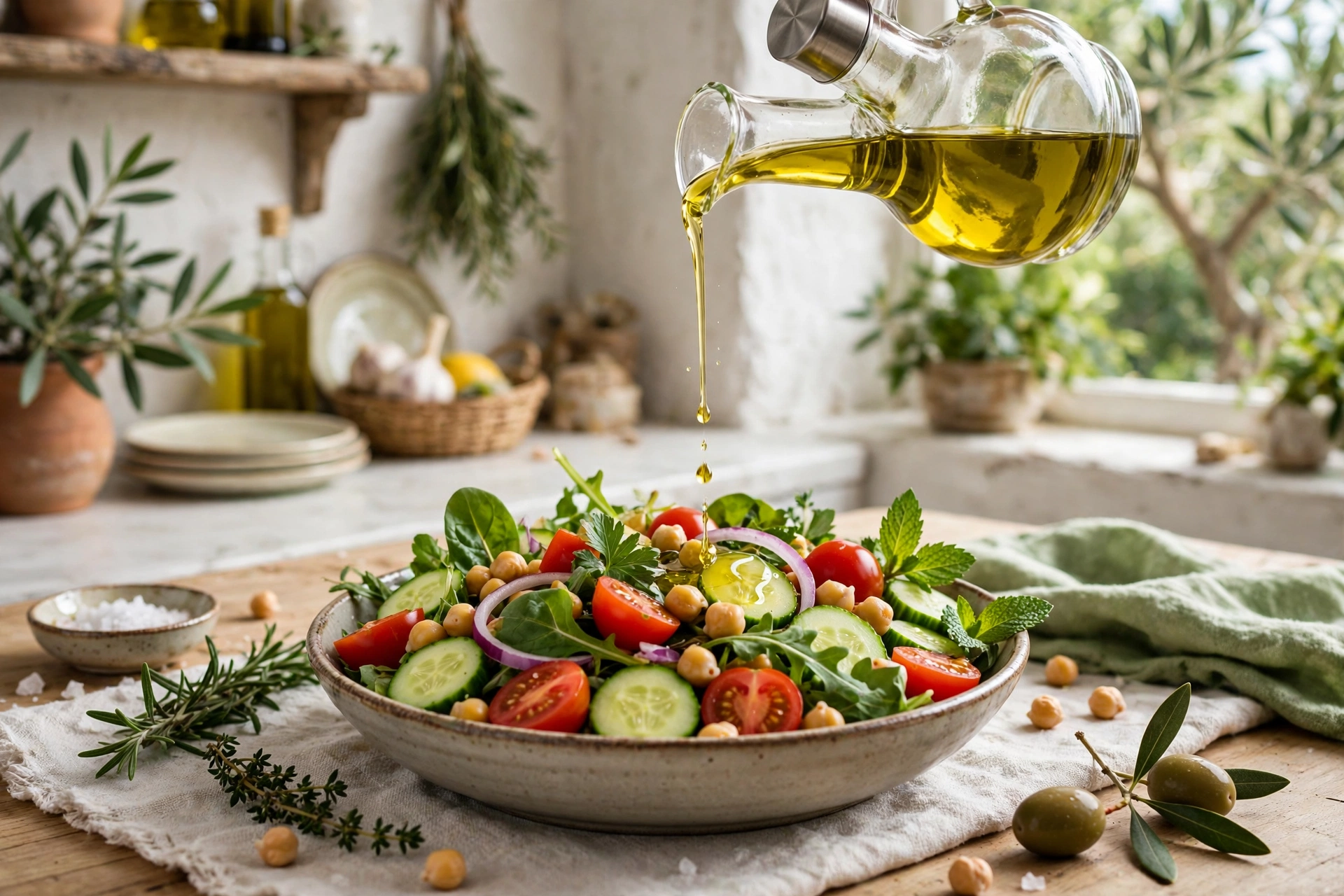
- Extra-virgin olive oil as your main fat — at least 4 tablespoons a day in the trial, including oil used in cooking. Drizzle it over salads and vegetables, sauté with it, finish soups with it.
- Vegetables at every meal — at least 2 servings a day (a 200-gram serving is about two generous handfuls of chopped vegetables), with one serving raw or as a salad.
- Fruit every day — 3 or more pieces, whole fruit rather than juice.
- Whole grains as the base — barley, bulgur, farro, brown rice, oats, whole-grain bread and pasta.
- Legumes three or more times a week — about a cup of cooked lentils, chickpeas or beans in a soup, stew or salad. Among the cheapest proteins on earth.
- A handful of nuts most days — 3 or more 30-gram servings a week (walnuts, almonds, hazelnuts, peanuts).
- Fish and seafood three times a week — 100–150 grams per serving, with oily fish like salmon, sardines and mackerel getting priority.
- Poultry over red meat — chicken or turkey when you eat meat; red and processed meat stays an occasional food, closer to a few times a month.
- Dairy in moderation — yogurt and cheese rather than milk by the glassful.
- Cook with sofrito — tomato, onion, leek or garlic simmered in olive oil at least twice a week. The flavor backbone of the whole pattern.
- Less of the rest — butter, margarine and cream minimized; sweet or carbonated drinks under one a day; commercial pastries kept occasional.
- Water as the main drink. The original trial screener counted wine among those who drank, but current guidelines advise limiting alcohol. Never start drinking for your health.
Read also: Glycemic Index vs Glycemic Load: Which One Should You Use?
Notice what isn’t on the list: no macro targets, no forbidden ingredients, no special products. If you want to self-score, the full 14-point adherence screener used in the trial is a quick quiz you can retake every few weeks.
Read also: Fiber 101: Soluble vs Insoluble Fiber and Why Both Matter
Five swaps to start tonight
Pick one swap today, add another each week:
- Butter → olive oil for cooking eggs, sautéing vegetables and dressing salads. This one swap captures most of the pattern’s fat logic.
- Sugary drink → sparkling water with lemon. Keep the ritual, change the content.
- One red-meat dinner → lentil soup or chickpea stew, with a slice of whole-grain bread.
- Chips or crackers → a 30-gram handful of almonds or walnuts for the afternoon slump.
- White rice or regular pasta → barley, bulgur or brown rice for one meal this week.
A week of ordinary meals
Seven days of templates, not prescriptions:
Day 1. Greek yogurt with berries and honey; lentil soup with olive oil, whole-grain bread, an orange; baked salmon, roasted vegetables, barley salad.
Day 2. Oatmeal with walnuts and apple; chickpea and tuna salad over greens with olive-oil dressing; vegetable and bean chili with brown rice.
Day 3. Whole-grain toast with tomato and olive oil; leftover chili; grilled chicken thighs with Greek salad and farro.
Day 4. Fruit smoothie with yogurt and peanut butter; white-bean soup; sardines on whole-grain toast with arugula.
Day 5. Vegetable omelet with fruit; bulgur tabbouleh with chickpeas; pasta with sofrito sauce and white beans.
Day 6. Overnight oats with almonds and apricots; roasted vegetable and hummus wrap; baked cod with tomatoes, olives and quinoa.
Day 7. Whole-grain pancakes with fresh fruit; lentil and spinach salad with feta; slow-cooked chicken and vegetable stew.
The starter shopping list
One focused grocery trip covers most of the week:
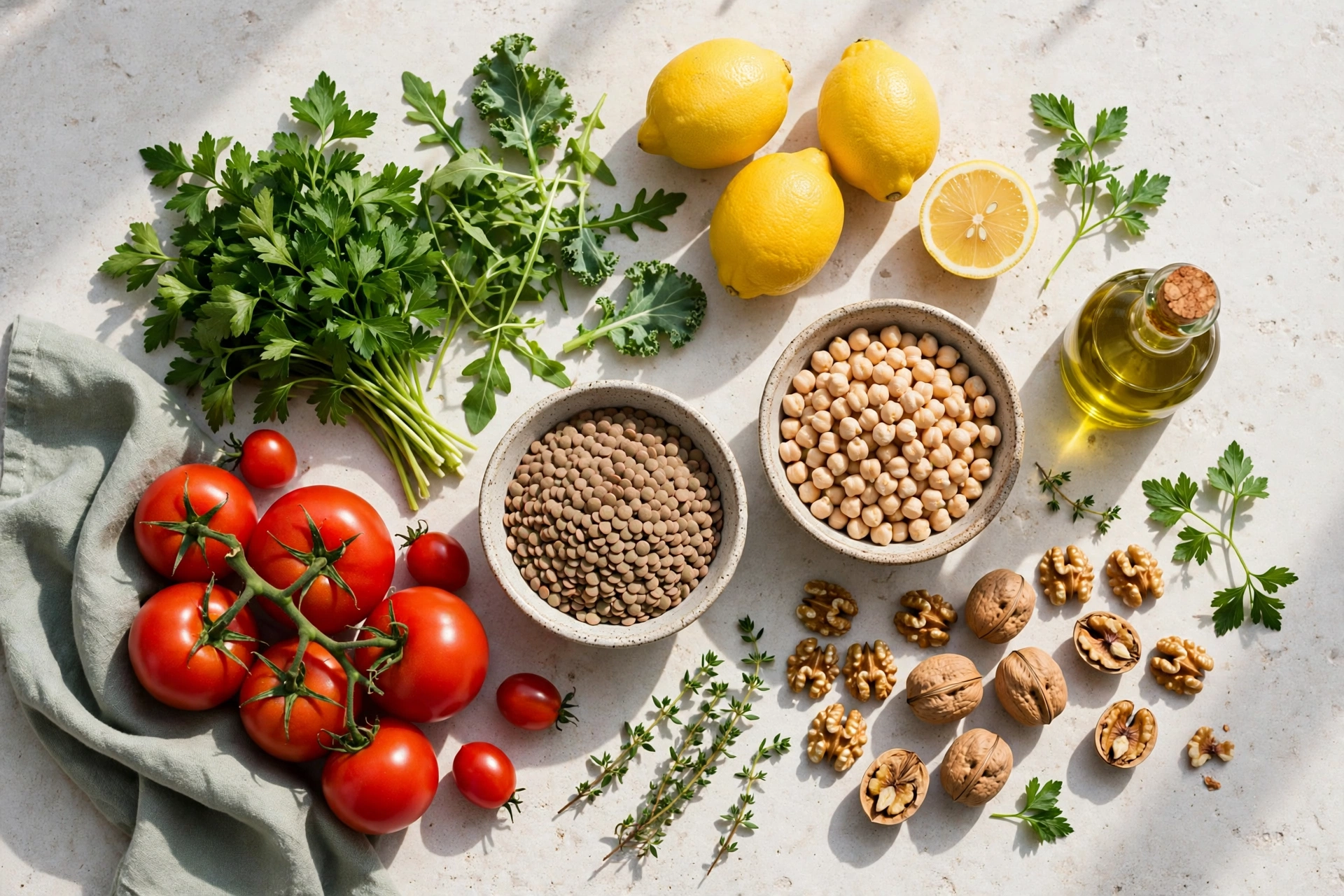
- Pantry: a good bottle of extra-virgin olive oil, dried lentils and chickpeas (or canned), brown rice or barley, bulgur, whole-grain pasta, canned tuna and sardines, walnuts and almonds, canned tomatoes, olives.
- Fridge: Greek yogurt, eggs, feta or hard cheese, fresh fish for two or three meals, chicken thighs.
- Produce: onions, garlic, carrots, celery, leafy greens, tomatoes, peppers, zucchini, lemons, citrus and apples, fresh herbs (parsley, oregano, basil).
- Freezer insurance: frozen vegetables, frozen fish fillets, frozen berries — so the pattern survives your busiest weeks.
Read also: How to Create a Healthy Grocery List
Where it fits today’s guidelines
The Mediterranean pattern lines up neatly with the 2025–2030 Dietary Guidelines for Americans, released in January 2026. The new guidelines place extra-virgin olive oil at the center of the food pyramid for the first time, advise prioritizing olive oil when cooking, cap saturated fat below 10% of daily calories, limit sodium to under 2,300 mg a day, and urge limits on ultra-processed foods and added sugars — the American College of Cardiology’s summary walks through the recommendations in full.
Frequently asked questions
Do I need to count calories?
No. The PREDIMED trial was energy-unrestricted — nobody counted calories, and the benefit appeared anyway. Meals built on vegetables, legumes, whole grains and olive oil are filling, so most people naturally eat reasonable amounts.
Isn’t four tablespoons of olive oil a day a lot of calories?
Fair question — 4 tablespoons is around 480 calories. The key is substitution, not addition: the oil should replace butter, margarine and cream sauces in your cooking, not sit on top of them.
Is it expensive?
The cheapest foods in the pattern are also the most important: dried lentils and beans, seasonal vegetables, eggs, oats and whole grains. Spend the budget on one good bottle of extra-virgin olive oil; buy fish affordably (frozen fillets, canned sardines and tuna all count).
What if I don’t like fish?
Start with mild white fish, and give oily fish another try prepared Mediterranean-style — sardines on toast with lemon and herbs taste nothing like a sad fish stick. If fish truly isn’t for you, lean harder on legumes, nuts and olive oil rather than falling back on red meat several times a week.
The bottom line
The Mediterranean diet endures because it asks so little and delivers so much evidence. No counting, no banning, no special products — just a kitchen that runs on olive oil, a plate crowded with plants, and protein that mostly swims, grows in a pod or falls from a tree. Pick one swap this week and build from there.
This article is for general information only and is not medical advice. If you have heart disease, diabetes or another health condition, or you take medication, talk with your clinician before making major dietary changes.
Sources
- Experimental Outcomes of the Mediterranean Diet: Lessons Learned from the Predimed Randomized Controlled Trial — review of PREDIMED’s ~30% reduction in major cardiovascular events (HR 0.69 EVOO, 0.72 nuts), diabetes substudy findings. Nutrients, via PubMed Central.
- Mediterranean Diet and Cardiovascular Health: Teachings of the PREDIMED Study — the trial’s 14-point Mediterranean diet adherence screener and protocol details. Nutrients, via PubMed Central.
- PREDIMED official Q&A on the 2018 republication — results remained intact after accounting for randomization departures: ~30% lower CVD risk vs. the low-fat control diet.
- PREDIMED — Wiki Journal Club — trial interventions (1 L/week extra-virgin olive oil, 30 g/day nuts), dietary counseling protocol, 4.8-year median follow-up.
- The Prevention of Cardiovascular Disease Through the Mediterranean Diet — review covering the Lyon Diet Heart Study (50–70% lower recurrent heart disease risk) and PREDIMED (absolute reduction ~3 events/1,000 person-years).
- How Do the 2025–2030 Dietary Guidelines for Americans Measure Up for Cardiovascular Health? — American College of Cardiology summary: olive oil prioritized, saturated fat <10% of calories, sodium <2,300 mg/day, limit ultra-processed foods and alcohol.
- The New Dietary Guidelines Embrace Food Is Medicine — and Put Olive Oil Front and Center — olive oil placed at the center of the 2025–2030 Dietary Guidelines pyramid.