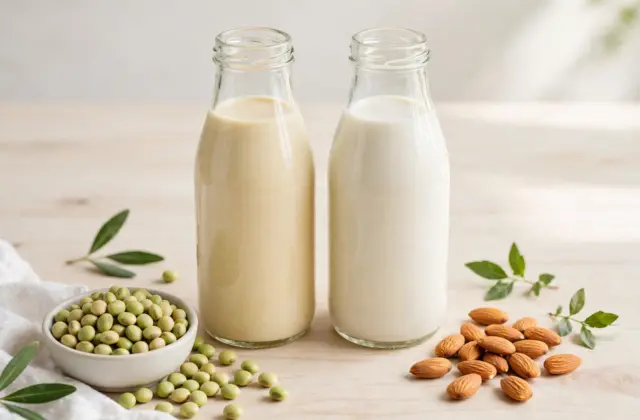
Oat Milk vs. Dairy Milk: How to Compare Them
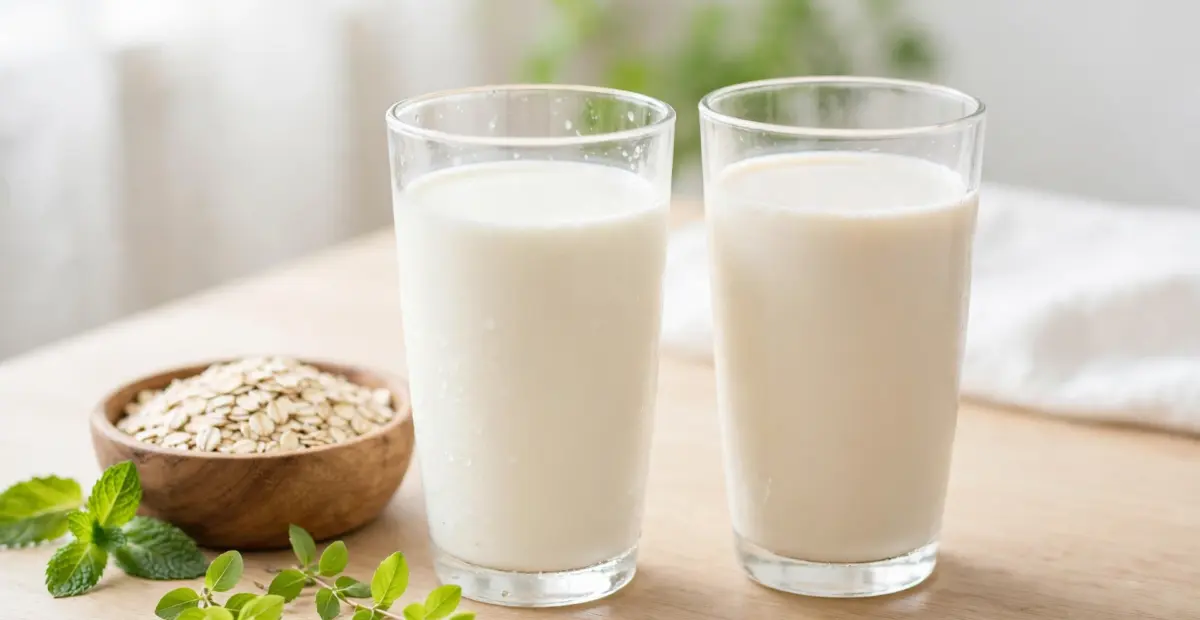
Oat milk has quietly taken over the coffee shop. It steams well, it tastes mild and a little sweet, and it shows up in everything from flat whites to overnight oats. So when the carton in your fridge runs out, swapping dairy milk for oat milk feels like the easiest health upgrade in the world.
It can be a good swap. It just isn’t a like-for-like one. A glass of whole milk and a glass of oat milk look similar and behave similarly in cereal, but they deliver very different amounts of protein, fat, and sugar — and the calcium in oat milk only matches dairy because someone added it at the factory. None of that makes oat milk a bad choice. It makes the label worth thirty seconds of your time.
The numbers, side by side
Everything below is per cup — 244 grams of whole dairy milk against 240 grams of unsweetened oat milk — using figures from the USDA FoodData Central database. Brands vary, especially for oat milk, so treat these as a solid reference point and check your own carton for the exact numbers.
| Per cup | Whole dairy milk | Oat milk, unsweetened |
|---|---|---|
| Calories | 149 | About 116 |
| Protein | 8 g | About 2 g |
| Total fat | 8 g | About 6.5 g |
| Saturated fat | 4.6 g | About 0.5 g |
| Carbohydrate | 12 g | About 12 g |
| Sugars | 12 g (lactose) | About 5 g |
| Fiber | 0 g | About 1 g |
| Calcium | 276 mg | About 356 mg |
| Vitamin D | About 3.1 mcg | About 4.1 mcg |
| Vitamin B12 | 1.3 mcg | About 1.2 mcg |
Two things jump out right away. The protein gap is enormous — dairy gives you four times as much. And oat milk’s calcium and vitamin D numbers look as good as dairy’s, or better. Both observations matter, but the calcium story has a catch worth understanding.
Protein is the real gap
If there is one number to remember from this comparison, it is 8 grams versus 2 grams. A cup of whole milk delivers about 8 grams of complete protein — all nine essential amino acids, in proportions your body can use well. A cup of unsweetened oat milk delivers about 2 grams, and oat protein is lower in lysine, one of the essential amino acids, so the quality is thinner as well as the quantity.
But the gap matters a lot in specific situations. If you rely on milk as a protein source — a glass with breakfast, milk in oatmeal, a post-workout shake — swapping to oat milk quietly removes a meaningful chunk of your daily protein. It matters more for older adults, who need protein to hold on to muscle, and for children, whose growth depends on it. If you are switching for a child, talk to your pediatrician first rather than assuming any plant milk is a one-for-one replacement.
Of the plant milks, soy is the one that comes closest to dairy on protein, landing around 6 to 8 grams per cup depending on the brand. Almond milk, by contrast, usually has about 1 gram per cup.
Read also: Almond Milk vs. Soy Milk: How to Compare Them
Calcium and vitamin D: fortification does the heavy lifting
Dairy milk contains calcium because cows put it there. Oat milk contains calcium because the manufacturer added it, usually as tricalcium phosphate. In the end, the amounts are close: about 276 mg per cup for whole milk and about 356 mg for a fortified oat milk. The adult calcium target is 1,000 mg a day for ages 19 to 50, rising to 1,200 mg for women over 51 and everyone over 71, according to the National Institutes of Health. Either milk covers roughly a quarter to a third of that in one glass.
The important detail is that the calcium in oat milk is not guaranteed. It is a choice the brand made. An unfortified oat milk can have almost no calcium at all, and the same goes for vitamin D: dairy milk in the United States is almost always fortified with about 3 mcg (120 IU) of vitamin D per cup, while oat milk ranges from well-fortified to not fortified at all. The vitamin D target is 15 mcg (600 IU) a day for adults up to 70, and 20 mcg (800 IU) after that, so a fortified cup of either milk covers a useful slice — but only if the fortification is actually there.
Two practical habits make the difference. First, shake the carton. Added calcium can settle at the bottom, and the last glass from an unshaken carton can be noticeably lower in calcium than the first. Second, check the label for three things: calcium at 20% of the Daily Value or more, vitamin D listed, and vitamin A if you want the closest match to dairy. The guidelines count fortified soy beverages as part of the dairy group precisely because they carry those nutrients at milk-like levels; oat milk is not listed as a dairy-group equivalent, so with oat milk the label check is on you.
One reassurance: the calcium added to fortified plant milks is absorbed at roughly the same rate as the calcium in dairy — about 30%, according to the NIH — so a fortified oat milk is a genuine calcium source, not just a number on a label.
Sugar: lactose versus added sugar
A cup of whole milk contains about 12 grams of sugar, and every gram of it is lactose — the sugar naturally present in milk. There is no added sugar in plain milk. That distinction matters, because the sugar limits you hear about from health authorities are limits on added sugars, not on the lactose in a glass of milk.
Unsweetened oat milk is lighter here: about 5 grams of total sugar per cup, most of it maltose produced when the oats are broken down during processing. But many oat milks on the shelf are not unsweetened. Sweetened and “barista edition” cartons — the ones designed to foam beautifully in coffee — can carry several grams of added sugar per cup. That is the version most people actually drink, because it is the version most coffee shops pour.
The American Heart Association suggests keeping added sugars to no more than 25 grams a day for women and 36 grams for men. A sweetened oat milk in your morning coffee will not blow that budget on its own, but it spends some of it, while plain milk spends none of it.
Fat and saturated fat
This is where oat milk has its clearest advantage. A cup of whole milk carries about 4.6 grams of saturated fat — roughly a third of the American Heart Association’s suggested daily ceiling of about 13 grams on a 2,000-calorie diet. Oat milk carries about 0.5 grams, because oats are naturally very low in saturated fat and the small amount of oil added during processing is mostly unsaturated.
Total fat tells a subtler story: oat milk is not a low-fat drink. At about 6.5 grams of fat per cup it sits close to whole milk’s 8 grams, and the barista versions often run a little higher because extra oil is what makes them foam. The difference is the type of fat, not the amount.
What about the oats themselves?
Oat milk starts with oats, so it is natural to assume it carries the benefits of oats — the soluble fiber, the beta-glucan linked to cholesterol support. In practice, most of that stays behind. The oats are soaked, blended, and strained, and the fiber is largely left in the pulp. What reaches your glass is about 1 gram of fiber per cup, against roughly 4 grams in a small bowl of cooked oatmeal. Oat milk is not a meaningful source of fiber, and it should not be counted as a serving of whole grains. If you want the oat benefits, eat the oats; if you want the creamy liquid, drink the milk and get your fiber elsewhere.
Read also: Dairy vs. Plant-Based Milk: Key Nutrients to Compare
Who might choose which
There is no single winner here, because the right answer depends on what you need milk to do.
Oat milk is often the better fit if you are lactose intolerant or allergic to dairy — oat milk is naturally free of both lactose and dairy protein — or if you eat a vegan diet and want a creamy, neutral-tasting milk for coffee, cereal, and cooking. Its mild flavor and good foaming make it the most popular plant milk in coffee shops for a reason, and its low saturated fat is a genuine plus if you are watching that number.
Dairy milk is often the better fit if you count on milk for protein — growing children, older adults, anyone rebuilding strength — or if you want a food that delivers calcium, vitamin D, B12, and complete protein without depending on fortification. It is also usually the cheaper option, and it is the more reliable one for young children, where pediatric guidance generally still favors whole dairy milk unless a clinician advises otherwise.
Either can work if milk is a small part of your diet and the rest of it is varied. A splash in coffee, a pour over cereal — at that scale, the differences are small and the choice is mostly about taste, budget, and digestion. What matters is not being surprised: if you switch, make sure the protein you lose shows up somewhere else on your plate, and make sure the calcium you assume is there actually is.
How to read the carton in 30 seconds
Whatever you buy, the label settles the comparison for your specific carton. Run through this checklist in the aisle:
- Unsweetened? The front of the carton should say so. If it doesn’t, check the “Added Sugars” line — that is the number that counts.
- Calcium 20% Daily Value or more? That is roughly 260 mg per cup, in the same range as dairy milk. Below that, the carton is not pulling its weight on calcium.
- Vitamin D listed? Look for at least 10% of the Daily Value. If the vitamin D line is missing, the carton isn’t fortified with it.
- Vitamin B12? Dairy milk provides it naturally; oat milk only has it if it was added. Vegans in particular should look for it.
- Protein per cup? If the answer is 1 to 2 grams, treat the carton as a beverage, not a protein food, and plan accordingly.
And if you mostly drink oat milk in coffee, remember that the milk is only part of the drink. A large sweetened latte can carry more sugar from syrups and sweetened milk than from anything else in the cup.
Read also: Coffee Nutrition: What Affects Its Calories?

The bottom line
Oat milk and dairy milk are not the same food in different packaging — they are different foods that happen to pour the same way. Dairy milk wins clearly on protein and on delivering calcium, vitamin D, and B12 without any help. Oat milk wins clearly on saturated fat and on being free of lactose and dairy allergens.
Choose dairy if milk is doing nutritional work for you — protein at breakfast, calcium for growing kids or aging bones. Choose oat milk if dairy doesn’t agree with you, or if you prefer the taste and the lower saturated fat. Either way, buy the unsweetened, fortified version and read the label once before it becomes a habit.
Frequently asked questions
Is oat milk healthier than dairy milk?
It depends on what you mean by healthier. Oat milk is lower in saturated fat and free of lactose, but it has much less protein — about 2 grams per cup against about 8 grams in dairy milk — and its calcium and vitamin D depend entirely on fortification.
Does oat milk have as much calcium as dairy milk?
A fortified oat milk can match or slightly exceed dairy milk, with about 356 mg per cup against about 276 mg in whole milk. But unfortified oat milk has very little calcium, so check the label for at least 20% of the Daily Value — and shake the carton, since added calcium settles.
Is oat milk good for people with lactose intolerance?
Yes. Oat milk is naturally lactose-free and dairy-free, which is one of the main reasons people switch. Just make sure the brand you buy is made in a facility that suits your allergy needs if you also have a dairy allergy, and check that it is fortified with calcium and vitamin D.
Can children drink oat milk instead of dairy milk?
Not as a straight swap without a conversation first. Young children need the protein, fat, and nutrients that whole dairy milk provides, and most pediatric guidance still favors dairy milk for children under two. If your child needs to avoid dairy, ask your pediatrician which fortified plant milk fits best.
This article is for general information only and is not medical advice. If you have a milk allergy, lactose intolerance, or a medical condition that affects your diet, talk to your clinician or a registered dietitian about the best choice for you.
Sources
- USDA FoodData Central — Oat milk, nutrition facts per 100 g (via NutritionValue.org)
- USDA FoodData Central — Milk, whole, nutrition facts per cup (via NutritionValue.org)
- National Institutes of Health, Office of Dietary Supplements — Calcium: Health Professional Fact Sheet
- National Institutes of Health, Office of Dietary Supplements — Vitamin D: Health Professional Fact Sheet
- American Heart Association — Saturated Fats
- MedlinePlus — Dietary Guidelines for Americans 2025–2030 (dairy group and fortified soy beverages)