How to Read Whole-Grain Claims on Food Labels
You pick up a loaf that says “made with whole grains” in big friendly letters. It sounds like the healthy choice. Then you flip it over and the first ingredient is enriched wheat flour, and the fiber line reads 1 gram per slice. Did the front of the package lie? Not exactly — and that gap between what a claim suggests and what the label actually means is the whole problem with whole-grain claims.
Whole-grain wording on food packages is some of the most confusing labeling in the grocery store. A 2020 study from Tufts University and NYU asked 1,030 U.S. adults to judge real and hypothetical grain products: 29 to 47 percent picked the wrong item as the healthier choice, and for real products that were not mostly whole grain, 43 to 51 percent of people overstated how much whole grain they contained. Even people with advanced degrees struggled. The labels are not written to be decoded at a glance. They are written to sell bread.
First, what “whole grain” actually means
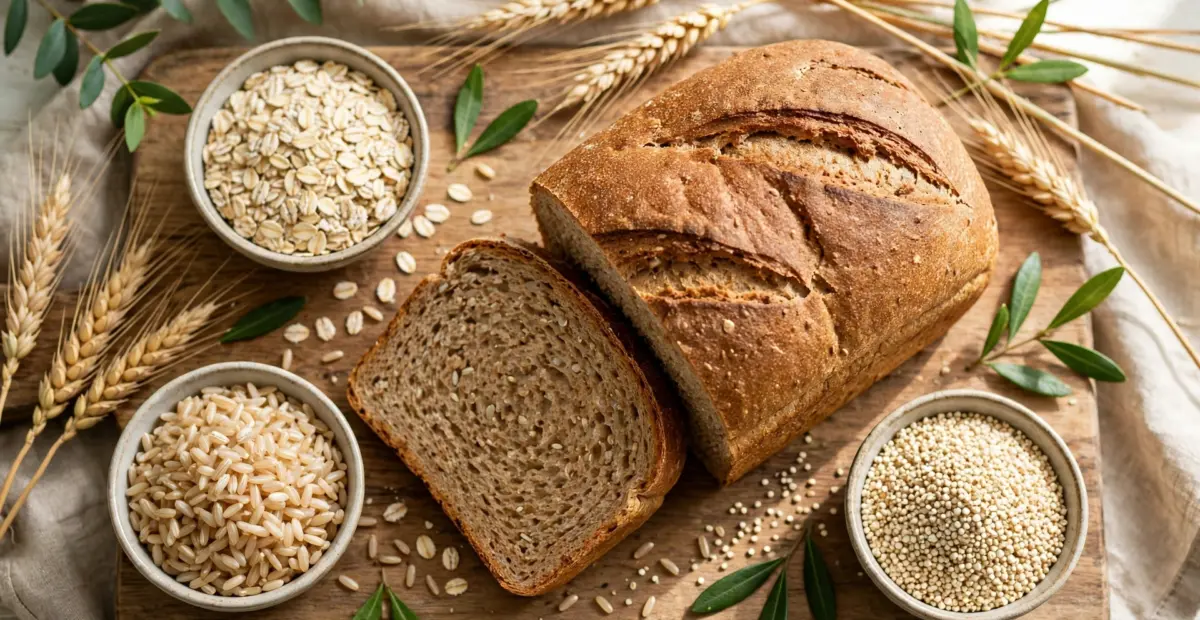
A whole grain is a grain that still has all three parts of the kernel: the bran (the fiber-rich outer layer), the germ (the nutrient-dense core), and the endosperm (the starchy middle). Refining strips away the bran and germ, leaving mostly the endosperm — which is why white flour is softer and keeps longer, but also why it carries far less fiber and fewer micronutrients.
The numbers make the difference concrete. USDA FoodData Central lists commercial whole wheat bread at 6.0 grams of fiber per 100 grams, against 2.7 grams for commercial white bread — more than double the fiber, at nearly the same calories (252 versus 266 kcal per 100 grams). One slice of whole wheat bread gives you about 1.9 grams of fiber; a slice of white bread gives you about 0.8 grams. That gap is the entire nutritional case for whole grains in one comparison.
Whole grains also carry magnesium, B vitamins, and other nutrients that live mostly in the bran and germ. As a swap — whole for refined — the upgrade is real.
The 51% rule: the one number that actually matters
The closest thing to a legal definition of a whole-grain food comes from the U.S. Food and Drug Administration. Since 1999, the FDA has allowed a health claim on whole-grain foods — wording along the lines of “diets rich in whole grain foods and other plant foods, and low in saturated fat and cholesterol, may help reduce the risk of heart disease.” To carry that claim, a food must contain at least 51 percent whole-grain ingredients by weight per reference amount customarily consumed, and meet criteria for fat, cholesterol, and fiber.
That 51 percent figure is useful to know, because it tells you what “whole grain” means when it is regulated: just over half. The FDA’s own 2006 draft guidance on whole-grain label statements recommended that same 51 percent threshold for using the words “whole grain” in a product name — but the guidance was never finalized. Nearly twenty years later, there is still no final rule, and no legal minimum amount of whole grain required for a package to say “made with whole grains.”
That is the regulatory gap at the heart of this whole topic. The health claim is regulated. The casual phrases on the front of the box mostly are not. They only have to avoid being outright false or misleading under general food-labeling law, which is a low bar when the claim is vague.
Read also: How to Choose Whole-Grain Bread
The Whole Grain Stamp: helpful, but read the fine print
The gold stamp with the sheaf of wheat is the most recognizable whole-grain symbol on U.S. packages. It comes from the Oldways Whole Grains Council, a nonprofit, and it appears on more than 13,000 products in over 60 countries. There are three versions, and the differences between them matter more than the stamp itself:
- 100% Stamp: all of the grain in the product is whole grain, and each serving contains at least 16 grams of whole grain — a full serving, or one ounce-equivalent.
- 50%+ Stamp: at least half of the grain is whole grain, with at least 8 grams of whole grain per serving.
- Basic Stamp: at least 8 grams of whole grain per serving, but the product may contain more refined grain than whole grain.
The stamp always prints the grams of whole grain per serving, which is genuinely useful. But notice what the Basic Stamp allows: a product can carry a prominent whole-grain stamp while most of its grain is refined. Treat the 100% Stamp as the strong signal, the 50%+ as a decent one, and the Basic Stamp as a starting point that still needs the ingredient list.
Decoding the most common claims
“Made with whole grains”
This is the phrase that causes the most trouble. Because the FDA never finalized its 2006 guidance, there is no minimum whole-grain content behind it. Researchers analyzing 545 grain products sold in U.S. grocery stores found that products with “whole grain” displayed prominently on the front had a median whole-grain content of just 24 percent by weight, and products labeled “made with whole grain” had a median of 12 percent. In other words, a typical “made with whole grains” product is about one-eighth whole grain.
The phrase is not a lie — the product does contain some whole grain. But it tells you nothing about how much. If a package says “made with whole grains” without stating grams, flip it over and check the ingredient list before deciding.
“Multigrain” and “12 grain”
Multigrain means the product contains more than one type of grain. It says nothing about whether any of those grains are whole. A multigrain cracker can be made entirely from refined flours, and the same goes for “7 grain” or “12 grain” counts: the number counts grain types, not whole grains. In the Tufts study, 51 percent of respondents overstated the whole-grain content of a 12-grain bread — the highest overstatement of any real product tested.
“Wheat flour” versus “whole wheat flour”
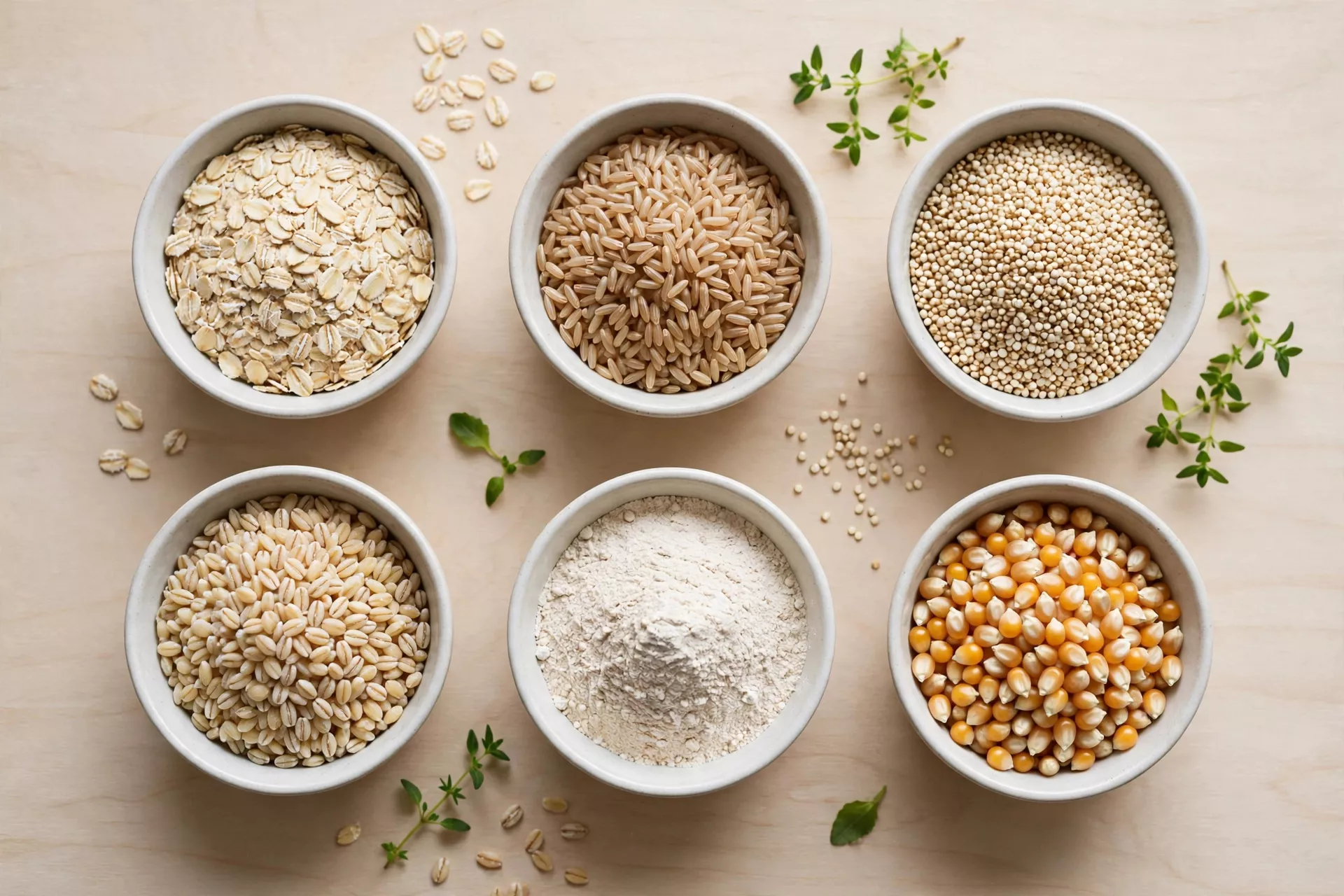
This is the single most useful distinction on an ingredient list. “Wheat flour” is refined white flour — the word “wheat” alone does not make it whole. “Whole wheat flour” (or “whole grain wheat flour”) means the entire kernel was used. The same pattern holds across grains: “oat flour” is refined, “whole oat flour” is whole; “cornmeal” can be refined or whole-grain, so look for “whole grain cornmeal” or “whole cornmeal.”
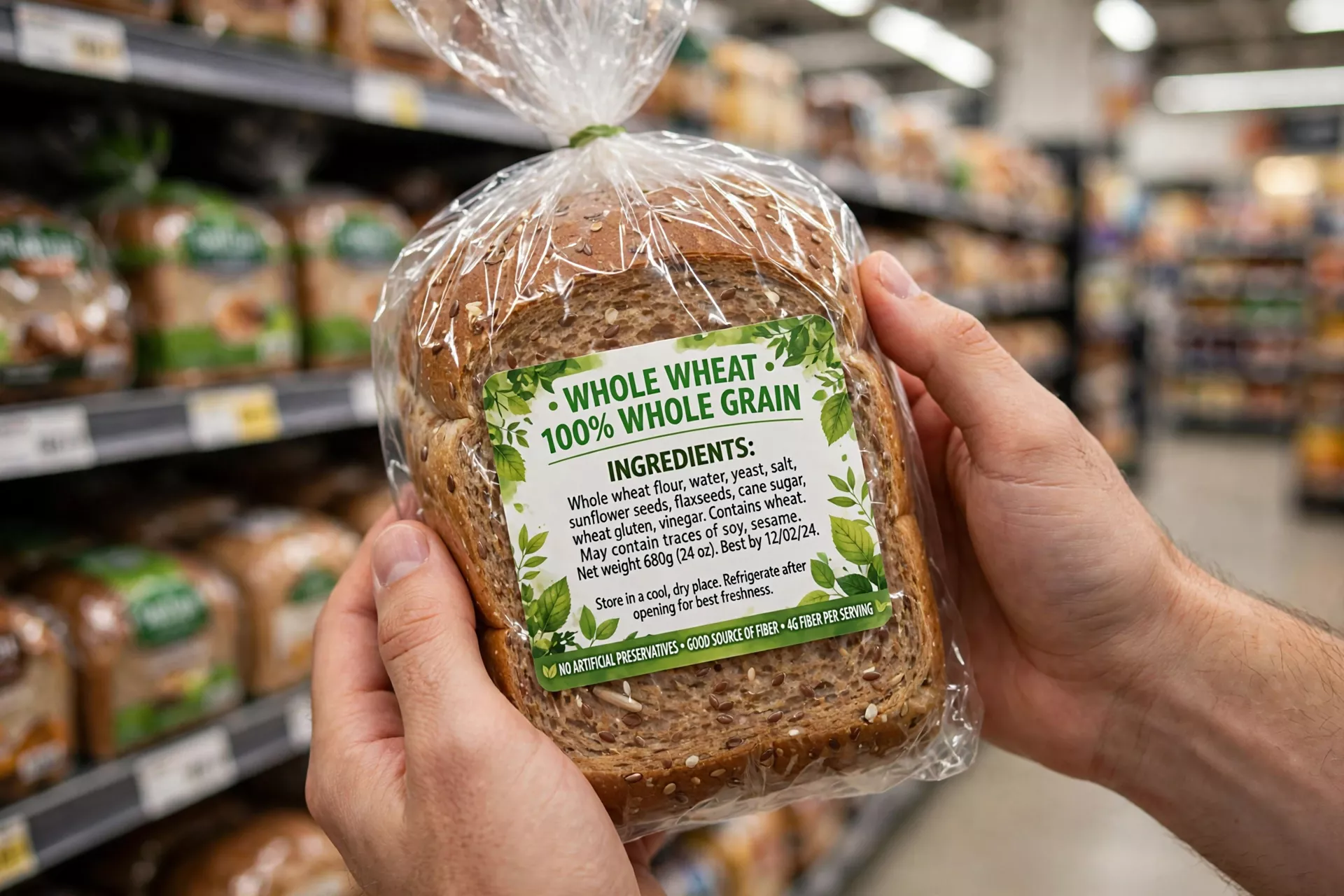
Ingredients are listed by weight, heaviest first. If the first ingredient is a whole grain — whole wheat flour, whole oats, brown rice — that is a good sign. If the first ingredient is enriched flour and a whole grain appears third or fourth, the product is mostly refined no matter what the front says.
“100% whole wheat” and “100% whole grain”
These are the strongest front-of-package claims, and they mean what they say: all the grain in the product is whole grain. A loaf labeled “100% whole wheat” is made entirely with whole wheat flour. When you see this phrasing, you can trust it more than any other claim on the shelf — it is also the phrasing the FDA’s draft guidance reserves for products where all the grain is whole.
“Stone ground,” “cracked wheat,” and brown color
“Stone ground” describes how flour was milled, not whether the grain was whole. “Cracked wheat” is a whole grain, yet it can appear in small amounts in an otherwise refined product. And color is no guide at all: brown bread is often white bread with molasses or caramel color added. Judge by the ingredient list, never by the shade.
“Good source of fiber” is a different claim entirely
Fiber claims are regulated separately, and they are not the same as whole-grain claims. A product can be a “good source of fiber” because fiber was added — inulin, chicory root fiber, or isolated oat fiber — without containing much whole grain at all. Added fiber is not worthless, but it is not the same package of nutrients you get from an intact whole grain. Conversely, some genuine whole-grain foods are modest in fiber: brown rice, for example, has only about 1.8 grams of fiber per cooked cup. Use fiber as a supporting clue, not as proof of whole grain.
Read also: Whole-Grain Foods to Add to Your Grocery List
The 30-second label check
Put the front of the package aside and run these three checks in order. They take about half a minute once you know them.
1. Read the first ingredient. It should name a whole grain: “whole wheat flour,” “whole oats,” “brown rice,” “whole rye flour.” If the first ingredient is “enriched flour,” “wheat flour,” or “degerminated cornmeal,” the product is mostly refined — no matter what the front claims. If a whole grain shows up second or lower, treat the product as a mix, not a whole-grain food.
2. Look for grams of whole grain. The Whole Grain Stamp prints them. Some packages state them in the ingredients or in a callout (“16g whole grains per serving”). A full serving of whole grain is 16 grams; 8 grams is half a serving. If no grams are stated anywhere and the front just says “made with whole grains,” assume the amount is small.
3. Check the fiber as a sanity test. The National Academies set the adequate intake for fiber at 25 grams a day for women and 38 grams for men, and most people fall well short. A bread with 3 grams of fiber or more per serving is a decent choice; 5 grams or more is strong. A “whole grain” bread with 1 gram of fiber per slice is a red flag. The carbohydrate-to-fiber ratio helps too: divide total carbohydrate by fiber. A ratio under 10 to 1 (for example, 20 grams of carbohydrate and 2 or more grams of fiber) generally marks a genuinely whole-grain food; white bread sits around 18 to 1.
Why it is worth the 30 seconds
The 2025–2030 Dietary Guidelines for Americans urge people to prioritize fiber-rich whole grains — 2 to 4 servings a day at a 2,000-calorie level — and to significantly reduce refined carbohydrates such as white bread, flour tortillas, and crackers. A serving is simple to picture: one slice of bread, or half a cup of cooked oats, brown rice, barley, or quinoa.
Most people are a long way from that target. Refined grains make up about 87 percent of the grains Americans eat, according to the scientific report behind the current guidelines. And the payoff for closing the gap is well documented: diets higher in whole grains are consistently linked with lower risk of heart disease, type 2 diabetes, and colorectal cancer in large observational studies — which is exactly why the FDA authorized the whole-grain health claim in the first place.
None of this means every grain you eat must be whole. White rice, white pasta, and white bread all have their place, and refined grains are often enriched with iron and B vitamins. The goal is the pattern: most of your grains whole, most of the time, and the label check is how you make sure the grains you think are whole actually are.
Read also: How to Compare Packaged Snack Labels
A worked example: two loaves, side by side
Imagine two loaves on the shelf. The first says “Made with Whole Grains” in large letters, with a picture of wheat. Its ingredient list starts “enriched wheat flour, water, whole wheat flour…” and the Nutrition Facts show 1 gram of fiber per slice. The second says “100% Whole Wheat” in plain type. Its ingredient list starts “whole wheat flour, water…” and it has 4 grams of fiber per slice.
The first loaf is not lying — it is made with whole grains, somewhere in the recipe. But its whole-grain content is small, and its fiber tells the story. The second loaf is the whole-grain food. Same aisle, same price range, very different products — and the only way to tell them apart was the back of the package.
Frequently asked questions
Does “multigrain” mean whole grain?
No. Multigrain only means a product contains more than one type of grain. Those grains can all be refined. Always check whether the first ingredient names a whole grain.
How many grams of whole grain should a serving have?
A full serving of whole grain is 16 grams. Look for at least 8 grams (half a serving) as a minimum, and prefer products with 16 grams or more, or the 100% Whole Grain Stamp.
Is brown bread always whole grain?
No. Brown color often comes from molasses or caramel coloring added to white bread. Color tells you nothing — the ingredient list does.
Does “made with whole grains” guarantee a healthy product?
No. There is no legal minimum whole-grain amount behind that phrase, and products carrying it have been found to contain a median of about 12 percent whole grain by weight. Check the first ingredient and the fiber before deciding.
Sources
- U.S. Food and Drug Administration — Draft Guidance for Industry and FDA Staff: Whole Grain Label Statements (2006)
- Oldways Whole Grains Council — Government Guidance on Whole Grain Labeling
- Oldways Whole Grains Council — The Whole Grain Stamp
- Wilde et al. — Consumer confusion about wholegrain content and healthfulness in product labels, Public Health Nutrition (2020)
- Whole-grain food intake among US adults, based on different definitions of whole-grain foods, NHANES 2003–2018
- Oldways Whole Grains Council — U.S. Dietary Guidelines and Whole Grains (2025–2030)
- USDA FoodData Central — Bread, whole-wheat, commercially prepared (FDC 172688); Bread, white, commercially prepared (FDC 174924)
Disclaimer: This article is for general nutrition education only and is not medical advice. If you have a medical condition such as celiac disease, diabetes, or a digestive disorder, talk with your clinician or a registered dietitian before changing your diet.