Make-Ahead Breakfast Ideas for Busy Mornings
Your alarm goes off, the kids need lunchboxes, the dog needs out, and breakfast is the thing that gets dropped. Again. You grab coffee, promise yourself you’ll eat properly tomorrow, and by 10 a.m. you’re raiding the office biscuit tin. Sound familiar? The fix isn’t more willpower at 6 a.m. — it’s moving the work to a moment when you actually have time. Make-ahead breakfasts let you cook once, eat well all week, and walk out the door with something better than a vending-machine pastry.
This guide covers seven breakfasts that genuinely hold up in the fridge or freezer, a simple Sunday system that takes about half an hour, and the food-safety numbers that keep a week’s worth of prep safe to eat.
Why make-ahead breakfasts actually work
Most breakfast advice assumes you have a calm, unhurried morning. Real mornings are the opposite: you’re half-dressed, half-awake, and negotiating with a toddler or a train timetable. A jar of overnight oats sitting at eye level in the fridge needs no decision at all — and no-decision breakfasts are the ones that actually happen.
There’s a nutrition angle too. A rushed morning often means skipping breakfast or grabbing something sweet and low in fibre. A planned breakfast can be built around the foods that keep you full: protein, fibre, and some fruit or vegetables. The World Health Organization recommends at least 400 grams of fruit and vegetables a day, and most of us get nowhere near that before lunch. A breakfast that includes berries, a banana, or a handful of spinach in a smoothie is a head start most people never get from a croissant.
The 30-minute Sunday system
You don’t need a whole afternoon of meal prep. One focused half-hour on Sunday (or whatever evening is quietest) covers the week:
- Pick three breakfasts, not seven. Variety matters, but three options rotated across five days beats a fridge full of half-used ingredients. Overnight oats, egg muffins, and smoothie packs is a solid trio.
- Cook the hot one first. Put the egg muffins in the oven, then assemble the cold ones while they bake.
- Portion into single servings. Individual jars and containers mean you grab and go — no measuring at 6:30 a.m.
- Label with the date. A strip of masking tape and a pen saves you from the sniff test on Thursday.
That last point matters more than it sounds. Cooked breakfasts like egg muffins and baked oatmeal keep for 3 to 4 days in the fridge, according to the USDA Food Safety and Inspection Service, and should be reheated to 165°F (74°C). Overnight oats and chia pudding keep about the same length. Anything you won’t eat within four days belongs in the freezer, where it keeps its best quality for 3 to 4 months. Cooked food should go into the fridge within 2 hours of cooking — or within 1 hour if the room is above 90°F (32°C) — and your fridge should stay at or below 40°F (4°C).
1. Overnight oats (the five-minute classic)
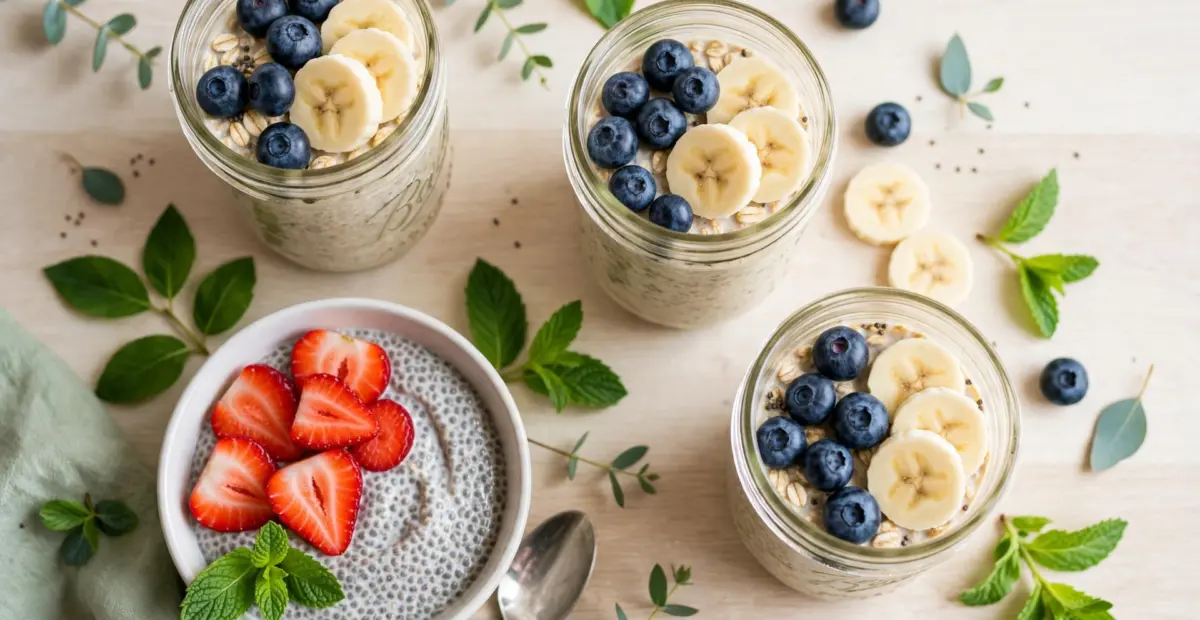
Overnight oats are the gateway make-ahead breakfast, and for good reason: you stir them together in a jar, refrigerate overnight, and eat them cold or warmed. The base ratio is simple — half a cup of rolled oats to half a cup of milk (dairy or fortified plant milk), plus a spoonful of yogurt if you like it creamier.
A 40-gram serving of dry rolled oats gives you roughly 5 grams of protein and 4 grams of fibre, according to USDA FoodData Central. Add a handful of berries and a spoonful of chia seeds and the fibre climbs fast: one ounce (28 grams) of chia seeds adds about 9.8 grams of fibre and 4.7 grams of protein for around 138 calories. Sweeten with fruit rather than honey or syrup — the American Heart Association suggests keeping added sugars to about 25 grams a day for women and 36 grams for men, and a breakfast that starts sweet tends to stay sweet.
Try three flavour rotations so you don’t get bored by Wednesday: blueberry and lemon zest; banana, peanut butter, and a pinch of cinnamon; or grated apple with walnuts and a spoonful of yogurt. Make three jars on Sunday and two more on Wednesday evening — a two-minute job once the habit is set.
Read also: How to Build a Better Breakfast
2. Baked egg muffins (protein you can hold in one hand)
Whisk a dozen eggs, pour them into a greased muffin tin with chopped vegetables and a little cheese, and bake at 350°F (175°C) for about 20 minutes. Twelve muffins take roughly half an hour start to finish and give you breakfast for days. Each large egg provides about 6 grams of protein, and the vegetables — spinach, peppers, mushrooms, whatever is in the crisper — add fibre and colour for almost no extra effort.
Let them cool completely, then refrigerate in a sealed container for up to 4 days or freeze for up to 3 months. To reheat, microwave for 30 to 45 seconds or warm in the oven until steaming all the way through — leftovers should reach 165°F (74°C) before eating. Wrap one in foil and it travels well in a bag, which is more than you can say for a bowl of cereal.
If you eat dairy-free, skip the cheese and add cooked sweet potato or black beans instead. The muffins still hold together, and the beans add fibre the cheese never would.

3. Chia pudding (dessert that counts as breakfast)
Stir 3 tablespoons of chia seeds into a cup of milk with a splash of vanilla, leave it overnight, and it sets into a thick pudding. Top with sliced fruit in the morning. One serving lands at roughly 10 grams of fibre before you even add the fruit — a serious contribution toward the 25 grams a day the World Health Organization cites as a minimum for adults, and a meaningful step toward the 25 grams for women and 38 grams for men aged 19 to 50 in the US Dietary Reference Intakes.
Chia pudding keeps 3 to 4 days refrigerated. Make it in small jars with lids, and layer the fruit on top the night before so there’s nothing to assemble in the morning.
4. Yogurt parfaits, pre-layered
Greek yogurt is one of the easiest protein sources in the breakfast world: plain non-fat Greek yogurt has about 10 grams of protein per 100 grams. Layer it in jars with berries and a spoonful of oats or crushed nuts, and you have a parfait that survives three days in the fridge. Keep any crunchy topping in a separate small bag or container so it doesn’t go soggy — a sandwich bag clipped to the jar works fine.
Watch the yogurt you buy. Flavoured yogurts can carry as much added sugar as a dessert, so check the label: on a Nutrition Facts panel, 5% of the Daily Value or less is low and 20% or more is high, per the FDA’s guide. Plain yogurt plus your own fruit gives you the sweetness with the fibre intact.
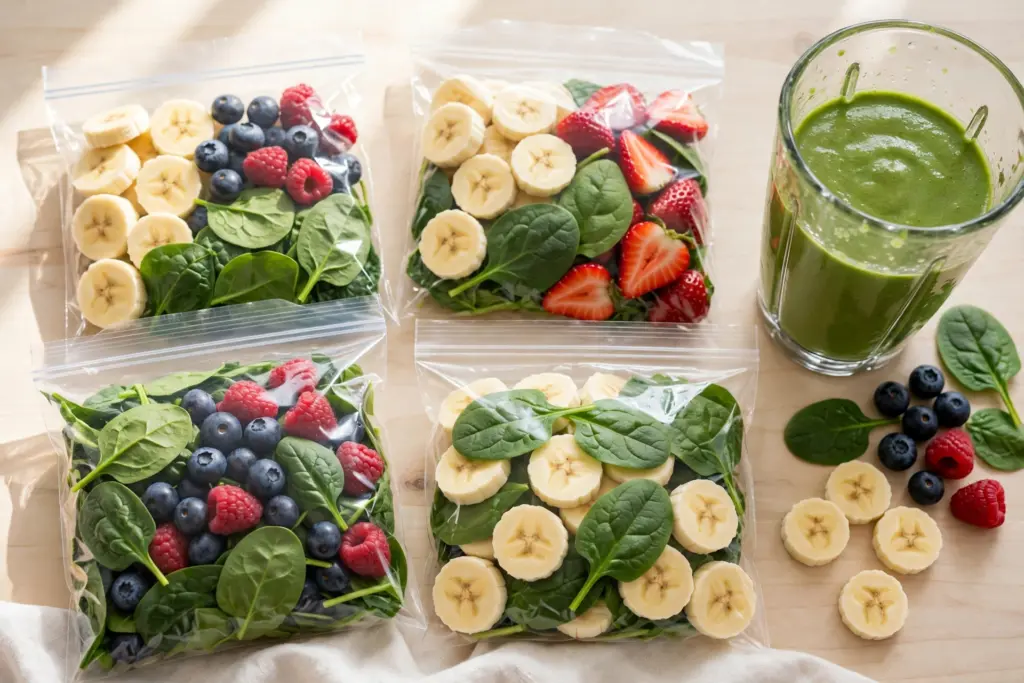
5. Freezer smoothie packs
Smoothie packs are the fastest make-ahead breakfast of all, because the morning work is just “add liquid and blend.” Fill zip-top bags with a banana, a handful of berries or mango, a handful of spinach, and a tablespoon of oats or chia seeds. Squeeze out the air, lay them flat in the freezer, and they keep for 3 to 4 months at best quality.
In the morning, empty a pack into the blender with milk or water and a spoonful of Greek yogurt or peanut butter for protein. Thirty seconds later, breakfast is done. This is also the easiest way to get vegetables into a morning that otherwise wouldn’t have any — spinach blends in invisibly, and a cup of it is a real contribution toward that 400-gram daily fruit and vegetable target.
Read also: Easy Breakfast Meal Prep Ideas
6. Freezer breakfast burritos
Scrambled eggs, black beans, a little cheese, and salsa wrapped in a whole-grain tortilla and frozen individually — the burrito is the make-ahead breakfast for people who want something warm and savoury. Make a batch of eight on Sunday, wrap each one in foil, and freeze. Microwave one for about 90 seconds, flipping halfway, until it’s hot all the way through.
Beans are doing quiet work here: they’re cheap, they add fibre and protein, and they make one egg stretch further. Use whole-grain tortillas when you can — the fibre difference between whole-grain and refined wraps is real, and breakfast is a good place to bank it.
7. Baked oatmeal squares
If overnight oats feel too cold and egg muffins feel too savoury, baked oatmeal sits in the middle. Mix rolled oats with milk, eggs, mashed banana, and cinnamon, pour into a baking dish, and bake until set. Cut into squares, refrigerate for up to 4 days, and reheat a square in the morning with a spoonful of yogurt on top. It’s also a good use for overripe bananas — mashed banana sweetens the whole pan, so you can skip the added sugar entirely.
Keeping it safe: the numbers to remember
Make-ahead breakfasts only work if they’re safe to eat on day four. The USDA’s rules are short and worth memorising:
- 2 hours: get cooked food into the fridge within 2 hours of cooking (1 hour if it’s above 90°F).
- 40°F (4°C): keep the fridge at or below this temperature.
- 3 to 4 days: eat refrigerated leftovers within this window, or freeze them.
- 165°F (74°C): reheat leftovers to this temperature, measured with a food thermometer.
When in doubt, throw it out. Food that causes illness doesn’t always look or smell off, and a breakfast you made on Sunday isn’t worth a sick day on Friday.
Read also: Easy High-Protein Breakfast Ideas
Frequently asked questions
How long do overnight oats last in the fridge?
About 3 to 4 days in a sealed container at or below 40°F (4°C). Make a Sunday batch for Monday to Wednesday, then a quick Wednesday batch for Thursday and Friday.
Can I freeze egg muffins?
Yes. Cool them completely, wrap individually, and freeze for up to 3 to 4 months. Reheat in the microwave or oven until they reach 165°F (74°C) all the way through.
What’s the highest-protein make-ahead breakfast?
Egg muffins and Greek yogurt parfaits lead the pack. Two eggs give you about 12 grams of protein, and a cup of plain non-fat Greek yogurt adds roughly 25 grams. Pair either with oats or fruit for fibre and the meal keeps you full for hours.
Do make-ahead breakfasts lose nutrients in the fridge?
Some vitamin C is lost over time in cut fruit, but the protein, fibre, and minerals in oats, eggs, yogurt, and beans hold up well over a few days. A breakfast you actually eat beats a theoretically perfect one you skip.
Sources
- USDA Food Safety and Inspection Service — Leftovers and Food Safety
- FoodSafety.gov — 4 Steps to Food Safety
- World Health Organization — Healthy Diet (fact sheet)
- USDA FoodData Central
- American Heart Association — Added Sugars
This article is for general information only and is not medical advice. If you have a health condition or dietary restriction, talk to your clinician or a registered dietitian before changing how you eat.