Protein, Satiety and Sustainable Weight Loss
Of all the macronutrients, protein has the strongest effect on how full you feel. That makes it the most useful lever in a fat-loss phase.
If every diet you’ve tried has left you white-knuckling your way through the afternoon, the problem probably isn’t your willpower. It’s your plate. Of all three macronutrients, protein is by far the most filling per calorie — and research keeps showing that a higher-protein way of eating makes a calorie deficit feel less like a siege and more like a routine. Not because protein has magic fat-burning powers. Because it changes the signals your gut sends to your brain, costs more energy to digest, and protects the muscle you actually want to keep.
Why protein fills you up more than anything else
Hunger isn’t a single switch — it’s a conversation between your gut and your brain, carried by hormones. Protein speaks to that system more strongly than carbs or fat do. After a protein-rich meal, your gut releases more GLP-1 and peptide YY (PYY), two hormones that tell your brain “we’re fed, stand down.” At the same time, the high-protein meal blunts the rebound of ghrelin, the hormone that makes your stomach feel empty and your thoughts drift toward snacks.
This isn’t guesswork. In a carefully controlled study, researchers fed 25 men meals that were identical in calories but differed in protein — 14%, 25%, or 50% of energy — and tracked both hormone levels and self-reported hunger for four hours. The result was dose-dependent: the higher the protein, the greater the rise in GLP-1 and PYY, the deeper the drop in ghrelin, and the stronger the ratings of fullness. Hunger scores fell by 15% with the medium-protein meal and 25% with the high-protein meal, compared with the normal-protein version. The effect on satiety was real and measurable within a single meal (Belza et al., American Journal of Clinical Nutrition).
That’s the mechanism behind something you’ve probably felt: a 400-calorie chicken-and-vegetable bowl keeps you satisfied for hours, while a 400-calorie pastry has you rummaging through the pantry by mid-morning. Same calories, completely different conversation with your brain.
Protein costs more to digest than any other macronutrient
Every food you eat carries a hidden processing fee — the energy your body spends digesting, absorbing, and storing it. This is the thermic effect of food, and protein’s fee is dramatically higher than everyone else’s. A 2024 narrative review of the literature puts the numbers at roughly 20–30% for protein, 5–10% for carbohydrate, and just 0–3% for fat (Pesta & Samuel, Nutrients, via PMC).
In plain terms: if you eat 100 calories of protein, your body burns around 20–30 of them just handling it, leaving roughly 70–80 net. Eat 100 calories of fat and you keep almost all of it. Nobody should build a diet strategy around this alone — the thermic effect is only about 10% of your total daily energy expenditure — but when you’re eating 100–140 grams of protein a day, the difference between protein and fat’s processing cost adds up quietly in your favor. The satiety advantage remains the bigger deal; this is a useful bonus, not the headline.
How much protein do you actually need for weight loss?
The standard daily minimum — the RDA of 0.8 grams per kilogram of body weight — was designed to prevent deficiency in sedentary people, not to support fat loss or muscle preservation. For weight loss, the evidence points clearly higher. The International Society of Sports Nutrition’s position stand on diets and body composition defines a high-protein diet as at least 25% of calories or 1.2–1.6 g/kg per day, noting a substantial evidence base for improved body composition compared with RDA levels, especially when training is part of the picture (Aragon et al., JISSN).
What does that look like in practice? If you weigh 70 kg, 1.2–1.6 g/kg is 84–112 grams of protein a day — roughly three palm-sized portions of lean protein spread across your meals. If you weigh 90 kg, it’s 108–144 grams. People who train regularly and are in a deliberate deficit often go higher still, and a meta-analysis of resistance-training studies found fat-free mass gains topped out around 1.6 g/kg, with progressively smaller returns above it (Morton et al., 2018).
One striking study shows what happens at the upper end. Longland and colleagues put overweight young men through a month of intense training in a calorie deficit, feeding one group 1.2 g/kg and another 2.4 g/kg of protein. The lower-protein group held onto their lean mass (about 0.1 kg) and lost 3.5 kg of fat. The higher-protein group actually gained 1.2 kg of lean mass while losing 4.8 kg of fat — body recomposition in the middle of a deficit (Longland et al., 2016, cited in Aragon et al.). You don’t need to copy those exact numbers, but the direction is unmistakable: in a deficit, more protein protects — and can even build — the tissue that keeps your metabolism healthy.
Protecting your muscle is what makes the loss sustainable
Here’s the part most crash diets get wrong. When you lose weight without enough protein or resistance training, a quarter or more of what you lose can be muscle, not fat. Losing muscle means a smaller metabolic engine, weaker bones and joints, and a body that regains the weight faster. That’s the familiar yo-yo: the pounds come back because the machinery that burns calories got smaller.
Read also: How Much Water Should You Really Drink?
Protein is the raw material for muscle repair, and a deficit is exactly when repair demand is highest — your body would happily break down muscle for fuel. Pairing a higher protein intake with resistance training two to four times a week is the most evidence-backed way to make sure the scale moves mostly in fat. This is also why protein matters beyond the diet phase: keeping muscle through your 40s, 50s, and beyond is one of the strongest predictors of independence and health later in life.
Putting it on the plate: no weighing required
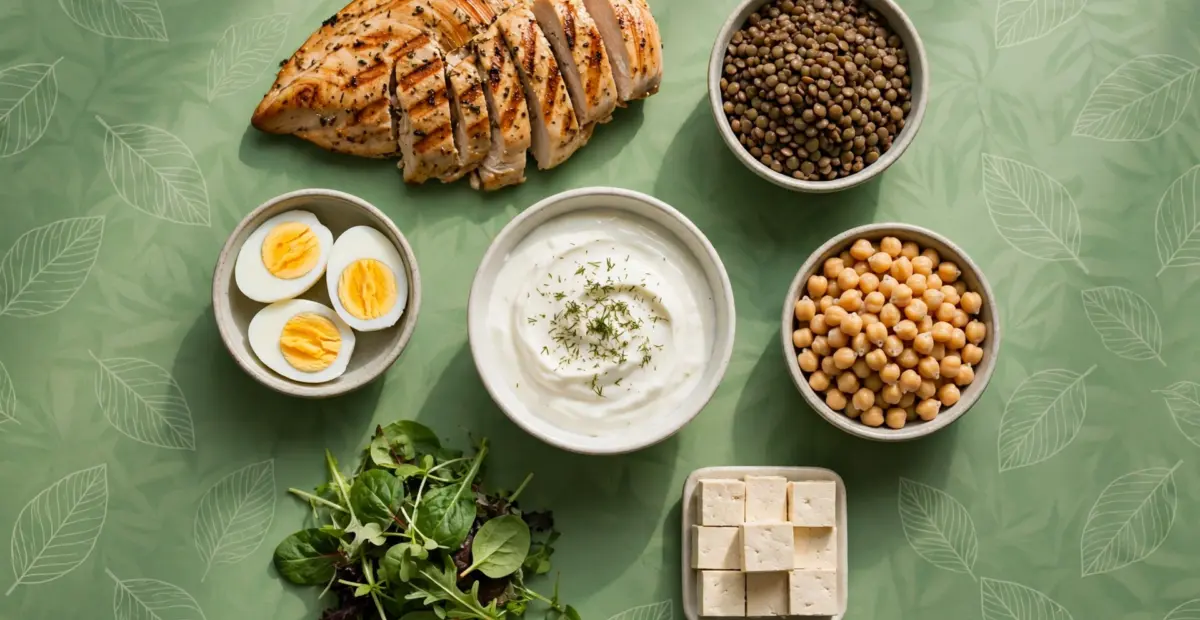
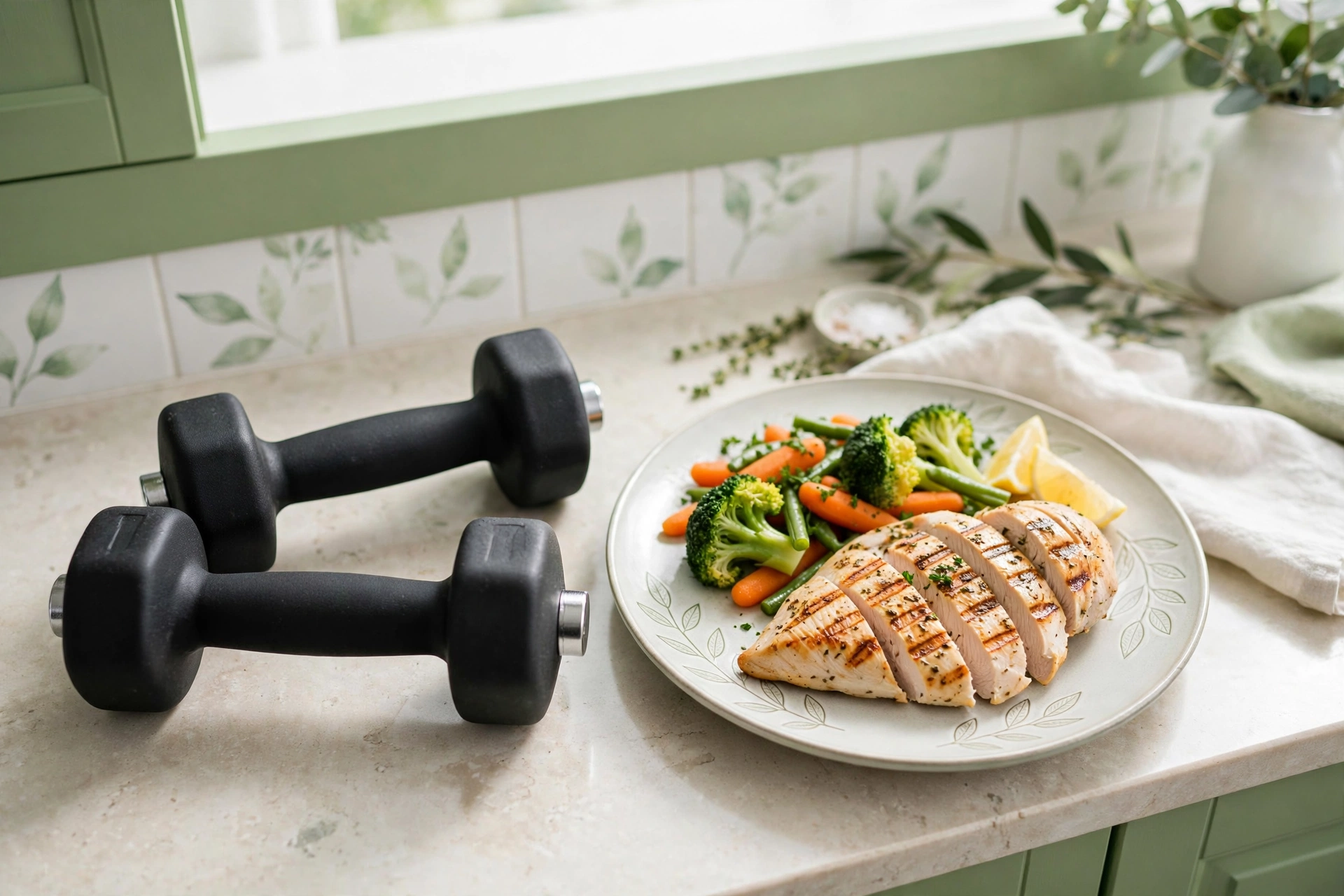
You don’t need a food scale to eat more protein — you need a repeatable system. The simplest one: anchor every meal with a palm-sized portion of protein first, then build vegetables and starch around it. A palm of chicken breast is roughly 30–35 grams of protein. Two eggs plus a spoon of Greek yogurt gets you close to 20. A cup of lentils gives you about 18.
A few principles that make it stick:
- Front-load the day. Most people eat almost no protein at breakfast (a pastry, a piece of fruit) and then try to cram 100 grams into dinner. Shifting 25–35 grams to breakfast — eggs, Greek yogurt, a tofu scramble — noticeably flattens mid-morning hunger.
- Spread it across 3–4 meals. Muscle protein synthesis responds best to repeated doses of 0.4–0.55 g/kg per meal, so four 30-gram meals beat one 120-gram dinner.
- Keep grab-and-go options. Canned tuna, boiled eggs, cottage cheese, roasted chickpeas, and edamame all travel well and prevent the 4 p.m. vending-machine raid.
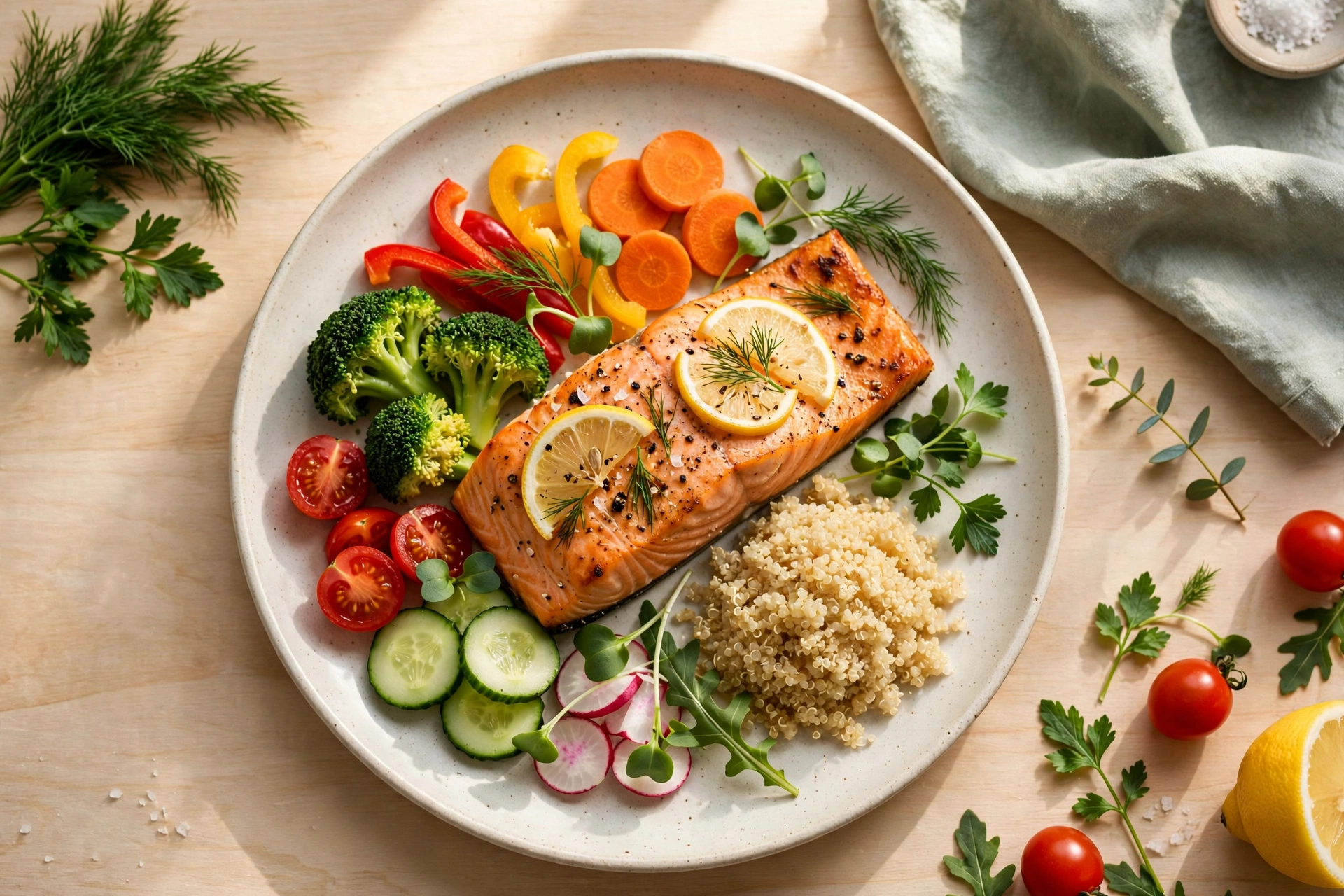
- Don’t fear the carbs you cut to make room. You’re not eliminating them — you’re letting protein lead. A bowl of rice is fine next to a solid serving of fish.
One caution: “more protein” is not a license to drown everything in cheese or to eat 200 grams a day if you’re sedentary. Aim for the 1.2–1.6 g/kg range, favor whole-food sources, and remember that people with kidney disease or certain metabolic conditions should check with their doctor before increasing protein — the safety data on high intakes applies to healthy people.
Frequently asked questions
Will eating more protein hurt my kidneys?
In healthy people, no — reviews of controlled trials have found no evidence that higher protein intakes damage healthy kidneys. The ISSN position stand is explicit on this point. The caveat is real, though: if you already have kidney disease, talk to your doctor before changing your protein intake.
Can I get enough protein on a plant-based diet?
Yes, with a little planning. Soy, lentils, chickpeas, beans, tofu, tempeh, and seitan are all strong sources. Aim for variety across the day and slightly larger portions than an omnivore would need, since plant proteins digest a touch less efficiently.
Do I need protein powder?
No — it’s a convenience tool, not a requirement. If you consistently fall short of your target with whole foods, a scoop of whey or pea protein (about 20–25 grams per scoop) is an easy fix. But whole foods bring fiber, micronutrients, and satiety that powder can’t match.
How fast should I expect to lose weight?
Protein helps, but it doesn’t override the fundamentals: a moderate calorie deficit plus enough protein plus resistance training. A steady loss of 0.5–1 kg per week is the range most guidelines consider sustainable. If the scale stalls for weeks despite honest consistency, that’s a sign to review portions, sleep, and stress — not to add more protein.
Sources
- Belza, A. et al. “Contribution of gastroenteropancreatic appetite hormones to protein-induced satiety.” American Journal of Clinical Nutrition (2013).
- Pesta, D. & Samuel, V. “Diet induced thermogenesis, older and newer data with emphasis on obesity and diabetes mellitus.” Nutrients (2024).
- Aragon, A. et al. “International society of sports nutrition position stand: diets and body composition.” Journal of the International Society of Sports Nutrition (2017).
This article is for general information and is not medical advice. Talk to a qualified health professional before making major changes to your diet, especially if you have a medical condition.