Low-Carb vs Low-Fat: What the Evidence Actually Says
Trial after trial shows the two approaches converge on the same result. The diet you can sustain is the one that works.
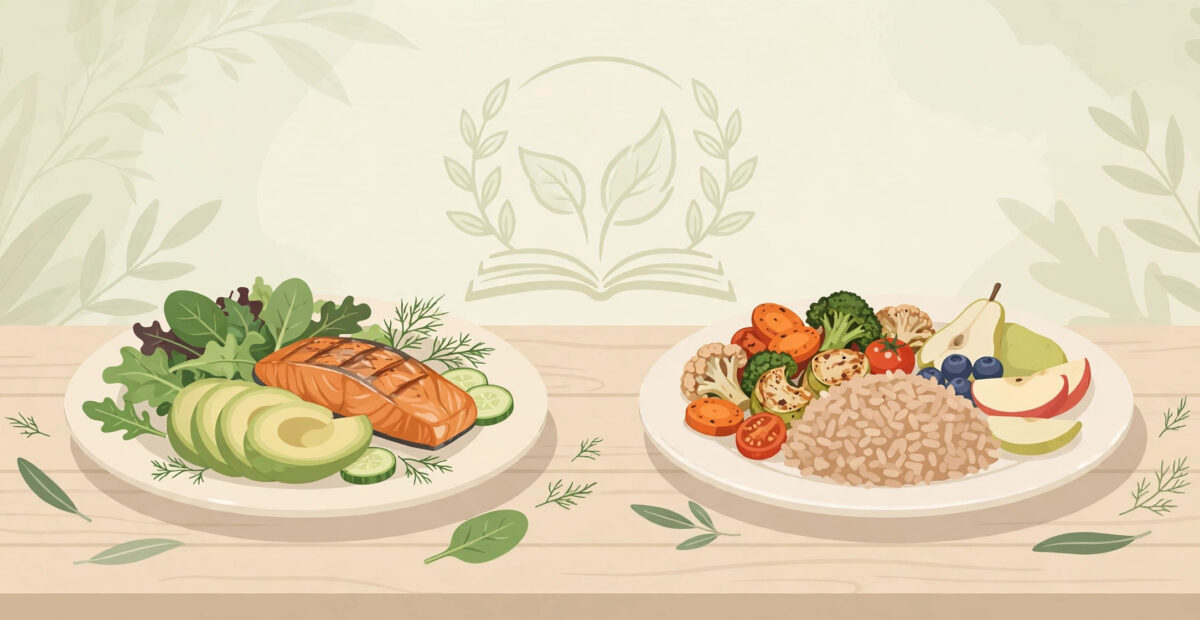
For thirty years, diet advice has been framed as a rivalry: cut the carbs, or cut the fat? Pick the wrong camp, the gurus warned, and you’d stay stuck.
Here’s what the research actually says, after some of the largest nutrition trials ever conducted: for weight loss, both approaches work, and the difference between them is remarkably small. What separates people who lose weight from people who don’t has far less to do with the carb-to-fat ratio on their plate than with something much less glamorous — whether they can stick with the plan.
First: what do “low-carb” and “low-fat” actually mean?
Part of the confusion is that neither term has a single definition. Studies use different cutoffs, which is one reason results vary.
Low-carb usually means roughly 26–45% of daily calories from carbohydrates, per the American Diabetes Association’s nutrition guidance. Very low-carb drops to about 26% or less — often just 20–50 grams of non-fiber carbs a day, the range used by ketogenic-style plans. Even so, a “low-carb” diet at 40% carbs on 2,000 calories still includes 200 grams of carbohydrate a day: a big bowl of rice plus fruit. The two diets overlap far more than the debate suggests.
Low-fat generally means less than 30% of daily calories from fat; very low-fat plans go down to around 10%.
What the biggest trials found on weight loss
If you only read one study, make it DIETFITS, published in JAMA in 2018. Stanford researchers assigned 609 adults with overweight to a healthy low-fat or healthy low-carbohydrate diet for 12 months. After a year, the low-fat group had lost an average of 5.3 kg and the low-carb group 6.0 kg — a 0.7-kg difference that was not statistically significant (95% CI, −0.2 to 1.6 kg). Neither participants’ genetic patterns nor their insulin secretion predicted which diet worked better.
DIETFITS isn’t alone. The POUNDS Lost trial, published in the New England Journal of Medicine, randomized 811 adults to four diets varying fat, protein, and carbohydrate over two years. Everyone lost roughly 6 kg in the first six months, ending around 3 kg down at two years — with no significant differences between the compositions. Follow-up analysis found that losses of body fat, abdominal fat, and liver fat depended on calorie intake, not the macronutrient mix.
Zoom out further and the picture holds. A network meta-analysis of 48 trials and 7,286 adults (Johnston et al., JAMA, 2014) found nearly identical weight loss at 12 months: 7.25 kg for low-carb versus 7.27 kg for low-fat. Another meta-analysis of randomized trials noted that average weight loss in 12-month trials was roughly 39–48% lower than in 6-month trials — and the low-carb edge shrank the longer trials ran. The Johnston authors’ conclusion was blunt: the differences between individual diets were small, and doctors should “recommend any diet that a patient will adhere to in order to lose weight.”

Why low-carb often looks faster at first
Low-carb diets often produce dramatic results in the first week or two — but that’s mostly water, not fat. Carbohydrates are stored in your muscles and liver as glycogen, and each gram of glycogen holds several grams of water. Cut carbs sharply and you flush that glycogen and its water too. The scale drops fast, which feels rewarding, but it isn’t fat loss.
Pooled trials show low-carb with a modest early advantage — about 1.1–1.3 kg over 6–12 months — but the gap narrows, and by 24 months the two approaches converge completely. An early sprint is not the same as winning the marathon.
Beyond the scale: cholesterol, blood pressure, and blood sugar
A 2022 meta-analysis of 33 randomized trials and nearly 4,000 adults compared low-carb diets (≤40% of energy from carbs) with low-fat diets (<30% of energy from fat) over 6 to 24 months. The two had genuinely different — and complementary — effects:
- Low-carb did better on: triglycerides (down an extra 0.14 mmol/L), HDL (“good”) cholesterol (up an extra 0.07 mmol/L), and diastolic blood pressure (down an extra 0.87 mmHg).
- Low-fat did better on: total cholesterol and LDL (“bad”) cholesterol, which fell an extra 0.14 and 0.10 mmol/L respectively.
- By 24 months, the differences between the two diets had disappeared on every measure.
One caution: if a low-carb diet is loaded with butter, fatty meats, and cheese, LDL cholesterol can rise in some people — this varies a lot between individuals. If you go low-carb, lean toward olive oil, nuts, avocado, and fish rather than treating bacon as a health food. And if you have diabetes or take glucose-lowering medication, cutting carbs can lower blood sugar fast enough to require medication adjustments — do it with your clinician, not alone.
The real deciding factor: which one can you actually live with?
Here’s the finding that shows up everywhere once you look: adherence beats composition. In a secondary analysis of DIETFITS, the biggest losers weren’t distinguished by which diet they’d been assigned — they were the ones who actually stuck to it and improved their overall diet quality.
As obesity researcher Deirdre Tobias put it after a major analysis in The Lancet Diabetes & Endocrinology: “Long-term adherence is critical for the success of any dietary intervention.” Both diets work when people follow them, and both fail when people don’t.
Diet quality matters within either pattern. A low-carb diet of steak and cheese is not the same as one of salmon, avocado, and leafy greens. A low-fat diet of white rice and sugary cereal is not the same as one of lentils, fruit, and vegetables. The trials with the smallest differences — like DIETFITS — told both groups to eat whole, minimally processed foods.
Read also: Protein, Satiety and Sustainable Weight Loss
An honest pros-and-cons list
Low-carb tends to suit you if:
- You find protein- and fat-rich meals more filling, and steady hunger is your biggest obstacle.
- Your triglycerides are high or your blood sugar runs high — cutting carbs often improves both.
- You enjoy meat, eggs, fish, nuts, and vegetables, and you won’t miss bread and rice much.
Watch out for: constipation and low fiber intake, the restrictive feeling of skipping whole food groups, and a possible rise in LDL cholesterol — worth checking with a blood test a few months in.
Low-fat tends to suit you if:
- You love fruit, grains, beans, and starchy vegetables and want to keep them central.
- Your LDL cholesterol is a concern — low-fat diets lower it more reliably.
Watch out for: hunger between meals if protein drops too low, and the classic trap of replacing fat with refined carbs — fat-free cookies are still cookies.
How to choose for yourself
Forget picking the “scientifically superior” diet — for weight loss, the science says there isn’t one. Instead, ask three practical questions:
1. Which foods would you genuinely miss? If giving up bread feels like a bereavement, strict low-carb will make you miserable within weeks. If dry chicken breast and endless salads depress you, low-fat won’t last either. The best diet is the one that doesn’t feel like a punishment you can endure only until the next birthday party.
2. What does your health profile need most? High LDL cholesterol leans toward lower-fat, fiber-rich eating. High triglycerides or prediabetes lean toward moderating carbs. These aren’t rules — they’re starting hypotheses to discuss with a clinician or dietitian.
3. Can you picture yourself eating this way in two years? Not two weeks — two years. The people who kept weight off in every long-term trial are the ones whose “diet” quietly became just how they eat. Try an approach for a month, honestly, and notice your energy, hunger, mood, and lab numbers — then decide.
And remember: you don’t have to choose an extreme. A middle path — adequate protein, plenty of fiber, mostly whole foods, moderate carbs and fats — captures most of the benefits of both camps. The ratio is a detail. The foundation is quality, quantity, and consistency.
Frequently asked questions
Which diet loses weight faster — low-carb or low-fat?
Low-carb often produces faster results in the first few weeks, largely from water loss as glycogen stores empty. Over 6–12 months, pooled trials show only about a 1-kg advantage, and by 24 months the two converge completely. Speed in week one predicts little about year one.
Is a low-carb diet bad for your heart?
It depends on what replaces the carbs. In trials, low-carb diets improved triglycerides and HDL cholesterol but were less effective at lowering LDL cholesterol than low-fat diets — and very-low-carb diets rich in saturated fat can raise LDL in some individuals. Choosing unsaturated fats (olive oil, nuts, fish) and checking your lipid panel after a few months is the sensible middle ground.
Can I combine the two approaches?
Absolutely. A diet that’s moderately lower in refined carbs, moderate in healthy fats, and higher in protein and fiber captures most of the benefits of both camps without the strictness of either. The evidence supports the pattern you can maintain, not the label on it.
The bottom line
After decades of trials, the low-carb vs low-fat question has a refreshingly boring answer: both can work, neither is magic, and the winner is whichever one fits your body, your health needs, and your actual life. Put your energy into food quality, a sensible calorie level, enough protein and fiber — and a plan you won’t abandon by March.
Disclaimer: This article is for general information only and is not medical advice. If you have diabetes, heart disease, kidney disease, or take medication affected by diet changes, talk to your clinician or a registered dietitian before making major changes to how you eat.
Sources
- Gardner CD et al. Effect of Low-Fat vs Low-Carbohydrate Diet on 12-Month Weight Loss in Overweight Adults and the Association With Genotype Pattern or Insulin Secretion: The DIETFITS Randomized Clinical Trial. JAMA. 2018. jamanetwork.com
- Champagne CM et al. Effects of 4 weight-loss diets differing in fat, protein, and carbohydrate on fat mass, lean mass, visceral adipose tissue, and hepatic fat: results from the POUNDS LOST trial. Am J Clin Nutr. 2011. PMC3278241
- Mansoor N et al. Dietary Intervention for Overweight and Obese Adults: Comparison of Low-Carbohydrate and Low-Fat Diets. A Meta-Analysis. PLoS ONE. 2016. PMC4618935
- Li H et al. Effects of low-carbohydrate diets versus low-fat diets on metabolic risk factors in overweight and obese adults: A meta-analysis of randomized controlled trials. Front Nutr. 2022. frontiersin.org
- Tobias DK et al. Effect of low-fat diet interventions versus other diet interventions on long-term weight change in adults: a systematic review and meta-analysis. Lancet Diabetes Endocrinol. 2015 (summary: healio.com)