Nutrient Density, Explained With Food Examples
You have probably heard a food described as “nutrient-dense” and wondered what that actually means. Is it just a fancier way of saying healthy? Not quite. Nutrient density is a measurable idea: how much nutrition a food delivers for the calories it costs you. Once you understand it, grocery shopping gets simpler, because you can spot the foods that give you the most for your calorie budget — and the ones that give you the least.
Think of your daily calories as a budget. You can spend 200 calories on a food that brings fiber, potassium, vitamin C, and folate along for the ride, or 200 calories on something that brings almost nothing but sugar and salt. Only one of them helps you meet your nutrient needs.
What nutrient density actually means
Nutrient density is the amount of beneficial nutrients a food provides relative to its energy content. Researchers usually express it per 100 kilocalories, per 100 grams, or per serving. A food earns the label “nutrient-dense” when it supplies a substantial amount of vitamins, minerals, fiber, and protein for relatively few calories — and brings little added sugar, saturated fat, or sodium with it.
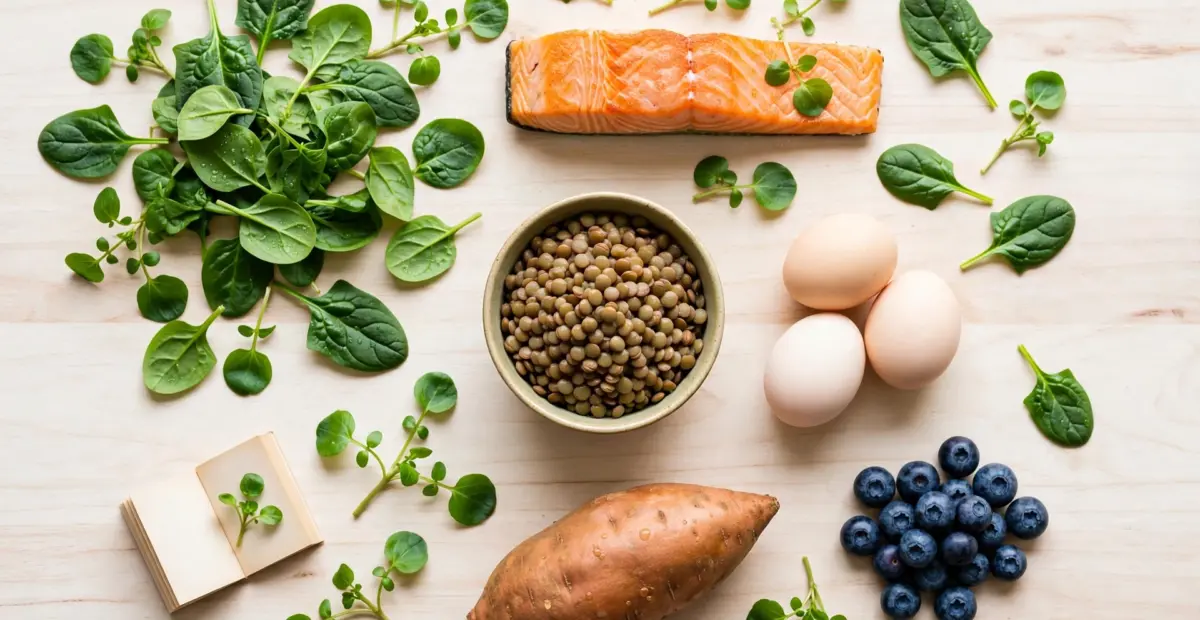
The current Dietary Guidelines for Americans describe nutrient-dense foods in much the same way: foods that provide vitamins, minerals, fiber, protein, and other beneficial nutrients while containing relatively low amounts of added sugars, saturated fat, and sodium. Most vegetables, fruits, whole grains, seafood, eggs, beans and peas, unsalted nuts and seeds, fat-free and low-fat dairy, and lean meats and poultry count as nutrient-dense when they are prepared with little or no added solid fat, sugar, or salt.
Notice what the definition does not do. It does not rank foods as good or bad. A food can be low in nutrient density and still have a place in your diet — a drizzle of olive oil, for instance, is almost pure fat and scores poorly on nutrients per calorie, yet it is a useful source of unsaturated fat. Density is a tool for comparing foods, not a verdict on them.
Read also: How to Build a Balanced Plate
Nutrient density is not the same as energy density
People mix these two terms up all the time, and the difference matters. Energy density is calories per gram of food. Nutrient density is nutrients per calorie. A food can be high in one and low in the other.
Water is the main reason. Foods with a lot of water — fresh vegetables, fruit, soups, cooked grains — tend to be low in energy density, so a satisfying portion costs few calories. Foods with little water and a lot of fat — nuts, oils, cheese, chocolate — are high in energy density. That does not make nuts a poor choice: a small handful of walnuts is energy-dense but also delivers unsaturated fats, fiber, and magnesium. The question is always what you get for the calories, not just how many there are.
How scientists actually score it
Because “nutritious” is vague, researchers have built scoring systems that put numbers on the idea. The best known is the Nutrient Rich Foods (NRF) index, developed by Adam Drewnowski and colleagues. Its most widely used version, NRF9.3, balances nine nutrients to encourage — protein, fiber, vitamins A, C, and E, calcium, iron, potassium, and magnesium — against three nutrients to limit: saturated fat, added sugar, and sodium. Each nutrient is counted as a percentage of its daily value per 100 kilocalories, and the “limit” nutrients are subtracted from the “encourage” nutrients. In validation studies, higher NRF9.3 scores lined up with lower energy density and more nutrient-rich diets overall.
A second, more famous ranking took a different approach. In 2014, researcher Jennifer Di Noia published a study in Preventing Chronic Disease, a journal of the Centers for Disease Control and Prevention, that scored 47 fruits and vegetables on 17 nutrients of public health importance — including potassium, fiber, protein, calcium, iron, folate, zinc, and vitamins A, B6, B12, C, D, E, and K — measured per 100 kilocalories. Foods providing, on average, at least 10% of the daily value per 100 kilocalories earned the label “powerhouse.” Forty-one of the 47 foods made the cut.
Both systems have limits, and their authors say so openly. They count vitamins and minerals, not phytochemicals or other bioactive compounds, and they use raw foods, so cooking is not factored in. No single score can capture everything about a food — but as a guide to which foods pack the most nutrition per calorie, they are genuinely useful.
The highest-scoring foods, with real numbers
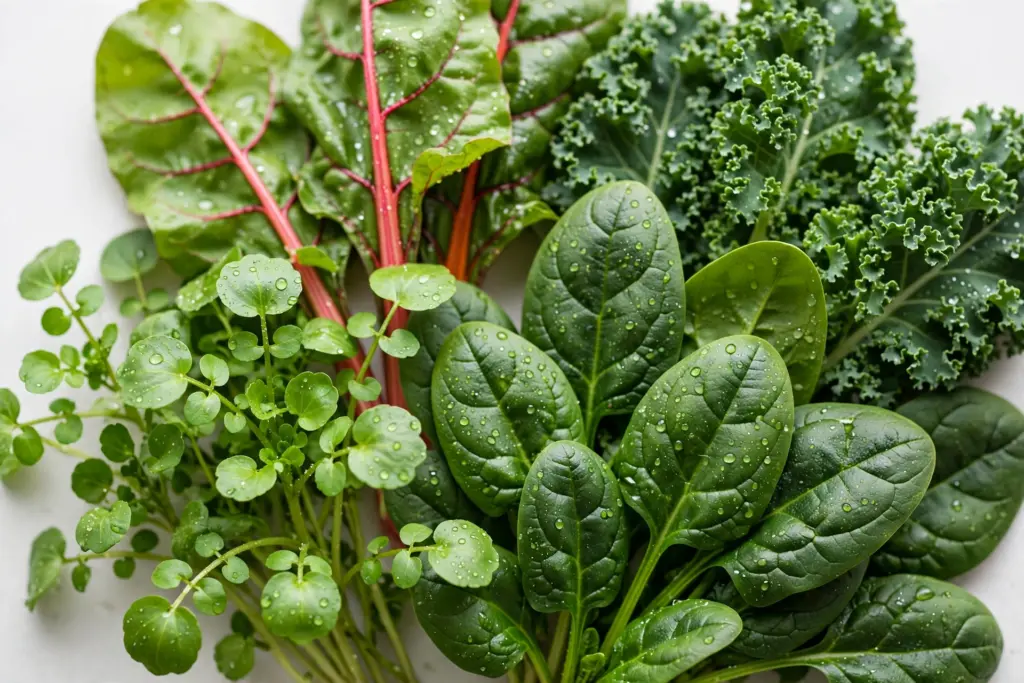
The CDC powerhouse ranking produced a few surprises. Watercress came first with a perfect score of 100 — scores were capped at 100, meaning it provides, on average, 100% of the daily value of the 17 qualifying nutrients per 100 kilocalories. Chinese cabbage followed at 91.99, then chard at 89.27, beet greens at 87.08, and spinach at 86.43. Kale, the vegetable most people would guess at the top, ranked 15th with a score of 49.07 — still firmly in powerhouse territory, just not at the summit.
The pattern at the top is hard to miss: cruciferous and green leafy vegetables dominate. Watercress, Chinese cabbage, collard greens, kale, and arugula clustered in the upper half, along with chard, beet greens, spinach, chicory, and leaf lettuce. Yellow and orange vegetables, citrus fruit, and berries landed lower — still powerhouse foods, but with less nutrition packed into each 100 kilocalories.
It is also worth noting which foods did not qualify at all. Of the 47 foods studied, six missed the powerhouse threshold: raspberry, tangerine, cranberry, garlic, onion, and blueberry. That does not make them poor foods — blueberries, for example, are rich in anthocyanins, compounds the scoring system simply does not count. A score measures what it measures, and nothing more.
Here is what the top of the ranking looks like in practice:
- Watercress — 100.00. Peppery, delicate, and almost calorie-free. Toss it into salads or wilt it into soups.
- Chinese cabbage — 91.99. Mild and crunchy. It works raw in slaw and cooked in stir-fries.
- Chard — 89.27. Earthy leaves with colorful stems. Sauté with garlic and olive oil.
- Beet greens — 87.08. The leaves sold with beets, often thrown away. Cook them like spinach.
- Spinach — 86.43. The most practical powerhouse of all: cheap, mild, and easy to add to almost anything.
- Kale — 49.07. Sturdier than spinach, with more fiber per bite. Massage raw leaves with a little oil to soften them.
Read also: How to Add More Vegetables to Your Meals
Nutrient-dense foods beyond the produce aisle
Leafy greens win the per-calorie contest because they are mostly water and fiber. But nutrient density is not only a vegetable story — foods from every food group can score well, and a balanced diet needs them all.
Beans and lentils. Cooked lentils deliver about 9 grams of protein and 7.9 grams of fiber for just 116 kilocalories per 100 grams, according to USDA FoodData Central — plus folate and iron. That combination of protein and fiber is why a lentil soup keeps you full for hours while a bowl of white rice with butter does not.
Eggs. One large egg has about 6 grams of protein for roughly 70 kilocalories, along with choline, vitamin B12, vitamin D, and selenium. Few foods deliver that much nutrition in such a small calorie package, which is why eggs show up in nearly every nutrient-density ranking.
Fish and seafood. Salmon, sardines, and other oily fish bring protein, vitamin D, vitamin B12, selenium, and long-chain omega-3 fats in a modest calorie count. The American Heart Association suggests eating fish at least twice a week, in portions of about 3.5 ounces each.
Dairy and whole grains. Plain Greek yogurt and milk offer protein, calcium, potassium, and B vitamins — a cup of milk provides roughly 300 milligrams of calcium for around 100 to 150 kilocalories. Oats, brown rice, and whole-wheat bread carry fiber and B vitamins that refined grains lose in processing; the 2025–2030 Dietary Guidelines recommend 2 to 4 servings of whole grains a day.
Nuts and seeds. These are the exception that proves the rule about energy density. Almonds, walnuts, pumpkin seeds, and chia seeds are calorie-dense, but they are also rich in unsaturated fats, fiber, magnesium, and vitamin E. The trick is portion: a small handful, not a whole bag.
What about low-density foods?
Foods on the low end of the scale — soda, candy, chips, pastries, sugary cereals — are often called “empty calories,” and the phrase is fair: they supply energy with very few of the nutrients your body needs. A 200-calorie soda delivers sugar and nothing else. A 200-calorie serving of berries delivers fiber, vitamin C, and potassium for the same energy.
That does not mean low-density foods are forbidden. A birthday cake is not a nutrition decision; it is a celebration. The practical question is proportion. When low-density foods crowd out nutrient-dense ones day after day, it becomes hard to meet your vitamin and mineral needs without overshooting your calorie needs. The World Health Organization’s healthy-diet guidance points the same way: at least 400 grams of fruit and vegetables a day, free sugars below 10% of energy, and salt below 5 grams a day.
How to build a more nutrient-dense day
You do not need a scoring app or a spreadsheet. Five small habits do most of the work.
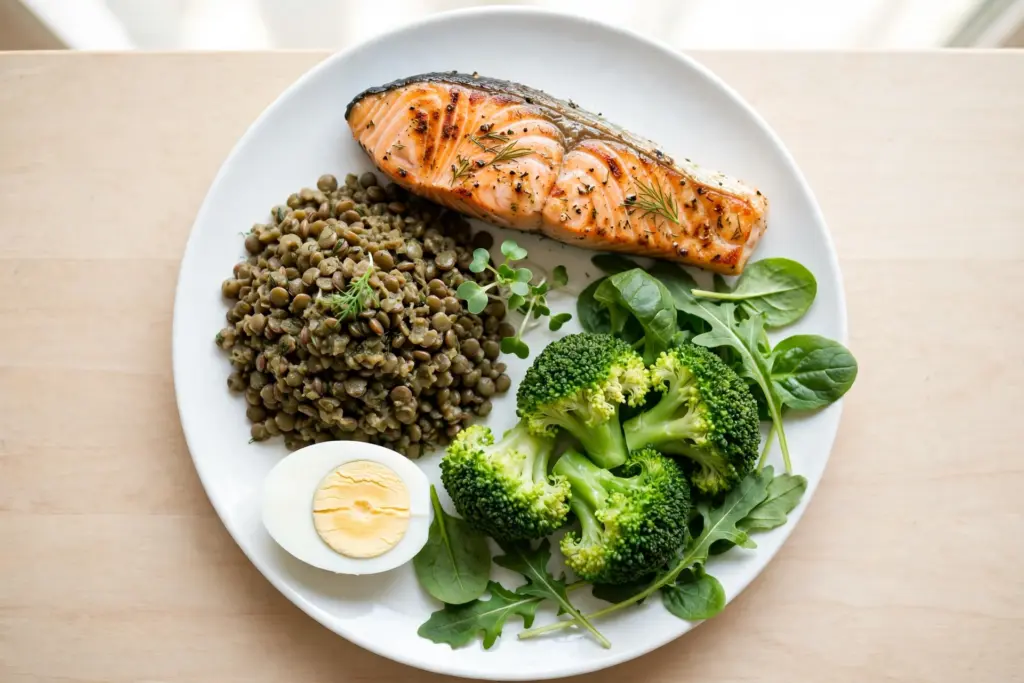
1. Start with the plate, not the calories. Fill half your plate with vegetables and fruit, a quarter with protein, and a quarter with whole grains. The classic plate method — half vegetables and fruit, a quarter whole grains, a quarter protein — remains nutritionally sound, and it automatically raises the density of the meal.
2. Swap, don’t subtract. Trade white rice for brown rice, a sugary cereal for oats with berries, or a bag of chips for a handful of nuts and an apple. Each swap keeps the meal satisfying while adding fiber, vitamins, or minerals.
3. Add a green to every meal. Spinach wilts into pasta, soup, eggs, and smoothies without changing the flavor much. A handful of leafy greens is one of the cheapest nutrient-density upgrades available.
4. Choose the whole food over the processed version. Whole fruit beats juice, because the fiber stays in. Plain yogurt with fresh fruit beats a flavored yogurt with added sugar. The less processing, the more of the original nutrients survive.
5. Keep a few high-density staples on hand. Canned beans, lentils, frozen vegetables, eggs, oats, and canned sardines are inexpensive, keep well, and are all nutrient-dense.
Read also: How to Add Fiber to Your Diet
Frequently asked questions
Is nutrient density the same as healthy?
Not exactly. Nutrient density is one measurable part of how healthy a food is — nutrients per calorie. A food can be nutrient-dense but high in sodium, or low in density but useful in small amounts, like olive oil. Think of density as a lens, not the whole picture.
Which food is the most nutrient-dense?
By the CDC’s powerhouse scoring, watercress tops the list with a perfect score of 100, followed by Chinese cabbage, chard, beet greens, and spinach. Among foods beyond vegetables, liver, sardines, eggs, and lentils are frequently cited as exceptionally dense — though rankings differ depending on which nutrients a system counts.
Can a high-calorie food still be nutrient-dense?
Yes. Nuts, seeds, avocado, and oily fish are all relatively high in calories and high in nutrient density. The calories come with unsaturated fats, fiber, and minerals attached. What matters is what the calories bring with them.
Do I need to count nutrient density scores to eat well?
No. The scores are a research tool, not a daily requirement. The practical version is simple: eat mostly whole foods, fill half your plate with vegetables and fruit, choose whole grains, and keep added sugars, salt, and highly processed foods to a smaller share of your day. If you do that, your diet will be nutrient-dense whether or not you ever see a score.
Disclaimer: This article is for general information only and is not medical advice. If you have a medical condition or specific dietary needs, talk to your doctor or a registered dietitian before making major changes to your diet.
Sources
- Drewnowski A, Fulgoni VL 3rd. Nutrient density: principles and evaluation tools. American Journal of Clinical Nutrition, 2014.
- Drewnowski A, Dwyer J, King JC, Weaver CM. A proposed nutrient density score that includes food groups and nutrients to better align with dietary guidance. Nutrition Reviews, 2019.
- Di Noia J. Defining Powerhouse Fruits and Vegetables: A Nutrient Density Approach. Preventing Chronic Disease, 2014.
- U.S. Department of Agriculture. FoodData Central — nutrient values for cooked lentils, eggs, and milk.
- American Family Physician. Dietary Guidelines for 2025–2030: Recommendations From the USDA and HHS, 2026.
- World Health Organization. Healthy diet fact sheet.