Balanced Meals Without Counting Calories
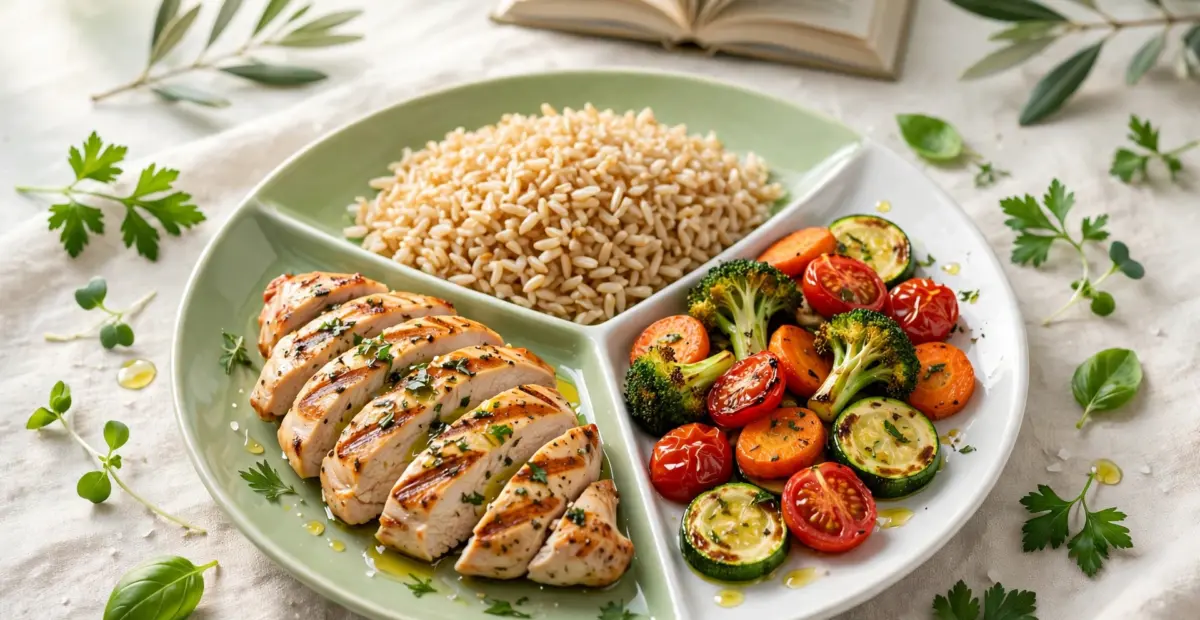
You do not need a calculator at the dinner table to eat well. Calorie counting works for some people, and for plenty of others it turns every meal into homework — a running tally in the back of the mind that makes food feel like a maths problem instead of something to enjoy. There is another way to build a balanced meal, and it does not require a single number: a plate built from the right food groups, portions guided by your own hand and your own hunger, and a few habits that keep the whole thing on track without tracking.
This approach is not about ignoring what you eat. It is about shifting your attention from the numbers on a label to the foods on your plate. When the plate itself is balanced, the calories tend to take care of themselves.
Start with the plate, not the numbers
The simplest framework for a balanced meal is the plate method, the classic approach that divides your plate into sections rather than counting grams or calories. Picture an ordinary dinner plate and fill it like this:
- Half the plate: vegetables and fruit. This is the biggest section, and it does the most work. Vegetables and fruit add volume, fibre, and a wide spread of vitamins and minerals for relatively little energy, which is exactly what makes a meal satisfying without being heavy. The World Health Organization recommends at least 400 grams of fruits and vegetables a day — roughly five portions — and a plate that is half produce gets you most of the way there in a single meal.
- A quarter of the plate: protein. Chicken, fish, eggs, tofu, tempeh, beans, or lentils — pick one or combine two. Protein is the nutrient most strongly linked to feeling full after a meal, which is why a salad with no protein rarely holds you until dinner, while the same salad with chickpeas or grilled chicken does.
- A quarter of the plate: whole grains or starchy foods. Brown rice, whole-wheat bread, oats, quinoa, sweet potato, or corn. These provide steady energy and, when you choose whole-grain versions, fibre that slows digestion and keeps you fuller for longer.
- A little healthy fat on top. A drizzle of olive oil, a handful of nuts, some avocado, or a spoonful of tahini. Fat carries flavour and helps your body absorb certain vitamins, so a small amount is part of a balanced meal, not an indulgence to feel guilty about.
Notice what this framework does not ask of you: no weighing, no app, no arithmetic. You can apply it at home, at a restaurant, or at a family gathering, because all it needs is your eyes.
Use your hand as the measuring tool
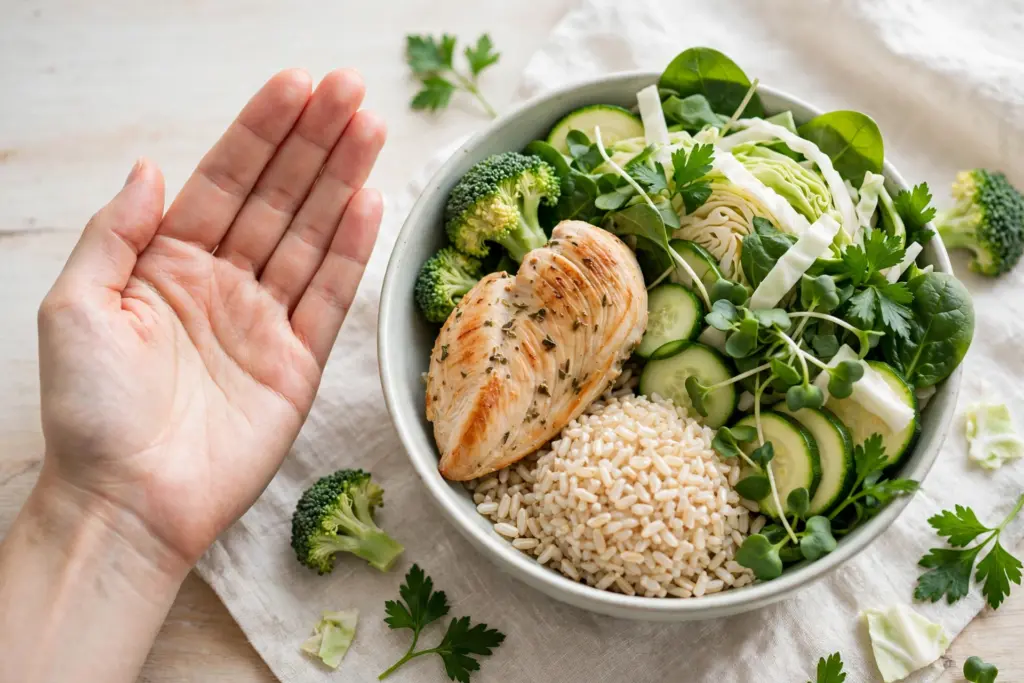
Plates and bowls come in wildly different sizes, so the plate method works best when you pair it with a rough sense of portion — and your hand is a surprisingly good guide, because it scales with your body.
- Your palm — about the right amount of protein for one meal.
- Your fist — roughly a serving of grains or starchy foods.
- Two open handfuls — a good target for vegetables.
- Your thumb — about a serving of oils, butter, or nut butter.
These are starting points, not rules carved in stone. A teenager training five days a week needs more than someone working at a desk, and that is fine — the hand guide flexes with appetite and activity in a way a fixed calorie target never does. If you are still hungry after a balanced plate, eat more vegetables first, then more protein. That simple order of operations solves most “am I still hungry?” moments without a second thought about numbers.
Read also: Why Calorie Counting Fails (and What to Track Instead)
Let hunger and fullness do the counting
Your body already has a calorie-tracking system built in: hunger and fullness signals. The trouble is that modern eating habits — eating quickly, eating while distracted, eating straight from the packet — tend to drown those signals out. Rebuilding the habit of listening to them is a skill, and like any skill it gets easier with practice.
A practical way to start is the hunger scale. Before you eat, pause and ask: how hungry am I, from 1 (not hungry at all) to 10 (ravenous)? Most people eat best when they start around a 3 or 4 — genuinely hungry, but not so hungry that they eat anything in sight. Halfway through the meal, pause again. Fullness arrives with a delay, often 15 to 20 minutes after you start eating, so eating slowly and putting your fork down between bites gives the signal time to catch up.
Research on intuitive eating — eating guided by internal hunger and fullness cues rather than external rules — has found it associated with healthier self-reported food intake, including more frequent fruit and vegetable consumption. It is not magic, and it is not an excuse to eat without thought. It is a feedback loop: eat when hungry, stop when comfortably full, and notice which meals actually keep you satisfied. Over weeks, that loop teaches you more about your own eating than any spreadsheet could.
A few habits make the signals easier to hear:
- Eat sitting down, without a screen. Distracted eating is consistently linked to eating more and feeling less satisfied afterwards.
- Serve your food on a plate rather than eating from the container. Seeing the whole portion helps your brain register it.
- Slow down on purpose. Chew properly, take a sip of water between bites, and give the meal at least 15 minutes.
Build meals around fibre and protein
If there is one quiet trick to balanced eating without counting, it is this: make fibre and protein the backbone of every meal, and let the rest fall into place. Both nutrients slow digestion and stretch out fullness, which is why a bowl of oats with nuts keeps you going until lunch while a pastry leaves you hunting for a snack by 10 a.m.
Fibre is the one most people fall short on. The World Health Organization recommends at least 25 grams of naturally occurring dietary fibre a day for adults, and US guidance puts the figure at about 25 grams a day for women and 38 grams for men under 50. Most adults eat far less — roughly 15 grams a day on average. You do not need to count your grams to close that gap. Just make sure most meals include at least one clearly fibrous food: vegetables, beans, lentils, whole grains, fruit with its skin on, nuts, or seeds.
Protein works the same way. Research on satiety shows that protein reliably increases feelings of fullness in the hours after a meal, and meals built around a solid protein source tend to keep people satisfied longer than meals built around refined carbohydrates alone. You do not need a target number — just make protein a deliberate part of every meal rather than an afterthought. Eggs or Greek yogurt at breakfast, beans or chicken at lunch, fish or tofu at dinner, and you are covered.
Read also: Small Diet Changes That Last
Make the balanced choice the easy choice
Willpower is a poor meal plan. The people who eat well without counting calories usually are not resisting temptation all day — they have set up their kitchens and routines so the balanced option is the one within reach.
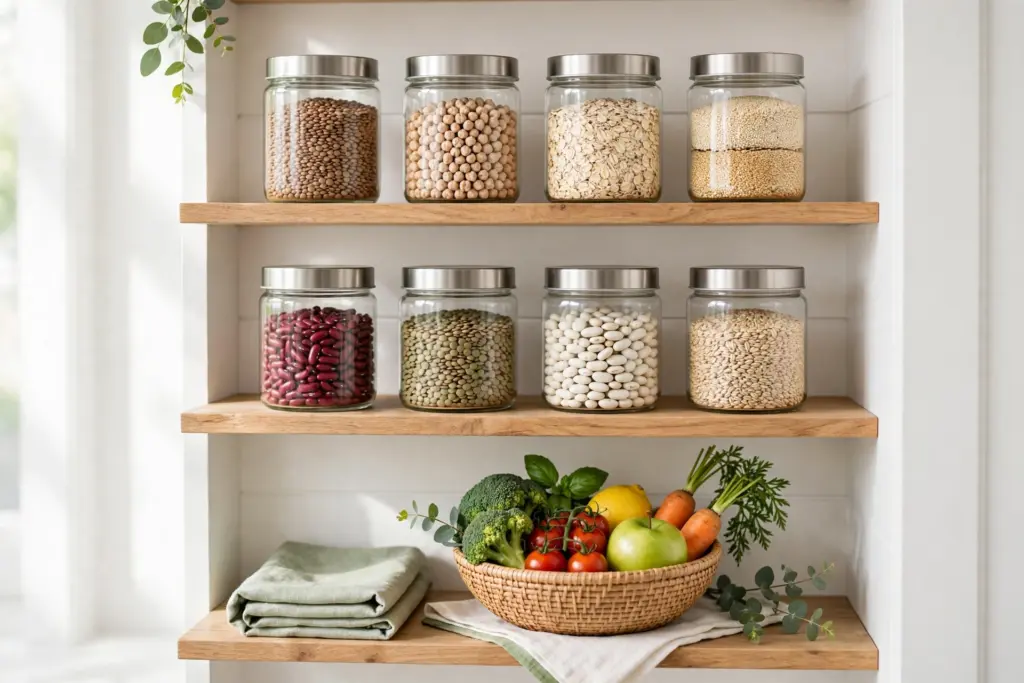
- Keep vegetables visible and ready. Washed salad leaves, cut carrots, cherry tomatoes, and fruit in a bowl on the counter get eaten; vegetables buried in a drawer do not.
- Stock the building blocks. A pantry with beans, lentils, oats, whole grains, canned tomatoes, and olive oil means a balanced meal is always 20 minutes away, even on a night when cooking feels like too much.
- Prep one thing, not everything. Cooking a batch of brown rice or roasting a tray of vegetables on Sunday covers the base of several meals through the week, and that single step removes most weeknight guesswork.
- Plan the rough shape of the week, not every detail. Knowing roughly what is for dinner on Tuesday beats deciding at 6 p.m. when you are already hungry, which is when takeaway apps tend to win.
These are environmental fixes, not diet rules. They work precisely because they do not require daily effort or daily maths.
What about the foods that throw the balance off?
Skipping calorie counts does not mean anything goes. Some foods are designed to be easy to overeat: highly processed snacks, sugary drinks, and large portions of fried food deliver a lot of energy with very little fibre, protein, or volume, so they bypass your fullness signals. The World Health Organization recommends keeping free sugars below 10% of daily energy — ideally below 5% — and salt below 5 grams a day, roughly a teaspoon.
You do not need to ban these foods or count their sugar grams. A simpler filter works: how often, and how much? A sugary drink every day is a habit; one at a weekend gathering is an occasion. A small bowl of chips shared with friends is different from a large bag eaten alone in front of the television. Frequency and portion are the levers, and both are visible without a single number.
And when a meal goes off-script — a birthday dinner, a holiday feast, a stressful day that ends in takeaway — that is not a failure to correct. It is one meal among hundreds. The pattern across the week is what shapes your health, not any single plate.
Read also: Healthy Eating Habits for Beginners
A week of balanced meals, no counting required
Here is what this looks like in practice — not a meal plan to follow exactly, but a sketch of how the plate method plays out across a few ordinary days:
- Monday: Oats cooked with milk, topped with berries and a spoonful of peanut butter — protein, whole grains, and fruit in one bowl.
- Tuesday: A grain bowl — brown rice, roasted sweet potato and broccoli, chickpeas, and a drizzle of tahini.
- Thursday: Lentil soup with whole-grain bread and a side salad. Lentils bring both protein and fibre in a single ingredient.
- Friday: Grilled fish or tofu, a fist-sized portion of quinoa, and a big pile of roasted vegetables with olive oil.
None of these meals required a scale, an app, or a calculator. Each one covers the food groups, leans on fibre and protein, and leaves room for hunger and fullness to do their job.
The bottom line
Balanced eating without counting calories is not a looser version of a diet — it is a different skill entirely. Build the plate from the food groups, use your hand for portions, let hunger and fullness guide how much, anchor meals with fibre and protein, and set up your kitchen so the balanced choice is the easy one. The numbers, for the most part, sort themselves out.
If you have tried counting and found it exhausting, unsustainable, or simply joyless, this approach is worth a genuine try — not for a week, but long enough for the habits to settle. Give your body’s own signals a chance to be heard, and you may find they were keeping count all along.
Frequently asked questions
Can I really eat a balanced diet without counting calories?
Yes — for most people, yes. When meals are built from vegetables, protein, whole grains, and healthy fats, and portions follow hunger and fullness cues, energy intake tends to self-regulate. Calorie counting can still be useful as a short-term learning tool, but it is not a requirement for healthy eating.
How do I know if I am eating enough without tracking?
Steady energy through the day, comfortable fullness after meals without constant hunger between them, and stable weight over months are the practical signs. If you are frequently exhausted, constantly hungry, or losing weight without trying, that is worth discussing with a clinician or dietitian.
What if I am still hungry after a balanced plate?
Eat more — starting with vegetables, then protein. Persistent hunger after balanced meals can also mean you ate too quickly for fullness signals to register, so slowing down and waiting 15 minutes before a second helping often resolves it.
Does this approach work for weight management?
It can. Meals rich in fibre and protein with plenty of vegetables tend to be more filling per bite, which helps many people naturally eat less overall. But weight is influenced by sleep, stress, activity, and medical factors too, so if weight is a specific concern, personalised advice from a clinician or registered dietitian is the right next step.
Sources
- World Health Organization — Healthy diet: at least 400 g of fruits and vegetables per day, at least 25 g of naturally occurring dietary fibre, free sugars below 10% of energy, salt below 5 g per day, total fat below 30% of energy.
- World Health Organization — Nutrition for a healthy life: the same core recommendations, including the 400 g produce target and the 5 g salt limit.
- Mayo Clinic — How much fiber do you need?: general fiber guidance of 25 grams a day for women and 38 grams for men.
- Learning to eat intuitively: a qualitative exploration of the experience of mid-age women (Journal of Health Psychology, via PMC): eating in response to hunger and satiety signals and the practical barriers to doing so.
Disclaimer: This article is for general information only and is not medical advice. If you have a medical condition, dietary restriction, or specific nutrition concern, speak with a qualified clinician or registered dietitian.