Quinoa vs. Rice: How They Compare
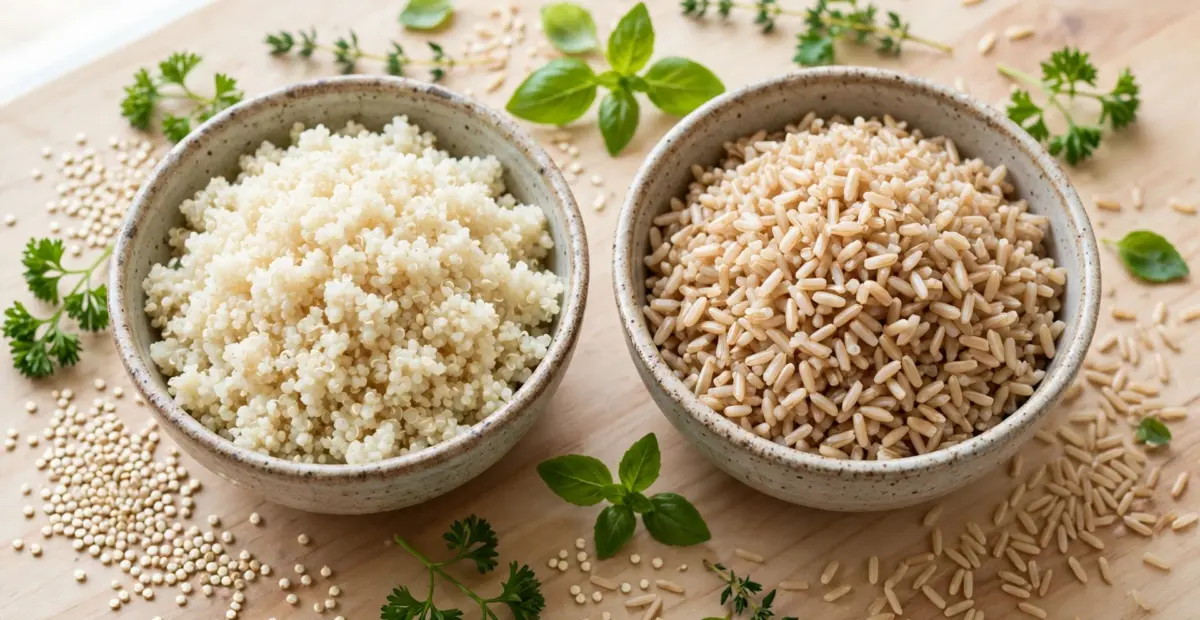
Quinoa and rice sit side by side on supermarket shelves and answer the same weeknight question: what goes under the stir-fry? Yet they are not close cousins. Quinoa is a seed from a South American plant, cooked and eaten like a grain. Rice is a true cereal grain, and the white and brown versions on the shelf are the same plant processed differently. Those differences show up on the nutrition label, in how full you feel after eating, and in how quickly your blood sugar rises.
Neither food is a villain, and neither is a miracle. Both can anchor a balanced meal. The honest comparison is about trade-offs: quinoa brings more protein, fiber, and magnesium per bite; rice — especially brown rice — costs less and works in dishes where quinoa would feel out of place. Here is what the numbers actually say, so you can pick the right one for the meal in front of you.
First, What Are We Actually Comparing?
Quinoa (Chenopodium quinoa) is a pseudocereal: a seed that behaves like a grain in the kitchen. It comes in white, red, and black varieties with a mild, slightly nutty flavor and a tiny white “tail” — the germ — that curls out as it cooks.
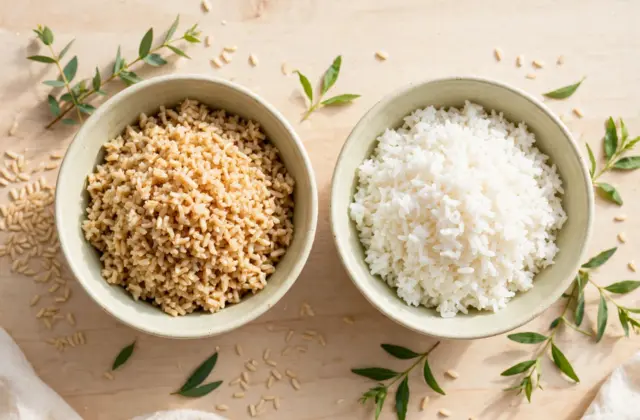
Rice, meanwhile, is the seed of a grass, and the version you buy depends on how much of the grain survives milling. Brown rice keeps its bran and germ, so it counts as a whole grain. White rice has the bran and germ milled away, leaving mostly the starchy endosperm; in the United States it is usually enriched with iron and B vitamins to replace some of what milling removed. So a fair comparison has three players, not two: quinoa, brown rice, and white rice.
Nutrition Head-to-Head: The Numbers
All figures below are for plain food cooked in water, with no added oil, butter, or salt, from the USDA’s FoodData Central database. Comparing cooked weights keeps the comparison honest, since dry grains absorb different amounts of water.
| Per 100 g, cooked | Quinoa | Brown rice | White rice |
|---|---|---|---|
| Calories | 120 kcal | 123 kcal | 130 kcal |
| Protein | 4.4 g | 2.7 g | 2.7 g |
| Carbohydrate | 21.3 g | 25.6 g | 28.2 g |
| Fiber | 2.8 g | 1.6 g | 0.4 g |
| Fat | 1.9 g | 1.0 g | 0.3 g |
| Magnesium | 64 mg | 44 mg | 12 mg |
| Iron | 1.5 mg | 0.6 mg | 1.2 mg* |
| Folate | 42 mcg | 4 mcg | 58 mcg* |
*White rice is enriched, which is why its iron and folate look higher than brown rice’s. Enrichment adds back a handful of nutrients; it does not restore the fiber, magnesium, or other compounds lost in milling.
Per cup, the picture shifts a little because the grains weigh differently cooked: a cup of quinoa (185 g) has about 222 calories and 8.1 g of protein; a cup of brown rice (202 g) has about 248 calories and 5.5 g of protein; a cup of white rice (158 g) has about 205 calories and 4.3 g of protein. Cup-for-cup, the calorie gap is small. The real gaps are protein, fiber, and magnesium.
Read also: Brown Rice vs. White Rice: Nutrition Differences
Protein: Quinoa’s Clear Edge
At 4.4 g of protein per 100 g cooked, quinoa carries about 60% more protein than either rice — and the quality of that protein is different, too. Quinoa is one of the rare plant foods that is a complete protein: it supplies all nine essential amino acids in meaningful amounts, including lysine, which most grains are short on. Rice protein is incomplete on its own, though it becomes complete easily when paired with beans or lentils across the day.
Does that matter in practice? If your plate already includes chicken, fish, eggs, tofu, or beans, the protein in your grain is a bonus, not the main event. But on a meatless night, quinoa’s extra protein does real work: a cup of cooked quinoa gives you about 8 g of protein before you add anything else, roughly double what a cup of white rice contributes. For plant-based eaters, that is the single strongest reason to keep quinoa in rotation.
Fiber and Fullness
Fiber is where the three part ways most sharply. Quinoa has 2.8 g of fiber per 100 g cooked — nearly double brown rice’s 1.6 g and seven times white rice’s 0.4 g. That is a meaningful gap when most adults fall well short of the daily fiber target (about 25 g a day for women and 38 g for men, according to the National Academies).
Fiber slows digestion, steadies the rise in blood sugar after a meal, and feeds the beneficial bacteria in your gut. Quinoa also contains some resistant starch, which passes undigested to the colon and ferments into short-chain fatty acids that support gut health. Brown rice offers a respectable amount of fiber for a grain; white rice offers almost none. In everyday terms, a quinoa bowl with vegetables and beans tends to keep you full longer than the same bowl built on white rice — more protein plus more fiber plus a slower blood-sugar rise is a reliable recipe for satiety.
Glycemic Index: How Fast Does Blood Sugar Rise?
The glycemic index (GI) ranks carbohydrate foods by how quickly they raise blood sugar. According to the 2021 international tables of glycemic index values, cooked quinoa tests at about 53 — in the low range (55 or below). Brown rice averages about 68, in the medium range, and white long-grain rice about 73, in the high range.
That means quinoa tends to raise blood sugar more gently than either rice, and brown rice sits between the two. The gap between quinoa and white rice is the one that matters most: a 20-point GI difference, combined with quinoa’s extra fiber and protein, makes for a noticeably steadier post-meal curve.
A few honest qualifications. GI values vary with variety, cooking time, and what else is on the plate — cooling cooked rice forms some resistant starch that lowers its effective GI, and eating any grain with protein, fat, and fiber blunts the rise. GI is one useful lens, not a verdict. If you are managing blood sugar, the overall meal — portion size, protein, vegetables, fiber — matters more than any single GI number, and it is worth discussing your grain choices with your clinician or dietitian.
Vitamins and Minerals: The Quiet Differences
Beyond the macros, quinoa is the more mineral-dense of the three. Its magnesium stands out: 64 mg per 100 g cooked, against 44 mg in brown rice and 12 mg in white rice. Magnesium supports muscle and nerve function and blood pressure regulation, and many diets fall short of it. Quinoa also brings more iron than brown rice (1.5 mg vs. 0.6 mg per 100 g), plus manganese, phosphorus, copper, and zinc in useful amounts.
White rice’s one surprise on the label — higher iron and folate than brown rice — is an artifact of enrichment, not a nutritional win. Enrichment adds back iron, thiamin, niacin, and folic acid, but it cannot replace the fiber, magnesium, and plant compounds that milling strips away. Brown rice keeps those naturally; quinoa has them in larger amounts still. None of this makes white rice “bad” — it is easy to digest and a legitimate source of energy and B vitamins — but the mineral story favors the less-processed options.
Cost, Cooking Time, and Everyday Practicality
Nutrition is only half the decision. The other half is your kitchen, your budget, and your week.
Cost. Rice wins, and it is not close. Dry white and brown rice are among the cheapest staple foods in any supermarket, often a fraction of quinoa’s price per serving. Quinoa costs more to grow, harvest, and process, and that shows up at the checkout. If budget is the deciding factor, brown rice gives you most of quinoa’s whole-grain benefits at a fraction of the price.
Cooking time. Quinoa wins here: 15 minutes, simmered, versus 40–45 minutes for brown rice. White rice cooks in 15–20 minutes, about the same as quinoa — a real difference on a busy weeknight, when brown rice’s 40-plus minutes means planning ahead or batch-cooking on Sunday.
Storage and shelf life. All three keep for months dry in a sealed container. Cooked, they last 4–5 days refrigerated and freeze well in portions.
Taste and texture. Quinoa is fluffy with a slight pop and a nutty flavor; it works best in salads, bowls, and pilafs, and it can feel out of place in dishes built around rice’s soft, sticky comfort — sushi, risotto, congee, or a saucy curry that needs a grain to soak it up. Rice is the more versatile team player. The smart move is not to pick a winner but to match the grain to the dish.
Read also: Whole-Grain Foods to Add to Your Grocery List
Which One Should You Choose?
It depends on the meal, the eater, and the budget — so here is a simple decision guide.
Choose quinoa when: you want the most protein and fiber from your grain; you are eating plant-based and the grain is carrying more of the protein load; you need something gluten-free; you want a lower-glycemic option; or you need dinner ready in 15 minutes.
Choose brown rice when: you want a whole grain at the lowest cost; you are cooking for a family and need a familiar, crowd-pleasing staple; you are batch-cooking for the week; or the dish is a curry, stir-fry, or burrito bowl that wants rice’s texture.
Choose white rice when: you need something gentle on digestion; you are cooking a dish that depends on it (sushi, risotto, congee); or you simply prefer it — and you balance the plate with plenty of vegetables, protein, and fiber elsewhere.
Or mix them. Half quinoa, half brown rice in the same pot is a genuinely good compromise: you get quinoa’s protein and magnesium, rice’s lower cost and familiar texture, and a more interesting bowl. The 2025–2030 Dietary Guidelines recommend 2–4 servings of whole grains a day at a 2,000-calorie level and urge cutting back on highly processed refined carbohydrates. Both quinoa and brown rice count toward that goal; white rice does not.
Read also: How to Choose Whole-Grain Bread
How to Cook Each One Well
Quinoa: rinse it first. Quinoa seeds wear a natural coating called saponin that tastes bitter and soapy; most packaged quinoa is pre-rinsed, but a quick rinse in a fine-mesh strainer is cheap insurance. Use a 2:1 ratio of water to quinoa, bring to a boil, then simmer covered for about 15 minutes until the grains turn translucent and the little white germ ring appears. Let it rest 5 minutes, then fluff with a fork. One cup dry makes about 3 cups cooked.
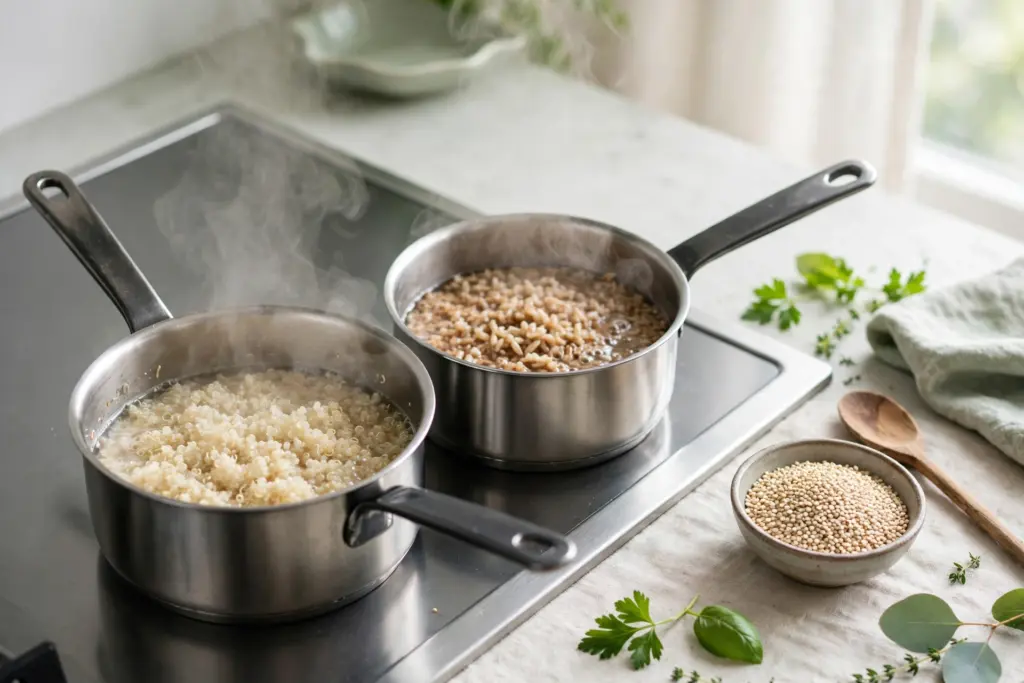
Brown rice: rinse, then use about 2¼ cups of water per cup of rice. Simmer covered for 40–45 minutes, then rest 10 minutes before fluffing. The most common mistake is lifting the lid to check on it — leave it alone and it will take care of itself.
White rice: rinse until the water runs mostly clear, use about 1½–2 cups of water per cup of rice, and simmer 15–20 minutes. Rest 10 minutes, fluff, and serve. For fried rice, cook it a day ahead and refrigerate it overnight — cold, dry grains fry up crisp instead of clumping.
Season the cooking water with a pinch of salt, or cook the grain in broth instead of plain water for more flavor without more work.
Frequently Asked Questions
Is quinoa healthier than rice?
On the nutrition label, yes — quinoa has more protein, more fiber, more magnesium, and a lower glycemic index than both white and brown rice. But “healthier” depends on the whole plate. Brown rice is an excellent whole grain at a much lower price, and white rice fits well in balanced meals built around vegetables and protein. Quinoa wins the head-to-head; rice wins on cost and versatility.
Can I eat quinoa if I have celiac disease?
Quinoa is naturally gluten-free, so it is generally suitable for people with celiac disease or gluten sensitivity. Look for packages labeled certified gluten-free if cross-contact is a concern, since grains can share processing facilities with wheat.
Why does my quinoa taste bitter?
The likely culprit is saponin, the bitter coating on the seed. Rinse quinoa thoroughly in a fine-mesh strainer under cold running water before cooking, rubbing the grains gently with your fingers. Most packaged quinoa is already rinsed, but a second rinse at home solves the problem when it appears.
Is brown rice always better than white rice?
For everyday eating, brown rice is the stronger choice: more fiber, more magnesium, and a lower glycemic index, with the same calories. But white rice has its place — it is easier to digest, cooks faster, and suits dishes where texture matters. The best grain is the one that fits the meal and the person eating it.
Disclaimer: This article is for general information only and is not medical advice. If you have diabetes, celiac disease, kidney disease, or another condition that affects your food choices, talk with your clinician or a registered dietitian before changing your diet.
Sources
- U.S. Department of Agriculture, FoodData Central — Quinoa, cooked (FDC 168917)
- U.S. Department of Agriculture, FoodData Central — Rice, white, long-grain, regular, enriched, cooked (FDC 168878)
- U.S. Department of Agriculture, FoodData Central — Rice, brown, long-grain, cooked (FDC 169704)
- Atkinson, F. S., et al. — International tables of glycemic index and glycemic load values (2021), via MyFitnessPal
- Whole Grains Council — U.S. Dietary Guidelines and Whole Grains (2025–2030 Dietary Guidelines for Americans)
- Healthline — Quinoa 101: Nutrition Facts and Health Benefits